My sister asked me to look after my niece for the weekend, so I brought her to the community pool with my daughter. Inside the locker room, my daughter suddenly whispered, “Mom… look at Lily.”
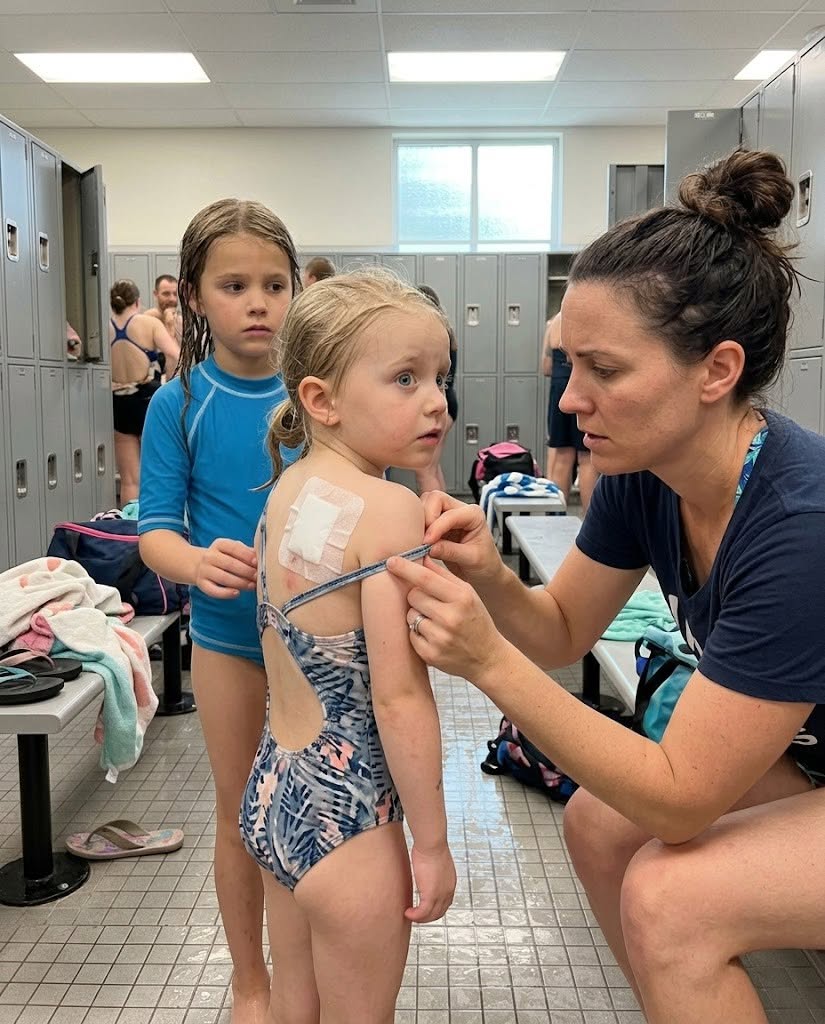
I gently adjusted my niece’s swimsuit strap and noticed a fresh medical dressing near her shoulder.
“Did you hurt yourself?” I asked softly.
Lily slowly shook her head.
Then she leaned closer and whispered,
“It didn’t happen by accident.”
I immediately gathered our belongings, helped both girls get dressed, and began driving toward the children’s hospital so a doctor could check her and make sure she was safe.
Ten minutes later, a message from my sister appeared on my phone:
Turn around. Now.
Sarah had called late Friday evening asking if Lily could stay with me for the weekend. She sounded exhausted and said she desperately needed a break.
There was nothing unusual about the request on its face. Sarah was my sister. Lily was my niece. Our girls were close enough in age that a weekend together usually meant cartoons, snacks, blankets on the living-room floor, and the kind of constant chatter that made the house feel twice as full.
So I agreed without thinking much of it.
Lily was six, and there had always been something unusually careful about her.
Not badly behaved. Not withdrawn in the obvious way adults tend to notice. She could laugh, play, ask questions, and get excited about little things just like any other child.
But there was a hesitation in her that I had never quite understood.
She asked permission before touching things most kids would simply pick up. If I put out crayons, she would look at me before choosing one. If there were cookies on a plate, she waited until somebody specifically told her she could have one. If Emma changed the television channel, Lily sometimes watched me as though she needed to know whether that was allowed too.
And when she made even the smallest mistake, the apology came instantly.
If she spilled a little water, she apologized.
If she dropped a toy, she apologized.
If she interrupted someone by accident, she apologized so quickly that half the time the adult she had interrupted had not even realized what happened.
Sometimes, after she said something, she studied an adult’s face for a second or two, almost like she was checking whether the words had been acceptable.
I had noticed it before.
I had simply explained it away.
Some kids were shy. Some were sensitive. Some needed more reassurance than others. Sarah had always described Lily as cautious, and because Sarah was her mother, I accepted that explanation.
Saturday morning, I decided to take the girls to the community pool.
It seemed like the easiest kind of weekend activity. No complicated plans, no pressure, just two children getting to burn off energy while I sat close enough to keep an eye on them.
For nearly an hour, everything looked normal.
Emma and Lily splashed through the shallow end, chased each other along the edge, and argued cheerfully over whose turn it was to use a pool toy. Lily laughed harder than I had heard her laugh in months.
That laugh is what stayed with me later.
She did not look afraid in the water.
She looked six.
She looked free enough, for that one hour, to forget whatever had taught her to be so careful everywhere else.
Eventually, I told them it was time to change.
We went into the crowded locker room, carrying damp towels and plastic bags with our dry clothes. The room was full of ordinary weekend noise: locker doors closing, children calling for their parents, wet sandals squeaking against the floor, people trying to keep track of shampoo bottles and socks and keys.
I was helping Emma pull off her wet swim shirt when she suddenly stopped moving.
“Mom,” she whispered. “Look.”
Her voice was different enough that I turned immediately.
Lily had her back to us.
She was pulling one swimsuit strap higher over her shoulder with a quick, practiced movement. It was not the slow adjustment of a child fixing an uncomfortable swimsuit. It looked automatic, almost rehearsed, as though covering whatever was beneath that strap had become something she knew she needed to do without being reminded.
I felt a small tightening in my chest.
“Lily,” I said gently, “do you need help?”
Her whole body tightened.
That reaction made me stop where I was.
I did not want to rush toward her. I did not want to make her feel trapped in a crowded room. So I moved slowly, keeping my voice calm, and asked again if I could help with the strap.
She did not say yes, but she did not move away.
I adjusted it just enough to see what she had been hiding.
A clean medical dressing sat near her shoulder.
It was not loose or old. The skin around the edges looked irritated, and the dressing appeared recent.
For a second, my mind reached for the most ordinary explanation available.
Maybe she had fallen.
Maybe she had scraped herself somewhere.
Maybe Sarah had taken her to a doctor and simply forgotten to mention it when dropping her off.
“Did you fall?” I asked.
Lily shook her head.
“Did someone take you to a doctor?”
That question changed her face.
The playful child from the pool disappeared so quickly that I almost felt dizzy watching it happen.
Fear replaced everything else.
She glanced toward the locker-room entrance.
Then she leaned closer to me.
“It didn’t happen by accident,” she whispered.
I crouched beside her so I was not towering over her.
“Can you tell me what happened?”
Lily twisted the edge of her swimsuit between her fingers.
Her eyes moved toward the entrance again.
“I’m not allowed to talk about it.”
Emma, who had been standing beside me with one sleeve still half inside out, grabbed my arm.
“Is Lily in trouble?”
“No,” I said immediately.
I wanted that answer out before Lily had even a second to wonder whether telling me had been a mistake.
“Lily hasn’t done anything wrong.”
I turned back to my niece.
“You’re safe with me. We’re just going to let a doctor look at the dressing and make sure you’re okay.”
I did not ask her to explain anything else in that locker room.
I did not want to question her until she felt pressured into giving me an answer. I did not want Emma filling the silence with frightened guesses. More than anything, I wanted Lily to understand that she did not have to earn help by explaining herself perfectly.
She gave the smallest nod.
That was enough.
I helped both girls get dressed. I packed the wet towels into our bags. I checked the bench twice because my hands were beginning to feel clumsy, and I was afraid I would leave something behind.
Then I walked them out of the recreation center.
I tried not to let my fear show.
Lily was already watching adults too carefully. I did not want her looking at my face and deciding she had created a disaster simply by letting me see the dressing.
Emma stayed unusually quiet beside her.
The girls climbed into the back seat of my SUV. I buckled them in, put the bags behind the passenger seat, and shut the doors.
Only after I climbed into the driver’s seat and locked the SUV did my hands start shaking.
I sat there for several seconds with both hands resting on the steering wheel.
I could hear the girls shifting quietly behind me.
I knew what I was going to do.
I was taking Lily to the children’s hospital.
Whatever that dressing covered, a doctor could check it. Whatever explanation existed, I did not need to invent it in a parking lot. I only needed to make sure Lily was safe and medically okay.
I started driving.
The first several minutes passed without much conversation.
Emma seemed to understand that something serious had happened, even if she did not know exactly what. Lily sat beside her, quiet enough that I kept checking the rearview mirror without making it obvious.
Each time I looked back, I thought about all those tiny apologies.
The spilled water.
The dropped toys.
The way she watched adult faces after she spoke.
I had filed each moment separately in my mind because separately they had seemed explainable.
Now they were beginning to connect.
I hated that they were beginning to connect.
I also knew that fear could make a person build a story too quickly, so I tried to stay focused on the one thing I actually knew.
Lily had a recent medical dressing.
She said it was not there because of an accident.
She said she was not allowed to talk about what happened.
Those facts were enough to keep driving.
About ten minutes after we left the pool, my phone vibrated against the center console.
I glanced down when it was safe to do so.
Sarah.
The message was only three words.
Turn around. Now.
My stomach dropped.
I read it again at the next safe opportunity, hoping for a second message that would make the first one less alarming.
Nothing appeared.
No question.
No explanation.
No “Where are you?”
No “Is Lily okay?”
No “What happened?”
Sarah had not asked where we were going.
She had not asked whether Lily was hurt.
She had not asked what I had found.
She had simply ordered me to turn around.
I looked into the rearview mirror.
Lily sat silently behind me.
Emma was next to her, watching her cousin with the solemn concern children sometimes show when they know something matters but do not yet have the language for it.
I felt the urge to call Sarah immediately.
I wanted to demand an explanation. I wanted to ask how she knew I had found anything. I wanted to ask why her first response was an order instead of concern for her daughter.
But Lily was in the car.
So was Emma.
Whatever I said, they would hear at least my side of it.
And Lily had already told me she was not allowed to talk.
I was not going to turn the inside of my SUV into another place where she had to sit silently while adults fought about her.
I kept driving.
My phone stayed on the console.
The message remained visible for a while before the screen went dark.
Turn around. Now.
Three words should not have been enough to change the meaning of an entire morning.
But they did.
Until that moment, I had been trying to understand Lily’s dressing.
After that message, I was trying to understand Sarah.
The difference mattered.
If Sarah had texted asking where we were, I might have assumed she was checking in.
If she had asked whether Lily had gotten hurt at the pool, I would have answered.
If she had told me the dressing was from a known medical issue and explained what had happened, I would have listened carefully and still made sure Lily was okay.
But that was not what she did.
She told me to turn around before I had told her what I had seen.
Before I had told her where I was going.
Before I had accused anyone of anything.
That was the part I could not get past.
I thought back to Friday night.
Sarah had sounded exhausted.
She had said she desperately needed a break.
I had heard that as an ordinary request from a tired parent.
Maybe it still was.
I did not know enough to turn suspicion into certainty, and I refused to do that in my own head just because I was scared.
But the message meant there was one thing I could no longer pretend.
Sarah knew there was something about Lily that might make me keep driving instead of bringing her home.
Behind me, Lily shifted slightly in her seat.
I kept my voice steady.
“You doing okay back there?”
There was a pause.
“Yes,” she said quietly.
Emma answered too, almost at the same time. “We’re okay.”
That small overlap nearly broke me.
I tightened my grip on the steering wheel and kept my attention on the road.
I did not promise Lily that everything would instantly be fine. I did not tell her I knew what had happened, because I did not. I did not ask her again to explain the dressing.
I had already told her the only thing I was sure I could keep saying honestly.
She had not done anything wrong.
We were going somewhere a doctor could look at her.
I was not turning around simply because someone ordered me to.
The longer I drove, the more details from the past returned to me—not dramatic memories, just small ones.
Lily asking if it was okay to get another glass of water.
Lily apologizing after dropping a toy that had not even broken.
Lily glancing toward Sarah before answering an ordinary question.
Lily going still in the locker room when I offered to help with her swimsuit strap.
None of those moments proved what had happened.
 But they no longer felt random.
That realization was painful because I had seen all of them before.
I had simply given each one a harmless explanation.
Shy.
Sensitive.
Careful.
Well behaved.
Adults like tidy explanations, especially when the alternative would force us to ask questions we are afraid to ask.
I had accepted mine because it had been easy.
Now ease was no longer an option.
My phone vibrated again in my imagination more than once, even when it had not actually moved. Every time I glanced toward the console, I saw that first message in my head.
Turn around. Now.
I wondered how Sarah knew.
Had Lily said something before the weekend?
Had Sarah noticed the dressing and assumed I would eventually see it?
Had there been some instruction I did not know about?
I had questions, but none of them belonged in front of the girls.
And none of them changed what I needed to do next.
Keep driving.
Get Lily checked.
Let the facts come before the accusations.
That decision steadied me more than any answer could have in that moment.
I did not need to solve my sister’s behavior from behind the wheel.
I did not need Lily to tell me everything before she was ready.
I only needed to refuse the one action Sarah had demanded without explanation.
I was not turning around.
I looked into the rearview mirror one more time.
Lily was staring down at her hands.
Emma sat close beside her, not touching her, not questioning her, simply staying there.
It struck me that only an hour earlier the two of them had been laughing in the pool.
That memory hurt in a different way now.
I wanted Lily to have more moments like that—moments where she could be a child without checking anyone’s expression first.
Maybe the doctor would tell me there was an explanation I had not considered.
Maybe Sarah would eventually give me information that made sense of the message.
I was willing to hear facts when they came.
What I was no longer willing to do was ignore the fear I had seen on Lily’s face.
Sarah’s message still did not tell me what had happened to my niece.
It did not tell me why the dressing was there.
It did not tell me who had put it on her, why Lily believed she could not talk about it, or why Sarah seemed to know that I had discovered something worth hiding.
But the message did answer one question I had not known to ask when the weekend began.
My sister already knew there was something to discover.
And once I understood that, turning around was no longer an option.
But they no longer felt random.
That realization was painful because I had seen all of them before.
I had simply given each one a harmless explanation.
Shy.
Sensitive.
Careful.
Well behaved.
Adults like tidy explanations, especially when the alternative would force us to ask questions we are afraid to ask.
I had accepted mine because it had been easy.
Now ease was no longer an option.
My phone vibrated again in my imagination more than once, even when it had not actually moved. Every time I glanced toward the console, I saw that first message in my head.
Turn around. Now.
I wondered how Sarah knew.
Had Lily said something before the weekend?
Had Sarah noticed the dressing and assumed I would eventually see it?
Had there been some instruction I did not know about?
I had questions, but none of them belonged in front of the girls.
And none of them changed what I needed to do next.
Keep driving.
Get Lily checked.
Let the facts come before the accusations.
That decision steadied me more than any answer could have in that moment.
I did not need to solve my sister’s behavior from behind the wheel.
I did not need Lily to tell me everything before she was ready.
I only needed to refuse the one action Sarah had demanded without explanation.
I was not turning around.
I looked into the rearview mirror one more time.
Lily was staring down at her hands.
Emma sat close beside her, not touching her, not questioning her, simply staying there.
It struck me that only an hour earlier the two of them had been laughing in the pool.
That memory hurt in a different way now.
I wanted Lily to have more moments like that—moments where she could be a child without checking anyone’s expression first.
Maybe the doctor would tell me there was an explanation I had not considered.
Maybe Sarah would eventually give me information that made sense of the message.
I was willing to hear facts when they came.
What I was no longer willing to do was ignore the fear I had seen on Lily’s face.
Sarah’s message still did not tell me what had happened to my niece.
It did not tell me why the dressing was there.
It did not tell me who had put it on her, why Lily believed she could not talk about it, or why Sarah seemed to know that I had discovered something worth hiding.
But the message did answer one question I had not known to ask when the weekend began.
My sister already knew there was something to discover.
And once I understood that, turning around was no longer an option.