My husband did not answer immediately. Through the speaker, I heard his breathing change, and that silence told me his father had just exposed something worse.
“What crate?” I asked, although I was already moving toward the laundry room, one arm wrapped tightly around my daughter’s shoulders as she followed beside me.
My father-in-law pushed the second key toward me. “David packed Scout before leaving for work. He told us exactly how long to keep him hidden.”
My mother-in-law lunged for the key, but I grabbed it first. Her fingernails scraped my wrist before my father-in-law stepped between us and blocked her.
“Enough, Linda,” he said. His voice shook, yet he did not move aside. “You’ve frightened that child enough. This ends right now.”
Linda stared at him as if he had betrayed her, while David shouted through the phone that everyone needed to calm down and discuss things rationally.
I unlocked the laundry-room door and smelled urine immediately. Behind stacked detergent boxes, Scout was curled inside a travel crate covered with an old blanket.
He lifted his head when my daughter whispered his name. Then his tail struck the plastic wall once, twice, before his entire body began trembling.
My daughter dropped to her knees, but I stopped her from opening the crate until I could check whether Scout appeared injured or dangerously sick.
A nearly empty water bowl had been fastened inside. There was no food, and Scout’s collar and identification tag had been removed from his neck.
Beside the crate sat a pharmacy bag containing calming tablets prescribed months earlier for Scout’s fear of thunderstorms. Several pills were missing from the bottle.
My husband had known Scout was terrified of confinement. He had also known our daughter slept with him beside her bed whenever storms shook the windows.
“David packed the crate last night,” my father-in-law said. “He gave Scout the pills before your daughter woke up, then carried him in here.”
From the kitchen, Linda screamed that Scout was perfectly safe and that one uncomfortable day would teach my daughter not to behave like a spoiled princess.
My daughter flinched so violently that Scout began whining inside the crate. That sound broke through the shock that had kept me moving mechanically.
I took photographs of everything before touching it: the locked door, covered crate, medication bottle, missing collar, note, untouched dinner, and both brass keys.
Then I recorded my father-in-law explaining what he had seen. I asked only simple questions and let him describe David’s instructions in his own words.
David had ordered them to keep Scout hidden until I signed an agreement giving his parents our daughter’s bedroom and unrestricted access to the house.
If I refused, Linda was supposed to take Scout to a shelter two counties away and say she had found him wandering without identification.
The missing collar had not been an accident. David had removed it so the shelter could not immediately connect Scout to our family.
My father-in-law opened a kitchen drawer and handed me the collar. He had taken it from Linda’s purse after hearing her describe the shelter plan.
Linda charged toward him, calling him weak, but he raised his hand and told her he had spent forty years confusing obedience with loyalty.
On the phone, David stopped pretending he was concerned. He ordered his father to put the collar back and told me I was recording a private conversation illegally.
He was wrong. The speakerphone conversation was happening in my home, and he had already been told clearly that I was documenting what everyone said.
I called the police, reported that my dog had been confined and medicated without my permission, and explained that my child had received a threatening note.
Next, I called Scout’s veterinarian. She told me to bring him directly to the clinic because she could not assess the medication’s effects over the phone.
When I opened the crate, Scout tried to stand but stumbled against my knees. My daughter covered her mouth, struggling not to cry loudly and frighten him.
I wrapped him in the blanket, carried him toward the front door, and told my daughter to bring the note and her overnight backpack.
Linda blocked the doorway. She said nobody was leaving until I admitted that the bedroom argument had forced them to take drastic action.
The responding officers arrived while she was still standing there. One officer separated Linda from us while another photographed the crate and medication bottle.
My father-in-law gave his statement without being asked twice. Then he unlocked his phone and showed the officers a family group conversation David believed I had never seen.
The messages began three weeks earlier. David had written that I would never surrender the bedroom willingly, so they needed to create pressure through my daughter.
Linda suggested hiding Scout. David answered that fear worked faster than discussion and instructed her to make our daughter believe the dog was permanently gone.
The meal had been Linda’s idea, but David had reacted with a laughing emoji when she described what she planned to say at dinner.
My father-in-law had objected once. David told him to stay out of it because the house would soon belong to “the people who respected family.”
That sentence made no sense until an officer asked whose name appeared on the property deed. Linda answered before I could speak.
“David’s, naturally,” she said. “A wife doesn’t need to own everything merely because she pays for it.”
The house was not David’s. I had purchased it before our marriage using money inherited from my grandmother, and the deed carried only my name.
David knew that. He had spent years resenting it, especially whenever I reminded him his parents could stay temporarily but could not establish permanent residency.
The officers did not decide ownership disputes at my kitchen table, but they made Linda and my father-in-law leave after I withdrew permission for them to remain.
My father-in-law took one suitcase. Linda had six boxes, three garment bags, and a stack of mail she claimed proved the house was already her residence.
One envelope was addressed to David and marked by a mortgage company. I photographed it before handing it to the officer collecting information from everyone.
Linda saw me photograph the envelope and suddenly stopped arguing. She grabbed for it, but the officer stepped between us and returned it to David’s mail pile.
Scout remained at the veterinary clinic overnight. The veterinarian documented dehydration, stress, and sedation consistent with the missing tablets, but expected him to recover completely.
My daughter refused to leave the clinic until Scout had a clean blanket. She pressed her note into my hand and asked whether her father wanted her gone too.
I told her the truth carefully. Her father had made a cruel decision, and none of it had happened because she refused to surrender her bedroom.
That night, we stayed with my sister. I changed every exterior lock remotely and disabled David’s access to the garage and security system.
Then I opened our financial records, looking for the mortgage company named on the envelope. What I found explained David’s promise that the house would soon change hands.
For six months, he had been sending altered copies of utility statements, insurance records, and a forged property document to a mortgage broker.
The documents listed him as co-owner. They also claimed his parents were purchasing an interest in the property using funds David described as a family investment.
There was no completed loan against my house, but the broker’s emails showed David had been trying to obtain one using documents bearing a signature resembling mine.
The final application still needed in-person verification. David had scheduled that appointment for the following Monday, expecting me to attend without understanding what I was signing.
The bedroom fight was not merely about space. His parents wanted mail delivered there and belongings established throughout the home before the appointment occurred.
They believed the appearance of residency would support their story that we had all agreed to combine households and finances permanently.
The next morning, I met a family-law attorney and a property attorney. I gave them copies of the messages, photographs, veterinary report, and mortgage correspondence.
My property attorney contacted the lender’s fraud department. The application was frozen for investigation before David could submit another document or move any money.
My family-law attorney helped me seek temporary orders protecting my daughter and restricting David from removing her, Scout, or property from the house.
No judge granted a permanent outcome overnight. But the evidence was specific enough that David could not dismiss everything as a misunderstanding between relatives.
At the emergency hearing, his attorney argued that the dinner had been a tasteless joke and Scout had been confined only to prevent him from escaping.
Then my attorney displayed the note from my daughter’s door beside the messages explaining how Linda should threaten to surrender Scout without his collar.
David claimed he had never seen the note. The judge asked whether he denied writing the message instructing his mother to “make the point clear.”
He stared at the printed conversation for several seconds before saying he had been under enormous pressure from both sides of the family.
My daughter’s attorney asked the question nobody else had asked: why had David chosen to relieve that pressure by terrorizing an eleven-year-old child?
David had no answer. Linda whispered from the back row that children recovered quickly, and the court officer warned her to remain silent.
The temporary order allowed David only supervised contact with our daughter while the custody evaluation and related investigations continued. Linda received no contact permission.
My father-in-law submitted his phone voluntarily and admitted he should have intervened sooner. His cooperation did not erase his silence, but it preserved crucial evidence.
He also moved into a small extended-stay hotel instead of returning to Linda. For the first time in decades, he stopped letting her decide what truth meant.
Three days later, Scout came home. My daughter prepared his bed downstairs, but he walked past it and climbed directly onto the rug beside her bedroom.
She knelt beside him, touching his collar repeatedly as if she needed proof that nobody had removed his name again.
I replaced her bedroom door because black marker had soaked into the paint around the edges of the threatening note.
Before the new door was installed, my daughter asked me to cut out the small section where the tape had been attached.
She did not want it as a frightening souvenir. She wanted evidence that adults could lie, and that showing someone the truth could still save what mattered.
The mortgage investigation uncovered two forged signatures and several false statements. Authorities opened a case, although my attorneys warned that criminal proceedings could take months.
Our divorce moved more quickly. David initially demanded the house, arguing that marriage entitled him to half of every asset associated with our family.
My attorney produced the purchase records, inheritance documents, deed, and every payment showing the house had remained my separate property.
David’s parents had not invested in it. Their supposed contribution was money David secretly transferred from our joint account to Linda, who returned portions disguised as deposits.
The court did not award final punishment because his mother behaved cruelly at dinner. It relied on documents, dates, financial records, and his own written instructions.
David eventually stopped claiming the dog had been misplaced. Instead, he blamed Linda for escalating his plan beyond what he intended.
Then Linda produced messages proving he had approved everything, including the missing collar, medication, locked door, and threat involving the distant shelter.
She exposed her son to protect herself. David responded by releasing messages showing she had planned the dinner and written the note herself.
Their loyalty survived only while both believed my daughter was the easiest person in the family to sacrifice.
My father-in-law accepted responsibility differently. He apologized directly to my daughter without demanding forgiveness or explaining that Linda had controlled him.
He said, “I watched something wrong because speaking felt expensive. You paid the price for my cowardice, and I am sorry.”
My daughter did not hug him. She said she needed time, and he nodded as though time was something he owed rather than deserved.
Months later, the divorce became final. I kept my house, while David remained responsible for debts and legal consequences created by his fraudulent application.
He received structured supervised contact that could be reviewed only after completing the requirements established for our daughter’s safety. Linda remained outside those visits.
Scout recovered physically much faster than my daughter did. For weeks, she woke whenever the laundry door rattled or someone moved a bowl in the kitchen.
We found a therapist who never asked her to forgive anyone. Instead, she helped my daughter understand that fear was not proof she was weak.
On Scout’s first birthday after the incident, my daughter chose his dinner herself: chicken, rice, vegetables, and a biscuit shaped like a bone.
She placed his bowl beside her chair, watched him eat, and laughed when gravy-free rice stuck to his nose.
Then the doorbell rang.
A courier stood outside with a certified envelope addressed to David. Because he no longer lived there, I marked it for return without opening it.
Through the envelope window, I could see the lender’s fraud-investigation department listed above his name. My daughter noticed it but asked no questions.
She simply closed the new bedroom door, called Scout onto her bed, and began reading while he rested his head across her ankles.
The old piece of door remained sealed inside my attorney’s evidence file, along with Linda’s note and David’s messages approving their plan.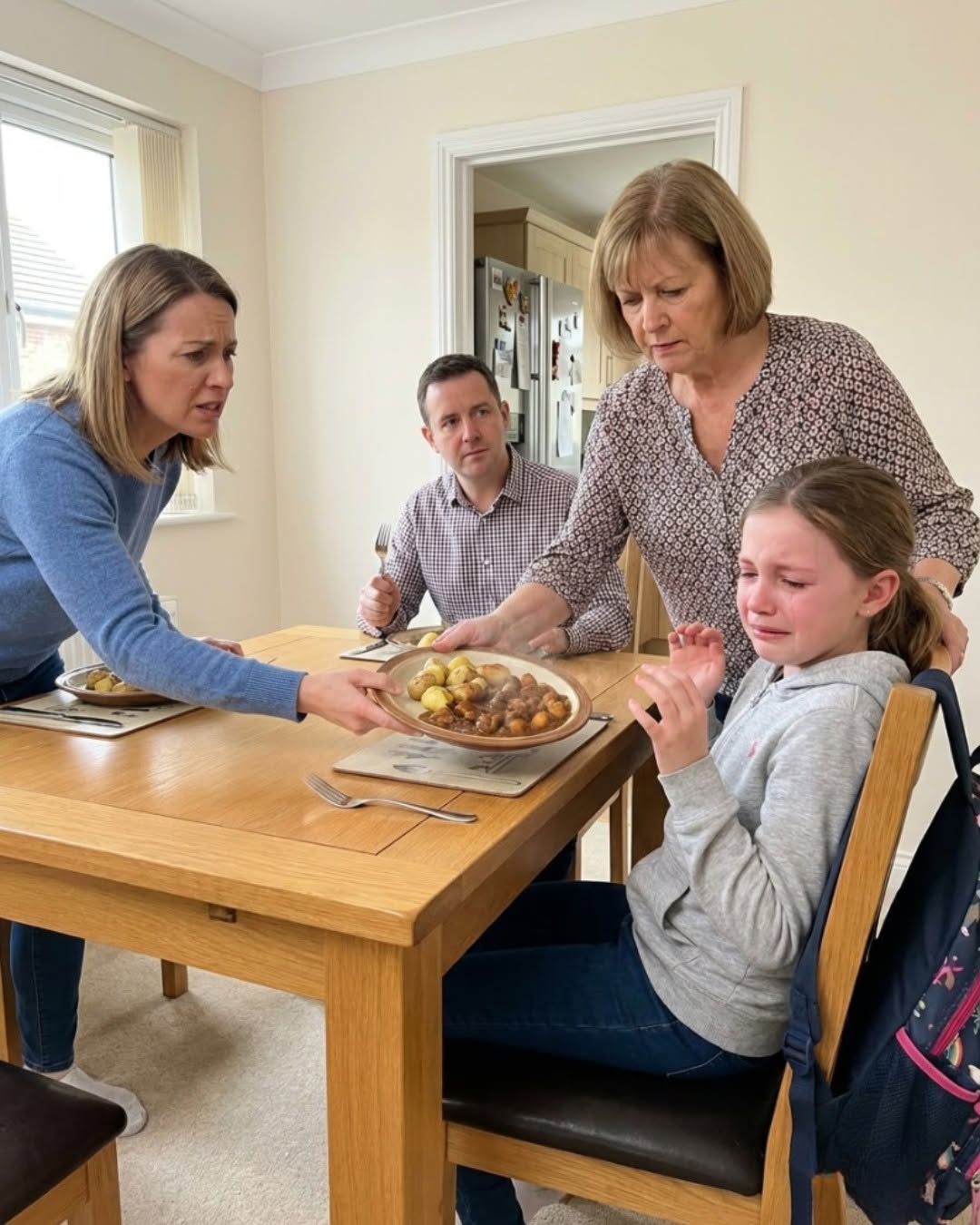 They had tried to convince an eleven-year-old that love could be taken away until her mother surrendered a room.
Instead, they lost access to the house, the child they attempted to frighten, and the family silence that had protected them for years.
Scout was never the meal in that steaming bowl. He was the hostage they believed would make my daughter feel powerless.
But the note meant to frighten her became the first piece of evidence that brought their entire plan into the light.
And when my daughter finally understood that, she stopped hiding every cruel message adults expected her to carry alone.
They had tried to convince an eleven-year-old that love could be taken away until her mother surrendered a room.
Instead, they lost access to the house, the child they attempted to frighten, and the family silence that had protected them for years.
Scout was never the meal in that steaming bowl. He was the hostage they believed would make my daughter feel powerless.
But the note meant to frighten her became the first piece of evidence that brought their entire plan into the light.
And when my daughter finally understood that, she stopped hiding every cruel message adults expected her to carry alone.