“Daddy put something inside my sister’s belly,” a seven-year-old girl told the desk officer. Then she clarified, “He made her swallow it and said not to tell.” Her twin curled around her stomach while the first girl produced an empty medicine syringe hidden inside her shoe. The officer called an ambulance and entered the pharmacy code into his computer. When their father’s name appeared as the prescriber, he quietly locked the station doors.
The station smelled like burnt coffee and rain-soaked jackets that afternoon.
A box fan rattled behind the front counter, pushing warm air through a leaning stack of incident forms while the fluorescent lights buzzed above Officer Daniel Reed’s desk.
Rain had been coming down in short, heavy bursts since lunch, and every person who entered left wet footprints across the faded tile.
Daniel was halfway through a parking report when the glass doors opened and two little girls stepped inside holding hands.
They wore nearly identical gray hoodies, jeans, and worn sneakers, the kind of clothes that made them look as though they had dressed from the same laundry basket.
At first glance, Daniel thought they might be waiting for a parent who was parking outside.
Then he noticed that only one of them could stand upright.
The second girl kept folding at the waist, straightening for half a step and then bending again as though every movement pulled something tighter inside her stomach.
Daniel pushed back from the desk so quickly that his chair rolled into a filing cabinet with a metallic bang.
Both girls flinched.
He stopped himself from rushing toward them.
“Are you here with an adult?” he asked.
The girl nearest the counter shook her head.
Her wet hair clung to the sides of her face, and one sleeve of her hoodie had been pulled over her hand.
“My name is Emma,” she said.
She spoke with the careful seriousness of a child who had repeated the same words silently many times before daring to say them aloud.
“My sister is Olivia,” Emma continued. “Daddy said she would feel sleepy, but she says it hurts.”
Olivia tried to take another step.
Her knees buckled, and she lowered herself beside the counter before drawing both legs toward her chest.
She wrapped her arms around her stomach and pressed her forehead against her knees.
Daniel started around the desk.
Emma moved between him and her twin.
The motion was quick, protective, and practiced.
“Don’t make her go home,” she whispered.
Daniel stopped.
That sentence changed the room more completely than a shouted accusation could have.
Until then, he had been looking at two children who might be lost, frightened, or dealing with a medical emergency.
Now he was looking at two children who believed the place they had left was more dangerous than a police station full of strangers.
Daniel crouched several feet away so he would not crowd them.
He kept both hands where they could see them and lowered his voice.
“I’m not sending either of you anywhere right now,” he said. “I need to understand what happened so I can help Olivia.”
Emma looked down at her right sneaker.
Daniel asked her to tell him only what she had personally seen or heard.
He did not want her guessing, and he did not want to put adult words into a frightened child’s mouth.
“What did your dad give Olivia?” he asked.
Emma’s eyes stayed on her shoe.
“I don’t know.”
“Was it a pill?”
She shook her head.
“Was it something she drank?”
“He put it in her mouth.”
“With what?”
Emma glanced at her sister, then sat on the tile and tugged at the laces of her sneaker.
The knot was tight from the rain, and her fingers trembled as she worked it loose.
She pulled off the shoe, peeled back a worn insole, and reached into the narrow space beneath it.
An empty oral medicine syringe slid into her palm.
There was no needle attached, but faded blue printing ran along the clear plastic barrel.
Emma held it carefully between two fingers.
“I hid it,” she said.
Daniel felt a hard pressure settle behind his ribs.
“Why did you put it in your shoe?”
“Daddy checks our pockets.”
The answer came without hesitation.
Daniel had spent enough years behind a badge to recognize the difference between a child inventing a detail and a child describing a household rule.
Anger rose through him, hot and immediate, but anger could not be allowed to control the next question or the next movement.
Olivia needed medical help, and Emma needed to know that telling the truth would not make the adults in the room unpredictable.
Daniel kept his voice steady.
“Did that syringe ever have a needle?”
“No.”
“Is there anything left inside it?”
“I don’t know.”
“Did you touch the end?”
Emma looked frightened that she had already done something wrong.
“I picked it up after Daddy left the bathroom.”
“You’re not in trouble,” Daniel told her. “I’m just making sure everyone handles it safely.”
He did not take the syringe from her bare hand.
Instead, he placed a clean evidence envelope on the counter and opened it wide.
“Set it in here for me.”
Emma leaned forward and dropped the syringe inside without touching the envelope.
Daniel sealed the flap and wrote the time across it in dark ink: 4:17 p.m.
The numbers gave the moment a fixed place in the day.
Whatever happened next, no one would be able to say later that the syringe had appeared after the girls’ father arrived or that the children had been prompted to produce it.
Daniel reached for the desk phone and called for an ambulance.
He reported a seven-year-old child with stomach pain, increasing drowsiness, and possible exposure to an unidentified oral medication.
He did not guess at the substance.
He did not diagnose her.
He asked for an urgent medical evaluation and gave the station entrance as the pickup point.
While the dispatcher confirmed the response, Daniel watched the color drain from Olivia’s face beneath the fluorescent lights.
Her breathing remained steady, but each breath seemed to require concentration.
She shifted her arms higher across her stomach and closed her eyes.
Emma sat beside her and pressed one small hand between Olivia’s shoulder blades.
“You did the right thing by coming here,” Daniel said.
Emma’s mouth trembled.
“Are we in trouble?”
“No,” he said. “You came for help.”
Olivia began crying without making a sound.
Tears slipped down her cheeks and disappeared into the sleeves wrapped around her knees.
Emma did not cry.
She watched the sealed envelope on the counter as though it were the only object in the station that could prove what she had been brave enough to say.
Daniel asked when Olivia had been given the medicine.
Emma said it happened after school.
Their father had taken them home, brought Olivia into the bathroom, and told Emma to stay in the hallway.
The door had not fully closed.
Emma saw him press the syringe into Olivia’s mouth.
Olivia tried to turn her head, but he told her to swallow and said she would feel sleepy soon.
Emma heard him tell Olivia not to talk about it.
When he left the bathroom to answer his phone, Emma slipped inside and found the empty syringe near the sink.
She hid it in her shoe because she believed he would search their pockets before letting them leave the house.
Daniel asked how they had reached the station.
Emma pointed toward the rain-streaked doors.
“We walked.”
The station was not close enough for two seven-year-olds to reach casually.
They had crossed wet streets, passed storefronts, and kept moving while one of them fought worsening stomach pain.
Daniel did not praise Emma in a way that might make her feel responsible for everything that happened next.
She had already carried more responsibility than any child should have been given.
He told her simply that help was coming and that she could stay beside Olivia.
Then he looked more closely at the syringe through the clear evidence window.
The blue printing was faded but readable.
A pharmacy code ran along the barrel beside a short series of numbers.
The code might lead nowhere useful without the original packaging, but Daniel entered it into the station computer while keeping the desk phone within reach.
The first search identified the dispensing location connected to the marking.
The second showed a transaction recorded earlier that afternoon.
Daniel leaned closer to the screen.
The time listed on the transaction fit Emma’s account of what happened after school.
He opened the credential information attached to the order.
A prescriber’s name appeared beneath the transaction details.
Michael Carter.
Daniel looked at the girls.
“Is your dad’s name Michael?”
Emma nodded.
The name itself did not tell Daniel what had been inside the syringe or why it had been given.
It did establish that the order was connected to the man Emma had identified as their father.
Daniel printed the record and placed it beside the sealed evidence envelope.
He checked the transaction time against the station camera timestamp showing the girls entering the lobby.
Then he opened the incoming dispatch log.
A missing-child notice had been received seven minutes earlier.
The reporting parent was Michael Carter.
Daniel read the summary twice.
Michael had told dispatch that his daughters had wandered away after refusing their medicine.
According to the notice, both children were supposed to be returned home immediately if found.
Daniel glanced toward Olivia.
She was curled beside the counter, fighting to stay awake while Emma rubbed the back of her hoodie in small circles.
The father’s version described two defiant children avoiding routine care.
Emma’s version described one child being made to swallow an unknown substance and warned not to tell.
Olivia had never been told what she was taking.
The two accounts could not both be accurate.
Daniel printed the missing-child notice and set it beside the pharmacy record.
The paper coffee cup near his keyboard had gone cold, and rain tapped steadily against the front windows.
He opened the incident log and typed one sentence in capital letters:
CHILDREN REQUESTED PROTECTION BEFORE PARENT ARRIVAL.
He read it once before saving the entry.
The order of events mattered.
The children had entered the station on their own.
Emma had asked him not to send Olivia home before their father had appeared.
She had revealed the syringe before Daniel located the pharmacy transaction or the missing-child report.
Her fear had not been created by anything Michael might say in the lobby.
It had arrived with her.
Daniel contacted dispatch again and asked for the ambulance’s location.
It was approaching but had been slowed by rain and traffic at the intersection two blocks away.
Olivia’s head dipped lower.
Daniel moved a wastebasket out of the way and cleared the area beside the counter so emergency personnel would have room to reach her the moment they entered.
He considered moving the girls into a back office, but he did not want to make Olivia walk unless necessary.
Instead, he opened the half gate behind the counter and positioned himself where he could shield them from anyone entering through the front doors.
Emma watched every movement.
“You said we don’t have to go home,” she reminded him.
“You’re staying here until the medical team checks Olivia,” Daniel said.
“And after that?”
Daniel could not promise an outcome he did not control.
He could promise the next safe step.
“After that, the adults helping you will listen to what both of you say.”
Emma seemed to study his face, looking for the part of the answer that might change without warning.
Before she could ask another question, tires hissed across the rain-slick street outside.
A dark SUV turned sharply into the station lot.
It swung across the painted lines and stopped crooked over two parking spaces.
The windshield wipers snapped back and forth at full speed.
Emma saw the vehicle through the glass.
Her entire body went rigid.
The hand on Olivia’s back stopped moving.
Olivia lifted her head just enough to look toward her sister.
A small sound escaped her throat.
Daniel followed Emma’s gaze.
“Is that your dad’s SUV?”
Emma nodded without speaking.
Daniel stood and walked toward the front doors.
He did not run, but every movement became deliberate.
He turned the deadbolt, lowered the interior latch, and tested the handle once.
The station was still open, but keeping the girls physically separated from the arriving parent had become the immediate priority.
Daniel returned to the counter and guided them through the half gate.
Olivia could not stand on her own, so Emma took one arm while Daniel supported the other side without pulling her upright too quickly.
They moved only a few feet, placing the girls behind the desk where the counter blocked the view from the parking lot.
Olivia lowered herself onto the floor again and curled against a filing cabinet.
Emma crouched beside her.
Daniel angled the rolling chair away so the aisle remained clear for the ambulance crew.
Outside, the SUV’s driver door opened.
Michael Carter stepped into the rain holding a phone to his ear.
He wore a dark jacket and moved with the impatient confidence of someone who expected the situation to be corrected the moment he arrived.
He was already talking before he reached the walkway.
Through the glass, Daniel could see him pointing toward the station as though whoever was on the phone needed to understand that everyone inside had failed to follow his instructions.
Michael mounted the short steps and looked through the doors.
His eyes moved across the lobby, searching for the girls.
Daniel stepped into the center of his line of sight.
Michael reached for the handle.
The door did not open.
He pulled again, harder.
Daniel stayed several feet back with his hands visible.
Michael lowered the phone and spoke through the glass, but the rain and the thickness of the door swallowed most of his words.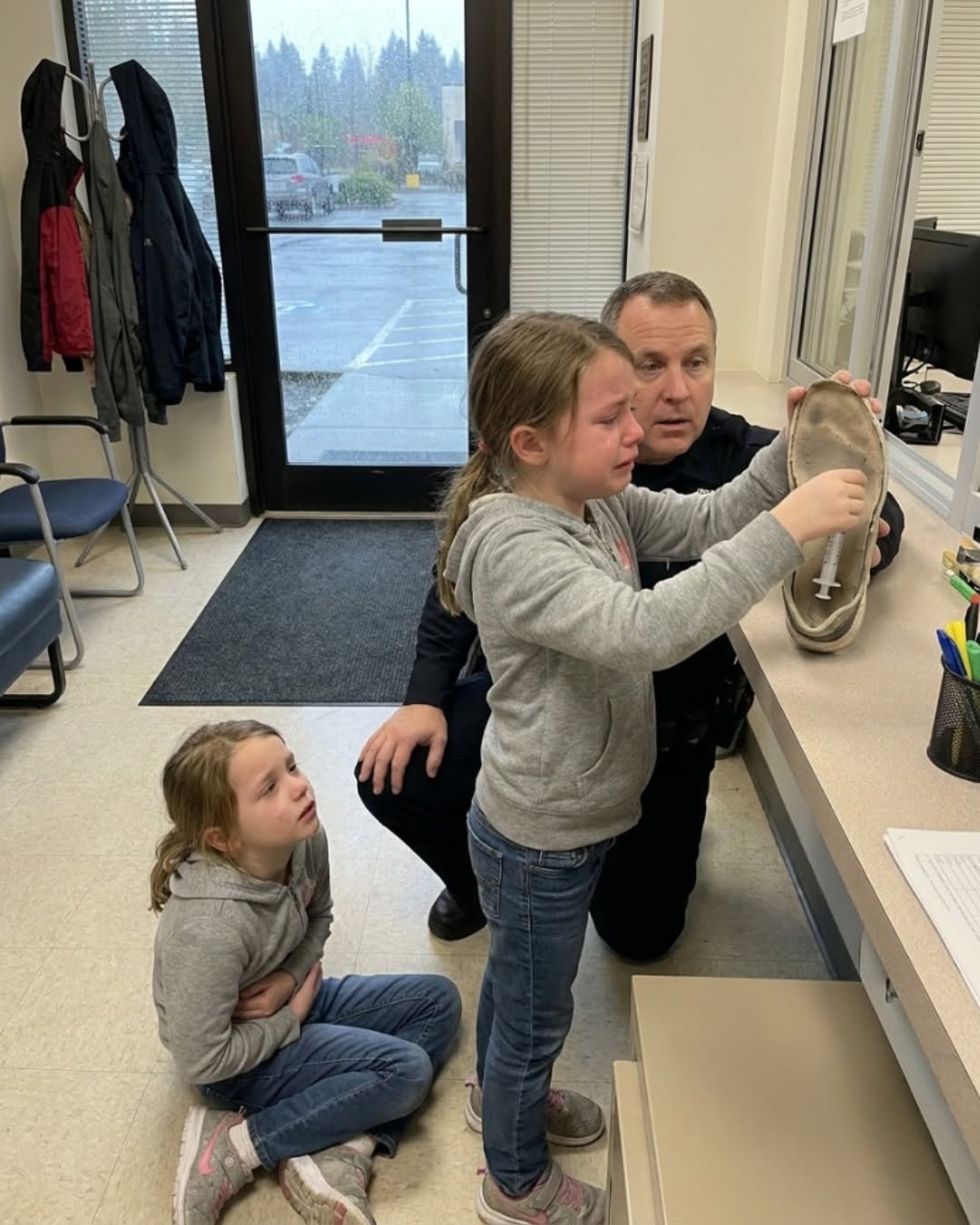 The meaning was clear from his expression and the sharp movement of his free hand.
He wanted the door opened.
Behind the counter, Emma whispered something to Olivia that Daniel could not hear.
He looked over his shoulder just long enough to confirm that both girls remained out of sight.
The sealed syringe lay on the counter beside the printed pharmacy transaction.
Michael’s name appeared in black ink beneath the prescribing credential.
The missing-child notice rested beside it, showing that he had reported the girls missing only minutes before they entered the station seeking protection.
The ambulance was still approaching through the rain.
Until it arrived, Daniel was the only barrier between the children and the man outside.
Michael raised the phone again, apparently calling someone, then pointed at the lock.
Daniel did not move toward it.
The father’s mouth tightened.
He stepped closer until his face was inches from the wet glass.
Daniel could hear him now.
“Those are my daughters.”
Daniel kept his tone calm.
“They are receiving assistance.”
“Open the door.”
“I need you to remain outside.”
Michael looked past him, trying to see around the counter.
“They refused their medicine and ran away. I already reported them missing.”
Daniel’s eyes dropped briefly to the printed report.
That statement matched the account Michael had given dispatch.
It did not explain why Emma had hidden a syringe beneath her shoe, why Olivia had not been told what she was swallowing, or why both girls were terrified of being sent back outside.
Daniel looked at the clock above the filing cabinets.
Only minutes had passed since the girls entered, but the station no longer felt like the quiet room where he had been completing a parking report.
Every object now had a purpose.
The locked door created distance.
The counter created cover.
The incident log preserved the order of events.
The sealed envelope protected the syringe from being handled, removed, or dismissed.
Most important, the girls had reached a place where their account existed independently of their father’s authority.
Michael struck the flat of his hand against the glass.
Emma flinched behind the counter.
Olivia pressed closer to the filing cabinet and held her stomach.
Daniel remained between them and the door.
He did not argue through the glass about the pharmacy record.
He did not reveal what Emma had said or show Michael the sealed syringe.
The children’s safety and Olivia’s medical care came before confrontation.
Sirens became faintly audible beyond the rain, still distant but drawing closer.
Michael heard them too.
His head turned toward the street, then back toward Daniel.
His grip tightened around the phone.
Daniel looked once more at the evidence envelope, the pharmacy record, and the two children crouched behind his desk.
Emma had carried the syringe through the rain because she believed someone might need proof.
Now the proof was sealed, timed, and placed beyond her father’s reach.
The ambulance was almost there.
The front entrance remained locked.
Then someone pulled hard on the glass door again.
The meaning was clear from his expression and the sharp movement of his free hand.
He wanted the door opened.
Behind the counter, Emma whispered something to Olivia that Daniel could not hear.
He looked over his shoulder just long enough to confirm that both girls remained out of sight.
The sealed syringe lay on the counter beside the printed pharmacy transaction.
Michael’s name appeared in black ink beneath the prescribing credential.
The missing-child notice rested beside it, showing that he had reported the girls missing only minutes before they entered the station seeking protection.
The ambulance was still approaching through the rain.
Until it arrived, Daniel was the only barrier between the children and the man outside.
Michael raised the phone again, apparently calling someone, then pointed at the lock.
Daniel did not move toward it.
The father’s mouth tightened.
He stepped closer until his face was inches from the wet glass.
Daniel could hear him now.
“Those are my daughters.”
Daniel kept his tone calm.
“They are receiving assistance.”
“Open the door.”
“I need you to remain outside.”
Michael looked past him, trying to see around the counter.
“They refused their medicine and ran away. I already reported them missing.”
Daniel’s eyes dropped briefly to the printed report.
That statement matched the account Michael had given dispatch.
It did not explain why Emma had hidden a syringe beneath her shoe, why Olivia had not been told what she was swallowing, or why both girls were terrified of being sent back outside.
Daniel looked at the clock above the filing cabinets.
Only minutes had passed since the girls entered, but the station no longer felt like the quiet room where he had been completing a parking report.
Every object now had a purpose.
The locked door created distance.
The counter created cover.
The incident log preserved the order of events.
The sealed envelope protected the syringe from being handled, removed, or dismissed.
Most important, the girls had reached a place where their account existed independently of their father’s authority.
Michael struck the flat of his hand against the glass.
Emma flinched behind the counter.
Olivia pressed closer to the filing cabinet and held her stomach.
Daniel remained between them and the door.
He did not argue through the glass about the pharmacy record.
He did not reveal what Emma had said or show Michael the sealed syringe.
The children’s safety and Olivia’s medical care came before confrontation.
Sirens became faintly audible beyond the rain, still distant but drawing closer.
Michael heard them too.
His head turned toward the street, then back toward Daniel.
His grip tightened around the phone.
Daniel looked once more at the evidence envelope, the pharmacy record, and the two children crouched behind his desk.
Emma had carried the syringe through the rain because she believed someone might need proof.
Now the proof was sealed, timed, and placed beyond her father’s reach.
The ambulance was almost there.
The front entrance remained locked.
Then someone pulled hard on the glass door again.