I locked Dennis out of the security system first.
Then I replaced the door code from my phone and gave the officers permission to secure whatever video, login history, and device records were still attached to the account.
Only after that did I slide Serena’s key deeper into my scrub-pocket beside the single latex glove I had carried all the way from the clinic.
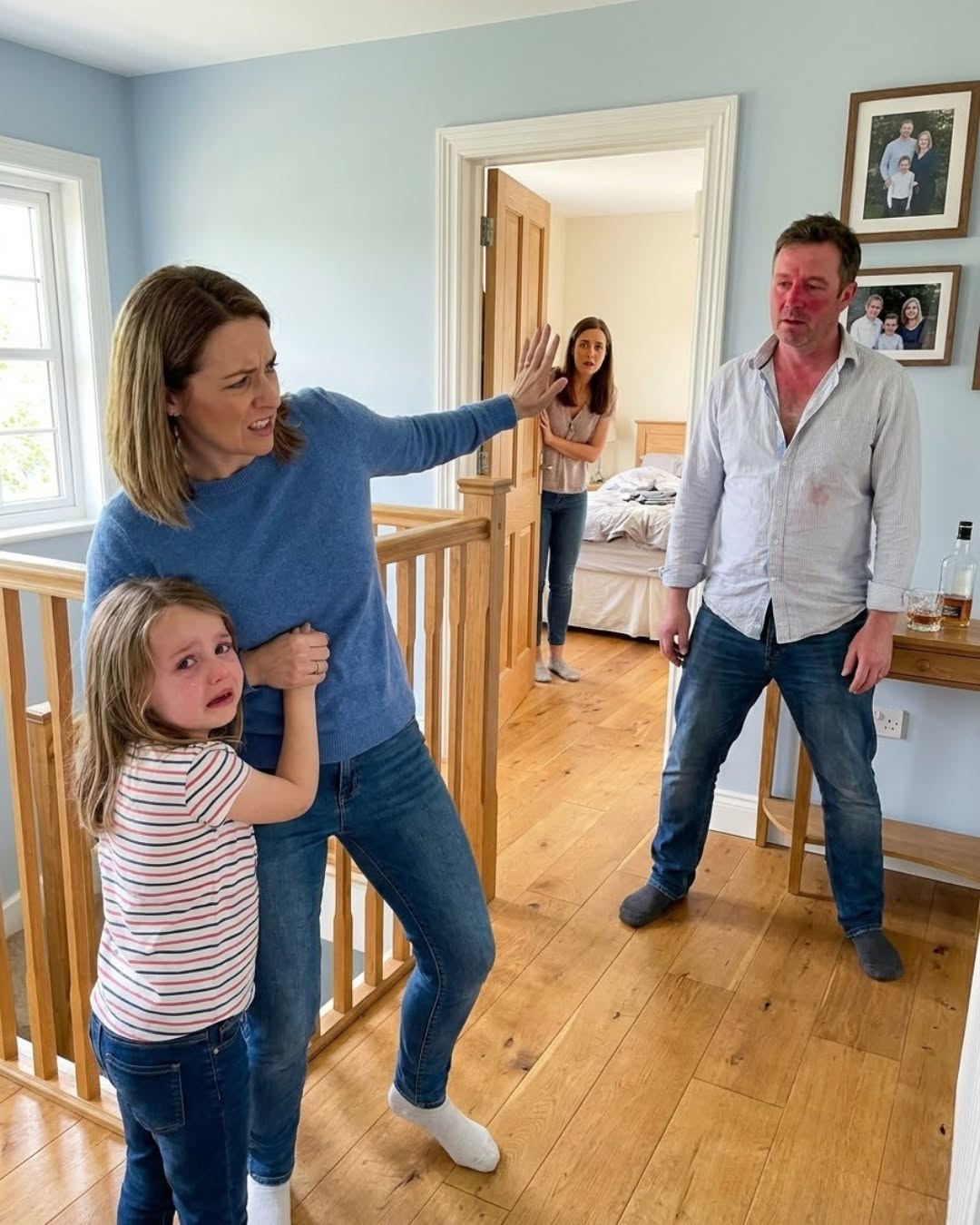
Dennis watched my hands.
He said nothing.
For once, neither did Serena.
The kitchen smelled faintly of whiskey and the lemon cleaner I used on the counters, and I remember noticing that somebody had left the refrigerator door open about an inch.
I walked over and shut it.
It was a ridiculous thing to care about.
I shut it anyway.
The lead officer, Officer Hale, separated Dennis and Serena before asking either of them another question.
Dennis went to the living room.
Serena stayed at my dining table.
I stayed where I could see both doorways and answered Hale’s questions about the cameras: one at the front door, one over the driveway, one facing the mudroom entrance, and the small stairwell camera we had installed after Meadow started sleepwalking two winters earlier.
That camera had never been about surveillance.
It was supposed to help us keep our daughter safe.
Dennis knew that.
He had mounted it himself.
Hale asked whether the system recorded continuously.
“No,” I said. “Motion and sound events. Some clips upload before the device finishes processing them.”
Dennis called from the living room, “She doesn’t understand the technical side of it.”
I turned toward Hale instead of Dennis.
“I understand the account.”
That was enough.
Hale asked me to show him where the hub normally sat.
I walked him to the mudroom and pointed at the dangling cable and the pale rectangles in the dust.
The shelf was cool beneath my fingertips.
My stomach reminded me that I had not eaten since a granola bar before seven that morning, so I drank half a glass of tap water and left the rest beside the sink.
One of the officers found the hub twelve minutes later.
Not hidden well.
Dennis had put it in the garage inside a reusable grocery bag beneath two old beach towels.
The officer carried the bag into the kitchen without opening the hub or touching anything more than necessary.
Serena looked at it.
Dennis did not.
That difference mattered to Hale.
It mattered to me too.
When Hale asked who moved it, Serena rubbed her bare heel against the chair leg and said, “I already told you. I was helping.”
“Helping with what?”
She pressed her lips together.
Dennis answered from the other room.
“She was upset. Everyone was upset.”
Nobody asked him.
Serena stared at the tabletop.
The napkin she had been wiping across it had torn along one edge.
“I unplugged it,” she said.
Hale waited.
Serena picked at the torn paper.
“Dennis told me the police would misunderstand the video.”
Dennis stood up so quickly that the leg of the coffee table scraped the floor.
“That is not what I said.”
An officer stepped between the rooms.
I put both hands flat on the counter.
Serena finally looked at Dennis.
He gave her the same expression I had seen him use on Meadow when she was little and about to admit she had colored on a wall.
Not anger.
Disappointment.
That was worse.
“Serena,” he said softly, “you’re confused.”
She flinched.
I saw it.
So did Hale.
But Serena did not suddenly become my ally.
She did not confess everything.
She said only that Dennis had handed her the hub after the ambulance left and told her to put it somewhere out of sight until they could “figure out what Meadow had told people.”
Then she stopped.
It was more than Dennis wanted her to say and far less than I needed.
Hale had the hub packaged.
I asked whether I could return to Meadow.
He said yes, but before I left, he asked if Dennis had somewhere else he could stay if officers required him to leave the house for the night.
Dennis laughed once from the living room.
“This is my house.”
I looked at Hale.
“Our names are both on it.”
Hale nodded.
He was careful with his next words.
The officers could take immediate steps based on what they had, but longer restrictions would depend on decisions made through the court and whatever charges the evidence supported.
I understood what he was telling me.
Changing a code did not change ownership.
Taking back a spare key did not erase a marriage.
So I did the next useful thing.
I photographed the mudroom shelf, the cord, the grocery bag before it was removed, the whiskey glasses, and the place Serena’s key had been sitting.
Then I put my phone away.
Dennis watched me from across the room.
“You’re documenting your own house now?”
“Yes.”
One word.
He smiled without humor.
“You need sleep, Tori.”
I walked past him.
At the hospital, Meadow was awake when I returned.
The room was warmer than the hallway, but her hands were cold when she reached for me.
I chose the chair beside her bed rather than the edge of the mattress because I did not want to jostle her shoulder.
She had been given a paper cup of apple juice and had peeled the foil lid halfway off, then apparently forgotten about it.
I opened it the rest of the way.
She took one sip.
“Did you see Dad?”
“Yes.”
Her eyes moved toward the door.
“Is he mad?”
I could have lied.
I could have said no.
Instead I said, “You are not responsible for how he feels.”
Meadow looked down at the blanket.
Then she told me something she had not told the officers yet.
Before she reached the stairs, she had been standing in our bedroom doorway.
Dennis saw her first.
Serena had grabbed the sheet and covered herself.
Meadow said Dennis crossed the room and caught her by the upper arm when she tried to run.
“He said I was making something bad out of nothing.”
I kept my face still.
Meadow continued.
“He said you were already tired all the time.”
My jaw tightened.
“He said if I told you, you’d get sick.”
There it was.
Not a threat that sounded like a threat.
Concern.
Always concern.
Dennis had not told a seven-year-old that he needed her silence to protect himself.
He told her silence would protect me.
Meadow twisted the corner of the blanket with her good hand.
“I thought if I could get outside, I could call you.”
I reached for the apple juice instead of reaching for her injured side.
“You tried to get to me.”
She nodded.
Then she said, “Aunt Serena told him to let go.”
That stopped me.
I asked Meadow what happened next.
“She said, ‘Dennis, let go of her.’ Then Dad said she needed to calm down too.”
Meadow swallowed.
“He let go, but then I ran.”
“And the stairs?”
She closed her eyes.
“He caught me.”
I did not make her say more.
I pressed the call button and asked the nurse to tell the doctor Meadow had remembered additional details and that I wanted them documented when Meadow was ready.
Sometime after six, Marcy arrived carrying a sweatshirt for me and the charger I had left plugged into my kitchen wall that morning.
She was fifty-eight, lived two doors down, and had known Meadow since the day we brought her home.
She put the sweatshirt across the back of my chair.
Then she got one thing wrong.
“I saw Serena’s car leave before the ambulance came,” she said.
Meadow looked toward her.
“No.”
Marcy frowned.
I asked her not to guess.
She apologized and corrected nothing else because she genuinely did not know.
What she did know was simpler.
She had heard someone crying outside.
She had walked through her side gate and found Meadow sitting near the hedge in socks, one shoe missing, trying to stand with one arm held against her body.
Marcy asked what happened.
Meadow told her she slipped.
Then Meadow asked Marcy not to call Dennis.
That part had frightened Marcy enough to call 911 first.
I thanked her.
She stayed for ten minutes, then left to feed her cat.
The useless detail I remember is that her phone case had a tiny plastic lemon stuck to the back, and she kept turning it around in her hands while she spoke.
Later that evening, Officer Hale called.
The account provider had preserved the system records.
He could not give me every detail yet, but he could tell me something important.
Dennis’s attempt to remove the stairwell camera had not been his first account action that afternoon.
At 2:24 p.m., minutes after the ambulance took Meadow away, his administrator profile changed the retention settings on multiple cameras.
At 2:31, the hub went offline.
At 2:36, his account tried to delete the stairwell device.
The sequence was saved on the company side.
I stared at the wall above Meadow’s bed while Hale spoke.
The wall had been painted a beige color that looked almost pink beneath the fluorescent light.
“Was he successful?” I asked.
“Not completely.”
That was all Hale would say.
It was enough for that night.
The first reversal had been the 911 recording.
The second was the account log.
The third came the next morning, and it hurt more because I thought I had already secured the one place Meadow needed.
Dennis still had legal access to our house.
Changing an electronic code had slowed him down, not erased his rights.
Before sunrise, Hale called to tell me Dennis had not been held overnight.
I was standing beside the vending machines with a paper tray of eggs I had no intention of finishing.
The hallway smelled like burnt toast.
Dennis could not come to Meadow’s hospital room while staff restrictions were in place, and officers had instructed him not to contact her directly while the investigation moved forward.
But my house was another matter.
I had won something and then lost part of it again.
So I stopped treating the keypad like protection.
I called my clinic associate, Jenna, and asked her to cancel my surgeries for the day.
She said, “Done.”
Then I called a local family-law attorney whose number one of the hospital advocates gave me.
I did not ask for a dramatic promise.
I asked what I could legally do that morning to protect Meadow and preserve the home situation while the criminal investigation continued.
By late morning, the attorney had begun the paperwork for emergency temporary orders based on the hospital records, police documentation, and Meadow’s disclosure.
Nothing happened instantly.
No judge appeared in a hallway.
No one handed me a magical piece of paper before lunch.
There were forms.
There was waiting.
There was a missing signature box I had overlooked on the first set, so I filled it in and sent the pages again.
I walked to the cafeteria while the attorney’s office handled the filing.
I bought Meadow crackers she did not eat.
I bought myself soup and forgot the spoon.
For twenty minutes, nothing dangerous happened.
Meadow watched a cartoon with the volume low.
I answered two messages from the clinic about a Labrador with an infected paw.
Then my phone rang.
Serena.
I let it ring out.
She called again.
I answered the second time but put her on speaker with the hospital advocate beside me.
Serena’s voice sounded dry.
“Tori, I need to tell you what happened.”
I looked at Meadow, who was asleep.
“Tell the police.”
“I will.”
“Then tell them first.”
Serena started crying quietly.
I did not fill the silence for her.
Finally she said Dennis had been telling her for months that our marriage was essentially over.
He told her I stayed only because of Meadow.
He told her I had asked for distance.
I had not.
She said she believed him because I worked late and because Dennis had complained that I was “more comfortable with animals than people.”
I did not debate any of it.
Whatever lies Dennis had told Serena did not explain why she stayed in my house after Meadow was hurt.
They did not explain the hub.
They did not explain the napkin wiping the clean table while my daughter was in an ambulance.
I asked one question.
“Did you see him push her?”
Serena went quiet.
The advocate stopped writing for half a second, then continued.
“Yes.”
A flat word.
My hand tightened around the phone.
Serena kept talking.
She said Dennis grabbed Meadow near the landing.
She said Meadow twisted away.
She said Dennis shoved her with both hands.
She said Meadow went backward.
Then Serena did something I did not expect.
She tried to reduce it.
“He didn’t mean for her to go all the way down.”
I ended the call.
Serena had finally confirmed the central act, then immediately tried to soften it.
She had moved toward the truth without moving all the way toward Meadow.
I sent the recording information and the advocate’s notes to Hale through the process he had given me.
Then I blocked Serena’s number on Meadow’s tablet.
Not mine.
I wanted any future contact coming to me preserved.
That afternoon the emergency order was granted.
It gave me temporary exclusive use of the house and set restrictions around Dennis’s contact with Meadow while the larger proceedings continued.
It was not a final judgment.
It was a boundary with a date and a case number.
I read every line twice.
Then I read it once more.
Dennis was served away from the hospital.
For several hours, it looked like the crisis had narrowed.
Meadow was medically stable.
The house was temporarily protected.
The recordings had been preserved.
Serena had admitted seeing the shove.
I let myself think the worst uncertainty was over.
It was not.
That evening Hale came to the hospital with a second officer and asked to speak with me outside Meadow’s room.
I followed him into a family consultation room where somebody had left three sugar packets lined up beside an empty coffee cup.
The air conditioner blew directly onto my neck.
Hale placed no dramatic folder on the table.
He just sat down.
The security provider had recovered a short stairwell clip that had synchronized before Dennis took the hub offline.
Not the entire incident.
Enough.
Hale asked whether I wanted to view it.
I said no.
That was deliberate.
I did not need to watch my daughter fall to believe her.
I asked him to tell me only what investigators believed it showed.
Hale said the clip supported Meadow’s account.
Dennis was visible moving toward her on the landing.
Meadow was trying to get away.
His arms extended.
She disappeared backward from the camera’s frame.
Audio continued after she fell.
Serena screamed Meadow’s name.
Dennis told Serena to stop screaming and go downstairs.
A few seconds later, he said, “She slipped.”
Before anyone had called for help.
Before Marcy found Meadow.
Before Meadow repeated the same sentence because she had been told to.
The lie existed before the ambulance.
I asked Hale what happened next.
He told me the evidence had changed the direction of the case, but he did not promise me an outcome he could not control.
There would be interviews, review by prosecutors, and decisions based on the full record.
That mattered to me.
I had heard enough false certainty in my own kitchen.
I did not need another kind.
Two days later, Meadow came home with me.
Dennis was not there.
Neither was Serena.
The first thing Meadow did was stop at the bottom of the stairs.
I stood beside her without touching her.
She looked up.
Then she said, “Can I sleep downstairs?”
“Yes.”
We turned the den into her room for the week.
I dragged the small guest mattress in myself, caught my sock on the corner, and nearly dropped the fitted sheet.
Meadow laughed once.
It surprised both of us.
We ate toast for dinner because it was what she wanted.
I burned mine.
The next morning, I returned to the clinic for only three hours.
Jenna had covered everything without making me explain myself to clients.
She had also thrown away the coffee I left on my desk.
“I considered preserving it as evidence,” she said.
I looked at her.
She shrugged.
“Too soon?”
“A little.”
Then I laughed anyway.
At home, the case kept moving in ordinary, unsatisfying increments.
Dennis hired a lawyer.
Serena retained one too.
Statements were taken again.
Medical records were reviewed.
The account company supplied its logs through proper requests.
The recovered video became evidence, not gossip, and I stopped discussing details with neighbors even when people texted me versions of what they had heard.
Dennis’s reputation in town had once rested on being the father who coached Saturday soccer, carried folding chairs for everybody else, and remembered teachers’ names.
None of those things disappeared because of what he did.
They simply stopped being proof of anything.
A person could carry chairs and still hurt a child.
A person could use a gentle voice while trying to erase what happened.
Weeks later, Serena asked through her attorney if she could send Meadow a letter.
I said no.
Not yet.
Then I made an unnecessary trip upstairs to look for one of Meadow’s library books even though I knew it was already in the den.
I stood in the hallway for maybe thirty seconds.
Nothing came from it.
I went back downstairs.
The criminal case did not end in one explosive afternoon.
It narrowed through evidence.
The hospital documentation supported the injuries Meadow described.
The 911 audio captured Dennis coaching her account before the fall was reported as an accident.
The provider records showed his efforts to interfere with the camera system afterward.
The recovered clip supported Meadow’s description of the shove.
Serena’s statement corroborated what she had seen.
Eventually, Dennis’s lawyer stopped arguing that Meadow had simply fallen.
The fight shifted to what Dennis intended when he put his hands on her and what legal consequences should follow.
That was no longer a question he could answer by calling me tired.
Serena’s situation moved separately.
She had not pushed Meadow.
But investigators and attorneys examined what she did afterward, what she moved, what she said, and when she said it.
I refused to turn her into either a secret hero or an equal copy of Dennis.
She had told him to release Meadow.
She had also helped remove the camera hub.
She eventually told the truth about seeing the shove.
She had also sat in my kitchen drinking while Meadow was in the hospital.
Both things stayed true.
Months passed.
Meadow returned to school on a reduced schedule first, then full days.
She saw a therapist who never forced her to use adult words for what happened.
I adjusted my emergency rotation at the clinic and paid another veterinarian to cover one evening a week that I had previously handled myself.
It cost money.
I paid it.
Sometimes Meadow still asked whether Dennis knew where we were going.
Sometimes she did not mention him for days.
The first time she walked upstairs alone again, she went only to the fourth step.
Then she came back down.
I did not praise her.
I asked whether she wanted popcorn.
She did.
Later, she made it to the landing.
Later still, to her bedroom.
There was no speech.
She brought down three stuffed animals and complained that I had washed her purple blanket with the wrong detergent.
That was better.
The court process eventually gave us something more durable than the emergency order, with contact and custody decisions shaped by the evidence, professional recommendations, and Meadow’s safety needs.
I will not pretend a legal document repaired my daughter.
It gave us structure.
Structure mattered.
Dennis could no longer walk into the house because he felt entitled to be there.
He could no longer reach Meadow whenever he wanted.
Any future contact had rules he did not control.
The criminal case also reached its own resolution through the system that had been building around the evidence from that first afternoon.
There was no moment when the entire town gathered to apologize for thinking Dennis was wonderful.
Most people never said anything at all.
A few crossed the street when they saw me.
A few quietly told me they believed Meadow.
One woman from soccer left a casserole on our porch without a note.
I returned the dish three weeks later.
By then, Serena and I had not spoken directly in almost four months.
Her attorney contacted mine about personal belongings still in my house.
There were two sweaters, a phone charger, a ceramic travel mug, and a pair of sandals in the coat closet.
I boxed them.
At the bottom of her purse drawer in the mudroom cabinet, I found the old keychain she used before I gave her the spare house key.
A cheap blue plastic tag.
Nothing important.
I put it in the box too.
The spare key itself stayed with me.
For a while, it lived in the zippered pocket of my work bag.
Then one Saturday morning, Meadow and I changed the front-door lock completely.
A locksmith did the actual installation while Meadow sat on the porch eating dry cereal from a cup.
The morning was cool.
She asked if she could have one of the new keys.
I said yes.
The locksmith handed me three.
I tested the first in the door.
Then I gave the second to Meadow.
She held it by the edges as if it might be hot.
“Is this mine?”
“Yes.”
She chose a green rubber key cover from the little tray the locksmith carried and pushed it over the top herself.
I did not give the third key to Serena.
I did not give it to Dennis.
I put it in the locked cabinet at the clinic for emergencies.
The old spare key was no longer needed.
I took it off my ring and dropped it into the metal recycling bin behind the locksmith’s shop.