My daughter did not cry when my mother-in-law slapped her.
That was the first thing I noticed after the entire birthday banquet exploded around us.
One second, my 2-year-old daughter was sitting at the table surrounded by adults who were supposed to be family.
The next, my mother-in-law had struck her across the face and snarled, “You useless piece of trash, this girl has defective genetics!”
I remember looking at my husband first.
Maybe some part of me still expected him to stand up.
Maybe I thought seeing his own mother slap his little girl in front of an entire room would finally break whatever hold she had over him.
He did nothing.
He sat there in cowardly silence.
So I lunged across the table.
I slapped him hard enough that his glasses flew from his face and dropped straight into his stew.
Then I shoved my mother-in-law backward into her birthday cake.
Red frosting smeared across the table as people shouted and chairs scraped around us.
“You’re 30 years old and still can’t defend your own child!” I yelled at my husband.
Then I grabbed my daughter and walked out.
They had spent years treating me like the woman who would eventually calm down, apologize, and return to her assigned place in the family.
They thought I was submissive.
They thought humiliation worked on me.
What they did not understand was that I had already spent a month preparing for the possibility that my husband might force me to choose between keeping his family comfortable and keeping my daughter safe.
That night, he made the choice for me.
My daughter pressed her warm face against my neck as I carried her out of the banquet room.
Behind me, people were still shouting over one another.
The smell of spilled stew followed us through the doorway, mixed with the heavy sweetness of birthday frosting.
I could hear my mother-in-law’s voice somewhere behind the other voices, but I did not turn around.
My daughter still had not cried.
That frightened me more than screaming would have.
She held onto me while I crossed the parking lot, her little arms tight around my neck.
Then I felt her body start to shake.
Not dramatically.
Just small tremors against my chest that told me she had finally understood that something frightening had happened.
I opened the car, buckled her carefully into her car seat, and leaned close beneath the overhead light.
A red mark was already forming across her cheek.
She reached up and touched it with two fingers.
“Grandma mad,” she whispered.
Those two words nearly broke me more than the slap itself.
She was 2.
She did not have language for family dysfunction, loyalty, excuses, or generations of adults teaching one another to tolerate cruelty.
She only knew that Grandma had been angry and that somehow anger had ended with a hand against her face.
I wanted the lesson she took from that night to be different.
I wanted her to learn that when someone hurts you, even someone with the title of family, the people who love you are supposed to protect you.
Then my husband came running out of the building.
He was not wearing his glasses.
Broth stained the front of his shirt, and he looked disoriented without the frames he always wore.
But what struck me was the way he kept glancing over his shoulder toward the banquet room.
Our daughter was sitting a few feet from him with a red mark forming on her face, and he was worried about what was happening inside.
“You need to come back inside,” he said.
I stared at him from behind the open driver’s-side door.
“You humiliated my mom in front of everybody.”
For a moment, I could not believe that was the sentence he had chosen.
Not, Is she okay?
Not, Let me see her cheek.
Not even, I’m sorry.
His mother had slapped our toddler, and somehow the emergency in his mind was that his mother had landed in a birthday cake.
I asked him one question.
“Did your mother hit our daughter?”
He rubbed both hands across his face.
He looked exhausted, irritated, trapped between two women demanding something from him.
But I was no longer asking him to choose between two women.
I was asking whether he could acknowledge what had happened to his child.
“You know how Mom gets when she’s upset,” he said.
That was his answer.
He did not deny it.
He did not defend our daughter.
He explained his mother’s behavior as though her temper were weather, something everyone else simply needed to prepare for.
I looked past him toward the building for a second and thought about every gathering I had endured before that night.
Then I closed the car door.
I got behind the wheel, started the car, and drove away.
For two years, I had swallowed things I should never have swallowed because my husband always promised the next family gathering would be different.
His mother criticized the clothes I put on our daughter.
She criticized the food I packed for her.
She complained about how many hours I worked.
She even found fault with the way our toddler pronounced certain words, as though a 2-year-old were personally embarrassing her by still learning to speak.
Whenever I pushed back, my husband had a familiar response.
It was a misunderstanding.
His mother had not meant it that way.
She was from a different generation.
She was stressed.
I was taking things too personally.
Then came the request he always saved for last.
Could I please keep the peace?
For a long time, I believed keeping the peace meant being mature.
I thought marriage required compromise, and I kept confusing compromise with absorbing every insult so my husband would never have to confront the woman who raised him.
Eventually I understood the pattern.
His version of peace was not peaceful at all.
His peace required my silence.
As long as I stayed quiet, his mother could say whatever she wanted, he could avoid an argument, and everyone could leave another family gathering pretending nothing serious had happened.
I was the person paying the price for that arrangement.
Then our daughter became old enough to become part of it.
A month before the birthday banquet, something in me had changed.
There was no dramatic announcement.
I did not tell my husband I was preparing to leave.
I simply stopped trusting promises that were never followed by action.
I made copies of our important documents.
I started putting money from my own paychecks into an account only I could access.
I packed a small overnight bag for my daughter.
I did not do those things because I had already decided our marriage was over.
I did them because I wanted a choice if the moment ever came when staying became more dangerous than leaving.
I had not expected that moment to happen during a birthday banquet.
I had not expected it to arrive with red frosting, spilled stew, and my daughter’s cheek turning red beneath my hand.
But I had prepared for one specific possibility.
One day, my husband might choose his mother’s comfort over our child’s safety.
At the banquet, he did exactly that in front of an entire room.
By the time I reached my friend’s apartment, the adrenaline had started wearing off.
She opened the door before I could knock twice.
She looked at me, then at my daughter.
Her eyes stopped on the mark across my little girl’s cheek.
She stepped aside.
“You can stay as long as you need,” she said.
There was no speech about marriage.
No questions about whether I had overreacted.
No demand that I explain every detail before she decided whether I deserved help.
She simply made room for us.
I changed my daughter into a borrowed T-shirt and sat beside her while she settled under the blanket.
Her breathing gradually slowed.
Every few minutes, her hand moved toward her cheek almost automatically.
Her fingers would hover there for a second before falling back to the blanket.
I stayed close and watched her until I was certain she was beginning to relax.
My phone kept buzzing on the nightstand.
My husband sent thirteen messages.
I counted them because somewhere around the fifth one I realized what was missing.
Not one message asked whether our daughter was okay.
He accused me of assaulting his mother.
He said I had destroyed the banquet.
He said I had embarrassed his family.
He said the guests were frightened.
Then he demanded that I come back before people started “getting the wrong idea.”
I read that line several times.
The wrong idea.
Apparently the wrong idea was not that a grandmother had slapped a 2-year-old child.
It was not that the child’s father had watched it happen without stopping her.
The dangerous idea, to him, was that other people might finally see the family dynamic without me helping him hide it.
My thumb hovered over the screen.
I typed one reply.
“The wrong idea is that this was the first time you failed her.”
I stared at the sentence.
It felt true in a way that made my chest ache.
The slap had been the loudest failure, but it had not been the first.
Every time his mother insulted our daughter and he dismissed it, he had failed her a little.
Every time he asked me to absorb disrespect so he would not have to confront his mother, he had made the same choice in a quieter form.
The banquet had simply made the pattern impossible to ignore.
I still had not pressed send when another notification appeared.
This one was not from my husband.
It came from his cousin.
She had been sitting on the opposite side of the table during the birthday celebration.
She had been recording the candles.
Her message was short.
“I think you need to see the whole video.”
I looked over at my daughter before opening it.
She was lying quietly beside me, and I turned the volume down so the banquet noise would not wake or frighten her again.
Then I pressed play.
The video began several seconds before the moment I remembered most clearly.
At first, the frame held the ordinary chaos of a birthday table.
Then my mother-in-law leaned toward my daughter.
The camera had captured her hand closing around my child’s tiny wrist.
I watched the clip again because I needed to be certain of what I was seeing.
My daughter was not simply sitting near her.
My mother-in-law had taken hold of her wrist before the slap.
And my husband was watching from his chair.
There was no angle he could hide behind.
No confusion.
No split second where he had looked away and missed what happened.
He saw his mother holding our daughter.
Then the slap came.
It was clear on the recording.
Clear enough that no one could honestly call it an accident.
Clear enough that the excuses he had used in the parking lot already sounded different in my head.
You know how Mom gets when she’s upset.
I had thought those words meant he had witnessed something terrible and, out of cowardice, immediately started minimizing it.
That was bad enough.
Then I watched the few seconds before I lunged across the table.
That was when the meaning of the entire night shifted.
My husband leaned toward his mother.
He was close enough that his voice was lower than the shouting that came later, but the phone had captured it.
“Mom, I told you—not in front of everyone.”
I stopped the video.
For several seconds, I did not move.
The sentence was short.
But it opened a question much larger than the one I had been asking since we left the banquet.
Until that moment, I had believed my husband was a coward who froze when his mother crossed an unforgivable line.
I had believed his worst failure was silence.
Now I was hearing something else.
He had not said, Don’t touch her.
He had not said, Never do that again.
He had not sounded shocked that his mother would treat our daughter that way.
He had said, “Not in front of everyone.”
The words suggested the audience was the problem.
Not necessarily the behavior.
I played the clip again.
My daughter’s face was still visible in the frame.
My mother-in-law’s hand was still around her wrist.
My husband was still sitting there.
And there it was again, quietly preserved beneath the birthday noise.
“Mom, I told you—not in front of everyone.”
The thirteen messages on my phone suddenly felt different too.
His obsession with embarrassment.
His demand that I return before people got “the wrong idea.”
His refusal to ask about our daughter’s cheek.
His explanation in the parking lot.
None of those things proved what had happened before that night.
But they forced me to confront a possibility I had never allowed myself to consider.
Maybe my husband had not simply failed to stop his mother’s behavior.
Maybe he already knew far more about what she was capable of than he had ever admitted to me.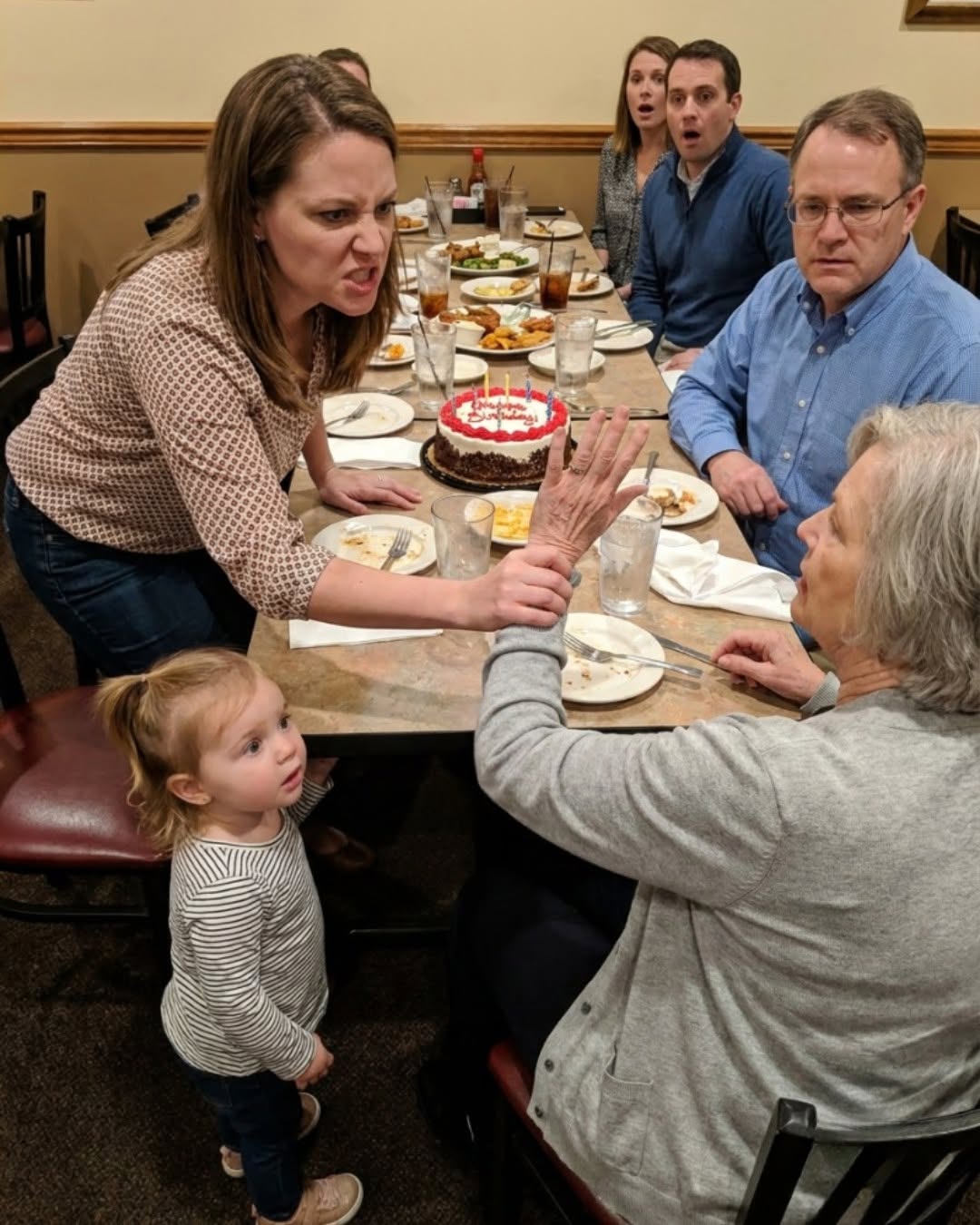 I looked at the unsent message on my screen.
“The wrong idea is that this was the first time you failed her.”
A few minutes earlier, I had written it out of anger and exhaustion.
Now the sentence felt frighteningly literal.
I thought about all the family gatherings where he had insisted I misunderstood his mother.
All the times he had pushed me to keep the peace.
All the times I had assumed his excuses came from weakness rather than knowledge.
For two years, I had believed I was married to a man who could not stand up to his mother.
The video raised a much harder question.
What if silence had never been the whole story?
My daughter shifted beneath the blanket beside me and lifted one hand toward her cheek again.
I reached over and gently lowered her hand before she touched the sore spot.
She settled back down.
I looked from her face to the frozen video frame on my phone.
My mother-in-law’s fingers were wrapped around her wrist.
My husband was watching.
And suddenly the most important part of that birthday banquet was no longer the slap I had given him, the glasses floating in his stew, or his mother landing in her own cake.
It was the seven quiet words he never expected anyone else to hear.
“Mom, I told you—not in front of everyone.”
That was the moment I realized leaving the banquet had only been the first decision I needed to make.
I looked at the unsent message on my screen.
“The wrong idea is that this was the first time you failed her.”
A few minutes earlier, I had written it out of anger and exhaustion.
Now the sentence felt frighteningly literal.
I thought about all the family gatherings where he had insisted I misunderstood his mother.
All the times he had pushed me to keep the peace.
All the times I had assumed his excuses came from weakness rather than knowledge.
For two years, I had believed I was married to a man who could not stand up to his mother.
The video raised a much harder question.
What if silence had never been the whole story?
My daughter shifted beneath the blanket beside me and lifted one hand toward her cheek again.
I reached over and gently lowered her hand before she touched the sore spot.
She settled back down.
I looked from her face to the frozen video frame on my phone.
My mother-in-law’s fingers were wrapped around her wrist.
My husband was watching.
And suddenly the most important part of that birthday banquet was no longer the slap I had given him, the glasses floating in his stew, or his mother landing in her own cake.
It was the seven quiet words he never expected anyone else to hear.
“Mom, I told you—not in front of everyone.”
That was the moment I realized leaving the banquet had only been the first decision I needed to make.