The submission window disappeared from my monitor, leaving my name attached to a report I could no longer pull back.
I printed the confirmation page and handed it to Elena.
She read the number at the top, folded the paper once, and put it beneath Tommy’s chart instead of leaving it on the counter.
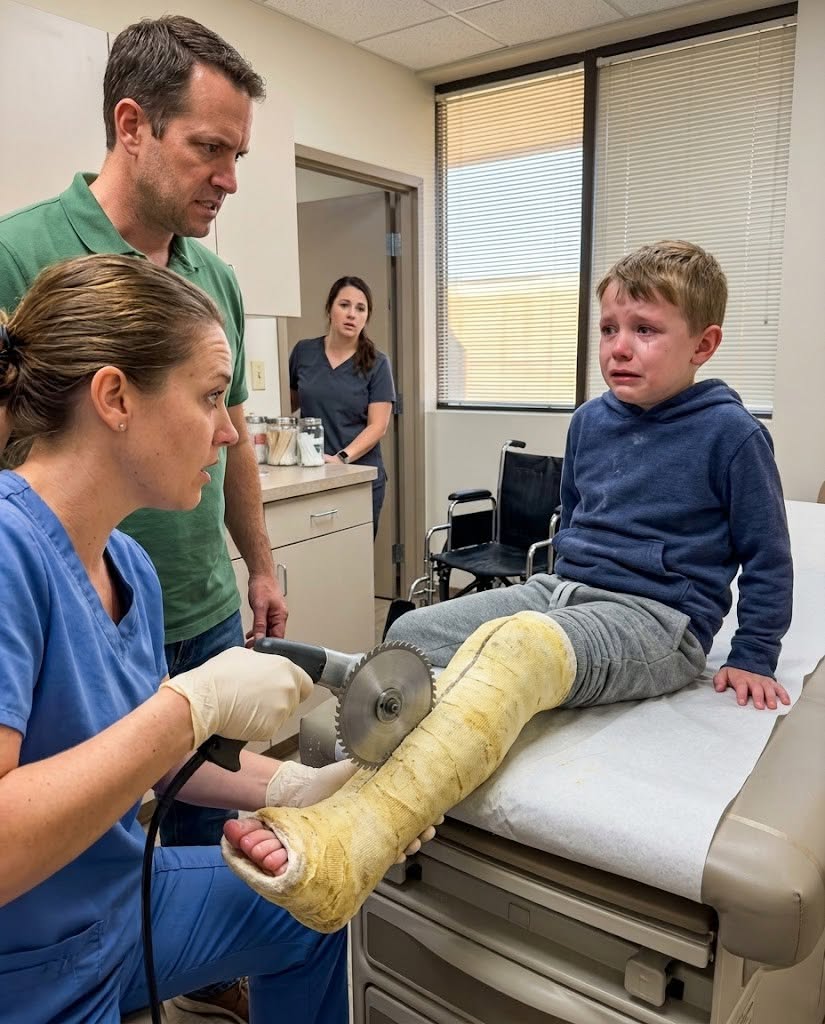
Outside the exam room, Richard was still talking.
His voice had gone quiet now.
That worried me more.
He told the security officer that Tommy was hungry, that the appointment had become unnecessarily stressful, and that a six-year-old with fragile bones should not be kept sitting under fluorescent lights because clinic staff had misunderstood a piece of paper.
Tommy drank his apple juice.
He held the carton with both hands.
He did not ask for Richard.
I crouched beside him again and checked the skin where the packet had pressed into his calf.
The room smelled faintly of resin even after Elena had swept most of the cast dust into a disposable tray, and a strip of torn exam-table paper kept sticking to the bottom of my shoe.
“Does your leg hurt right now?”
Tommy nodded.
“Where?”
He pointed below his knee, then toward the back of his calf.
I did not ask why.
Not yet.
Instead, I photographed the pressure marks beside a measurement card and documented exactly what I could see.
No guesses.
No diagnosis.
Just facts.
Richard knocked once and opened the door before anyone answered.
The security officer stopped him at the threshold.
“I need my son,” Richard said.
Tommy lowered the juice carton.
Richard looked past me and gave him a patient smile.
“Buddy, we’re going to get lunch. You can tell everyone you’re okay.”
Tommy shook his head.
Richard kept smiling.
Tommy shook his head again.
Richard looked at me.
“You are frightening him.”
I moved the wheelchair farther from the doorway and asked Elena to bring a regular clinic chair instead.
The wheelchair belonged with the examination now.
The black case was gone with Richard, but the footrest strap still carried a rectangular dust mark where it had been clipped underneath.
I photographed that too.
The security officer told Richard he could remain nearby but could not enter while Tommy was being examined.
Richard objected.
He asked for a supervisor.
He asked for Tommy’s physician.
He asked whether I understood that technicians did not diagnose children.
On that last point, he was right.
I said so.
Then I kept working.
Tommy watched the doorway until Richard’s shoes disappeared from the gap beneath it.
Only then did he push the hood off his head.
His hair was damp against his forehead.
“Is Mom coming?” he asked.
“Someone is trying to reach her.”
He rubbed his thumb over the corner of the juice carton.
“Dad took her phone before.”
I stopped typing.
“When?”
Tommy looked at Elena.
Then at me.
“When she said no more hard stuff.”
I entered his words exactly as he had said them.
He chose another sip of juice before continuing.
“He does it in the garage.”
“What happens in the garage?”
Tommy pulled one sneaker partly off with the heel of the other.
“Dad cuts the hospital one. Then he puts more on. Mom used to hold the light.”
Elena’s hand stopped over the tray.
That changed the shape of the story.
Not the danger.
The shape.
“Used to?” I asked.
Tommy nodded.
“She stopped.”
“What did your mom do when she stopped?”
“She yelled.”
He thought for a second.
“Then Dad said she was making me sick because she kept talking about it.”
A paper cup rolled off the counter when Elena reached for a clean dressing.
Neither of us picked it up.
Tommy pulled his sneaker back on.
He chose to keep talking.
The previous night, he said, Richard had removed part of the old cast because he wanted to build it again before the clinic visit.
His mother had been in the garage with them.
When Richard went inside for something, she pushed the folded packet beneath the soft wrap against Tommy’s leg, covered it with fresh padding, and told him not to touch it.
The key went in with the note.
Then Richard came back.
He rebuilt everything over it. “Did he know she put something there?” “No.” “Did you know what the note said?” Tommy shook his head. “Mom said it was for a doctor person.” I was not a doctor person. But the note had reached someone. Twenty minutes later, one of Tommy’s physicians arrived with a child-protection nurse from another floor. I gave them the photographs, the removed material, and my measurements without adding anything I had not personally seen. Tommy asked for another juice. He got water instead because the refrigerator was empty. He made a face but drank it. Richard produced paperwork in the hallway. That was our first real setback. One page came from an urgent-care visit nine months earlier and contained the phrase “possible underlying bone fragility.” Another recommended follow-up with a specialist. Richard held those pages like a verdict. “There,” he said. “You people keep acting like I invented this.” The physician read them twice. The room shifted. Richard had documentation now. Tommy’s chart was still incomplete, but incomplete was not the same as false, and none of us could claim that a rare disorder had been excluded simply because Richard had failed to produce a genetic report at the beginning of the appointment. I hated that uncertainty. I kept it anyway. The physician ordered imaging of Tommy’s current leg and requested records from the clinics already listed in his chart. Richard agreed immediately. “Good,” he said. “Finally someone is doing medicine instead of playing detective.” Tommy looked at his socks. I carried the cut cast pieces to a locked specimen cabinet and signed them in. For the next hour, nothing dramatic happened. That mattered. Tommy went for X-rays. Tommy came back. Tommy asked whether the cafeteria had grilled cheese. Tommy complained that the paper gown scratched his neck. Richard stayed outside with the black case resting beside his shoe. The July heat had made the hallway warmer than the exam room, and when the door opened I could smell the burnt coffee from the nurses’ station. The new images did not hand us a clean answer. Tommy had a healing fracture. That was real. Some older images requested from another clinic showed previous fractures too. Also real. Richard seized on that. “So we’re done now?” No. The issue had moved sideways. Whether Tommy could fracture more easily than another child still required specialist evaluation, but a genuine fracture did not explain why someone had thickened a hospital cast at home with nonstandard material. It did not explain the pressure injury. It did not explain the hidden note. And it did not explain why Tommy was afraid to answer questions while Richard was in the room. The physician told Richard exactly that. Richard stopped asking about lunch. He started asking about Tommy’s mother. “You need to understand who you’re dealing with,” he said. “She has been trying to turn him against me for months.” He held up the black case. “This is mine. The key is mine. Whatever she put in that cast was stolen from me.” I watched his hand tighten around the handle. He had just identified the key without seeing it closely after it fell from the cast. I documented his statement. I did not argue with him. Sometime that afternoon, Tommy’s mother arrived. Her name was Claire. She came through the clinic doors carrying a grocery tote with one handle repaired by a knot, and she stopped so fast when she saw the security officer that a container inside the bag tipped onto its side. She asked for Tommy. Then she asked whether Richard was with him. We separated them before anyone explained more. Claire was not the clean rescuer I had started imagining. She told the physician that she had helped Richard reinforce two earlier casts. Her voice barely changed when she said it. “He told me the hospital work was too thin,” she said. “He said Tommy would break the same leg again if we didn’t make it stronger. I believed him.” She stared at her hands. “Then I saw what the extra layers did to his skin.” The child-protection nurse asked when she had stopped helping. Claire gave a date from sometime in spring. She also admitted that she had not taken Tommy to a doctor herself afterward. That cost her credibility in the room. It had to. The physician did not excuse it because she had written the note. Neither did I. For a while, the simple version fell apart. Richard was no longer the only parent connected to the home cast work. Claire could not simply walk in, point at him, and leave with Tommy. The protection team needed more than a frightened child, an accusing note, and two parents blaming each other. Tommy sat on the exam table while adults talked in another room. He peeled the label from his empty water bottle. Halfway through, he stopped. “Can I have my shorts back?” I found them in the plastic belongings bag. He changed out of the gown himself except for the injured leg, where I helped guide the fabric over a temporary splint. Then he chose the chair farthest from the door. That was when the first records arrived. Not all of them. Enough. One clinic had documented a standard fiberglass cast and photographed it at application because Tommy had developed a small skin irritation during a previous visit. Three weeks later, another facility described the cast as “heavily reinforced” and difficult to remove. There was no record of a medical provider adding those layers. A second pair of records showed the same pattern months later. Standard cast at discharge. Abnormally thick cast at the next visit. No documented hospital modification between them. The child-protection nurse laid the pages side by side. Richard stopped talking about bone disease. He asked for the black case back even though nobody had taken it from him. The security officer looked down at it. So did I. Richard picked it up. “We’re leaving.” The physician told him Tommy was not medically cleared to leave yet. “You cannot hold my child because you don’t like his cast.” “We’re evaluating an injury caused by the cast,” she said. Richard turned toward the exit. The officer stepped into the hallway. For several seconds, nobody moved. Then Tommy spoke from behind me. “Don’t give him the key.” Richard closed his eyes. Just once. When he opened them, he lowered his voice again. “Tommy, your mother has put you in a very bad situation.” Tommy reached for the edge of the chair. “No.” Richard tried again. “You’re confused.” “No.” “You don’t understand what they’re doing.” “No.” Three words. Same word. Richard stopped. The protection team requested that Richard remain apart from Tommy while the hospital completed its safety process. He objected through a phone call in the hallway, but he did not get access to the exam room again that afternoon. For the first time since Tommy arrived, something we had gained stayed gained. Then we lost something else. Claire could not take Tommy home immediately either. Her involvement in the earlier cast modifications had to be evaluated, and the hospital could not treat her note as proof that every decision she made was safe. When someone explained that to her, she sat down hard in a plastic chair. She did not argue. “Okay,” she said. Tommy heard enough of the conversation to understand that he was not leaving with either parent that evening. His face went blank. He asked whether he had done something wrong. The physician answered before anyone else could. “No.” Tommy accepted that for about ten seconds. Then he asked where he was going to sleep. The hospital arranged for him to remain in pediatric observation while the reporting agencies reviewed the immediate safety plan. It was not a dramatic rescue. It was paperwork, phone calls, record requests, signatures, and people repeating names and dates into phones until their voices became flat. I stayed long past the end of my shift because I wanted my documentation completed while every detail was still fresh. My stomach cramped again. Elena found crackers in a drawer. They were stale. I ate them anyway. Near evening, Richard finally set the black case on the floor beside the security desk while making another call. He never abandoned it. He never consented to opening it. Nobody forced the lock in the clinic. Instead, its location and connection to the key were documented, and the responding authorities handled the next steps outside my role. That boundary mattered. I had already seen enough people in that room reach beyond what they actually knew. I would not become one of them. Tommy slept badly that night. I learned that the next morning when I came in and found him awake before breakfast, his hair flattened on one side and a cartoon playing silently on the wall television. He had eaten half a banana. The other half had turned brown on the tray. He asked whether I was going to use the saw again. “Not today.” He nodded. Then he asked whether his cast was still in the building. “Yes.” “Good.” I did not ask why that made him feel better. By late morning, the first temporary safety decision had been made. Tommy would not leave the hospital with Richard. Claire would be allowed supervised contact while her role was reviewed, and future orthopedic care would be coordinated through one medical system instead of scattered among unrelated clinics. The old records would be consolidated. The home-rebuilt casts would be documented as a safety concern. Richard could no longer move Tommy from clinic to clinic carrying only his own explanation of what had happened before. It felt finished. Almost. Tommy had a proper temporary splint. He had eaten toast. Claire was sitting with him under supervision, reading a library book he kept interrupting to correct. Richard was no longer in the pediatric hallway. For twenty quiet minutes, the biggest problem in the room was that Tommy disliked grape jelly. Then the call came about the black case. The authorities had obtained the necessary permission to examine it as part of the investigation. I was not present when it was opened. I received the inventory later because items inside directly related to the medical report I had filed. There were strips of casting material. Packets of resin hardener. A small cutting tool. Several folded instruction sheets from different clinics. And a stack of index cards. The cards did not contain a confession. They were worse in a quieter way. Each one had a clinic date at the top and short phrases underneath. Fell off couch. Hurts when touched. Cried all night. Do not mention garage. One card included Tommy’s age written incorrectly and crossed out. Another listed a clinic that had never diagnosed a bone disorder at all. The materials did not answer every question about Richard’s purpose, and nobody in our clinic pretended they did. They answered the narrower questions that mattered to us. The casts had been altered deliberately. The alterations had happened outside medical care. The pattern had repeated. Tommy had been coached about what to say. That was enough for the hospital to close its part of the uncertainty. Not the legal case. Not the family case. Our part. The final specialist evaluation took longer. Tommy was assessed for the bone condition Richard had repeatedly referenced, because suspicion of abuse did not erase the possibility that a child might also have a genuine medical problem. The specialists reviewed his history, imaging, laboratory work, and the fragmented records from the earlier clinics. The dramatic diagnosis Richard had presented as settled was not supported. Tommy did have real fractures. He did need orthopedic care. But his care plan did not require the extreme restrictions Richard had described, and it certainly did not require layers of industrial material applied in a garage. The distinction changed everything that happened next. Tommy’s records were corrected. His future visits were routed through a coordinated team. Any cast or brace applied to him would be documented at placement and checked at follow-up. Claire’s earlier participation remained part of the review rather than being erased because she had eventually tried to expose what was happening. Richard’s contact with Tommy became a matter for the protection process and the court, not something a technician in an orthopedic clinic could determine. That was the causal ending I could actually stand behind. No instant punishment. No perfect parent. No miracle. Just the end of one system Richard had depended on: separate clinics seeing separate injuries, each one starting from whatever story arrived through the door. Six weeks later, Tommy came back for a brace fitting. He wore shorts this time. The room was cold enough that he rubbed his arms while I adjusted the straps, and he complained that the Velcro sounded like someone ripping paper in church. Claire waited in the corner with a staff member nearby. Tommy answered my questions without looking at her first. When I asked whether anything pinched, he said yes. When I adjusted it, he said it still pinched. I moved the strap again. “Now?” “Better.” He stood between the parallel bars and put weight through the leg as instructed. Then he asked if the loud saw was somewhere in the room. I pointed to the cabinet where we kept it. “Want me to show you?” He thought about that. “Not today.” “Okay.” He walked another few steps. By winter, the physical evidence that no longer needed to be retained was released through the proper process. Claire brought a small envelope to one of Tommy’s follow-up visits and asked whether he wanted what was inside. He opened it himself. The rusted key dropped into his palm. He looked at it for a few seconds, closed his fingers, and asked if he could keep it. Claire said yes. Tommy put the rusted key in his desk drawer.