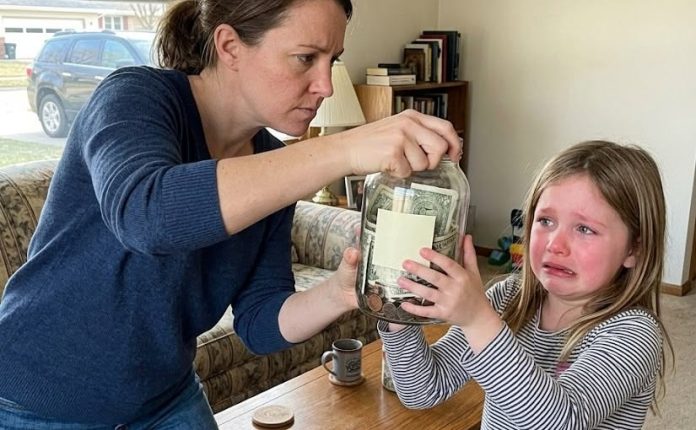
The metal corner was a key.
Mia pushed until a small brass key slid from beneath the notebook lining, followed by a white plastic tag with B-14 written in faded blue marker.
Her breathing had gone shallow, so I set the key on the carpet instead of picking it up and moved the notebook back toward her.
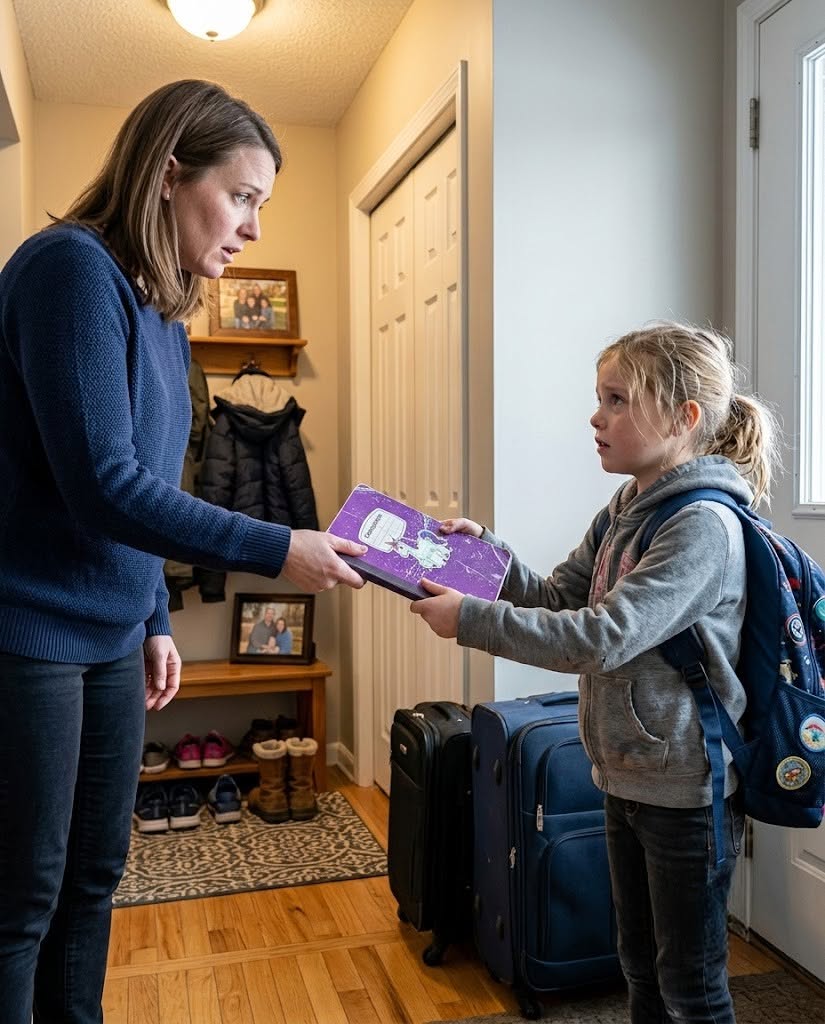
She tapped the drawing of the blue storage unit.
Once.
Then she tapped the key.
Agent Morris was still on the phone.
When I described the tag, she went quiet long enough for me to hear someone laughing in the hallway outside her office.
“Could be a cash box,” she said. “Could be nothing. Photograph it, but don’t start opening things that don’t belong to you.”
I took pictures from both sides.
For no good reason, I tried the key in the locked desk drawer beside my office.
It did not fit.
Mia watched me put it back on the carpet without smiling.
Before Agent Morris hung up, she asked whether Mia had ever used any way to communicate besides handwriting.
I told her I didn’t know.
That answer bothered me more than anything my parents had said.
Caleb and I had been close until the last year of his life, but I had let my mother turn every canceled visit into something reasonable.
Mia was tired.
Mia needed routine.
Mia had a hard week.
After Caleb died, I accepted the same excuses because arguing with my parents always turned into three days of phone calls from relatives asking why I was upsetting everyone.
I had stopped pushing.
That part belonged to me.
Mia picked up the purple notebook and wrote beneath the picture of the blue unit.
TABLET.
Then: DAD TALK BOX.
I stared at the words.
“Did Caleb give you a tablet?”
She nodded.
My throat was dry, and I could not remember the last time I had finished a glass of water, so I went to the kitchen and filled two cups.
Mia followed with the backpack still on her shoulders.
The room smelled faintly of the toast I had burned earlier.
I put one cup near her.
She did not drink.
Instead, she opened the backpack and removed a laminated card creased through the middle.
YES.
NO.
AGAIN.
STOP.
I DON’T KNOW.
Five boxes, each printed above a simple symbol.
The bottom corner had Caleb’s handwriting on it: Mia’s card — keep with her.
I photographed that too.
Sometime that afternoon, Agent Morris called again.
She had located the storage facility from the photograph Mia had drawn and from the partial logo visible behind the blue door.
She told me not to go there.
The unit was rented under my mother’s name, and whatever the key opened, she wanted the location preserved before anybody realized Mia had shown it to me.
“What are you looking for?” I asked.
“Right now? A reason someone described a child who can communicate as a child who can’t.”
That was all she would say.
I made grilled cheese because Mia had eaten almost nothing since breakfast.
She pulled the crust off hers, stacked the pieces into a little square, and finally took three bites. My parents called seven times before dinner. I let every call go to voicemail. The eighth came from my father alone. Mia saw his name and moved behind the kitchen counter. I answered in the hallway. Dad did not ask how she was. He asked whether I had signed the statement. “No.” He exhaled into the phone. Behind him, I could hear plates and silverware and the low engine vibration of the ship. “Your mother is trying to keep this family from being dragged through Caleb’s death again,” he said. “Why does a temporary custody statement mention investigators?” “You’re doing exactly what he used to do.” “What did Caleb do?” Dad paused. A woman somewhere near him asked whether a chair was taken. He said, “He made everything into a fight.” Then he lowered his voice. “Do not sign it.” I stopped walking. “What?” “Just don’t.” “Dad, what is in unit B-14?” The call ended. Mia was still behind the counter when I returned. I did not tell her what he had said. I put my phone facedown and cut her sandwich into smaller pieces. At 9:18 that night, Dad called from the ship’s Wi-Fi again. This time he whispered. He told me Caleb had bought Mia a speech-generating tablet when she was little and had worked with her school to build a communication system around it. Mia did not speak, he said, but she answered questions. She answered dates. She answered names. She could correct adults when they misunderstood her. After the fire, my mother had taken the tablet because Mia kept using it to repeat the same sequence of events. “What sequence?” I asked. Dad did not answer. Instead he said, “Your mother thought stopping it would help her move on.” “That isn’t helping.” “You weren’t there.” “No. You made sure I wasn’t.” He breathed through his nose. For a few seconds, neither of us said anything. Then he told me the blue storage unit contained some of Caleb’s things and some of Mia’s school materials. He said my mother had put them there after the funeral. “Why?” “She said Mia needed a clean start.” I looked toward the kitchen. Mia was standing on a chair reaching into the cabinet for a cereal bowl, still wearing the backpack. Dad said my name. I waited. “Don’t let her sign anything either.” He hung up before I could ask what that meant. For the first time since my parents had boarded their cruise, I thought my father might actually help us. The next morning, he took it back. A text arrived before sunrise. Forget what I said. Your mother is right. Mia gets confused. Do not make this worse. I read it twice while sitting on the edge of my bed with one foot still numb from sleeping badly. Then I forwarded the screenshots to Agent Morris. She called ten minutes later. “Keep the original messages,” she said. “And keep your doors locked.” My mother’s counterattack looked nothing like anger. At eleven, groceries arrived. Mia’s favorite cereal. Apple juice. A box of the crackers my mother used to keep at her house. The delivery note said: We love you both. Everybody is tired. Let’s reset Sunday. Mia carried the cereal box to the trash without opening it. I stopped her before she dropped it in. “You don’t have to eat it.” She looked at me. I set it on top of the refrigerator instead. The gesture accomplished nothing, but it gave my hands somewhere to go. Around lunchtime, Agent Morris called to say the storage facility had been ordered to preserve unit B-14 while investigators sought access through the existing case. She did not promise they would get inside that day. She did not promise the unit would contain anything useful. What she did tell me was enough. Two years earlier, investigators had tried to interview Mia after the warehouse fire. My parents had repeatedly described her as incapable of giving a reliable account. They had supplied school paperwork showing her as nonverbal. No one had been told that nonverbal did not mean unable to communicate. No one had been given her tablet. My mother had treated those two statements as though they meant the same thing. By midafternoon, Mia was sitting at my dining table copying dates from her notebook onto blank index cards. I asked whether she wanted me to stop Agent Morris from calling for the rest of the day. She wrote YES. I sent the message. For almost an hour, nothing happened. I washed two coffee mugs that were already clean and left them upside down on a dish towel. Mia watched an old baking show with the volume barely audible. Then someone tried my front door. Not knocked. Tried the lock. The deadbolt turned halfway and stopped because I had put the chain on. My mother said my name from the other side. Mia disappeared beneath the dining table. My parents were supposed to return Sunday. It was Saturday evening. Apparently they had left the cruise at its first port and flown home. Mom still had the key I had asked her to return years ago. “I know you’re upset,” she called through the door. “Open this so Mia can see we’re not fighting.” Dad stood behind her carrying only a small overnight bag. I could see him through the narrow front window. “Leave.” “We came home for her.” “No.” My mother’s voice softened. “You’re scaring a child who already has difficulty knowing what’s real.” Under the table, Mia pressed both palms against her ears. Mom continued talking through the door as though she were explaining something to a nurse. She said Mia fixated on drawings. She said Caleb had encouraged unhealthy habits. She said the notebook should have been taken away months ago. Dad stared at the porch boards. Then Mom said, “She was born this way. She cannot tell anybody what happened in that building.” Dad looked up. “Stop.” My mother turned toward him. He said it again. “Stop.” It was not an apology. It was not enough. But he walked back toward their car instead of standing beside her. My mother stayed on the porch for another minute, telling me I was making a temporary situation permanent. I kept the door closed. After they left, I called a locksmith. He arrived sometime after dark carrying a plastic organizer full of screws and three paper cups of coffee balanced in one hand. The house had gone cold because I had forgotten the back window was cracked open. While he replaced the front cylinder, Mia sat on the stairs with the purple notebook against her chest. I kept the old lock. Not as evidence. I just could not stand the thought of my mother’s key fitting anything in my house anymore. Sunday morning brought the first real break in the case. Investigators had received authorization to enter B-14. Agent Morris did not let me come. She sent one photograph afterward because she wanted me to identify something before anyone touched it unnecessarily. The photograph showed a blue plastic tablet case on a shelf between two cardboard boxes. I recognized the unicorn sticker on it. It matched the one on Mia’s notebook, except the horn was still intact. Below it sat binders from Mia’s old school, a packet of picture cards, noise-reducing headphones, and folders labeled with Caleb’s handwriting. No secret fortune. No dramatic confession. They had stored away the tools Mia used to answer people. The records showed she had used structured communication for years before Caleb died. Teachers had documented that she could identify people, sequence events, use calendars, correct yes-or-no questions, and request breaks when overwhelmed. After my parents became her caregivers, those supports stopped appearing in her active school file. Agent Morris was careful with her words. “It doesn’t tell me what Mia saw,” she said. “It tells me somebody knew she had a way to tell us.” That afternoon, my father called again. This time my mother was not with him. He said he wanted to speak to Agent Morris. I gave him her number instead of staying on the line. Twenty-three minutes later, she called me back. Dad had admitted he reached the warehouse before the first fire crew. He had found Mia hiding under a desk in the office while Caleb was already on the floor. He carried Mia outside. Then, instead of telling investigators exactly when he had arrived and what he had seen, he let my mother insist they had come only after receiving the emergency call. He had spent two years repeating that version. Mia had spent two years drawing the version she remembered. According to Dad, my mother’s first concern after the fire was that investigators would blame him for the delay between reaching the building and giving a complete account of what he saw. Whether that delay changed Caleb’s outcome was something investigators still had to establish. Dad could not establish it. Neither could I. He did admit one other thing. My mother had removed Mia’s tablet after Mia used it to answer an investigator’s question about who had been at the warehouse door. Dad had watched her pack the tablet and school binders into a box. He had helped carry the box to B-14. For a while after that call, the story seemed finished enough. My parents had hidden Mia’s communication system. Dad had finally admitted his part. The storage unit existed. The notebook matched records investigators could independently verify. Mia had a child-advocacy interview scheduled with communication support, and the county had put a temporary safety plan in place until a court could review where she should stay. I told myself that was the answer. That evening, Mia ate apple slices at the kitchen counter while I folded the custody statement into thirds and put it beside my phone. She left one slice untouched because it had a brown spot. Nothing happened for several minutes. Then Agent Morris called and asked me to read the statement to her again. Not the whole thing. Just the paragraph above the signature line. I read it slowly. The paragraph did more than authorize me to care for Mia. By signing, I would have affirmed that, to the best of my personal knowledge, Mia had been born without functional speech, had never demonstrated a reliable ability to report dates or sequences, and routinely became distressed when questioned about past events. I stopped halfway through the last sentence. Agent Morris asked, “How long have you personally been responsible for her day-to-day care?” “Three days.” “And how could you personally certify what she could do before Caleb died?” I looked at Mia. She was using a fingernail to scrape the brown spot from the apple slice. The cruise had never been the important part of that paper. Leaving Mia with me had created the opportunity. My parents needed someone outside their household to sign the same story they had already been telling investigators for two years. My signature would not have made the story true, and it would not have ended an investigation by itself. It would have given them one more adult who could be pointed to later and described as independent confirmation. That explained why my mother had handed me the statement before telling me where Mia’s clothes were. It explained why Dad kept asking whether I had signed. It explained why the language sounded less like temporary caregiving and more like testimony about a child I had barely been allowed to see. I photographed every page again and gave the original to Agent Morris when she came by Monday morning. She did not tell me anyone would be arrested. She did not tell me the warehouse investigation had been solved. She said Mia’s interview, the restored communication records, the storage contents, my father’s statement, and the document would now be evaluated together. That was the process available. I could live with process. What I would not do again was make things easier by pretending I had not seen them. At the temporary hearing later that week, the judge kept the safety arrangement in place while the adults’ conduct and Mia’s needs were reviewed. My parents were not erased from her life in one afternoon. They were given rules. No unannounced visits. No removing communication devices. No asking Mia to change or withdraw anything she had already provided to investigators. Contact had to follow the temporary plan until the next hearing. My father followed it. My mother tested it twice and learned that the answer stayed the same. At home, the changes were smaller. Mia stopped carrying her backpack to the bathroom after a couple of weeks. She still slept in her shoes some nights. She kept the purple notebook beside her bed, but she no longer hid the metal key inside it. A replacement communication tablet sat on the kitchen charger where anyone could see it. Sometimes she typed full sentences. Sometimes she pushed it away and used the laminated card. Sometimes she answered nothing at all. Nobody filled the silence for her. The locksmith had given me two new house keys after changing the lock. I kept one. A few days after the hearing, I put the other on the kitchen table beside Mia’s backpack and asked where she wanted me to keep it. She picked it up, opened the small inside pocket of her backpack, and clipped it to the ring herself. The spare key belongs to Mia now.