I told the coordinator to stop serving my mother’s tables and start packing every piece of equipment that belonged to my company.
Then I asked her to feed my children.
Not afterward. Now.
Image
The coordinator, Nina, looked from my phone to the head table and nodded, although she seemed to think I meant the party could wind down normally after cake.
That mistake gave my mother another minute with the microphone.
Helen tapped it twice while my warming trays were already being unplugged.
“Apparently Thomas thinks asking children to help is humiliation,” she said. “I hope nobody lets this spoil a beautiful family day.”
I didn’t answer.
Rebecca ate half a hamburger standing beside me because every chair near us was occupied, and Samuel drank water so quickly I took the cup away long enough to make him slow down.
Jacob wanted frosting.
I got him frosting.
Across the garden, Robert told Nina she had no authority to remove anything before the party ended.
She pointed toward me.
“The reservation holder does.”
My father stopped talking to her and came to me instead.
“You’re really going to punish your mother on her seventieth birthday over three aprons?”
I picked up Rebecca’s paper plate before answering.
“I’m taking my kids home.”
The white apron she’d been wearing had been tossed into one of our laundry tubs with the staff linens, and I watched the tub go onto the catering truck without asking anyone to separate it.
By the time the children were buckled into my car, people were carrying their own plates to trash cans and my mother’s cake was sitting untouched under the canopy.
My phone kept vibrating in the cup holder.
I ignored it.
Before I drove out, I opened the school portal and removed Robert and Helen from the authorized pickup list for all three children.
At home, nobody wanted the dinner I made.
I hadn’t eaten either, but the smell of reheated chicken turned my stomach, so I wrapped four plates and put them in the refrigerator.
Jacob sat on the kitchen floor pulling the paper sleeve off a drinking straw he’d brought home from the party.
Rebecca went upstairs.
Samuel followed her.
Only after they were out of the room did I look at my phone.
The family group had filled with messages.
My mother had written that I had destroyed her birthday because I couldn’t tolerate my children being treated like everyone else.
Robert wrote, “Thomas is teaching them that work is beneath them. Remember that before you take his side.”
An aunt said the kids had looked fine when she saw them.
Someone else said children helped at family parties all the time.
For several minutes, I typed replies and erased them.
Then I wrote one message.
I said I’d asked my mother to bring the children because I trusted her, and I had ignored years of comments about my family because keeping peace was easier than setting limits.
That part was mine.
I also said Rebecca, Samuel, and Jacob had not eaten while adults ate around them, and they would not be left alone with Robert or Helen again for the foreseeable future.
I didn’t mention the catering equipment.
Everybody already knew what happened to that.
My phone went quiet for maybe two minutes.
Then one of the teenage cousins who had been filming Jacob sent a video into the group.
His name was Mason.
I recognized the angle immediately because I’d seen him holding his phone near the table when I arrived.
The clip wasn’t dramatic.
That made it worse.
Jacob wiped a table while people talked behind him, and when one of my catering employees reached for the rag, Helen stepped between them and said, “No, let him finish. His father does too much for them already.”
Mason had filmed another thirty seconds after that.
Rebecca asked if the boys could eat.
My mother told her, “Helpers eat afterward. You know that.”
Nobody in the video objected.
Mason added one sentence under it.
“Grandma told me to delete this.”
My father called me before I finished watching.
I let it ring.
He called again.
I answered the second time because Rebecca had come halfway down the stairs and was watching my face.
“You got what you wanted,” Robert said. “Everyone thinks we’re monsters now.”
“I didn’t post the video.”
“You started this.”
Behind him, I could hear my mother asking somebody whether they had taken the leftover potato salad home.
Robert lowered his voice.
“Your mother has helped you with those kids for years. Pickups, afternoons, all of it. You want to throw that away because she expected them to lift a finger?”
There it was.
Not the party anymore.
Access.
For years, my parents had been the easiest answer when a catering delivery ran late or one child’s schedule collided with another’s.
I had told myself the comments were about me, so I could absorb them.
I had never asked what the children were absorbing when I wasn’t there.
“Don’t pick them up again,” I said.
My father made a short sound through his nose.
“We’ll see how long that lasts when you’re working.”
He hung up.
I opened the school portal again.
Beside both of my parents’ names was one word I hadn’t noticed in the parking lot: pending.
The change required office review.
For the moment, their access was still active.
I called the school number.
Voicemail.
I called again even though I knew the office had closed before the party ended.
Same voicemail.
The next morning, I drove over before the building opened anyway.
The doors were locked.
A delivery driver was eating something from a foil wrapper in the parking lot, and a sprinkler kept hitting the same metal sign every few seconds.
I sat there with cold coffee between my knees, feeling stupid for making a trip that could accomplish nothing.
Then I went home.
Once the office opened, I submitted the change directly and sent the same instruction in writing.
No grandparents on the pickup list.
No exception because I was running late.
No exception because a catering truck broke down.
That cost me immediately.
Rebecca’s mother had covered pickups before, but not on my busiest afternoons, and Samuel’s mother lived far enough away that asking her regularly would have turned her week upside down.
When I told them what had happened, I didn’t soften it.
Rebecca’s mother was quiet for a while.
Then she asked, “You knew your parents talked about our families like that?”
I rubbed the heel of my hand against my forehead.
“I knew what they said to me.”
“That’s not what I asked.”
I had no good answer.
She told me not to put Helen back on Rebecca’s pickup list, even if work became difficult.
“Figure work out,” she said.
I said I would.
By that afternoon, the school record had changed.
The first thing I gained at the party was control of my own equipment.
The first thing I lost afterward was the convenient version of my life that had made my parents useful enough to tolerate.
My mother understood that before I did.
She called while I was moving two catering jobs to different days.
“I’m worried you’re making permanent decisions while you’re angry,” she said. “You have three children and a business. You need help.”
I moved one delivery to Thursday.
“I do.”
She waited.
“So don’t punish the children by taking away their grandparents.”
I wrote a new pickup time on a yellow pad.
“They aren’t being punished.”
“Thomas, please. I’m your mother. I’m trying to make this easier.”
That was the language she always used when she wanted the old arrangement back.
Easier.
I had paid bills because it was easier than asking how Robert and Helen had gotten short again.
I had accepted last-minute criticism because it was easier than leaving a holiday dinner.
I had let them handle pickups because it was easier than rebuilding my workday around three children.
The party hadn’t created that arrangement.
It had made the children pay for it.
A few hours later, I went through the recurring expenses I covered for my parents.
I didn’t cancel my father’s prescription help without warning.
I sent them a message saying I would cover the pharmacy difference through the end of the current month, directly with the pharmacy, while the car insurance, utility top-ups, repairs, and miscellaneous transfers from me ended now.
My mother called within a minute.
I didn’t answer.
Robert texted, “So this was about money after all.”
I left the message where it was.
For the first time, the thing changing hands wasn’t an argument.
It was something measurable.
They would control their bills.
I would control my money.
And neither arrangement bought access to my children.
That evening, Uncle Darren called.
He had been one of the men telling Samuel not to drop the tray.
“I thought they were helping for ten minutes,” he said. “I should’ve asked.”
I waited.
“Your dad told us you’d asked the kids to pitch in because your staff was short.”
I hadn’t.
Darren knew that now, but hearing why he’d stood there and watched still landed harder than I expected.
Robert hadn’t needed everyone to be cruel.
He only needed them to believe there was a reasonable explanation.
Darren asked whether he should call my father.
“Do what you want,” I said. “Don’t do it for me.”
He didn’t push.
Before hanging up, he asked if Samuel liked baseball because he had an extra glove in his garage.
I almost laughed at how far the question was from everything else.
“He likes soccer.”
“Right. Okay.”
That was all.
For most of the next week, the practical problems were worse than the family ones.
I shortened two workdays, turned down a late delivery, and paid more for childcare than I had planned to spend that month.
None of it ruined me.
It was inconvenient.
That mattered because inconvenience was exactly what I’d spent years avoiding.
The family group became quieter too.
A few relatives defended my parents.
A few stopped responding to them.
Mason removed the video after everyone who mattered had seen it, and I never asked him to send it anywhere else.
I didn’t need strangers voting on my family.
At the end of that week, the catering equipment was back where it belonged, the school pickup list was corrected, and my parents had stopped calling every few hours.
For the first time since the birthday, dinner felt ordinary.
Samuel complained about peas.
Jacob dropped a fork.
Rebecca ate before anybody asked her to clear a plate.
I thought that might be enough.
Maybe distance would cool everybody down.
Maybe my parents would send some clumsy apology, we’d argue about the wording, and eventually I could allow supervised visits while keeping the new boundaries intact.
It wasn’t reconciliation.
It was a plan I could live with.
Saturday morning, I washed the catering linens because one of my employees had called in sick and I was already behind.
The dryer made a clicking noise it had been making for months.
When I pulled everything out, one of the white aprons from the birthday was twisted inside a tablecloth.
I set it on top of the machine.
Rebecca was sitting at the kitchen counter doing math homework when I carried the clean towels past her.
She saw the apron.
Her pencil stopped.
“Are you keeping that?” she asked.
“No reason to.”
She looked back at the worksheet.
I put the towels down.
“Becca.”
“I’m fine.”
I waited beside the counter.
After a while she asked whether Grandma was still mad at me.
“Probably.”
“Because I told you?”
“You didn’t tell me. I saw you.”
She erased something that didn’t need erasing.
“I was supposed to keep the boys from complaining.”
My mouth went dry.
“Who said that?”
“Grandma.”
Rebecca kept her eyes on the paper.
“She said you already had enough problems because everybody leaves, and I was old enough to make things easier for you.”
I didn’t speak.
She had been ten years old, hungry, wearing an apron at an adult birthday party, and she had believed her job was not merely to carry plates.
Her job was to keep her brothers quiet so their father wouldn’t cause trouble and lose more family.
That explained why she hadn’t looked at me when I arrived.
It explained why her hand tightened around mine when Robert said children needed to learn their place.
She hadn’t been embarrassed that I found her serving tables.
She had thought she’d failed at preventing what happened next.
Rebecca finally looked up.
“I told Samuel not to tell you Grandma wouldn’t let us eat yet.”
I pulled out the chair beside her and sat down.
My legs were stiff from standing in the catering kitchen all morning.
“You never have to protect me from adults,” I said.
She nodded, but too quickly.
I didn’t ask her to promise anything.
Instead, I called each child’s mother that afternoon and told them what Rebecca had said.
Then I sent one message to Robert and Helen.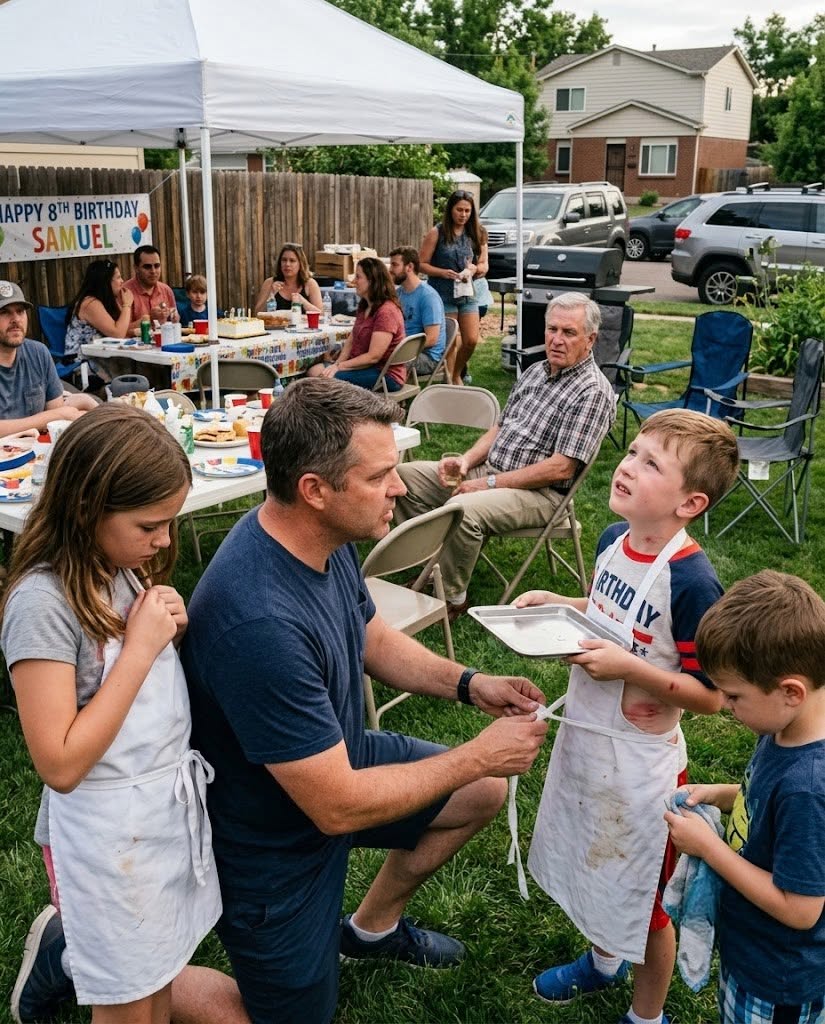 There would be no unsupervised time with the children.
If contact resumed, it would start with them acknowledging directly to Rebecca, Samuel, and Jacob that making them serve adults while withholding their meal was wrong.
No explanation about humility.
No discussion about my relationships.
No using the children to teach me a lesson.
My mother replied first.
“I will not apologize for teaching children to contribute.”
Robert added, “You are turning them against their own family.”
I read both messages once.
Then I muted the thread.
The prescription assistance ended on the date I’d given them.
The other payments stayed ended.
I didn’t send a bill for the birthday or charge my mother for the food that had already been served before I shut the event down.
I also didn’t restore the old arrangement just because not restoring it cost me time and money.
Some relatives still think I overreacted.
Darren doesn’t.
Mason barely speaks to me, which is probably normal for a teenager who wishes every adult would stop discussing the worst video he ever made.
My parents have seen the children twice since then, both times with me present, and neither visit lasted very long.
Helen brought snacks the first time.
She handed them directly to the kids before sitting down.
She still hasn’t given them the apology I asked for.
So the boundary hasn’t changed.
Rebecca doesn’t handle pickups or schedules or her brothers’ moods for me.
Samuel still loses things five minutes after putting them down.
Jacob still asks whether dessert counts as dinner.
My work calendar is harder now.
It is also mine.
A few weeks after the party, Rebecca came into the catering kitchen while I was frosting cupcakes for a small order.
The white apron had survived because I’d never gotten around to throwing it out.
She picked it up and asked if she could help.
I told her she could decorate six cupcakes after she finished her sandwich.
She ate the sandwich.
Then she tied the apron herself, left the strings loose, and asked Samuel whether he wanted chocolate or vanilla.
There would be no unsupervised time with the children.
If contact resumed, it would start with them acknowledging directly to Rebecca, Samuel, and Jacob that making them serve adults while withholding their meal was wrong.
No explanation about humility.
No discussion about my relationships.
No using the children to teach me a lesson.
My mother replied first.
“I will not apologize for teaching children to contribute.”
Robert added, “You are turning them against their own family.”
I read both messages once.
Then I muted the thread.
The prescription assistance ended on the date I’d given them.
The other payments stayed ended.
I didn’t send a bill for the birthday or charge my mother for the food that had already been served before I shut the event down.
I also didn’t restore the old arrangement just because not restoring it cost me time and money.
Some relatives still think I overreacted.
Darren doesn’t.
Mason barely speaks to me, which is probably normal for a teenager who wishes every adult would stop discussing the worst video he ever made.
My parents have seen the children twice since then, both times with me present, and neither visit lasted very long.
Helen brought snacks the first time.
She handed them directly to the kids before sitting down.
She still hasn’t given them the apology I asked for.
So the boundary hasn’t changed.
Rebecca doesn’t handle pickups or schedules or her brothers’ moods for me.
Samuel still loses things five minutes after putting them down.
Jacob still asks whether dessert counts as dinner.
My work calendar is harder now.
It is also mine.
A few weeks after the party, Rebecca came into the catering kitchen while I was frosting cupcakes for a small order.
The white apron had survived because I’d never gotten around to throwing it out.
She picked it up and asked if she could help.
I told her she could decorate six cupcakes after she finished her sandwich.
She ate the sandwich.
Then she tied the apron herself, left the strings loose, and asked Samuel whether he wanted chocolate or vanilla.