I did not ask Noah to explain what he meant.
I reached for the phone and told Carla to call emergency services, give them the address Noah had just repeated, and tell them to check the garage behind the property.
Mark heard the word garage from the hall.
He stepped back toward the exam room.
“His mother goes there sometimes,” he said. “After Mia. She gets overwhelmed and wants to be alone. You’re turning grief into something ugly.”
Noah pulled the paper cup against his chest with both hands.
I asked Mark whether Noah’s mother was at that address now.
“I don’t know.”
It came too quickly.
Before I could ask another question, Mark tried a different version.
“She asked me to leave her there for a little while. Noah probably heard us talking about it. That’s all this is.”
I called the number listed for Noah’s mother in his chart.
Voicemail.
The call accomplished nothing, and I never tried it again.
By then my stomach had started to hurt from not eating, but I opened the hospital’s suspected-abuse form and entered the fracture findings, the struggle in the hallway, the torn film, Noah’s words, and the address.
I should have opened that form earlier.
When Mark refused to leave the room the first time, I had tried to keep the situation quiet because I thought quiet would keep Noah calmer.
That delay had given Mark enough time to grab him, tear the film, and get halfway to the elevator.
I put my name on the report.
Then I entered Mark’s name as the adult who had tried to remove Noah before the examination was complete.
Mark stood outside the doorway and asked whether anyone had remembered to give Noah his jacket.
Noah didn’t answer.
Somewhere down the corridor, a printer kept feeding out pages even after nobody was standing beside it.
For a few minutes, nothing came back from the address.
I loosened the brace again, checked Noah’s toes, and replaced the padding Mark had shifted when he pulled him from the table.
The brace was not something I would have put on a child with that fracture.
It looked like an off-the-shelf support that had been tightened, loosened, and tightened again over several days.
Blue tape held one strap where the Velcro no longer caught.
Noah watched my hands.
“Is Mom going to be mad?” he asked.
“About what?”
He shrugged.
That was all he would say.
The first update from the address sounded almost like an answer Mark could use.
The main house was boarded, the yard was empty, and nobody had responded when emergency crews called out from the front of the property.
Mark heard Carla repeat that information at the desk.
He rubbed both palms down the front of his jeans and looked at me.
“See?” he said. “He’s six. He remembers a fire from when he was three. You’re scaring him over something that isn’t happening.”
For several seconds, I hated that his explanation fit one part of what we knew.
A frightened child could combine memories.
A grieving mother could visit an old property.
A fracture could be older than the story a parent gave without every other terrible possibility being true.
Then Noah tapped the side of his cup.
“Back,” he said.
I leaned closer.
“Back where?”
“The metal door.”
Mark stopped rubbing his hands.
Carla looked toward me, and I told her to get the same emergency dispatcher back on the line and ask whether anyone had checked a detached structure behind the burned house.
Earlier, Carla had said the healing might be from an older injury unrelated to Mark’s story.
That mistake had cost us time, and nothing later erased it.
Now she made the call without offering another theory.
While we waited, Noah pushed the plastic dinosaur off the exam table by accident.
It landed on its back.
He bent as if he meant to pick it up, winced when his leg moved, and left it on the floor.
A little while later, the answer came.
They had found his mother.
She was inside the detached garage.
Alive.
She was weak, bruised, and without her phone, but she was conscious and able to speak.
The garage door had jammed badly enough that she had not been able to force it open from the inside.
Mark shut his eyes for a second.
Then he said, “Thank God.”
His relief sounded convincing.
That mattered more than I wanted it to.
“She goes there when things get too loud,” he told me. “I dropped her off because she asked me to. The latch sticks. I’ve been telling her that place isn’t safe.”
He looked toward Noah.
“Buddy, Mom’s okay. That’s what matters, right?”
Noah pulled his free foot farther beneath the paper sheet.
By the time his mother reached our hospital, it was sometime later that afternoon, and I had eaten half a packet of crackers standing beside a sink.
She arrived in a wheelchair with dust along one sleeve and a strip of dried blood near her hairline.
Her first concern was not the garage.
“Did he eat?” she asked.
I told her Noah had refused crackers but had taken water.
She nodded twice.
Then she asked whether somebody could find him apple juice.
I asked what had happened at the old house.
She folded the corner of the blanket across her knees.
“The door sticks.”
Mark, still in the hall, exhaled loudly enough for me to hear him.
I asked whether she had gone there voluntarily.
She looked at the blanket.
“I went there.”
It was not the answer I expected after Noah had risked everything to give us that address.
Mark asked if he could come into her room.
“She’ll calm down if she sees me,” he said. “She’s had people questioning her for an hour. She doesn’t need more pressure.”
His concern had a shape now.
Every version of it ended with him inside the room.
For the moment, I kept Noah where he was and asked registration to confirm exactly what authority Mark had in his medical record.
The answer was narrower than Mark had implied.
He was listed as an emergency contact and as an adult permitted to bring Noah for routine care.
Mark pointed at the screen anyway.
“I’m his parent in every way that counts.”
Noah’s mother heard him from the next room.
She said nothing.
Because an abuse report was already active and Noah still required treatment, I did not clear him for discharge while the safety questions remained unresolved.
That did not settle who Mark was to the family.
It settled one thing only.
He could not pull Noah out of my exam room again because he wanted the conversation to end.
The threat had changed.
We were no longer trying to locate Noah’s mother.
We were trying to learn whether she and Noah could speak without Mark controlling who entered, who answered, and who left.
Mark asked for water.
When Carla brought him a paper cup, he thanked her and reminded her that Noah hated hospitals.
“He doesn’t sleep after doctors get him worked up,” he said.
Carla stared at the cup in his hand, then walked away.
Noah’s mother eventually asked to see her son.
I told her she could, but Mark would not be in the room during the first conversation.
She pressed her lips together.
“He’ll take that personally.”
I waited.
She pulled the blanket higher over her knees.
“Okay.”
Mark learned about the restriction within minutes.
He did not shout.
He stood beside the nurses’ station and asked whether humiliating a man in front of his family was now part of pediatric care.
Then he asked if I had children.
I did not answer.
When Noah’s mother entered his room, he looked at the mark near her hairline and immediately asked about something else.
“Did you see the red bike?”
She blinked.
“What red bike?”
“Outside.”
“No.”
Neither of them mentioned the garage.
She touched his sock instead.
“This one’s inside out.”
It wasn’t.
Noah looked down at it anyway.
For almost a minute, they talked about juice, his sock, and whether the dinosaur on the floor belonged to the hospital.
Then Noah asked, “Can I tell the garage part?”
His mother stopped folding the blanket.
From the hallway, Mark called her name once.
She looked toward the closed door.
Then she looked back at Noah.
“Tell the doctor everything you remember.”
Mark called her name again.
She did not answer him.
Noah told me the fracture had not happened beside a bunk bed.
About two weeks earlier, his mother had been in the old garage after an argument with Mark.
Noah had heard her calling through the door and tried to reach her.
He got as far as the concrete step beside the garage before Mark caught him.
“He pulled me,” Noah said.
I asked what happened next.
Noah rubbed the blue tape with one thumbnail.
“I fell wrong.”
His mother covered her mouth, but she did not interrupt.
She had been inside the garage and had not seen the fall.
Afterward, Mark told her Noah had tripped while running across the yard.
Mark brought the brace home and said the leg was only sprained.
When Noah continued to limp, Mark kept explaining why an emergency room would frighten him, why swelling took time, and why everyone needed to stop making the child more anxious.
His mother had believed enough of it to wait.
That was her mistake.
She said it without dressing it up.
“I let him tell me it could wait.”
Noah reached for her hand.
She let him take it.
Outside the room, Mark had begun telling the charge desk that his wife had suffered panic attacks since Mia’s death and that strangers were encouraging her to reinterpret ordinary family arguments as abuse.
He did not know Noah had started talking.
When he asked again to enter, Noah’s mother said no.
One word.
“No.”
Mark stopped talking for a few seconds.
Then he asked her whether she had taken her medication that morning.
She did not answer that either.
The hospital contact permissions still created one problem.
Mark remained listed to receive routine updates about Noah, and a staff member who had not been in our earlier conversations nearly gave him information about the next imaging check before Carla stopped the exchange.
For a brief stretch, he had regained part of the access we had just taken away.
Noah’s mother asked for the form herself.
Her hands were cold enough that the pen slipped once.
She crossed Mark out as the person permitted to receive information and wrote that all updates were to go through her while the safety review was pending.
Mark watched through the glass panel in the door.
She signed her name.
He walked away before she finished the date.
A little later, his voice came through her phone from a message she had not answered.
“Please don’t let people who don’t know us turn one bad day into the end of your family. Noah needs his bed. You need rest. We can talk at home.”
She listened twice.
Then she put the phone facedown.
Nobody said what he meant by home.
We returned to Noah’s leg.
The old brace came off completely, and I replaced it with proper immobilization after checking the fracture and circulation again.
Without the tight strap, the color in his toes improved.
He complained that his heel itched.
It was the most ordinary thing he had said all day.
By evening, the pieces appeared to fit well enough that everyone in the room started acting as though the worst part had passed.
Noah’s mother had been found.
She had refused Mark access to the room.
Noah had given a direct account of how his leg was injured.
The medical report and safety report were documented, and Mark no longer had permission to receive Noah’s updates through the hospital record.
He eventually left the floor after being told he could not visit either patient without their consent while the hospital’s restrictions remained in place.
No one arrested him in front of us.
No judge appeared.
Nothing ended that neatly.
But the elevator doors closed with Mark on the other side of them.
For the first time since Noah had grabbed my leg, he was not within hearing distance.
I washed my hands longer than I needed to.
Then I ate the other half of the crackers Carla had left near the computer and tried to remember whether I had eaten anything before that all day.
When I went back into Noah’s room, his mother was sitting beside him with the plastic dinosaur balanced on her knee.
Noah had finally eaten two crackers.
He held the third one without biting it.
For a few minutes, nothing happened.
Then he looked at his mother and asked, “Did I do the address right?”
She went still.
“Yes.”
“All of it?”
“All of it.”
I thought he meant that he had remembered the house from the fire.
He had been three when Mia died, so I had spent the entire afternoon assuming his memory of the street was an unusually sharp piece of childhood trauma.
His mother looked at me.
“He didn’t remember it from the fire.”
Noah stopped turning the cracker between his fingers.
She had taught him the address.
Not that morning.
Earlier.
After the first time Mark had taken her to the old property during an argument and left her at the garage until he believed she had calmed down, she realized Noah needed a way to tell another adult where she might be if it happened again.
She made him memorize the street number.
She made him memorize the words about the garage because the house itself was gone, and she was afraid an adult would hear the address, see a burned property, and assume a frightened child was confused.
“The garage didn’t burn” was not something Noah had blurted out from a three-year-old memory.
It was part of the sentence his mother had taught him.
So was the part I had almost misunderstood most.
Don’t save me first.
She had told him that if he was ever hurt and reached a doctor, teacher, neighbor, or anyone safe before she did, he was not to run back for her or try to open the garage himself.
He was supposed to stay where adults could see him and give them the address.
Two weeks earlier, he had ignored that rule and gone to the garage.
That was when his leg was broken.
This time he followed it.
Noah looked at his mother.
“I stayed.”
She nodded.
“You stayed.”
Nothing else needed to be said in that room.
The address had never been proof that Noah remembered more about Mia’s death than anyone realized.
It was proof that his mother had understood the danger before the rest of us did and had built the smallest safety plan she could manage around a six-year-old who might someday have to use it.
She had not managed to leave before that day.
She had not protected Noah from everything.
She had believed Mark when she should not have believed him, and Noah had spent nearly two weeks walking on a fracture because of it.
But she had given him one instruction Mark did not know about.
Noah used it exactly once.
It got us to her.
Before discharge planning began, his mother asked for copies of every page she was permitted to receive, including the imaging report and the documentation from the afternoon.
She did not ask me what would happen to Mark.
She asked where Noah needed to return for his fracture check and whether the appointment could be made without Mark receiving the reminder.
We changed the contact information according to her request.
The safety report moved forward through the ordinary process, and I never promised her an outcome I could not control.
What I could control was smaller.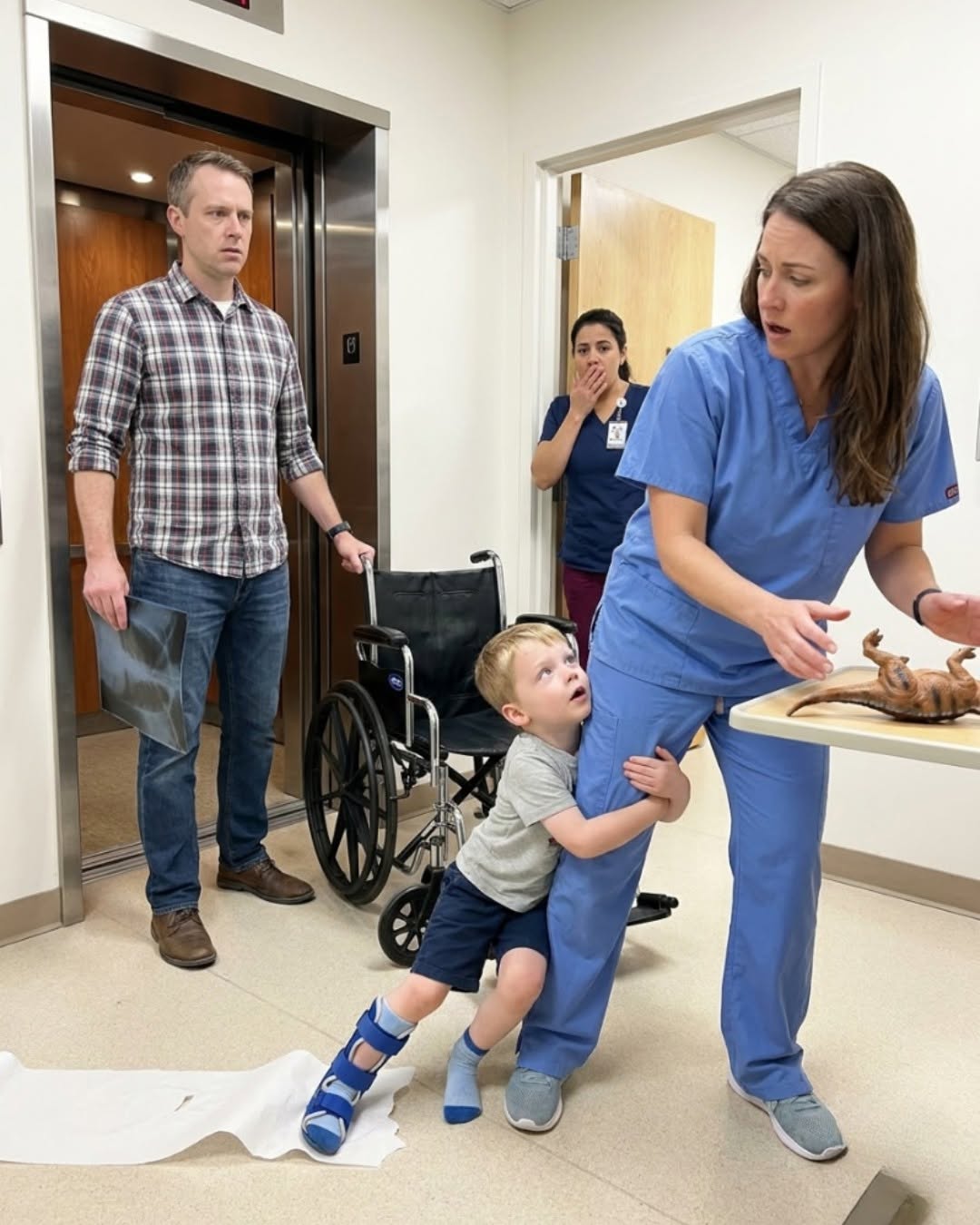 Noah would not leave with an untreated fracture.
Mark would not receive information from my department without permission.
The record would say what Noah had told us, not what Mark had tried to make him repeat.
A few weeks later, Noah came back for follow-up with his mother.
Mark was not with them.
I did not ask for details about where they were staying, and she did not volunteer them.
She looked tired and had forgotten to remove the visitor sticker from her shirt after checking in.
Noah’s leg was healing.
He talked more than he had during the first visit, mostly about a class project involving beans in a paper cup and whether the roots were supposed to look hairy.
When the new image went up, he stared at it for several seconds.
Then he looked at me.
“Can somebody rip that one?”
“No,” I said.
His mother asked for a copy.
Radiology printed one before they left.
The first film had been in Mark’s hands when he tore it.
This time, Noah’s mother carried the film out herself.
Noah would not leave with an untreated fracture.
Mark would not receive information from my department without permission.
The record would say what Noah had told us, not what Mark had tried to make him repeat.
A few weeks later, Noah came back for follow-up with his mother.
Mark was not with them.
I did not ask for details about where they were staying, and she did not volunteer them.
She looked tired and had forgotten to remove the visitor sticker from her shirt after checking in.
Noah’s leg was healing.
He talked more than he had during the first visit, mostly about a class project involving beans in a paper cup and whether the roots were supposed to look hairy.
When the new image went up, he stared at it for several seconds.
Then he looked at me.
“Can somebody rip that one?”
“No,” I said.
His mother asked for a copy.
Radiology printed one before they left.
The first film had been in Mark’s hands when he tore it.
This time, Noah’s mother carried the film out herself.