The recording came from a call Rachel had made to the park’s guest-services line shortly after noon. She thought she had hung up. She hadn’t, and the system kept recording while her phone sat nearby.
For the next few seconds, nobody moved.
Then my mother’s voice came through the speaker.
“Just leave her there for a few minutes. Maya needs to understand that we’re not her free babysitters.”
My father said something too low to catch.
Rachel laughed.
“She’ll be fine. The car’s in the shade.”
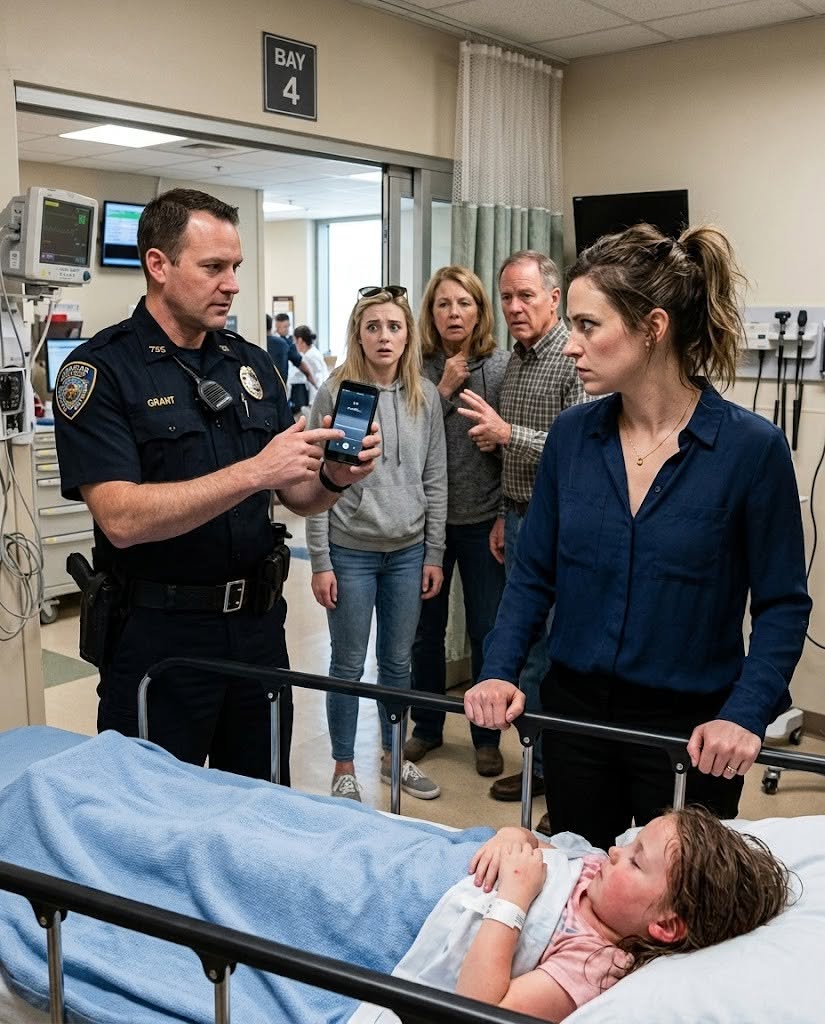
Officer Grant stopped the audio.
“The vehicle was not in the shade when Ellie was found,” he said.
My father rubbed both hands over his face. My mother immediately started talking about misunderstandings, stress, and how nobody had intended for Ellie to get hurt.
Rachel said nothing.
The room felt cold enough that I noticed my bare arms, even though I still hadn’t taken off the work badge hanging from my neck.
Officer Grant played the next section.
Ellie’s voice was faint in the background.
“Grandma?”
A door shut.
Then came footsteps, my mother telling Rachel to hurry, and Rachel saying, “She has water.”
There was laughter after that.
I looked at my mother.
She stared at the floor.
My father finally said, “Maya, we can handle this as a family.”
I reached into my purse for my phone.
Rachel looked up fast.
“What are you doing?”
I unlocked it and handed it to Officer Grant.
“There are messages from this morning, yesterday, and last week,” I said. “You can copy all of them.”
My mother whispered my name.
I didn’t answer her.
Then I pulled the plastic chair beside Ellie’s bed closer, sat down, and told Officer Grant I wanted my formal statement taken before anyone left the hospital.
He nodded once and asked the nurse to give us a little more room.
The nurse, Ava, moved an untouched cup of apple juice from the tray and pulled the curtain farther across the opening.
I had not eaten since breakfast, and the smell of somebody’s microwaved soup from the nurses’ station suddenly made my stomach hurt.
Officer Grant started with the morning.
I told him Rachel had called before eight and asked to borrow my SUV because her van was acting up again.
I told him she had been the one who suggested taking Ellie with her children and our parents.
Then I opened the messages.
The first one from Rachel said, Bring her. The kids want Ellie there anyway.
Another from my mother said, Stop worrying. We know how to take care of our own granddaughter.
My father had sent a thumbs-up beneath the plan.
Rachel leaned forward from the other side of the curtain.
“You’re really going to hand over private family texts?”
“Yes.”
My mother started folding a tissue into smaller and smaller squares.
Officer Grant asked them to wait outside until he was ready to speak with each of them separately.
Rachel stood first.
Before she left, she looked past me at Ellie and said, “When you calm down, you’re going to realize you need us.”
I wrote that sentence down in my phone after she left.
Not because it was evidence.
I did it because she was right about one part.
For years, I had built my entire schedule around needing them.
My mother and Rachel were still listed as emergency contacts at Ellie’s school, and both were authorized to pick her up.
I had left those names there even after Rachel returned Ellie late twice that spring and my mother ignored my rule about calling before taking her anywhere.
It had been easier.
That was mine.
While Officer Grant copied the messages, I opened the school portal and stared at the contact list until the letters blurred.
The portal would let me change phone numbers, but authorized pickup changes had to go through the office.
I put the phone down.
Somewhere down the hall, a copier printed three pages and kept running for another sheet that never came out.
When my father came back in alone, he looked older than he had an hour earlier.
He took the chair Rachel had been using but did not sit all the way back in it.
Officer Grant asked where he had been when Ellie was left in the SUV.
“At first, right there,” my father said.
My hands stopped over my phone.
He said my mother had told him they were going to leave Ellie in the car while Rachel took the other children to get frozen drinks near the park building.
He had said it was too warm.
My mother told him it would only be a minute. Then the cousins started arguing, and Rachel told him to take them ahead. “You went?” I asked. He looked at my work badge instead of me. “Yes.” Officer Grant asked whether he heard Ellie call for them. My father’s mouth tightened. “Yes.” He had heard her. He went anyway. There was no speech after that. He reached into his pocket and placed my SUV keys on the tray beside Ellie’s apple juice. Rachel had given them to him in the hall. The keys landed softly against the plastic. For years, handing my family a key had meant I trusted them to make my life easier. Now I slid the keys into my purse and zipped it shut. My father told Officer Grant he wanted to add something to his statement. He said Rachel and my mother had been complaining for weeks that I expected too much from them, even though they kept volunteering to take Ellie. He had agreed with them. That morning, when Rachel suggested the park trip, he understood that they planned to make some kind of point. He claimed he thought they were going to bring Ellie home early and embarrass me for having to leave work. Officer Grant asked, “Did you know they intended to leave her in the vehicle?” “Not until we got there.” “And once you knew?” My father looked at Ellie. “I walked away.” My mother heard that from the hallway. She came through the curtain before anyone invited her. “Oh, so now this is all me?” My father stood. “No.” “Because you agreed Maya takes advantage of us.” “I did.” Rachel appeared behind her. For the first time all afternoon, my father looked directly at them instead of trying to quiet everyone down. “But she didn’t leave Ellie with us,” he said. “Rachel asked to take her.” Rachel’s face tightened. My mother said, “That is not the point.” It was the point Officer Grant wrote down. Ava returned a few minutes later and told me the cafeteria downstairs should still be open if I wanted food before Ellie woke up. I went. It was closed. I stood in front of a dark sandwich case for a few seconds, bought crackers from a vending machine, and came back upstairs with the packet unopened in my pocket. By then, Rachel had changed tactics. She was no longer saying nothing had happened. She was saying I was about to destroy the only childcare system I had. “What happens next month?” she asked from the doorway. “What happens when your boss keeps you late and Mom won’t pick Ellie up? Are you going to call the police because we stopped helping?” I looked at the clock above the sink. Sometime that afternoon, the argument had stopped being about whether I was overreacting and become an argument about what protecting Ellie would cost me. Rachel knew where to push. My job had already warned our team about a busy quarter. My parents covered pickups when meetings ran late. Rachel took Ellie on school holidays. Without them, I did not have a neat solution. “I’ll handle it,” I said. Rachel laughed once. “How?” I didn’t answer. Officer Grant did not answer for me either. He explained that the investigation had its own process, that nobody in that hospital room could declare a permanent outcome that afternoon, and that his job was to document what had happened accurately. That made my mother calmer for about thirty seconds. Then she asked whether I planned to keep Ellie from her grandparents before anyone had even finished reviewing the case. “I’m not discussing visits today.” “You can’t punish an entire family because of one bad judgment.” I pulled the curtain closed. For a while, it worked. The nurse limited the room to me while Ellie rested, and Officer Grant finished taking the others’ statements outside. I finally ate three crackers and drank warm water from a paper cup. Then my phone buzzed. It was an automated reminder from Ellie’s school about updating emergency information before the new term. I opened it without thinking. Rachel Collins. Authorized pickup. My mother. Authorized pickup. My father. Authorized pickup. For twenty minutes I had believed I had taken control because the hospital curtain was closed and my keys were back in my purse. The list said otherwise. I tried calling the school office even though I knew classes were out for the day. The call went to voicemail. I left my name and number, asked for a return call in the morning, and hung up. It accomplished nothing that night. When Ellie woke, she was thirsty. She drank through a bendy straw while I held the cup and complained that the hospital blanket was scratchy. She asked where her purple backpack was. I told her we would find it later. Then she asked whether Grandma was mad at her. “No.” That answer came quickly. Ellie picked at the edge of her paper wristband. “Did I do something bad?” “No.” She looked toward the curtain. “Okay.” Nothing else came out of her for a while. Later, Officer Grant returned with the folder and said he had finished what he could do at the hospital. He had the recording information, the messages I had provided, the medical documentation, and separate statements from all four adults. My father had changed his statement to include hearing Ellie call from the vehicle before walking away. Rachel and my mother had both insisted they believed the stop would be brief. None of that changed the condition Ellie had been found in. Officer Grant also told me somebody from child safety would follow up separately, and I might be asked for more information. No dramatic ruling came next. Nobody was dragged away. My family was told to leave the treatment area, and they did. My mother cried in the hallway where Ellie could not see her. Rachel kept asking my father why he had “turned this into something bigger.” He did not answer. For the first time that day, the corridor became quiet enough that I could hear the wheels of a cleaning cart rattling over a seam in the floor. Ellie was cleared to go home later that evening with instructions for fluids, rest, and follow-up if certain symptoms appeared. Ava removed the hospital wristband. Ellie immediately asked if she could keep it. I put it in the side pocket of my purse because arguing with a six-year-old about a paper bracelet was beyond me by then. Before we left, I went down to the parking level to see whether I could get Ellie’s car seat from the SUV. The vehicle was still unavailable to me at that point. I came back upstairs with nothing. A ride took us home sometime after dark. Ellie slept against me most of the way. At home, the air conditioner had been running all day, and the living room felt too cold when I carried her inside. I put her in my bed instead of hers. She woke long enough to ask whether I had to work the next morning. “I’ll be here.” That part had a price. I emailed my manager before I slept and used two personal days I had been saving. I did not explain everything. I wrote that my daughter had been hospitalized and I had an urgent family-safety issue to address. At 7:18 the next morning, I was awake before Ellie. I had barely slept. The school office returned my call shortly after it opened. The secretary explained that because Rachel and my parents were listed as approved pickup contacts, I needed to update the enrollment record and present identification before the changes could be finalized. I asked what the office needed from me. Then I wrote it down. By midmorning, Ellie was sitting at my kitchen table eating dry cereal and coloring a horse green because she said brown was boring. I drove us to the school. The office smelled faintly like dry-erase marker, and somebody had left one child-sized mitten on the counter beside the visitor badges. While Ellie colored on a scrap sheet, I reviewed the list. Rachel. My mother. My father. Three names that had once meant backup. I crossed out all three. The secretary asked whether I wanted to add anyone else. “Not today.” She tapped the stapler twice before realizing there was nothing in it. I signed the updated pickup authorization and the emergency-contact change. Then I asked her to note that Ellie was not to be released to extended family unless I provided new written authorization. The secretary read the instruction back to me. I listened to every word. That was the part Rachel had been right about. There was no free replacement waiting for me. Removing my family meant rearranging work, paying for more after-school care when I could get it, and saying no to meetings I had spent years trying never to miss. It meant being the difficult person they had always warned me not to become. I signed anyway. For the next several days, my mother sent messages about forgiveness without once asking Ellie what she remembered. Rachel sent practical questions instead. Who will pick her up? What will you do on teacher workdays? Are you seriously cutting Dad off too? I saved the messages and did not argue with them. My father sent one message. I heard her call and I walked away. I gave Grant the same statement. I am sorry. I read it twice. I did not tell him it was okay. It wasn’t. The investigation continued outside my living room, and I stopped trying to predict where every official decision would land. What I could control was smaller. The school list. My car. My phone. Who could take Ellie somewhere without asking me first. About a week later, Ellie asked if we could go back to the park. I nearly said no. Instead, we went in the morning, when the playground equipment was still cool and only a few families were there. She wore the purple backpack she had eventually gotten back and carried a bottle of water she barely touched. She ran ahead, stopped at the slide, and turned to make sure I was following. I was. When we got home, I emptied my purse onto the kitchen counter. The hospital wristband was still in one pocket. My work badge was in another. The SUV keys were at the bottom. I put the everyday key on my ring and placed the spare in the small lockbox where I keep documents I do not lend out. The spare key stayed there.