The security supervisor tapped play, and eleven seconds after I disappeared toward the elevators, my husband checked the hallway, pulled a small bottle from his pocket, and bent over the drink beside our son’s bed.
He kept his body between the doorway and the cup, but the camera still caught his hand moving over the lid before he slipped the bottle back into his pocket.
The supervisor advanced to the second clip.
Different meal. Same movement.
On the third clip, my husband waited until I was far enough down the hall that I couldn’t turn around and see him, then leaned over another drink for only a few seconds.
I had been gone each time because he’d suggested something I supposedly needed to do.
Coffee.
My charger.
A phone call that would be easier to take outside the room.
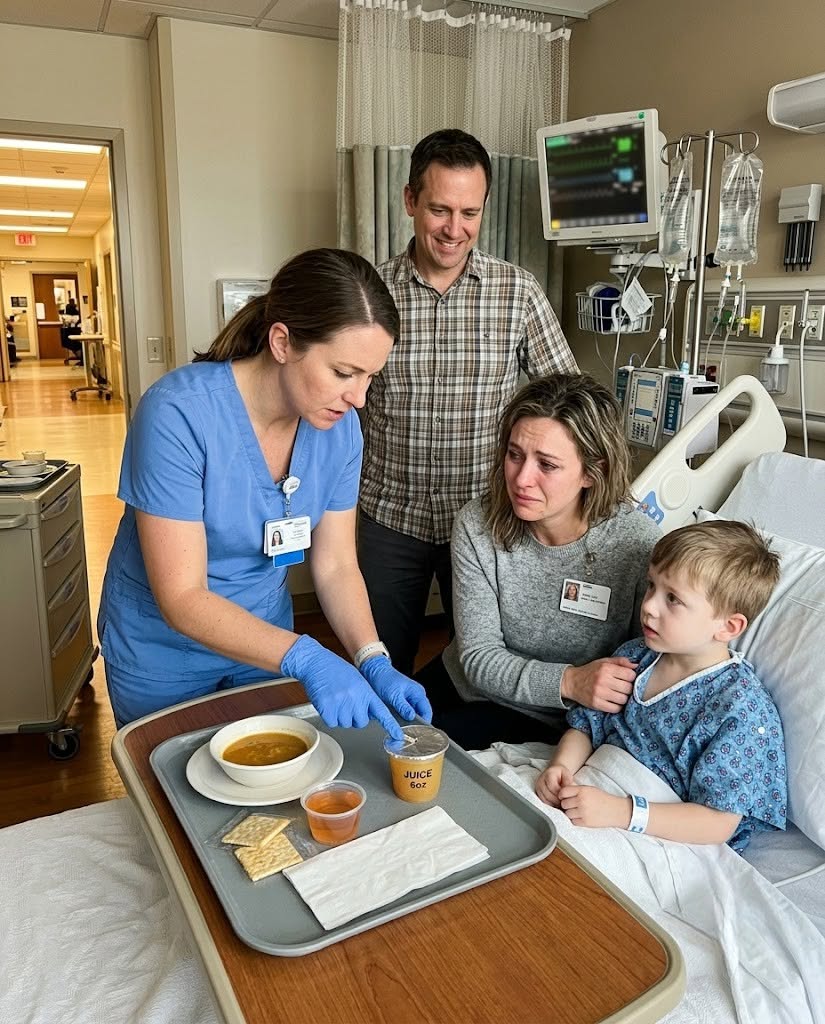
Beside me, the nurse folded her arms while the supervisor paused the tablet on my husband’s hand above the cup.
My husband looked at the screen and said, “I was helping him sleep. You know how bad he gets when he’s overtired.”
Nobody had accused him of using anything for sleep in that room yet.
The nurse asked what he’d been putting into the drinks.
He rubbed one thumb along the bed rail and said it was something harmless he had used at home before, something parents bought without a prescription, and that I was making it sound dangerous because I was scared.
Then he looked at me.
“You asked me to handle bedtime when you worked late.”
I didn’t answer him.
My mouth was dry enough that swallowing hurt, and I still hadn’t eaten anything except half a cracker I’d taken from my son’s untouched tray sometime earlier.
I told the charge nurse that my husband was not to be alone with our son again while we were in that hospital, and I told security I wanted every available clip preserved.
Then I said the thing my husband had been waiting for me not to say.
Our son would not be going home with him.
My husband stopped rubbing the rail.
For the next several minutes, he spoke almost entirely in the language of being helpful.
He said our son had always been difficult about sleep, that I knew it, that I had thanked him plenty of mornings for getting the boy settled while I worked late, and that a tired child could make himself sick if nobody stepped in.
“I’m not blaming you,” he told me. “I’m saying you weren’t there. I was.” The worst part was that one piece of that was true. I wasn’t there on many of those nights. For months, I had treated bedtime as the part of our family life my husband handled because I often came home after our son was already under the covers. Twice, maybe three times, my son had told me his juice tasted strange. I had told him to brush his teeth and stop inventing reasons to stay awake. Once he carried the cup into my bedroom while I was answering work email, and I sent him back to bed without tasting it. I remembered that now because I remembered the cartoon shark on the cup. I had forgotten what he said. He had stopped saying it. The nurse, whose name was Mara, brought in a replacement tray after dietary services removed the untouched food. She was trying to help, but she made one bad assumption: she thought a brand-new sealed drink, opened in front of us, would feel safe to him. My son saw the lid and shoved the cup away so fast that it struck the plastic water pitcher. Water ran across the tray. Mara caught the pitcher before it reached the floor, but he had already pulled the blanket over his mouth. His father was outside the room by then. The drink was clean. He still wouldn’t touch it. For the first time that day, removing my husband had not fixed the thing I thought it would fix. I called my sister twice from the corner near the window. Both calls went to voicemail, and I put my phone back in my pocket without leaving a message. Across the room, my son watched Mara replace the wet paper liner on his tray. She poured water into an ordinary paper cup where he could see her hands from beginning to end. He stared at it. “You can hold it yourself,” she said. He took the cup but didn’t drink. My husband sent me three messages from somewhere outside the unit. The first said I was overreacting. The second said he had never hurt our son. The third said, “Ask him how many nights he begged me for something to help him sleep.” I showed the messages to Mara instead of answering them. When she asked my son whether his father had ever told him what the drops were, he shook his head. Then he pointed at my phone. “Dad says they’re the night helper.” His voice was hoarse. “He says I need them when Mom is working.” My husband had given his explanation a name a child could repeat without understanding it. That mattered more to me than the argument he was making outside the room, because my son wasn’t describing a single bad decision made during one awful hospital stay. He was describing a routine. Sometime that afternoon, the hospital staff documented the footage, the punctured drinks, what my son had said, and the fact that no sleep medication had been ordered for him there. Nobody promised me what would happen beyond the hospital. Mara was careful about that. She told me they could control who entered the room under their immediate safety rules, document what had happened, preserve what they had, and make the reports their policy required. They could not settle my marriage for me. They could not turn a hospital restriction into a permanent rule about our home. That was when my husband’s argument changed. He stopped telling me the drops were harmless and started asking where I planned to take our son after discharge. “His home is with both of us,” one message said. “You can’t make a medical scare into permission to disappear with him.” The threat had changed shape without getting any smaller. Inside the hospital, he no longer controlled the room. Outside it, we still shared an address, our son’s clothes were there, his school bag was there, and my husband’s name was on every ordinary piece of family paperwork where a father’s name would be expected. I asked Mara to show me what the hospital actually had listed for discharge contacts instead of assuming I knew. My husband was still there. So was I. I couldn’t erase him with a pen, and nobody pretended I could. What I could do was tell the care team that I would be transporting our son myself and that we had another safe place to stay after discharge. My sister finally called back while I was speaking to the desk nurse. She had been in a grocery store with bad reception and started apologizing before I finished saying hello. I asked one question. “Can we stay with you?” She said yes. Then she asked whether I wanted her to come immediately. I looked at my son curled around the paper cup and told her to wait until I knew whether we were staying overnight. For a little while, that gave me something practical to do. I put his socks, charger, toothbrush, and the sweatshirt he’d refused to wear into the same canvas bag we’d brought in with us. I also walked downstairs to move my car closer to the discharge entrance, only to find that patient parking couldn’t be accessed from that side of the building after all. I went back upstairs with nothing accomplished except sore feet. By then, my husband had stopped texting me and started calling the unit. He wanted updates about our son. The desk nurse did not discuss the details with me in front of the child, but she made one thing clear: the safety restriction protected the room while the hospital reviewed what had happened; it did not magically solve every question about parental access afterward. I had gained a locked door and immediately discovered how small that victory was. My son still had to leave through it eventually. That evening, a pediatrician sat beside his bed and asked about food without mentioning his father. My son admitted that sometimes he had gone to bed hungry at home because unopened food felt safer than a drink that had been sitting near his father. Other nights, he ate dry snacks from packages he opened himself. He wasn’t trying to starve himself. He had built a rule. If he hadn’t watched something from the moment it was opened until the moment he swallowed it, he didn’t trust it. The hospital had mistaken the result for nausea because that was the explanation the adults kept giving them. I had helped that explanation survive. Each time somebody asked when his appetite had changed, I had answered with the dates of his stomach complaints instead of asking why food itself frightened him. My husband had an answer ready, and I had been tired enough to use it. Near bedtime, Mara brought crackers, applesauce, and water without setting any of it close to him. She placed everything on the rolling table and stepped back. My son opened the crackers himself. He ate one. A little later, he ate another. No one praised him. Mara talked to me about the terrible coffee in the lobby while he worked on the applesauce lid with both thumbs. I finally ate the last two crackers from the packet he didn’t want. The room was cooler after dark, and a television across the hall played a game show loud enough that I could hear applause every few minutes. My son drank nearly half the paper cup before falling asleep. The next morning, his first question was whether his father was coming into the room. I told him no. He nodded and asked for toast. For several hours, the crisis seemed to become something smaller and manageable. His vital signs were steady, he was drinking more, and the care team said they were comfortable continuing to watch him while they worked through discharge planning and the safety concerns already documented. My husband sent one longer message. He said he was sorry that I had become frightened. He said he never intended to hurt our son. He said he had only wanted the boy to sleep because I was exhausted, he was exhausted, and somebody had to keep the household functioning. Then he wrote, “I did what you needed me to do.” I read that sentence twice. I did not answer it. By sometime the next afternoon, my son had eaten toast, some soup, and most of a banana without being prompted more than once. The discharge plan was simple enough for the part the hospital could control: I would take him, my sister would meet us, and security would make sure we reached the car without an argument in the hallway. My husband was not waiting outside the room. For the first time since admission, my son asked when we could leave. A tech came in to change the pillowcase before the final paperwork was ready. My son watched cartoons with the sound off, and I folded his sweatshirt badly enough that one sleeve kept falling out of the bag. It felt almost ordinary. When we left, he carried his own paper cup to the trash and threw it away himself. My sister met us at her apartment later that day, still wearing the cardigan she’d apparently grabbed on the way out of work. She didn’t ask questions in front of him. She showed him where the towels were, let him pick which side of the guest bed he wanted, and asked whether he preferred noodles or scrambled eggs. He picked noodles. For most of that evening, we talked about nothing important. The microwave clock was blinking because my sister had unplugged it earlier, and my son rinsed a green plastic cup twice before setting it upside down on a dish towel. Then, while I was putting his hospital papers into a drawer, he asked, “Are you going to lose your job because I told?” I stopped with one hand on the drawer. He wouldn’t look at me. I sat on the floor instead of making him come closer. “Why would I lose my job?” He rubbed the edge of his hospital wristband with his thumb. “Dad said if I kept making trouble, you’d have to stop working to stay home with me. Then we wouldn’t have enough money and you’d be mad I told.” That explained the part none of the footage could show. My son had not only been afraid of the drops. He had believed staying quiet was one of the jobs keeping our family together. I had spent the hospital stay thinking the cost of what my husband did would be measured by what had gone into those cups and what it had done to our son’s body. My son had been paying another cost long before we reached the hospital. He had been carrying responsibility for my work, our money, and whether I would be angry with him. I didn’t tell him everything would be fine. I couldn’t promise that yet. I told him one thing I knew I could keep true. “My job is my job. Our money is an adult problem. You never have to stay quiet to protect me.” He pulled at the wristband again. “Even if Dad says so?” “Even then.” A few minutes later, he asked whether we could cut the wristband off. My sister brought scissors, handed them to me, and then went back to stirring the noodles as if that was all she had come into the room to do. I cut the band and put it with the discharge papers instead of throwing it away. Over the next several days, I kept communication with my husband limited to practical matters and saved every message without trying to argue him into admitting anything else. The hospital already had the statements it had collected, the preserved drinks, and the footage showing what happened when I left the room. I didn’t need another confession to make the boundary real. Our son stayed with me at my sister’s while the next steps were handled through the processes already set in motion rather than through a fight in a parking lot or a late-night argument at home. He still checked drinks. Sometimes he asked me to pour them while he watched. Sometimes he poured them himself. Once I reached automatically for his cup to move it away from the edge of the table, and he put his hand over it before I touched it. I stopped. “Can you move it?” I asked. He moved it himself. A few evenings later, he ate dinner without asking who had opened the ingredients, though he kept the green cup beside his plate the entire time. I apologized once for the nights I had dismissed what he was trying to tell me. I didn’t explain how tired I’d been or how reasonable his father’s answers had sounded. He listened, then asked if he could have more noodles. I got them. The hospital cup had started as something adults handed him and expected him to trust because the lid looked sealed. At my sister’s house, the green cup belonged to him. Nobody filled it, moved it, washed it, or took it from the table without asking first. The green cup stayed on the second shelf, and only he took it down.