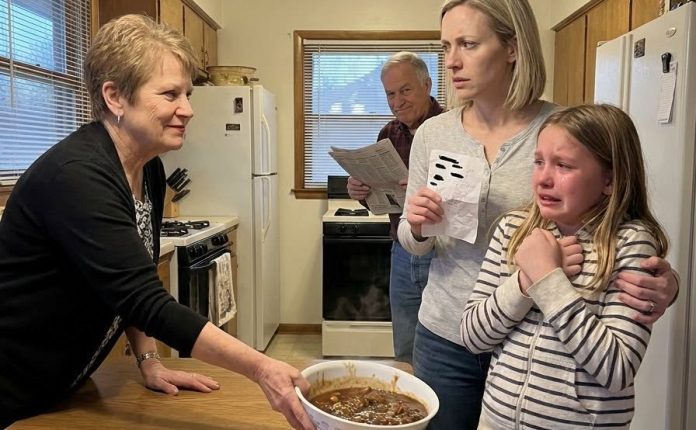
My father-in-law smiled as he told my daughter to try her Christmas gift.
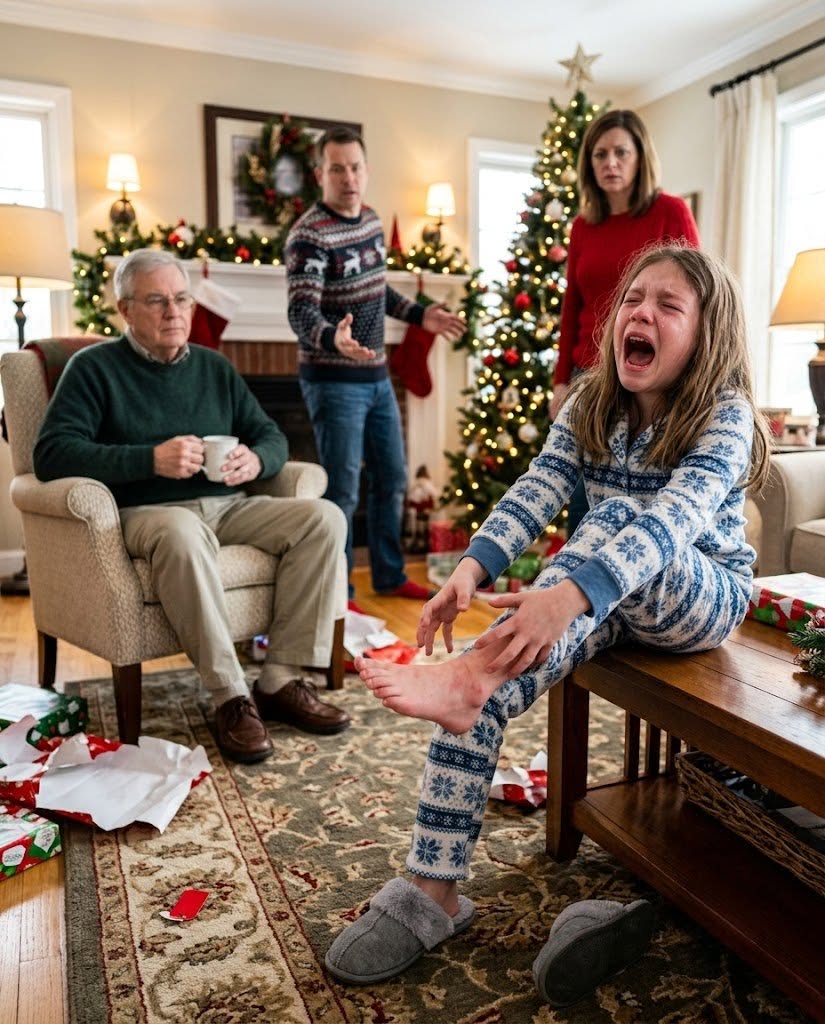
Thirty seconds later, she was screaming in agony while he calmly sipped his coffee without moving an inch.
Lucy was eleven, and until that Christmas morning, she still believed her grandfather’s worst habit was making long speeches before anyone could open presents.
He liked to hold a wrapped box in both hands and explain where he had bought it, why he had chosen it, and what lesson the person receiving it should learn from his generosity.
The adults usually smiled through those speeches because challenging him turned every family gathering into a debate he intended to win.
Lucy had learned to be patient.
She would sit cross-legged beside the tree, nod politely, and wait for him to finally hand over the gift.
That morning, the living room was warm enough that the windows had begun to fog near the corners.
Cinnamon from the breakfast rolls hung in the air, wrapping paper covered half the rug, and a paper snowman plate sat on the coffee table beneath three untouched cookies.
Someone had left a holiday movie playing quietly on the television, but no one was paying attention to it.
My father-in-law’s gift was separated from the others.
It sat beside his chair, wrapped in green paper with a red tag tied neatly around the ribbon.
For Lucy.
Be brave.
Grandpa.
Lucy read the tag twice.
The words seemed unusual for a pair of slippers, but my father-in-law watched her with the pleased expression of someone waiting for a performance to begin.
“Put them on before breakfast gets cold, sweetheart,” he said.
Lucy pulled the ribbon loose and opened the package carefully because she had been taught not to tear wrapping paper at her grandparents’ house.
Inside was a pair of soft gray slippers.
They looked comfortable, but they were at least one size too large, and the thick lining made them seem heavier than ordinary house shoes.
Lucy touched the fabric with two fingers, then looked at me.
That glance was part of an agreement we had made years earlier.
She never had to hug someone, wear something, eat something, or participate in a joke simply because an adult might be offended if she refused.
Before I could answer, my husband Mark laughed from the couch.
“Come on, Luce. He’s been waiting all morning.”
His tone was light, but it placed the decision on her in the way family pressure often does, disguised as encouragement so no one has to admit it is pressure.
Lucy hesitated for another second.
Then she set the slippers on the rug and slipped one foot inside.
My father-in-law leaned back in his chair.
She put on the second slipper.
He lifted his coffee mug and checked his watch.
The gesture was so deliberate that I noticed it, although I did not yet understand why it mattered.
Lucy stood and took one step toward the tree.
Then a second.
Then a third.
On the fourth step, her body went rigid.
The scream that followed emptied every conversation from the room.
Lucy kicked one slipper away, but the other remained caught on her foot. She grabbed at it, lost her balance, and fell against the edge of the coffee table. I reached her before anyone else moved. Her face had gone pale, but her feet were turning bright red beneath the Christmas lights. “They’re burning,” she cried. She said it again and again as though the words themselves might make us understand how bad it felt. I tried to pull the remaining slipper off, but Lucy screamed when my fingers touched the lining. I grabbed a dish towel from the kitchen and used it to remove the slipper without putting my bare hand inside. Then I lifted Lucy and rushed her toward the sink. Behind me, wrapping paper tore beneath someone’s shoes as the rest of the family finally began moving. Mark followed us while reaching for his phone. His sister Jenna pushed chairs out of the way. Someone turned off the television. My father-in-law stayed in his chair. He stayed seated while his granddaughter sobbed and clutched the counter. He stayed seated while I turned on the faucet and tested the water against my wrist before guiding Lucy’s feet beneath it. He stayed seated while Mark called for emergency help. “Don’t frighten her more,” he said calmly from the living room. His voice carried easily through the doorway. “She’s always had sensitive skin.” Lucy shook her head hard enough that her hair stuck to her wet cheeks. She had never reacted like that to socks, shoes, soap, or detergent. She had never screamed because of sensitive skin. The redness continued spreading across both feet, and the pain did not ease under the cool water. Mark stood beside us answering the dispatcher’s questions, but his attention kept shifting between Lucy and his father. He looked confused rather than suspicious. I was suspicious enough for both of us. My father-in-law finally walked into the kitchen carrying his mug. He did not ask Lucy where it hurt. He did not ask whether the water was helping. He did not touch her shoulder or tell her that help was coming. He asked whether I had kept the packaging. That was when I noticed the open slipper box tucked beneath his arm. The box had been beside the tree only moments earlier, but he had already collected it while everyone else was focused on Lucy. “Give it to me,” I said. “I’ll return them,” he replied. His voice had the same patient, reasonable tone he used whenever he wanted everyone else to appear emotional. “It was probably a factory mistake.” I looked at the box, then at the coffee mug still steady in his hand. “You don’t know that.” “What else would it be?” he asked. He smiled faintly, as though my suspicion were an embarrassing overreaction that he was gracious enough to tolerate. I took the box from him before he could pull it away. Using the dish towel, I wrapped the slippers back in the green paper without touching the lining. The red gift tag had fallen beside the cabinet. I picked it up by the ribbon and placed it on top of the package. For Lucy. Be brave. Grandpa. The words no longer looked encouraging. They looked like instructions. When the emergency responders arrived, the house became crowded with equipment, winter coats, and urgent questions. Lucy was trembling so badly that one responder had to ask her name twice. I stayed beside her while they examined her feet and prepared to move her. My father-in-law followed them from room to room, offering explanations no one had requested. He said Lucy was anxious. He said she had panicked before anything had actually happened. He said children sometimes convinced themselves they were hurt after being startled. Lucy heard every word. From the stretcher, she raised one shaking hand and pointed toward his coffee mug. “He asked me if it was burning yet,” she whispered. The room changed. No one spoke for a moment, but I saw Jenna turn toward her father. Mark immediately stepped closer to Lucy. “You must have misunderstood, honey,” he said. He sounded frightened, and I knew he wanted her statement to be a misunderstanding because the alternative would split his family in a way he was not ready to face. His father leaned over the stretcher with a worried smile. “You were scared, sweetheart,” he said softly. “Scared people remember things strangely.” Lucy pulled her blanket toward her chin. I stepped between them. “Back away from her.” My father-in-law straightened slowly. His expression did not change, but his fingers tightened around the mug. Mark looked at me as though I had escalated the situation. I looked at our daughter and knew there was no situation I could make worse than the one she was already in. At the hospital, the slippers, the box, and the red tag were sealed separately while a doctor examined Lucy. The waiting area smelled faintly of disinfectant and burnt coffee, and every few minutes a cart rattled past the open doorway. Lucy lay on the bed with her feet elevated while I sat beside her and held her hand. Mark paced near the wall. He kept checking his phone because his father would not stop calling. The doctor returned after completing the first evaluation and told us the reaction was not consistent with a normal allergy. The irritation had not begun inside Lucy’s body. Something outside her skin had caused it. The doctor did not speculate beyond what could be observed, but the distinction mattered. This was not a child becoming frightened by a harmless gift. Something in or on those slippers had hurt her. Mark stopped pacing. For the first time that morning, he looked directly afraid of his father. His phone rang again. He declined the call. It rang almost immediately afterward. On the fourth attempt, Mark left the room and answered. Through the narrow window in the door, I watched him stand in the hallway with one hand pressed against his forehead. He spoke quietly for several minutes. When he returned, his expression had settled into the guarded look he wore whenever he was trying to present someone else’s demand as a reasonable solution. “My dad wants to pay all the bills,” he said. I waited. Mark looked toward Lucy, then lowered his voice. “He said he’ll cover everything if we handle this privately before anyone involves anyone else.” The sentence was so carefully phrased that I knew it had not originated with Mark. “Why is an innocent man already talking about stopping people from asking questions?” I asked. “He isn’t stopping questions.” “He wants to pay us before we get answers.” “He feels responsible because it was his gift.” “Then why didn’t he help her?” Mark looked away. I reminded him that his father had stayed seated while Lucy screamed. I reminded him that he had collected the packaging before checking on her. I reminded him that Lucy had repeated a specific sentence, not made a vague accusation. Mark rubbed both hands over his face. “Don’t destroy the family over an accident,” he said. The words were quiet, but Lucy heard them. She turned her face toward the wall. That movement hurt more than anything Mark could have shouted at me. Our daughter had been injured, questioned, and then asked to protect the family from the consequences of telling the truth. I moved my chair closer to the bed. “Lucy,” I said, “you are not destroying anything.” She did not turn around. “You can tell me whatever happened,” I continued. “You will not be in trouble, and you do not have to protect any adult in this room or outside it.” Her fingers tightened around the blanket. For several seconds, she said nothing. Then she told me about a message I had never seen. Her grandfather had contacted her the night before using Grandma’s old tablet. The tablet had been left at his house after Grandma died, and Lucy sometimes used it to play games or watch videos when she visited. Her grandfather told her the Christmas gift was a secret test. He said she needed to be brave and follow his directions exactly. Most importantly, he warned her not to show me the message. He told her I would ruin the test if I found out. Lucy finally turned back toward me. “I thought it was supposed to be a surprise,” she whispered. Mark sat down hard in the chair beside the wall. “What exactly did he write?” he asked. Lucy repeated the parts she could remember. She said the full conversation was still on the tablet. The tablet was at his father’s house. Mark immediately said we should call his father and ask him to bring it. I refused. The packaging had already been under his arm before help arrived. I was not going to warn him that we knew another piece of evidence existed. I called Jenna instead. She had returned to the house after following us partway to the hospital because someone needed to secure the doors and make sure the rest of the family left. I asked whether she could find the tablet without confronting her father. Jenna became quiet when I explained what Lucy had said. Then she told me she would look. The minutes that followed felt longer than the entire drive to the hospital. Mark stared at the floor. Lucy watched the doorway whenever footsteps passed. My phone remained in my hand, the screen dark until Jenna’s name finally appeared. Her first message contained photographs of the conversation. The words were exactly as Lucy had described them. Her grandfather called the slippers a test. He told her to put them on when he instructed her. He told her not to warn me. He wrote that I would ruin everything if Lucy showed me the messages. The final message had been sent after midnight. Be brave tomorrow. I looked at the red gift tag sealed across the room. For Lucy. Be brave. Grandpa. It was not simply a holiday note. It repeated a private instruction that had begun the night before. Jenna sent another photograph. This one showed the coffee table in her father’s living room. A phone stood upright against the sugar bowl, angled toward the chair where Lucy had opened the gift. The phone was still there when Jenna arrived. She checked it because the screen displayed a recording timer. The recording had started eighteen seconds before my father-in-law told Lucy to put on the slippers. It captured the green package, the red tag, his instruction, Lucy’s hesitation, Mark’s encouragement, and the moment she began screaming. It also captured him remaining in his chair. The coffee mug rose to his mouth while I rushed toward our daughter. The video did not show surprise on his face. It showed him watching. Mark asked me to hand him the phone. He viewed the photograph, then the screenshots, then returned to the picture of his father’s recording setup. His lips moved as though he were trying to find a version of events that could still be explained away. There was no factory mistake that required a phone to be positioned in advance. There was no innocent grandfather who secretly instructed a child to obey him and hide the conversation from her mother. Jenna called before Mark could speak. Her voice was shaking. She had found more videos on the phone. Two files were labeled Incident One and Incident Two. The first showed an argument from months earlier that had begun after my father-in-law privately told Lucy I was planning to cancel a family visit because I did not want her spending time with him. Lucy confronted me while his phone recorded from a shelf. The second showed another argument after he told me Mark had agreed to lend him money, then told Mark I had already refused. He had not invented the emotions in those videos. He had arranged the conditions that produced them. He pushed Lucy or me toward a reaction, positioned himself as the calm observer, and preserved only the part that made someone else look unstable. Each recording appeared to support the same story. I overreacted. Lucy was frightened around me. Mark was trapped between an emotional wife and a confused child. The videos did not prove that story when viewed in full context. They proved someone was manufacturing it. Jenna said there was one more folder. It was labeled with that morning’s date. Inside it, she found a draft email addressed to an attorney Mark had never mentioned to me. The subject line read: Emergency Custody Petition. Mark stood so quickly that his chair scraped across the floor. He insisted Jenna must be reading the wrong file. She told him she was looking directly at his father’s draft. Then she began reading the first sentence aloud. “After Christmas, we should have enough evidence to remove her.” The hospital room seemed to narrow around us. Lucy stopped moving beneath the blanket. Jenna remained on the phone, waiting for one of us to answer. I looked at my husband. He knew about his father’s complaints. He knew about the arguments. He had defended the man who called our daughter’s pain an accident. But the draft email named a plan that had begun before the slippers were wrapped, before the phone was placed against the sugar bowl, and before Lucy had been told to be brave. I held Mark’s gaze and asked the only question that mattered. “Remove me from what?”