The night before my engagement, my parents drugged my two-year-old daughter and left her inside a commercial dumpster.
The next morning, while my niece posed beneath pink balloons and everyone celebrated how pretty she looked, I stood in the middle of the room demanding to know where my child was.
My mother laughed in my face.
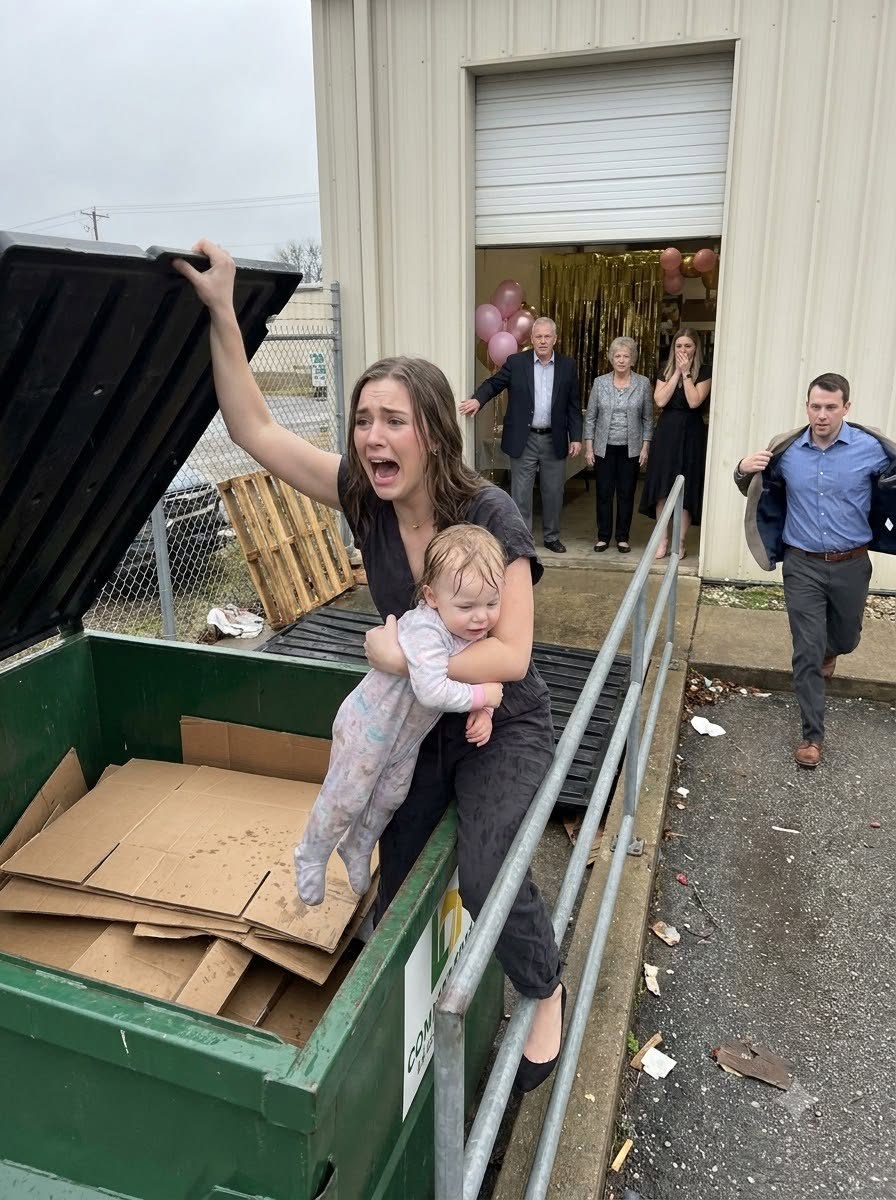
She told me, “Maybe you could find her in the waste, just like you are to this family.”
Everyone around her laughed too.
The first thing I noticed that morning was the yellow blanket.
It was folded over the back of the rocking chair exactly where I had left it before putting Maisie to bed.
She never slept without it.
Even when she was exhausted, she would reach for one frayed corner and rub it between her fingers until her eyes closed.
If I tried to wash it during the day, she followed me to the laundry room and sat beside the dryer as though I had placed her best friend in danger.
Yet the blanket was still on the chair, and Maisie’s crib was empty.
The fitted sheet had been pulled smooth.
Her stuffed rabbit sat upright against the rail, positioned so carefully that it looked less like a child’s bed and more like a room someone had staged after removing every sign of a struggle.
Too neat.
That was the thought I could not push away.
I stood inside the guest apartment above Holloway Home & Tool and forced myself to consider ordinary explanations.
Maybe Mom had taken Maisie downstairs for cereal.
Maybe Dad had carried her outside because she was restless.
Maybe Lucas had arrived early and was walking her around the block so I could sleep after the party.
Each explanation lasted only a second before collapsing under the weight of what I remembered from the night before.
Maisie had been unusually limp when I carried her upstairs.
Our engagement party had gone on until nearly midnight, filling the event room below the store with music, clinking glasses, and relatives who had not seen one another in years.
My father, Warren, had delivered three separate speeches.
In the first, he praised Lucas for being patient enough to join our family.
In the second, he talked about the store as though every shelf, cash register, and loading dock represented his personal sacrifice.
In the third, he barely mentioned me at all.
My mother, Elaine, spent most of the evening guiding Lucas’s parents through the room and describing our family as if she were showing potential buyers around a house.
She pointed out the catered food, the decorations, the framed photographs, and the display table she had arranged for my niece Sadie’s beauty competition trophies.
She never pointed out the small blue-and-yellow cake I had ordered for Maisie’s second birthday.
Maisie’s birthday fell the morning after the engagement party, and I had hoped we could gather for breakfast, let her open a few gifts, and give her one quiet hour that belonged to her.
Elaine had agreed only after reminding me that Sadie needed the event room for competition photographs.
“We can squeeze it in,” she had said, as though my daughter’s birthday were an inconvenience between appointments.
At nine that night, I carried Maisie upstairs.
She barely opened her eyes when I changed her into pajamas.
Her head rolled heavily against my shoulder, and when I whispered her name, she made a small sound but did not lift her arms toward me the way she usually did.
I blamed the long day.
There had been music, bright lights, strangers leaning close to kiss her cheeks, and relatives passing her from one pair of arms to another.
I thought she was overstimulated and exhausted.
I laid her in the crib, covered her, and watched her breathe until I convinced myself she was sleeping normally.
Then I returned downstairs because my father had already sent someone up twice to tell me that Lucas’s parents were waiting for photographs.
Now, in the pale morning light, I looked at the untouched blanket and understood that I had ignored something important.
“Maisie?”
My voice sounded too loud in the empty apartment.
I checked the bathroom even though the door had been open.
I looked behind the couch, inside the small bedroom closet, and beneath the table where she sometimes crawled when she wanted to hide.
Her shoes were still beside the door.
Her coat still hung from the hook.
Her diaper bag sat on the kitchen counter with the zipper closed.
No one taking a toddler outside would have left all three behind.
I ran downstairs so quickly that my shoulder slammed into the wall at the turn of the stairwell.
Pain shot down my arm, but I barely felt it.
The event room was already crowded.
Gold streamers from my engagement party still hung from the ceiling beside fresh pink balloons.
A paper banner had been pinned across the back wall for Sadie’s photographs, and a portable light stood near the folding chairs.
My eight-year-old niece was balanced on one of those chairs while my sister, Tessa, curled a section of her hair.
Sadie wore a sparkly dress and held her chin high while Elaine adjusted a jeweled clip near her temple.
Several relatives stood around drinking coffee and commenting on how grown-up she looked.
My engagement cake had been pushed to the far corner of the room.
So had Maisie’s birthday cake.
The little blue-and-yellow cake was still inside its clear plastic cover, untouched and nearly hidden behind a stack of empty catering trays.
I searched every face in the room.
Lucas was not there yet.
My father stood at the coffee table pouring from a large metal dispenser.
My mother remained beside Sadie.
Tessa stared at the curling iron cord. “Where’s Maisie?” I asked. No one answered. Dad kept pouring coffee even after the cup was almost full. Mom adjusted Sadie’s hair clip by less than an inch. Tessa lowered the curling iron and studied its cord as though she had discovered a knot that required her complete attention. A few relatives glanced toward me, then quickly looked away. The room did not feel confused. It felt prepared. “Where is my daughter?” I asked again. My voice cracked on the last word. Elaine finally turned. There was no concern on her face. There was not even surprise that I had discovered Maisie missing. She looked at me with the same irritated expression she used when an employee misplaced a price label in the store. Then she laughed. “Maybe you could find her in the waste, just like you are to this family.” Several relatives laughed with her. One of my uncles lowered his coffee cup to hide his mouth, but I still heard him. Someone near the back muttered something about Elaine always having the sharpest comebacks. Sadie looked from her grandmother to me without understanding why the adults were laughing. Tessa did not laugh. She also did not look up. That was what frightened me most. My body moved before my mind could catch up. I shoved through the stockroom doors, knocking one of them hard enough that it struck a shelf behind it. Boxes of work gloves and extension cords blurred past me as I ran toward the rear loading area. The heavy door at the end of the stockroom resisted for half a second before swinging open. Cold morning air hit my face. The loading area smelled like damp cardboard, asphalt, old coffee, and the sour residue that collected near the garbage bins after rain. Three commercial dumpsters stood against the chain-link fence behind the store. They were dark green, dented along the sides, and large enough that I could not see inside them from the ground. “Maisie!” Traffic moved beyond the building. A delivery truck changed gears somewhere down the block. Water dripped steadily from the corner of the roof. For one terrible second, those were the only sounds I heard. I ran to the first dumpster and pulled at the lid. It was heavy, and the metal edge slipped against my damp hands. Inside were torn bags, packing material, and broken pieces of shelving. No Maisie. I moved to the second one. “Maisie! Baby, answer me!” Nothing. My chest tightened so hard that each breath felt trapped behind my ribs. Then a tiny sound came from the middle dumpster. It was barely more than a whimper. I climbed onto the metal side rail and threw back the lid with both hands. Flattened boxes covered most of the bottom. A black garbage bag had been shoved against one wall. Beneath the cardboard, still wearing the pajamas I had put on her the night before, was my daughter. For a moment, my mind refused to understand what my eyes were seeing. Maisie was curled on her side between two broken-down boxes. Her cheeks were flushed a frightening shade of red. Her hair clung damply to her forehead. One pajama sleeve had ridden up her arm, exposing the small crease of her wrist. She looked impossibly small inside that metal container. “Maisie.” I climbed farther in, scraping my knee against the side. Her hand twitched when I touched her shoulder. Her eyes opened only a fraction, then drifted shut again. I slid one arm beneath her back and the other under her legs. She did not reach for me. That terrified me more than anything else. Maisie always reached for me. I lifted her out and held her against my chest while I screamed for someone to call 911. My voice echoed off the loading wall. The stockroom door opened behind me, but the first person who came running was not one of the relatives who had laughed. It was Lucas. He had just pulled into the parking lot and was still wearing the blue button-down shirt from the engagement party, wrinkled now at the elbows and untucked on one side. He saw Maisie in my arms and stopped so abruptly that his shoes slid on the damp pavement. “What happened?” I could not answer. I could barely form the store address when the emergency dispatcher came on the phone. Lucas stripped off his jacket and wrapped it around Maisie without covering her face. Then he crouched beside us, one hand beneath her back and the other steadying my arm because I was shaking so badly. The dispatcher asked whether she was breathing. I pressed my cheek near Maisie’s mouth and said yes. The dispatcher asked whether she was responsive. I said barely. The dispatcher told me not to give her food or water and asked whether she could have swallowed medication. Before I could answer, the stockroom door opened again. My family gathered in the loading doorway. They did not rush toward us. They formed a loose line beneath the metal awning, coffee cups still in several hands, as though they had come outside to watch an argument rather than a medical emergency involving a two-year-old child. Warren stepped forward. “Give her here,” he said. I turned my entire body away from him. He reached again, and Lucas rose between us. Lucas did not touch him. He simply planted his feet and made it clear that my father would have to go through him to reach us. Warren’s face tightened. “Stop making a scene,” he said. “She’ll wake up.” The dispatcher repeated the question through my phone. Could Maisie have swallowed any medication? I looked at my father. His words landed before he seemed to realize he had spoken them aloud. “We only gave her enough to sleep.” Every laugh stopped. Lucas turned his head slowly toward him. Tessa covered her mouth with one hand. Elaine hissed, “Warren,” but it was too late. The loading area was small. The dispatcher was still connected. Every relative standing in that doorway had heard him admit that they had given my toddler something intended to make her sleep. “What did you give her?” I asked. Warren stared at the pavement. Elaine crossed her arms. Her posture was defensive, but her expression remained irritated rather than afraid. “She was ruining Sadie’s morning,” she said. I thought I had misheard her. Elaine continued as though she were explaining a reasonable household decision. “She wouldn’t stop crying, and you always expect everyone to rearrange everything for that child.” That child. She was talking about her granddaughter. She was talking about a two-year-old who had been tired, overwhelmed, and surrounded by adults. She was talking about the little girl they had placed inside a dumpster so Sadie’s photographs would not be interrupted. Rage pushed against my ribs. I imagined standing, crossing the pavement, and demanding that my mother look directly at what she had done. I wanted every person who had laughed to explain why they had remained inside drinking coffee while my daughter lay beneath discarded boxes. Then Maisie’s fingers moved. They closed weakly around the front of my shirt. The grip was so small that I might have missed it if I had not been holding her against my chest. That tiny movement decided what mattered. Not my mother’s excuses. Not my father’s pride. Not the relatives shifting uncomfortably in the doorway now that the joke no longer seemed funny. Maisie needed me steady. I pressed the phone closer to my ear and repeated the store address slowly for the dispatcher. I described the rear loading entrance, the chain-link fence, and the three dumpsters behind the building. Warren stepped closer and reached toward the phone. “You’re making this sound worse than it was,” he said. Lucas moved with him, keeping his body between my father and me. “Do not touch her phone,” Lucas said. His voice was low and controlled. Warren pointed toward the store. “This is a family matter.” Lucas looked at Maisie, then back at him. “You put a toddler in a dumpster.” No one laughed at that. Elaine began telling the relatives to go back inside. A few obeyed immediately, grateful for an excuse to leave. Others remained frozen near the doorway, their faces changing as the truth settled over the scene. My uncle who had hidden his laugh behind his coffee cup set it on the ground without taking another sip. Sadie was no longer in the doorway. Someone had finally taken her away from the adults’ confrontation. Tessa stayed. Her shoulders shook. At first, I thought she was crying because she was afraid of what would happen to our parents. Then she stepped past Elaine. Mom caught her arm. “Don’t,” Elaine warned. Tessa pulled free. She had always been the one who surrendered first in our family. When Dad raised his voice, she apologized. When Mom rewrote an argument, Tessa agreed with the new version. When Sadie’s schedule took priority over everyone else’s plans, Tessa smiled and said it was easier that way. Now she stood in the loading area with tears running down her face and stared at the jacket wrapped around Maisie. “It wasn’t one dose,” she whispered. The words were so quiet that I almost thought the dispatcher had spoken through the phone. I looked at my sister. “What did you say?” Elaine moved toward her again. Lucas shifted just enough to block her path without leaving my side. Tessa pressed both hands over her mouth, drew one unsteady breath, and forced herself to continue. “It wasn’t one dose.” My father told her to stop talking. My mother said she was confused. Tessa shook her head. “Mom made me throw the bottle in the dumpster with her.” For the first time that morning, Elaine had no answer ready. I tightened my arms around Maisie and stared toward the open dumpster. Somewhere beneath those flattened boxes was the bottle that could explain why my child could barely open her eyes. My parents had believed the garbage would hide what they had done. Instead, they had placed their own admission beside my daughter.