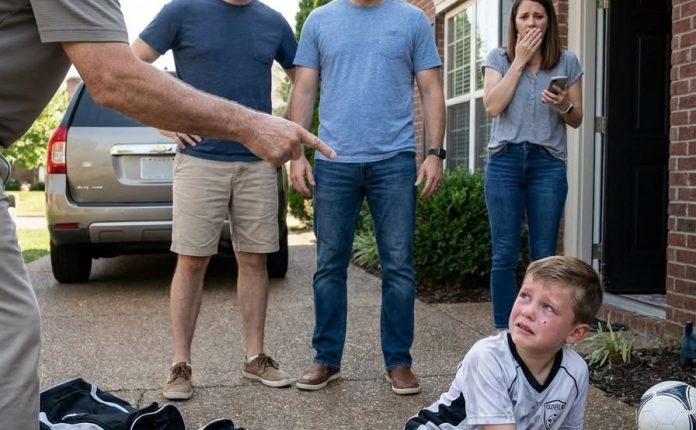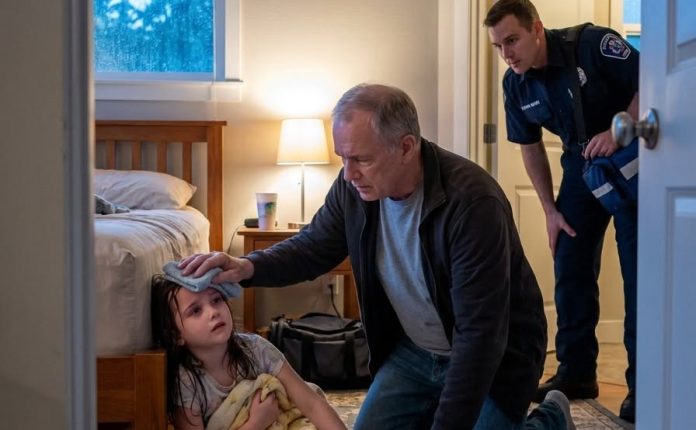
The hospital called at 4:00 p.m. and told me my six-year-old son had never checked in for his appointment.
By 3:47 the next morning, Ethan was standing inside our back door alone, wearing clothes I had never seen, his hair shaved almost to the scalp, his whole body trembling.
That was when I understood the missed appointment was not the worst thing that had happened.
The day had started so normally that, for a while, I kept trying to return to that version of it in my head.
Eggs hissed in butter on the stove.
A vanilla candle burned beside the sink because my wife liked the kitchen to smell warm even on gray mornings.
The refrigerator hummed in the corner, and Ethan sat at the table in his dinosaur hoodie, kicking his sneakers lightly against the chair rung while I packed his backpack.
He had fallen off his bike three weeks earlier.
Nothing dramatic.
A scraped elbow, a bruised hip, a few frightened tears, and one stubborn limp that lasted longer than his pediatrician expected.
The doctor had sent us to orthopedics as a precaution.
That appointment was supposed to be the final check before Ethan returned to recess without restrictions.
The reminder card was still on the refrigerator.
2:00 p.m.
Hospital Orthopedics Desk.
Ethan Richardson.
I read it twice because I am the kind of father who checks the same detail even after I know I checked it.
Extra snack in the backpack.
Insurance card in the front pocket.
Water bottle tightened.
Appointment time confirmed.
Then my wife came into the kitchen holding a paper coffee cup and said, “Actually, Mom is going to take him.”
I turned from the stove with the spatula still in my hand.
“Why?”
“She offered.”
That was Gertrude’s favorite way into our lives.
She rarely demanded anything directly.
She offered.
She offered to pick up Ethan from school.
She offered to bring dinner.
She offered to sit in during doctor visits.
She offered to help with bills we had not asked her to pay.
Every favor arrived wrapped in concern, but the ribbon always tightened later.
Control learns the language of care before it shows its teeth.
I had tried to explain that to my wife before.
She heard criticism of her mother where I meant warning.
That morning, I told her I did not want Gertrude taking Ethan to the hospital.
“This isn’t a grocery run,” I said. “It isn’t school pickup. It’s a medical appointment.”
My wife stared into her coffee.
“You have that meeting.”
“I can move it.”
“Mom already said she’d do it.”
“That doesn’t mean she should.”
She sighed.
It was the sigh that had ended a hundred arguments before they could become honest.
“Please don’t make this a whole thing.”
Those words did what they always did.
They turned my concern into the problem.
So I stopped talking.
At 10:00 a.m., Gertrude’s silver Mercedes rolled into our driveway.
The car was so clean that the bare branches above our roof reflected across the hood.
She stepped out in a cream coat with sunglasses pushed into her hair.
She looked expensive, composed, and mildly inconvenienced by the fact that I was standing on my own front porch.
Then Ethan came out.
Her expression changed immediately.
“Ready, sweetheart?”
Her voice softened the way it always did around him.
Too sweet.
Too practiced.
Ethan looked at me before he went down the steps.
That glance did not seem unusual at the time.
Children look back.
They check where home is.
They make sure the person they trust is still watching.
I zipped his backpack and handed it to him.
“Straight to the appointment,” I said. “Call me when you get there.”
Gertrude smiled without showing her teeth.
“We know.”
I watched her buckle Ethan into the back seat.
I watched the Mercedes back past our mailbox and turn onto the street.
Then I went inside and told myself I was being difficult.
That was how deeply the pattern had settled into our marriage.
Gertrude crossed a line.
I noticed.
My wife minimized it.
I apologized for noticing.
By 2:15 p.m., I was between meetings and staring at my phone.
No call from Gertrude.
No text from my wife.
No update from the patient portal.
I called the clinic.
The receptionist asked for Ethan’s date of birth.
I gave it to her.
She put me on hold.
The waiting music was soft and thin, almost like someone breathing on the other side of a wall.
When she returned, the careful brightness had disappeared from her voice.
“Sir, we don’t show Ethan Richardson as checked in today.”
I stood up from my desk.
“Can you check again?”
“I did.”
“The appointment is at two.”
“I see the appointment.”
“So where is he?”
There was a pause.
“Are you sure it wasn’t rescheduled?”
I opened the patient portal while she was still talking.
The appointment was there.
Same department.
Same confirmation number.
Same time.
I called Gertrude.
Voicemail.
I called again.
Voicemail.
I texted.
Where are you?
No response.
I called my wife.
No answer.
At 2:41, I called Gertrude again.
At 3:06, again.
At 3:39, again.
Each unanswered call made the rooms around me feel smaller.
By 4:00 p.m., the hospital scheduling office confirmed what the clinic had already told me.
“He never checked in.”
I wrote the sentence down.
I do not know why.
Maybe because part of me could not accept it unless I saw the words in front of me.
Maybe because another part already understood I might need a record.
I took screenshots of the call log.
I saved the appointment confirmation.
I downloaded the patient portal page.
I wrote down every time I had called.
2:17.
2:41.
3:06.
3:39.
I was not building a case.
Not consciously.
I was trying to hold the facts still because everyone around Gertrude had a way of making facts feel negotiable.
My wife came home carrying grocery bags over both wrists.
She walked into the kitchen and found me pacing between the island and the back door.
“Where is Ethan?” I asked.
She looked at the counter, as though she needed to set down the milk before answering.
“Mom probably took him for ice cream.”
“He missed the appointment.”
That made her stop.
Only for a second.
“Maybe she went to the wrong entrance.”
“The hospital said he never checked in.”
She placed the grocery bags on the counter too hard.
A carton tipped.
An apple rolled out, crossed the laminate, and dropped onto the floor.
Neither of us picked it up.
“You always do this,” she said.
“Do what?”
“You turn everything involving my mother into a crisis.”
“Our son is missing.”
“He is not missing. He is with my mother.”
“You don’t know that.”
Her face tightened.
“You’re being dramatic.”
The word hit with the weight of repetition.
Dramatic.
Paranoid.
Controlling.
Overreacting.
Those words had lived in our house for years.
They waited beside Gertrude’s name and came running whenever I asked a question no one wanted to answer.
I showed my wife the screenshots.
She barely looked.
I showed her the appointment page.
She folded her arms.
I showed her the unanswered calls.
“Her phone probably died.”
“At two?”
“Maybe.”
“At four?”
“I don’t know.”
“At six?”
“She will call.”
She did not.
Evening turned into night.
The porch light stayed on.
The driveway remained empty.
Every car that passed the mailbox pulled me toward the window.
My wife sat on the couch with her phone in her hand, refreshing messages she pretended not to be worried about.
At 9:00 p.m., I asked whether we should call the police.
She stood up so fast the blanket slid to the floor.
“Do not do that to my mother.”
The sentence told me everything about where her fear was aimed.
Not at Ethan.
At Gertrude.
At what Gertrude might say.
At what would happen if we treated her behavior like the emergency it had become.
I looked at my wife and realized we were standing in two different versions of the same house.
In mine, our child had disappeared after missing a hospital appointment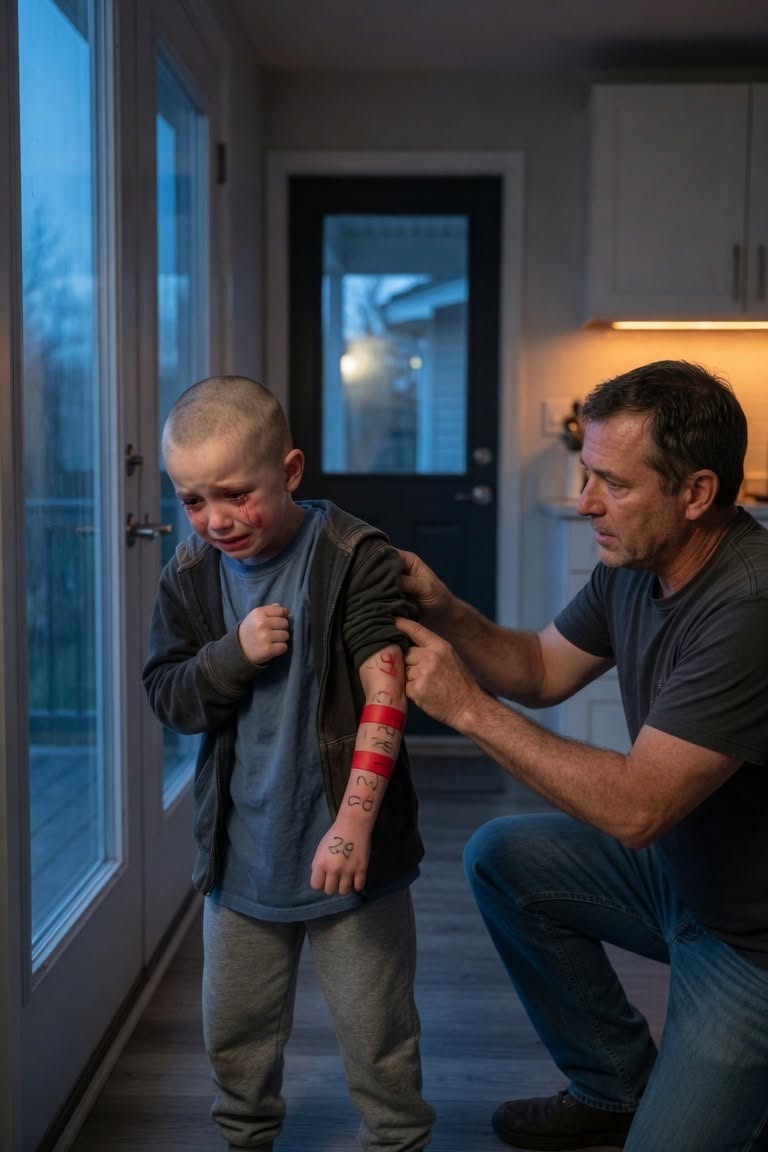 .
In hers, her mother had taken too long to return a favor.
Trust can survive one lie.
What destroys it is the moment one person decides the lie is safer than the truth.
I stayed downstairs.
The kitchen lights were off.
The microwave clock glowed blue across the room.
At midnight, I called Gertrude again.
Voicemail.
At 1:00 a.m., I walked the driveway.
Cold air slipped through my sweatshirt.
The mailbox looked ordinary.
The street looked ordinary.
That was the cruelest part.
The world had not changed shape just because mine had.
At 2:30, my wife finally went upstairs.
She said she needed to lie down.
I did not answer.
I sat at the kitchen table with Ethan’s appointment reminder in front of me.
At 3:47 a.m., the back door creaked.
At first, I thought the house had shifted in the cold.
Then I heard small footsteps on the tile.
Slow.
Uneven.
Barely steady.
I stood so fast the chair legs scraped the floor.
Ethan appeared in the kitchen.
For a second, my mind refused to recognize him.
He wore gray sweatpants that were too long and a faded T-shirt hanging off one shoulder.
Neither belonged to him.
His dinosaur hoodie was gone.
His backpack was gone.
His hair was gone too.
It had been shaved so close that pale skin showed beneath the weak kitchen light.
There were uneven patches near his ears, as though whoever had done it had been in a hurry.
His lips were cracked.
His cheeks looked hollow.
Both hands trembled.
He stared at me like he was afraid I might disappear if he blinked.
“Daddy…”
I dropped to my knees.
My shoulder struck the cabinet, but I barely felt it.
The smell hit me first.
Cold air.
Unfamiliar laundry detergent.
Something sharp and clean beneath it.
Not our soap.
Not our house.
Not him.
“Buddy,” I said.
My voice sounded too calm, which frightened me more than yelling would have.
“Where were you?”
His eyes filled.
He looked toward the stairs.
Then toward the back door.
Then down at the floor.
“Grandma told me I’m not allowed to say where we went.”
Every violent thought I had ever been ashamed of arrived at once.
I saw Gertrude in our driveway.
I saw that polished car.
That cream coat.
That closed-mouth smile.
For one ugly second, I imagined dragging the truth out of her with my bare hands.
I did not move.
I pressed both palms against the tile.
I counted one breath.
Then another.
Rage is loud.
Care is often the quieter choice you make while rage is still speaking.
“You’re safe,” I told Ethan.
He did not answer.
“Are you hurt?”
His shoulders rose.
Not quite a shrug.
Not quite a no.
I asked whether he wanted water.
He shook his head.
I asked whether he wanted me to get Mom.
His face changed.
Only slightly.
But I saw it.
Fear moved through him before he could hide it.
That frightened me more than the shaved hair.
I stayed on the floor.
I did not touch him.
I let him decide how close I could be.
After a moment, he took one step forward.
Then another.
He leaned into me without lifting his arms.
I wrapped him carefully, leaving room for him to pull away.
His body was cold through the borrowed shirt.
“Grandma said I made her do it,” he whispered.
“Do what?”
He did not answer.
Instead, he tugged his sleeve down.
It was a small movement.
Automatic.
Protective.
The kind of movement a child makes when he has already been told that being seen will cause trouble.
I looked at the cuff.
The sweatshirt was too big.
The sleeve covered half his hand.
He pulled it lower anyway.
My stomach turned.
“Ethan,” I said, “can I look at your arm?”
He shook his head.
“Okay.”
I waited.
He studied my face.
I kept both hands open on my knees.
“No one is going to be mad at you,” I said.
His lower lip trembled.
“Grandma said you would.”
“She was wrong.”
He looked toward the stairs again.
Then he slowly held out his arm.
I moved carefully.
One inch at a time.
My fingers touched the cuff.
He flinched.
I stopped.
“I can wait.”
His eyes closed.
Then he nodded.
I slid the fabric back.
Four narrow red bands crossed the inside of his forearm.
They were close together and too even to be from a fall.
Above them, two numbers had been written in black marker.
The ink had feathered into the fine hair near his wrist.
Ethan tried to pull away.
I let go immediately.
“You’re not in trouble,” I said.
His breath came fast.
“Grandma said Mommy already knew.”
A floorboard creaked behind me.
My wife stood at the bottom of the stairs in her robe.
One hand gripped the railing.
Her eyes moved from Ethan’s shaved head to the unfamiliar clothes.
Then to his arm.
The color drained from her face.
“Ethan,” she whispered.
He folded toward me instead of her.
My wife covered her mouth.
She sat down hard on the bottom step.
For the first time since the hospital called, she did not defend her mother.
She did not explain.
She did not tell me I was overreacting.
She simply stared at our son and understood that every excuse she had made had led him here.
I asked Ethan what the numbers meant.
He shook his head.
I asked whether Gertrude had left him somewhere.
He nodded once.
Then he opened his fist.
A torn paper wristband rested in his palm.
His first name was printed across it.
A time after midnight had been stamped near the edge.
My wife leaned forward.
“That isn’t from his hospital,” she said.
I turned the wristband over.
One word had been written on the back.
The handwriting was sharp and slanted.
Before I could say it aloud, Ethan looked at his mother.
“Grandma said you would tell Daddy I was lying.”
My wife made a broken sound and lowered her face into both hands.
I looked at the word on the wristband again.
Then at the missed appointment reminder on the table.
Then at the timestamps lined up on my phone.
2:17.
2:41.
3:06.
3:39.
3:47.
For the first time, the day did not feel like a string of separate wrong things.
It felt organized.
The missed appointment.
The silence.
The shaved head.
The borrowed clothes.
The marks.
The wristband.
Gertrude had not lost track of time.
She had not gone to the wrong entrance.
She had not taken Ethan for ice cream.
She had made a plan.
And whatever had happened between our driveway and that back door, she had counted on one thing more than secrecy.
She had counted on my wife protecting her long enough to make me doubt what I knew.
I looked at Ethan.
He was watching the floor.
His small hand had curled into the hem of my shirt.
I covered it with mine.
“You don’t have to tell us everything tonight,” I said. “But you never have to keep an adult’s secret when it makes you scared.”
His fingers tightened.
My wife lifted her head.
Her eyes were red now.
“What does the word say?” she asked.
I turned the wristband toward her.
The moment she saw it, every last defense disappeared from her face.
And I knew the truth Gertrude had hidden was bigger than a missed appointment, bigger than a haircut, and far more deliberate than either of us had been willing to imagine.
.
In hers, her mother had taken too long to return a favor.
Trust can survive one lie.
What destroys it is the moment one person decides the lie is safer than the truth.
I stayed downstairs.
The kitchen lights were off.
The microwave clock glowed blue across the room.
At midnight, I called Gertrude again.
Voicemail.
At 1:00 a.m., I walked the driveway.
Cold air slipped through my sweatshirt.
The mailbox looked ordinary.
The street looked ordinary.
That was the cruelest part.
The world had not changed shape just because mine had.
At 2:30, my wife finally went upstairs.
She said she needed to lie down.
I did not answer.
I sat at the kitchen table with Ethan’s appointment reminder in front of me.
At 3:47 a.m., the back door creaked.
At first, I thought the house had shifted in the cold.
Then I heard small footsteps on the tile.
Slow.
Uneven.
Barely steady.
I stood so fast the chair legs scraped the floor.
Ethan appeared in the kitchen.
For a second, my mind refused to recognize him.
He wore gray sweatpants that were too long and a faded T-shirt hanging off one shoulder.
Neither belonged to him.
His dinosaur hoodie was gone.
His backpack was gone.
His hair was gone too.
It had been shaved so close that pale skin showed beneath the weak kitchen light.
There were uneven patches near his ears, as though whoever had done it had been in a hurry.
His lips were cracked.
His cheeks looked hollow.
Both hands trembled.
He stared at me like he was afraid I might disappear if he blinked.
“Daddy…”
I dropped to my knees.
My shoulder struck the cabinet, but I barely felt it.
The smell hit me first.
Cold air.
Unfamiliar laundry detergent.
Something sharp and clean beneath it.
Not our soap.
Not our house.
Not him.
“Buddy,” I said.
My voice sounded too calm, which frightened me more than yelling would have.
“Where were you?”
His eyes filled.
He looked toward the stairs.
Then toward the back door.
Then down at the floor.
“Grandma told me I’m not allowed to say where we went.”
Every violent thought I had ever been ashamed of arrived at once.
I saw Gertrude in our driveway.
I saw that polished car.
That cream coat.
That closed-mouth smile.
For one ugly second, I imagined dragging the truth out of her with my bare hands.
I did not move.
I pressed both palms against the tile.
I counted one breath.
Then another.
Rage is loud.
Care is often the quieter choice you make while rage is still speaking.
“You’re safe,” I told Ethan.
He did not answer.
“Are you hurt?”
His shoulders rose.
Not quite a shrug.
Not quite a no.
I asked whether he wanted water.
He shook his head.
I asked whether he wanted me to get Mom.
His face changed.
Only slightly.
But I saw it.
Fear moved through him before he could hide it.
That frightened me more than the shaved hair.
I stayed on the floor.
I did not touch him.
I let him decide how close I could be.
After a moment, he took one step forward.
Then another.
He leaned into me without lifting his arms.
I wrapped him carefully, leaving room for him to pull away.
His body was cold through the borrowed shirt.
“Grandma said I made her do it,” he whispered.
“Do what?”
He did not answer.
Instead, he tugged his sleeve down.
It was a small movement.
Automatic.
Protective.
The kind of movement a child makes when he has already been told that being seen will cause trouble.
I looked at the cuff.
The sweatshirt was too big.
The sleeve covered half his hand.
He pulled it lower anyway.
My stomach turned.
“Ethan,” I said, “can I look at your arm?”
He shook his head.
“Okay.”
I waited.
He studied my face.
I kept both hands open on my knees.
“No one is going to be mad at you,” I said.
His lower lip trembled.
“Grandma said you would.”
“She was wrong.”
He looked toward the stairs again.
Then he slowly held out his arm.
I moved carefully.
One inch at a time.
My fingers touched the cuff.
He flinched.
I stopped.
“I can wait.”
His eyes closed.
Then he nodded.
I slid the fabric back.
Four narrow red bands crossed the inside of his forearm.
They were close together and too even to be from a fall.
Above them, two numbers had been written in black marker.
The ink had feathered into the fine hair near his wrist.
Ethan tried to pull away.
I let go immediately.
“You’re not in trouble,” I said.
His breath came fast.
“Grandma said Mommy already knew.”
A floorboard creaked behind me.
My wife stood at the bottom of the stairs in her robe.
One hand gripped the railing.
Her eyes moved from Ethan’s shaved head to the unfamiliar clothes.
Then to his arm.
The color drained from her face.
“Ethan,” she whispered.
He folded toward me instead of her.
My wife covered her mouth.
She sat down hard on the bottom step.
For the first time since the hospital called, she did not defend her mother.
She did not explain.
She did not tell me I was overreacting.
She simply stared at our son and understood that every excuse she had made had led him here.
I asked Ethan what the numbers meant.
He shook his head.
I asked whether Gertrude had left him somewhere.
He nodded once.
Then he opened his fist.
A torn paper wristband rested in his palm.
His first name was printed across it.
A time after midnight had been stamped near the edge.
My wife leaned forward.
“That isn’t from his hospital,” she said.
I turned the wristband over.
One word had been written on the back.
The handwriting was sharp and slanted.
Before I could say it aloud, Ethan looked at his mother.
“Grandma said you would tell Daddy I was lying.”
My wife made a broken sound and lowered her face into both hands.
I looked at the word on the wristband again.
Then at the missed appointment reminder on the table.
Then at the timestamps lined up on my phone.
2:17.
2:41.
3:06.
3:39.
3:47.
For the first time, the day did not feel like a string of separate wrong things.
It felt organized.
The missed appointment.
The silence.
The shaved head.
The borrowed clothes.
The marks.
The wristband.
Gertrude had not lost track of time.
She had not gone to the wrong entrance.
She had not taken Ethan for ice cream.
She had made a plan.
And whatever had happened between our driveway and that back door, she had counted on one thing more than secrecy.
She had counted on my wife protecting her long enough to make me doubt what I knew.
I looked at Ethan.
He was watching the floor.
His small hand had curled into the hem of my shirt.
I covered it with mine.
“You don’t have to tell us everything tonight,” I said. “But you never have to keep an adult’s secret when it makes you scared.”
His fingers tightened.
My wife lifted her head.
Her eyes were red now.
“What does the word say?” she asked.
I turned the wristband toward her.
The moment she saw it, every last defense disappeared from her face.
And I knew the truth Gertrude had hidden was bigger than a missed appointment, bigger than a haircut, and far more deliberate than either of us had been willing to imagine.