My daughter collapsed moments before we sang Happy Birthday, and while I screamed her name, my sister calmly smiled across the kitchen—then my husband looked at the unicorn cup in her hand and quietly asked, “Who made this drink?”
The birthday candles had not even been lit.
One moment, our kitchen was filled with the ordinary noise of a seven-year-old’s party—the scrape of paper plates, children laughing over one another, and balloons brushing the ceiling fan with soft, repetitive taps.
The next moment, every sound seemed to move farther away.
The room smelled like vanilla frosting, pink lemonade, and the warm cardboard of pizza boxes stacked beside the stove, while a row of unopened candles waited beside Harper’s cake as though the party could still continue if someone simply remembered what came next.
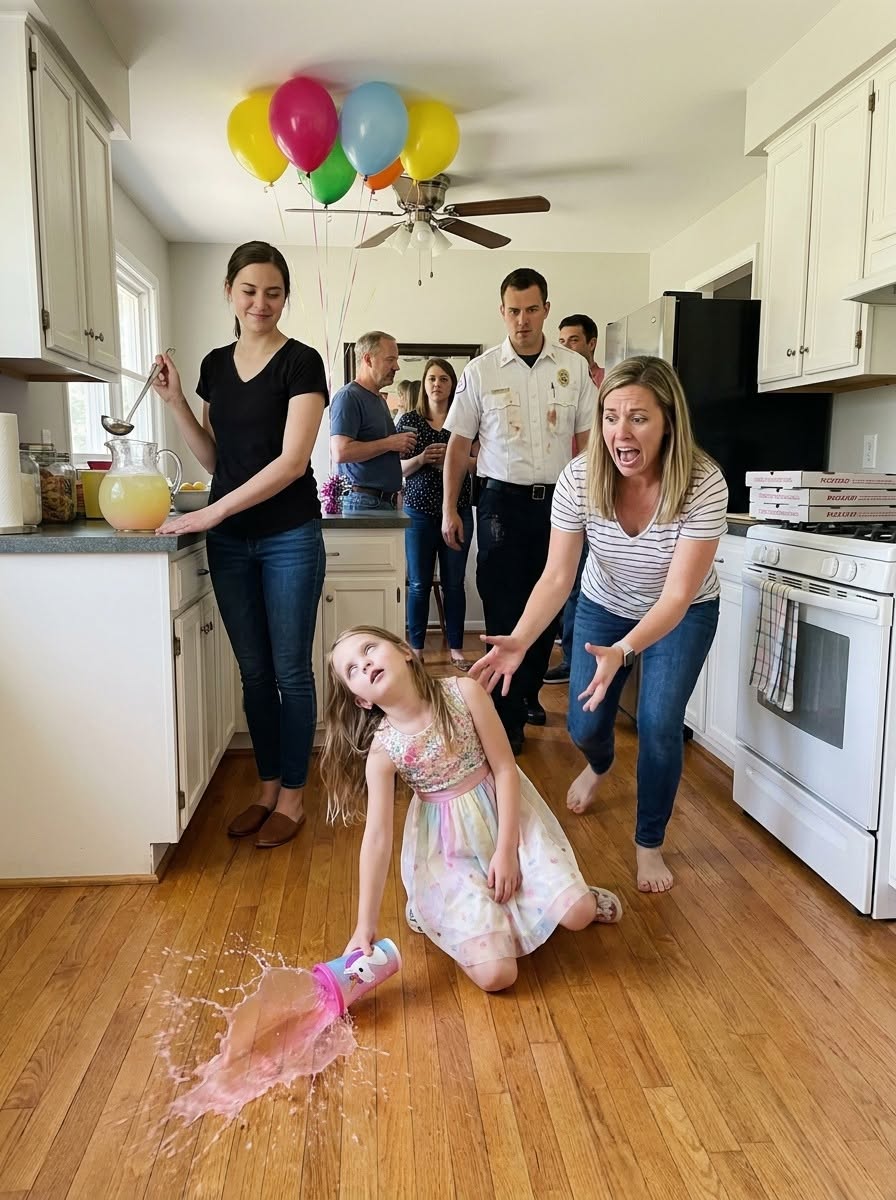
Harper stood at the center of the children with both hands wrapped around her favorite unicorn cup, laughing so hard at something one of her friends had said that another little girl started hiccupping.
Then Harper’s laugh stopped.
Her fingers loosened first.
The unicorn cup slipped from her hands and struck the hardwood with a hollow plastic bounce, spilling pink lemonade in a widening puddle beneath the kitchen table.
Her knees folded beneath her before I could reach her.
She did not put out her hands to catch herself.
She simply dropped.
“Harper?” I said, because my mind refused to understand what my eyes had already seen.
Her eyes rolled upward, unfocused and wrong, and the sound coming from her chest was so thin that it barely seemed like breathing.
“Harper!”
I was on the floor before I remembered moving, one hand under her shoulder and the other touching her cheek as I screamed her name again and again.
The children stopped laughing.
Someone began crying near the refrigerator, and a parent pulled two kids backward so quickly that a chair scraped across the floor and struck the wall.
I could hear people asking what happened, but none of the questions made sense because Harper had been fine seconds earlier.
She had been laughing.
She had been waiting for us to light the candles.
She had asked me twice that morning whether she could make the first slice of cake extra big because it was her birthday and birthday rules were different.
Now her small body felt frighteningly loose beneath my hands.
My husband, Nolan, had walked through the back door only minutes earlier after finishing a first-responder shift.
His uniform shirt was still creased across the shoulders, and a brown coffee stain marked one cuff from the gas-station stop where he had picked up the extra bag of ice I forgot.
He had barely set the ice beside the sink when Harper fell.
Nolan pushed through the guests and dropped beside her with a focus that frightened me more than panic would have.
Panic would have meant he was only her father.
That terrible calm meant he understood how serious this might be.
“Move the chair,” he said without looking up. “Give her air.”
Someone pulled the chair away.
Nolan checked Harper’s airway and then pressed two fingers against her wrist, his face changing by almost nothing.
That almost-nothing terrified me.
“Camille, what did she eat or drink?”
“Cake,” I said automatically.
Then I looked at the cake and realized only a few pieces had been cut for the children who arrived early, and Harper’s plate still held most of hers.
“No—the cake had barely been touched. Lemonade. She drank the pink lemonade.”
Across the kitchen, my older sister Sabrina stood beside the drink table, still holding the plastic ladle she had used to fill the children’s cups.
She was not rushing toward Harper.
She was not asking whether she was breathing.
She was watching.
One corner of Sabrina’s mouth twitched upward.
It was not a full smile, and it vanished almost immediately, but I saw it.
For years, I had been trained to notice the fraction of a second when someone’s expression failed to match the moment around them.
I had never expected to use that skill at my daughter’s birthday party. “Camille, sweetheart,” Sabrina said, her voice soft and polished, “please don’t make this dramatic. Kids get overtired at parties all the time.” My hands stopped shaking for one stunned second. Harper was barely responsive on the floor, and my sister was warning me not to be dramatic. I knew that tone. Sabrina used it whenever she wanted to turn disagreement into evidence that something was wrong with me. She used it when she told our parents I was “too emotional” to help run the family business. She used it whenever I questioned a decision she had already made and wanted everyone else to believe I was creating trouble instead of noticing it. Three months earlier, she had used the same syrupy voice during a meeting at the county clerk’s office when she suggested that my voting shares in the family business should be moved “temporarily” into a trust until I was more stable. The word temporarily had sounded harmless. The word stable had not. Stable never meant calm in my family. It meant quiet. It meant cooperative. It meant allowing Sabrina to make decisions while our parents avoided conflict and called their silence neutrality. Most of all, it meant becoming convenient. Nolan looked up from Harper, his jaw tightening as he followed my stare across the kitchen. “What exactly did she drink?” he asked. “The lemonade Sabrina mixed,” I said. For one blink, Sabrina’s face changed. Her mouth flattened, and something sharp moved through her eyes before she carefully tilted her head and offered the room a patient smile. It was the expression she used when she wanted everyone to believe she was the only reasonable person present. “Or maybe Camille mixed something up while prepping the food,” Sabrina said. “She’s been overwhelmed lately. We all know that.” The kitchen went still in a way that felt worse than noise. My father lowered his eyes toward the floor. My mother stared at the unopened birthday candles as though they required all of her attention. Parents held crying children against their shirts, shifting uneasily as Sabrina’s accusation settled over the room. Nobody defended me. Nobody told her that a mother screaming over her collapsed child was not instability. Nobody asked why Sabrina was more interested in blaming me than helping Harper. That silence should have broken me. Instead, something inside me became very clear. My tears stopped. Before my life became school pickup lines, packed lunches, lost sneakers, and remembering which stuffed animal Harper needed after a bad dream, I had spent nine years working as a senior corporate fraud investigator. My job had rarely looked dramatic from the outside. Most of it happened under fluorescent office lights, surrounded by spreadsheets, access records, payment histories, timestamps, ordinary emails, and people who insisted that every suspicious detail had an innocent explanation. I learned that evidence seldom arrived with a spotlight around it. It appeared in routines that did not line up. It appeared in an invoice submitted twice, a login from the wrong device, a meeting someone claimed never happened, or a person who answered a question before anyone had asked it. I also learned that panic and calculation did not look the same. A frightened person watched the victim. A calculating person watched the room. Sabrina was not looking at Harper. She was studying everyone else. Her gaze moved from Nolan to me, then to our parents and the guests nearest the drink table, measuring what they believed and how quickly she could control it. Guilty people did not always run. Sometimes they stayed exactly where they were and waited to see who had noticed the trail. My mind began sorting the afternoon into pieces. At 2:14 p.m., Sabrina had texted me, Let me handle drinks so you can enjoy your baby’s day. At the time, I had felt grateful. I had been icing the cake, answering the door, checking the pizza order, and trying to keep Harper from opening her presents before the other children arrived. Sabrina’s offer had sounded like help. At 2:37 p.m., she carried two grocery bags through my front door and set them beside the drink table. I remembered the time because Nolan had texted that he might be late, and I had checked the clock while opening the door for her. She had smiled, kissed my cheek, and told me to stop worrying about everything. Then she took over the cups, ice, and pitcher without being asked twice. At 3:06 p.m., Sabrina walked down the hallway toward the laundry room with Harper’s unicorn cup in one hand. I had not seen that part with my own eyes. The hallway camera had. Nolan installed the basic security system after someone stole packages from our porch the previous winter. There was a doorbell camera facing the driveway, another camera in the hallway, and a small black kitchen camera mounted above the pantry door to cover the back entrance. The cameras were not hidden. Sabrina had visited our home enough times to know they existed. She remembered the one near the front door. She remembered to enter carrying ordinary grocery bags and wearing the pleasant expression of an aunt arriving early to help with a birthday party. But she forgot the pantry camera. From its angle above the door, the camera faced more than the back entrance. It also captured the drink table, part of the kitchen counter, and the hallway leading toward the laundry room. Nolan slid one arm beneath Harper’s back and another beneath her knees. He lifted her carefully, holding her close enough to protect her neck while still watching her breathing. “Call 911,” he said. “I already did,” someone whispered behind me. A guest near the living room stood with a phone pressed to her ear, her free hand trembling against her chest. Sabrina stepped forward at last, but she did not reach for Harper. She kept the ladle in her hand. “Everyone needs to calm down before accusations start flying,” she said. The words were aimed at the room, not at me. She wanted witnesses to remember that she had been calm and I had been hysterical. She wanted the story organized before anyone examined the facts. I remained beside Nolan as he held Harper, keeping one hand around her socked foot because letting go felt impossible. Her sock had tiny silver stars around the ankle, chosen that morning because she said they matched the sparkles on her unicorn cup. The cup now lay on its side beneath the table. Pink liquid slipped slowly between the floorboards while a paper napkin absorbed the edge of the spill and turned darker by the second. I looked at the pitcher. I looked at the cup. I looked at the ladle still trapped in Sabrina’s tightened fingers. For one violent instant, I wanted to grab the pitcher and throw it against the wall. I wanted to scream every accusation that was racing through my mind. I wanted to force my parents to look at the daughter they had protected and the granddaughter lying limp in her father’s arms. But rage was loud. Evidence was quiet. Loud people could be dismissed. Quiet records could not be shamed, interrupted, or told they were remembering things incorrectly. So I swallowed the rage until it burned behind my ribs. Sabrina watched me closely, waiting for the explosion she could use. She wanted me to shout first. She wanted me to make a claim before I could support it. She wanted to point at my fear and call it proof that I was unstable. I refused to give her that gift. Instead, I looked toward the pantry door. The camera above it was small enough to disappear into the ordinary clutter of our kitchen, but from where I knelt, its dark lens was plainly visible. It had been there through the entire party. It had watched Sabrina set down the grocery bags. It had watched her arrange the cups. It had watched Harper drink. And unless Sabrina had somehow accounted for every angle, it had watched whatever happened in between. “Nolan,” I said. My voice sounded unfamiliar—low, controlled, and stripped of everything except purpose. He looked at me without shifting Harper in his arms. “The pantry camera.” Sabrina’s fingers tightened around the ladle. The thin plastic handle bent slightly under her grip. Nolan turned his head toward the small black camera mounted above the pantry door. Then his eyes moved to the unicorn cup on the floor. He looked at the half-empty pitcher on the drink table. Finally, he looked directly at my sister. The room followed his gaze. My father lifted his head. My mother finally looked away from the candles. The parents nearest the kitchen stopped murmuring, and even the crying children seemed quieter as the adults understood that Nolan was no longer asking a general question about what Harper had consumed. He was asking who had controlled it. Sabrina adjusted her grip on the ladle and gave a small, almost offended laugh. It was the kind of sound meant to suggest that the suspicion itself was ridiculous. But she did not ask whether Harper was breathing. She did not ask what Nolan needed. She did not put down the ladle. Nolan’s voice stayed quiet. That quiet carried farther than a shout. “Who made this drink?” For the first time all afternoon, Sabrina looked less like a helpful aunt at a birthday party and more like someone realizing the walls had been watching her.