He used a hydraulic press on my fingers one by one as punishment for talking back.
The bones crushed slowly while he smiled.
“These hands are useless if they can’t give me a son.”
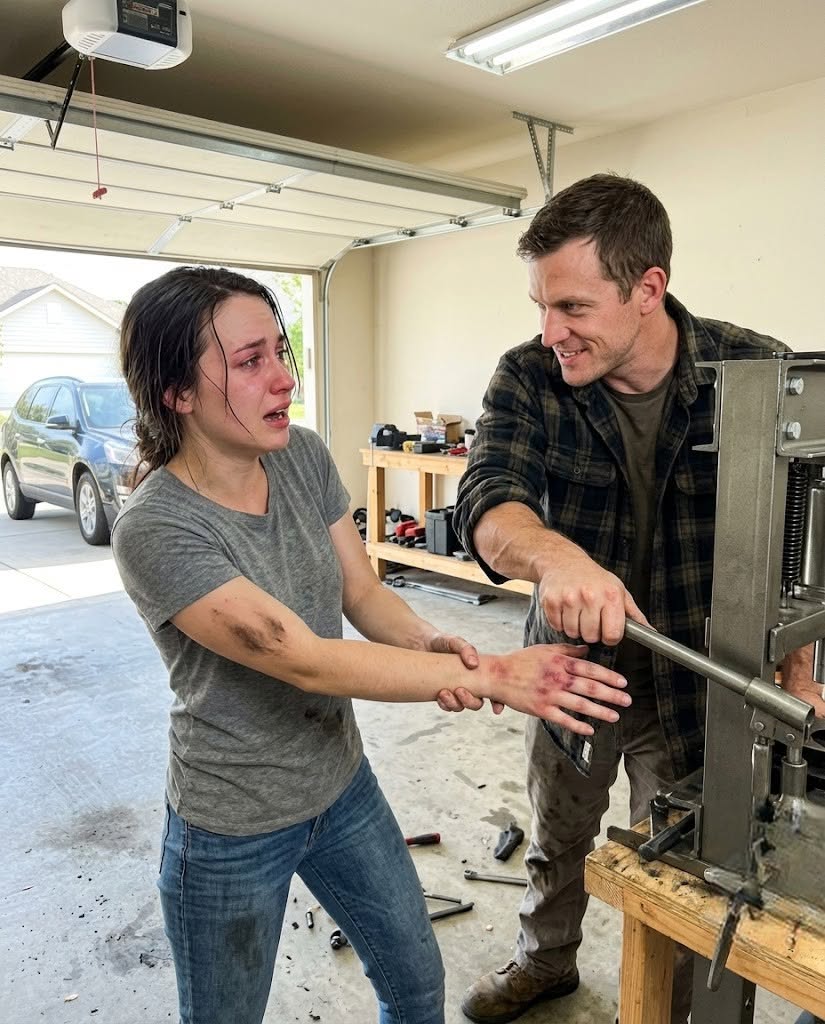
I screamed until I blacked out.
The doctor held the films and told me several fingers could not be saved because the damage was irreversible.
For a few seconds, the treatment room disappeared behind the sound of the paper beneath me.
Every small movement made it crackle, and that ordinary hospital noise felt strangely loud against the pounding in my hands.
The bandages were so thick that my arms seemed to end in two white shapes that belonged to someone else.
Pain pushed through the medication in bright waves, sharp enough to steal my breath before slowly releasing it again.
The doctor did not stand over me when he spoke.
He crouched beside the exam table until his face was level with mine, as if he understood that I had spent too long being forced to look up at men who expected obedience.
“Erin,” he said, “your husband told the front desk this was a workshop accident.”
He paused before asking the question that would divide my life into before and after.
“I need you to tell me whether that is true.”
My first instinct was not to tell him what Caleb had done.
My first instinct was to ask whether Caleb was angry. Even in that room, with my fingers crushed and my future changed, part of me was still measuring the danger by his mood. That was how far he had trained me away from myself. I looked toward the closed treatment-room door. Through the narrow pane of glass, I could see Caleb pacing the corridor in his work boots. There was a dark grease mark on one knee of his pants, and he kept rubbing his thumb across his palm as he repeated the story he had prepared. I had slipped while helping him in the garage. I had reached toward the machine before he could stop me. He had pulled me away as fast as possible. He had driven me to the hospital because he was a worried husband. The lie was clean because he had practiced making lies sound reasonable. Caleb rarely shouted in front of strangers. He saved shouting for the house, the garage, the car, and any other place where there would be no witness to compare his public voice with the one I knew. The doctor waited. He did not tell me what I should say. He did not call Caleb a monster. He gave me something Caleb had not given me in years: enough silence to hear my own answer. “It wasn’t an accident,” I said. The words came out so quietly that I thought the doctor might ask me to repeat them. He did not. He pulled a stool closer and sat down. “Tell me what happened in your own words.” The black grease on my sleeve brought the garage back before I was ready. I saw the steel frame of the hydraulic press bolted to the concrete floor. I smelled hot oil and metal. I heard the small mechanical complaint of the lever moving down. More than anything, I saw Caleb’s face. He had not looked out of control. That would have been easier to understand. He had looked calm. He had looked certain. He had smiled each time I begged him to stop. The argument had started with the fertility report in my purse. For six years, every negative pregnancy test had become evidence against me. Caleb counted months as if my body were a clock that kept failing him. He blamed the stress I carried from work. He blamed the coffee I drank in the morning. He blamed the few pounds I had gained one winter. He blamed the fact that I had waited too long to schedule another appointment. Whenever a doctor suggested that both partners should be evaluated, Caleb found a reason not to go. He was too busy. The appointment time was inconvenient. The clinic was trying to make money. Real men did not need tests. Eventually, the story became so familiar that I stopped noticing how much of my life had been rearranged around it. I stopped accepting baby-shower invitations because Caleb would punish me with silence afterward. I stopped calling Claire when I was upset because he said sisters turned wives against husbands. I stopped buying things for myself because every dollar, according to him, should be saved for treatments that were supposedly necessary because of my failure. The cruelest part was not that he lied once. It was that he built our marriage around the lie and made me carry it. The clinic had finally completed the testing he could no longer avoid. I went alone to collect the report because Caleb said he was working. I read the first page in the parking lot. Then I read it again because the words did not match the life I had been living. The fertility problem was not mine. The report explained that clearly. I sat behind the wheel with the papers in my lap and thought about six years of apologies I had never owed. I thought about all the nights I had cried quietly in the bathroom so Caleb would not accuse me of being dramatic. I thought about every time he had told me that another woman would have given him the family he deserved. I did not feel triumphant. I felt hollow. Truth does not always arrive like freedom. Sometimes it arrives like an invoice for every year you spent believing a lie. I put the report in my purse because I was not ready to confront him in the parking lot or over the phone. I wanted to read it one more time. I wanted to ask the doctor questions. I wanted one evening in which the truth belonged only to me. Caleb found the papers before I had decided what to do. He was searching my purse for a receipt, or at least that was what he claimed. When I walked into the kitchen, he was standing at the counter with the report open beneath his hands. The color had drained from his face, but his voice was hard. “What is this?” “You know what it is,” I said. He told me the clinic had made a mistake. I said the doctor’s name was on the report. He said I had misunderstood the numbers. I pointed to the conclusion written in plain language. For once, there was nowhere for him to move the blame. I asked him how long he had known. That was the moment his fear turned into anger. He called me a liar even though the evidence was under his hand. He accused me of going behind his back. He said I had humiliated him by discussing private matters with people who were not part of our marriage. Then he tore the report in half. The sound was small, but it changed the room. I reached for the pages. Caleb grabbed my wrist. He pulled me through the door leading to the attached garage, and I remember stumbling over the raised threshold because one of my shoes caught. The afternoon sun was still coming through the open garage door. A family SUV sat in the driveway. Someone’s lawn mower hummed several houses away. The normal world was close enough to see, but not close enough to help. Caleb pushed me toward the press. I knew the machine because he used it for metalwork and repairs. I had watched him operate it before. It had always seemed slow and controlled, which was exactly what made it terrifying in his hands. He said I needed to learn what happened to women who embarrassed their husbands. I told him the report was about his health, not his worth. That sentence made him smile. Not kindly. Not nervously. It was the cold, narrow smile he wore when he believed he had found the place where I was weakest. He forced my hand toward the steel platen. I fought him. I twisted my shoulder and tried to pull free. He was stronger, and he knew I was afraid of making him angrier. He moved the lever. The machine lowered. Pain erased the garage. When he released the pressure, I thought it was over. Then he repositioned my hand. That was when I understood this was not a burst of rage. It was punishment. He was choosing each movement. He was listening to me beg. He was deciding to continue. “These hands are useless if they can’t give me a son,” he said. By the time everything went black, my own voice no longer sounded human to me. I woke with Caleb standing over me. For one confused second, he looked frightened. Then the frightened look vanished and the planning began. He wrapped my hands in shop towels. He told me what I would say at the hospital. I had slipped. I had panicked. I had grabbed the machine. He had tried to stop me. He repeated the story in the car until the words began to sound like instructions I had known all my life. At the emergency entrance, he answered questions before anyone asked me. He held my purse. He stayed close enough that I could feel his attention every time a nurse looked my way. The staff separated us for imaging. That brief separation was the first opening I had been given. The films showed what his story could not hide. The injuries had not happened in one accidental compression. The damage was separate. Repeated. Deliberate. The doctor did not use that last word immediately, but it was present in the care he took with every question. He asked when I had last eaten. He asked what medications I had received. He asked whether I felt safe going home. Then he asked whether there was anyone I trusted. “My sister,” I said. Claire’s name felt strange in my mouth because I had spent years using it less and less. Caleb said she interfered. He said she was jealous of our marriage. He said she enjoyed imagining that I needed rescuing. The truth was simpler. Claire asked questions he did not want me to answer. A nurse called her from the room. Another staff member went into the corridor and told Caleb he could not come back without my permission. I heard his voice change immediately. He became polite. He said there had been a misunderstanding. He said his wife was frightened and confused. He said he only wanted to comfort me. Then the door opened. Caleb entered without waiting. My purse was tucked under one arm. His anger was hidden beneath the careful expression he used around people who could challenge him. “Tell them you were upset,” he said. His voice was low and gentle enough that someone passing the door might have mistaken it for concern. “Tell them you grabbed the machine.” I had seen that performance before. The concerned-husband face. The warning buried inside a request. The promise that things would become worse if I embarrassed him in front of another person. For years, I had accepted the promise. This time, the doctor was standing beside me. This time, my injuries were glowing on the wall. This time, Claire was already on her way. And this time, I was done helping Caleb erase what he had done. “I did not grab the machine,” I said. Caleb’s eyes sharpened. I felt the old reflex rise in me, the one that wanted to soften the sentence and protect him from consequences. I forced myself to continue. “You put my hand there.” He glanced at the doctor and gave a tired little shake of his head. “You’re confused from the medication.” The doctor did not raise his voice. “She made her first statement before receiving pain medication,” he said. “It is documented.” For the first time since entering the room, Caleb had no immediate answer. He set my purse on the counter too hard. The clasp opened. The torn fertility report slid onto the floor, one half landing faceup and the other folding near the doctor’s shoe. Claire arrived at the doorway at almost the same moment. Her hair was loose from running, and she was still holding her car keys. She looked at my bandaged hands. Then she looked at Caleb. Her face changed, but she did not waste the moment screaming at him. She came straight to me. The doctor bent and picked up the report. He read the first page. Then he matched it with the second torn half. His expression shifted, not with surprise, but with understanding. “This report says the fertility problem was never Erin’s,” he said. The room seemed to narrow around that sentence. Caleb looked at me. I could see him trying to decide which lie might still work. He could say the report was wrong. He could say I had misunderstood it. He could say the doctor was intruding. He could say Claire had poisoned me against him. Instead, he said the one thing that exposed more than any denial could have. “She wasn’t supposed to see that report.” Nobody had accused him of hiding it. Nobody had asked whether he had read it first. He admitted both because control had become so natural to him that he no longer recognized the confession inside his own words. The doctor looked at him for a long second. “Why wasn’t she supposed to see her own medical report?” Caleb opened his mouth. Nothing came out. Claire placed one hand on my shoulder, careful not to touch the bandages. Her breathing was still fast from running down the corridor, but her voice was steady. “Answer him.” Caleb tried to rebuild the public version of himself. He said the clinic had sent the report to the house. He said he wanted to protect me from being upset. He said years of disappointment had made me unstable. He said I had been emotional all afternoon. But the torn pages were in the doctor’s hand, and the images of my injuries were still illuminated behind him. One record said the fertility problem was Caleb’s. The other showed separate compression injuries to my hands. His explanation could not hold both facts at once. The doctor told him to leave the room. Caleb stepped toward the exam table instead. “Erin,” he said, “tell them this is between us.” For years, that sentence had closed every door. It had kept bruises inside the house. It had turned broken dishes into private misunderstandings. It had made missed dinners and unanswered calls seem like matters no decent wife would discuss. This time, Claire moved between us. I looked at Caleb and understood that privacy had never been what he wanted. He wanted isolation. “No,” I said. “It stopped being between us when you put my hand in that machine.” A staff member opened the door and repeated that Caleb had to go. He stared at me as if I were the person who had broken a vow. Then he backed into the corridor. The door closed between us. I expected to feel brave. Instead, I shook so hard that the paper beneath me crackled again. Claire kept her hand on my shoulder. The doctor turned back to the report. “Erin,” he asked, “did Caleb know what this said before he hurt you?” I looked through the glass in the door. Caleb was standing in the corridor, watching me. His face answered before his mouth ever could. He had known. That realization did not make the pain smaller. It did not restore my hands or give back the years I had spent apologizing for a failure that was never mine. But it returned one thing he had tried to take before the machine ever touched me. The truth belonged to me again. I told the doctor to write down everything. I told Claire not to let Caleb take my purse or the torn report. I repeated the sentence about the press one more time, not because they doubted me, but because I needed to hear myself say it without asking anyone’s permission. Caleb had called my hands useless. Yet even wrapped in thick bandages, they rested in my lap as proof that I was still here. He had tried to punish me for reading the truth. Instead, the truth was the first thing that opened the door.