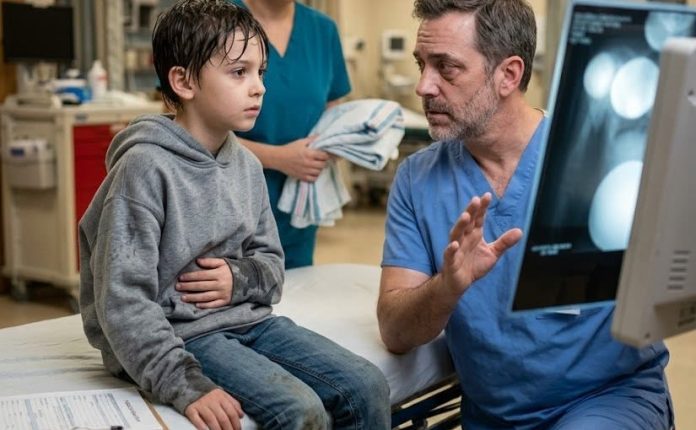
Richard stood over his six-year-old son while I cut through a cast that had been rebuilt at home and said, “He lies whenever strangers ask questions.”
He believed the extra plaster had sealed away whatever happened before Tommy reached our clinic.
He did not know that a rusted brass key and a note wrapped in plastic were pressed against the child’s bruised leg.
I had been a pediatric orthopedic technician for fourteen years, long enough to know that children bring their fear into an exam room in a hundred different ways.
Some ask the same question five times.
Some cover their ears before the cast saw even starts.
Some stare at their parent and wait for permission to cry.
Most of the time, the fear loosens once I explain what will happen.
I show them the small vibrating blade, touch it against my gloved palm, and tell them it is designed to cut the hard cast material without slicing their skin.
The machine is loud.
That is usually the worst part.
A nervous child hears the buzzing, watches a line appear in the fiberglass, then breathes again when the shell opens and the padding peels away.
The appointment ends with relief.
Tommy’s appointment felt wrong before I switched on a single tool.
It was the middle of July, the kind of day when heat shimmered above the clinic parking lot and every patient who came through the front door paused beneath the air vent.
The glass in the waiting-room windows looked almost white from the glare.
Parents carried sweating paper cups.
Children arrived in shorts, sandals, and T-shirts that stuck to their backs.
Tommy came in wearing an oversized hoodie.
The sleeves covered most of his hands.
His shoulders were pulled inward, and his whole body trembled hard enough that his teeth clicked.
His father, Richard, pushed the wheelchair into the room and positioned it beside the exam table with quick, irritated movements.
He did not ask Tommy whether he was comfortable.
He did not help him settle.
He placed one hand over the boy’s uninjured knee and kept it there.
At first glance, the gesture could have looked reassuring.
Then Tommy shifted.
Richard’s fingers tightened.
The boy stopped moving.
“Let’s get this over with,” Richard said. “We have somewhere to be.”
His tone did not carry the nervous impatience I sometimes heard from parents worried about missing work or getting another child from school.
It sounded like a warning directed at everyone in the room.
I opened Tommy’s chart and read the diagnosis that had followed him from clinic to clinic.
A rare bone-density disorder.
Frequent fractures.
Special precautions.
Seven injuries had been recorded in less than two years.
For a six-year-old, seven fractures should have created a trail of specialist appointments, imaging reviews, genetic testing, and treatment plans.
Tommy’s file had none of that.
There was no report from a pediatric bone specialist.
There were no genetic results.
There was no clear explanation of what disorder he supposedly had.
What the chart did contain were repeated accounts from Richard.
Tommy fell from a couch.
Tommy slipped on playground equipment.
Tommy tripped in a hallway.
Tommy was “too fragile for normal life.”
Each story could have been possible by itself.
Together, without supporting medical documentation, they formed a pattern that did not fit.
I did not say that aloud.
In a pediatric clinic, suspicion has to be handled carefully because a frightened adult can remove a child before anyone has time to understand what is happening.
I lowered myself until I was closer to Tommy’s eye level.
“The saw is going to sound scary,” I told him, “but it only cuts the hard material. It won’t hurt your skin.”
He kept looking down.
Then, slowly, he raised his eyes to mine.
Before he answered, his gaze snapped toward Richard.
“Please don’t look inside,” he whispered.
The words were so quiet I almost thought the air conditioner had swallowed them.
Richard gave a short, humorless laugh.
“See?” he said. “Always making things up.”
Children sometimes say strange things when they are scared.
They ask whether a cast contains bugs.
They worry that a toy has somehow fallen inside.
They imagine the saw cutting all the way through their leg.
But Tommy had not asked whether something was inside.
He had asked me not to look.
That difference mattered.
I checked the room without turning my head too obviously.
Elena, the nurse assigned to the clinic that afternoon, stood near the counter preparing fresh gauze.
She had worked with me long enough to notice when my voice changed.
I positioned the casted leg and turned on the saw.
The motor filled the room with its familiar mechanical whine.
Tommy jerked so hard that the white exam-table paper ripped beneath him.
Richard’s hand pressed down harder on the boy’s other knee.
I brought the blade to the cast.
Instead of giving way, the surface resisted.
A properly applied pediatric cast has predictable layers.
The blade should move through the outer shell in seconds while the padding beneath protects the skin.
This cast was different.
The calf section was almost twice as thick as it should have been.
Uneven ridges ran along one side.
Patches of yellowed material sat over the original hospital fiberglass like old repairs on a damaged wall.
The saw kicked against the surface.
Dark gray dust sprayed over my gloves and settled across the paper.
That dust was the first physical sign that someone had added material we did not use.
The smell was the second.
Industrial resin.
Old sweat.
And something metallic beneath both.
Rust.
I shut off the saw.
The sudden silence made Tommy’s uneven breathing easy to hear.
“Was this cast repaired outside the hospital?” I asked.
Richard’s expression changed.
It lasted less than a second, but years of watching adults in exam rooms had taught me to notice the moment before a lie settles into place.
His eyes widened.
His jaw loosened.
Then his face closed again.
“No.”
“There’s material here we don’t use.”
“I said no.”
He stepped closer to the table.
“Cut it off and stop interrogating us.”
The room seemed smaller after that.
The heat outside pressed against the window, while the clinic air stayed cold enough to raise bumps on my forearms.
I looked toward Elena.
“Can you bring me the blue tray?”
There was no blue tray in our clinic.
The phrase was part of a safety protocol used when a staff member needed security without announcing it to a patient or guardian.
It allowed us to ask for help without turning a tense room into a dangerous one.
Elena did not hesitate.
She set down the gauze and walked out.
Richard watched the door close behind her.
He had heard the words, but he did not know what they meant.
Still, he understood that the balance in the room had shifted.
“We’re done,” he said.
He reached for the wheelchair handle.
I stepped between him and Tommy.
“The cast is already open,” I said. “Moving him now could injure his leg.”
Richard stared at me.
For the first time since they entered the room, he removed his hand from Tommy’s knee.
Tommy pulled his leg away from him immediately.
It was not a slow adjustment for comfort.
It was the reflex of someone escaping pressure the moment it disappeared.
That small movement told me more than any sentence in the chart.
I placed the saw on the opposite side of the cast.
Tommy’s fingers disappeared farther into the sleeves of his hoodie.
“I need to finish this cut,” I told him. “I’m going to go slowly.”
He did not answer.
I turned the machine on again.
The blade traveled a few inches before it struck something solid beneath the plaster.
A sharp metallic click cut through the motor noise.
Richard swore.
Tommy started crying.
No sob came out.
Tears slid down his face while he kept his mouth shut, as if he had learned that crying was safer when no one could hear it.
I stopped the saw and looked at the cut line.
Metal did not belong there.
A cast might contain approved support material, but it would be documented, properly placed, and visible on imaging.
This felt crude.
Hidden.
Improvised.
The door opened.
Elena came back into the room carrying an empty tray because appearances still mattered.
Behind her, just outside Richard’s line of sight, stood our clinic manager and two security officers.
Elena placed the tray on the counter and met my eyes.
Help had arrived.
Richard could not see the officers from where he stood.
I reached for the metal spreaders used to separate a cut cast.
The tips slid into the opening.
When I applied pressure, the cast did not flex the way normal fiberglass does.
It cracked.
The sound was dry and ugly, more like a shell breaking than medical material releasing.
One half came away.
For a second, no one spoke.
A narrow steel ruler had been taped against Tommy’s calf as a homemade splint.
Industrial adhesive had hardened along its edges.
The placement was uneven, and the ruler pressed into the padding instead of supporting the leg correctly.
Beneath it, Tommy’s skin was discolored.
Some bruises were darker.
Others had already begun to fade.
The different colors suggested they had not all happened at the same time.
I felt anger rise so quickly that it tightened my hands.
Anger is not useful when a child needs you steady.
I forced my grip to loosen.
The most important thing in that room was not confronting Richard.
It was keeping Tommy where trained people could see him, hear him, and protect whatever evidence the cast contained.
Then I noticed the plastic.
At first it looked like a wrinkle in the padding.
I moved the edge aside with gloved fingers.
A tiny zippered bag had been pushed deep between the cast lining and Tommy’s leg.
It was positioned where someone removing the cast carefully would find it, but where a quick glance from the outside would reveal nothing.
Inside the bag was a folded square of notebook paper.
Beside it sat a rusted brass key.
Richard saw the bag at the same moment I did.
His attention fixed on it so completely that the rest of the room seemed to vanish for him.
“Give me that,” he said.
The order came out low and immediate.
Tommy’s hand shot from his hoodie sleeve and grabbed my scrub top near the elbow.
“Don’t let him take the key.”
His voice was louder than before.
The entire room froze.
Elena held the removed cast half in both hands.
The clinic manager remained just beyond the doorway.
The empty blue tray sat beneath the bright overhead lights.
Gray plaster dust covered the torn paper on the exam table.
No one moved for one long second.
Then I lifted the bag out with both hands.
Evidence found in a medical setting has to be handled carefully, especially when it may explain an injury.
I did not shake it.
I did not unfold the paper immediately.
I passed the cast half to Elena exactly as it had come away, preserving the ruler, padding, adhesive, and layered plaster in place.
Richard stepped toward me.
One of the security officers entered and moved into his path.
The officer did not touch him.
He simply took up the space between Richard and the exam table.
“This is a family matter,” Richard snapped.
His voice had risen, but the control underneath it was starting to fracture.
“That boy steals things. He lies. Whatever is in there means nothing.”
Tommy still held my sleeve.
His grip was weak.
He refused to let go.
A child who had been described as fragile, dishonest, and difficult had managed to hide an object inside a cast thick enough to resist a medical saw.
He had wrapped the paper in plastic.
He had kept the key pressed against his own injured leg.
He had waited until someone outside his home removed the cast.
None of that looked impulsive.
It looked planned by a child who believed he might get only one chance.
I lowered myself to one knee beside the exam table.
The movement placed me between Tommy and Richard without making the protection feel dramatic.
Elena shifted closer to the boy’s other side.
The security officer kept his body angled toward Richard.
I opened the small zipper on the plastic bag.
The rusted key dropped into my palm.
It was old, with dark oxidation around the teeth and a worn round head.
The paper had been folded again and again until it formed a square no larger than a postage stamp.
Purple crayon showed through the back.
The waxy lines were heavy enough to leave raised ridges beneath my glove.
Richard’s confidence disappeared.
He stopped arguing with the officer.
His face lost color.
“Do not read that,” he said.
The words were quieter than everything he had said before.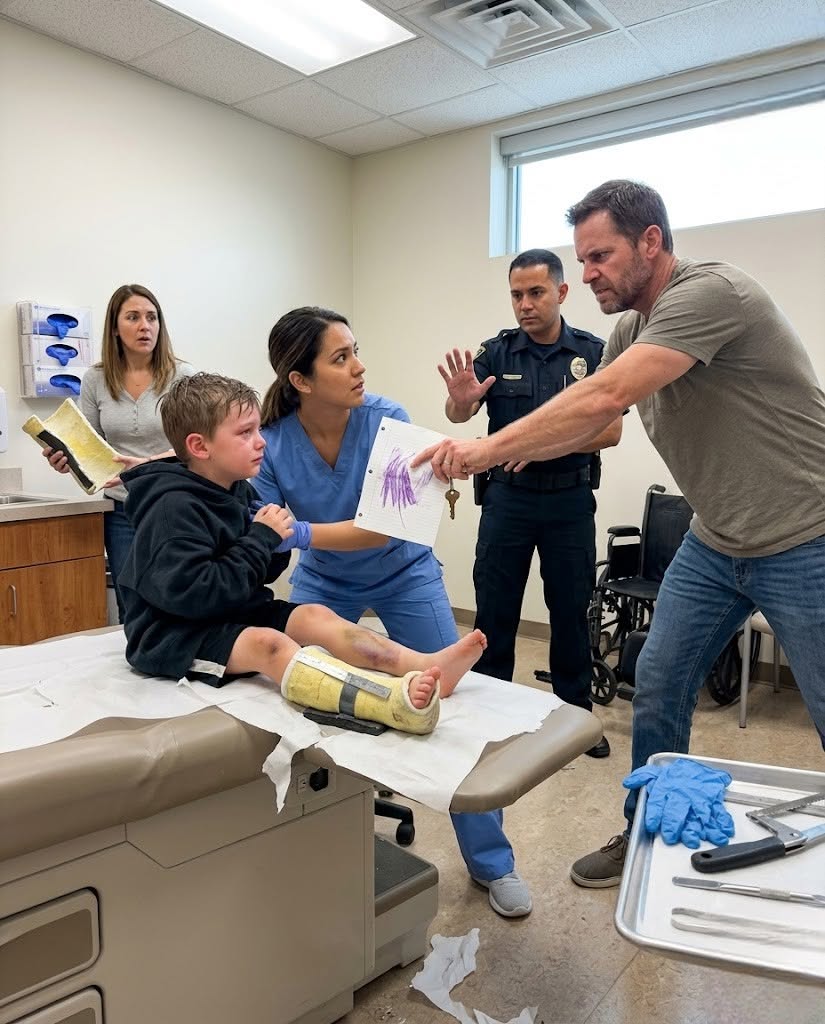 That made them more alarming.
I looked at Tommy.
His eyes were fixed on the folded paper.
He was still crying silently, but he gave the smallest nod.
I began to unfold it.
One crease opened.
Then another.
The notebook paper had softened from being held against the warmth of his leg.
The plastic had protected the writing from sweat and cast dust.
Purple letters appeared one piece at a time.
Richard leaned far enough to see over the edge of the table.
He read the first line before I did.
His face went white.
Then he lunged across the exam table.
That made them more alarming.
I looked at Tommy.
His eyes were fixed on the folded paper.
He was still crying silently, but he gave the smallest nod.
I began to unfold it.
One crease opened.
Then another.
The notebook paper had softened from being held against the warmth of his leg.
The plastic had protected the writing from sweat and cast dust.
Purple letters appeared one piece at a time.
Richard leaned far enough to see over the edge of the table.
He read the first line before I did.
His face went white.
Then he lunged across the exam table.