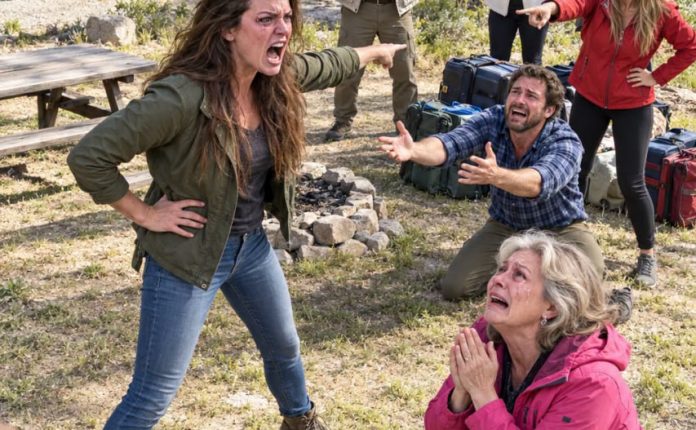
At first light, Lily tried to stand and sat down again.
“My head went funny.”
I felt her forehead with the back of my hand. No fever. Her lips were dry, and the cut on her heel had opened against her sock.
We had less than half a bottle of water between us.
I made her take three small drinks while I unwrapped the last granola bar.
She broke her piece in two.
“For later.”
“You can eat it.”
“What if later is worse?”
I wanted to tell her that children should not have to ask questions like that.
Instead, I put her saved piece back in the wrapper.
The rain had stopped. Mist hung among the firs, and the stream beneath the bridge sounded louder than it had the day before.
I considered trying the road again.
Then Lily leaned against the log with her eyes closed, and I knew I could not ask her to walk miles toward an unknown junction.
I also could not leave her.
We stayed.
I widened the SOS using pale branches and gravel. Lily supervised from beneath the poncho.
At intervals, we shouted. Between those intervals, I listened so hard that every gust of wind became an engine.
The second morning passed.
Friday, according to the recorder, had been the day someone would check the packet.
It was Saturday now.
Whatever signal Nolan expected to see had not appeared.
Neither had he.
Near noon, Lily asked for the saved piece of granola bar. She ate it slowly, pressing crumbs from the wrapper with one finger.
I would remember that gesture years later while watching someone scrape frosting from a plate.
Small things remain attached to the worst days.
I took out the recorder once more.
The display blinked.
I needed to know whether the rest of the conversation contained a route, a road name, anything useful.
I advanced past the section about the lower gate.
Brooke said, “What about the check-in?”
Nolan answered that he would handle it.
Then Dad asked whether the road was public.
“Access road,” Nolan said. “Nobody comes up here unless they have a reason.”
The machine went silent before the conversation ended.
I pressed the button once.
Nothing.
I put it away.
That afternoon, I saw a helicopter.
It was a small dark shape above the ridge, traveling across the gray opening between two banks of cloud.
I shouted before I knew I was shouting.
Lily stumbled onto the gravel beside me.
We waved the poncho. I threw damp needles onto the fire to make smoke, then dragged them away when they nearly smothered it.
The helicopter passed beyond the trees.
For several seconds, nothing happened.
Then the sound changed.
It circled.
Lily dropped the poncho and began crying with her whole body, soundless at first, her mouth open.
I held her upright and kept one arm raised.
The aircraft could not land in our clearing. A voice over a loudspeaker instructed us to remain where we were.
I had never heard anything more welcome than an instruction from a stranger.
A ground team arrived later along the road.
The first person into the clearing was a woman in a red jacket carrying a medical bag.
“My name’s Tessa. How many people are here?”
“Two.”
“Anyone else missing?”
I looked at the empty tent patches.
“No.”
She knelt beside Lily.
“Hi. Can you tell me your name?”
Lily answered, then asked whether Tessa had water.
The woman’s expression did not change.
“Yes. We’re going to do this slowly.”
A deputy came through the trees behind her.
I handed him Nolan’s note before he asked me what had happened.
“My family left us,” I said. “They took our phones.”
He read the paper.
For the first time since waking in the empty camp, I saw another adult understand that something was wrong.
Later, I learned why anyone had been looking.
On Saturday morning, Mason had borrowed Brooke’s phone to contact Lily.
He found a message drafted for Monday, telling me where to leave the signed papers.
He asked his father why Lily needed to sign papers to come home.
Nolan took the phone.
Mason waited until they visited his grandmother’s house. Then he used her landline to call Julian, whose number he knew from helping at company picnics.
Julian had already been unsettled by a message sent from my phone Friday morning.
It said I was extending the trip and Nolan would cover anything urgent.
That alone might not have triggered a search.
Mason telling him we had been left in the mountains did.
Julian called law enforcement.
A deputy went to my parents’ house.
Dad initially described a family disagreement. Nolan said we had chosen to remain at camp, with supplies, and that he intended to collect us.
When asked where the camp was, he gave the road number.
The lower gate was locked.
Search crews obtained access.
Those hours mattered. So did a twelve-year-old boy deciding an adult’s answer was not enough.
In the ambulance, Lily would not release my sleeve.
The medic worked around her hand.
I answered questions about water, food, medications, the time we had last seen another person.
“How many nights?” he asked.
“Two.”
He looked at the date on his tablet.
It seemed impossible that the world outside our clearing had continued measuring ordinary time.
At the hospital, a nurse removed Lily’s wet socks. One had dried against the wound on her heel.
My daughter apologized for flinching.
“You’re allowed to hurt,” the nurse told her.
I turned toward the wall.
Julian arrived with clean clothes, chargers, and Maren.
He stopped inside the doorway, looked at Lily asleep beneath a warm blanket, and gripped the back of a chair.
“I should have checked sooner.”
“You checked.”
“Mason called at nine. We lost time getting someone to tell us—”
“You checked,” I repeated.
Maren set her bag down.
“Have you spoken to your family?”
“No.”
“Do you want to?”
“No.”
“Then you won’t.”
I handed her the recorder, notebook, and packet.
“Please make sure these don’t disappear.”
She did not promise an outcome. She told me what she could do.
The deputy would take the original physical evidence. Her office would arrange copies through the proper process. The recording would be preserved. Any questions about its use would be handled before it went anywhere public.
For the first time in weeks, somebody discussed my problem without suggesting that my emotions were the problem.
My family’s calls began that evening after I recovered my phone through the deputy.
Mom called seven times.
Dad left a message saying we needed to keep matters proportionate.
Brooke wrote that Mason was devastated and that the police were frightening him.
Nolan’s message was shortest.
You have misunderstood the purpose of this.
I took screenshots.
Then I gave the phone to Maren.
On Sunday, I went home with Lily.
A friend from the company stayed in our guest room. I checked the locks before unpacking anything.
Lily stood in the kitchen holding Mr. Buttons.
“Can I sleep where I can see you?”
“Yes.”
“Even if I wake up a lot?”
“Yes.”
We made a bed on the living room floor beside the sofa.
At three in the morning, she woke and asked whether I had the keys.
I put them in her hand.
She fell asleep holding the ring.
Monday should have been an ordinary return to work.
Instead, Maren came to the house with Julian and a forensic accountant named Priya.
Lily was upstairs watching a film with our friend. I could hear the same scene replaying because she kept falling asleep and restarting it.
Priya spread four pages across my kitchen table.
“I want to separate what we know from what we’re still checking,” she said.
The reference number on Nolan’s settlement authorization belonged to an older supplier review.
Five years earlier, Ethan had questioned payments to a packaging intermediary.
Nolan had been approving invoices from that company.
The prices were high, but that alone had not been the problem. Several deliveries had been billed twice under slightly different descriptions.
Ethan had recovered part of the money, removed Nolan from procurement, and ended his employment.
“Why didn’t he tell me?”
Julian looked down at his hands.
“He said he was going to. Then your mother called him.”
I closed my eyes.
I could imagine that conversation too clearly.
Nolan had a child. Nolan was ashamed. Nolan needed a chance to put things right without losing his sister.
Ethan had chosen a private repayment arrangement over a public fight.
He had kept the documents.
“He didn’t erase it,” Julian said. “Everything’s in the archived legal file.”
The packet in the tub would have given Nolan authority to negotiate away the remaining claim and approve a release.
His temporary access after Ethan’s death had also allowed him to see which records still existed.
Priya pointed to the newer transactions.
“There are additional attempted payments. Some were stopped when you revoked his authority.”
The amounts had not all reached bank accounts. The review was not finished.
But the purpose of the paperwork in the woods was no longer mysterious.
Nolan needed me to surrender control before I understood what he was trying to control.
Dad’s drafting had made it look orderly.
Mom’s concern had made it look loving.
Brooke had made sure the phones went into the case.
I sat at the table where Lily did her homework and read the same signature line until the letters lost their shape.
“I almost signed,” I said.
Maren moved the page closer to herself.
“You didn’t.”
“I considered it.”
“Of course you did. Your child was cold and hungry.”
That sentence allowed me to breathe.
By Tuesday, Cedar & Steam had secured its systems, notified the relevant banks, and instructed staff to preserve records.
Nolan had no formal role, but he had been presenting himself as the family’s temporary representative. A few vendors had believed him.
Julian called each one.
I sent a short internal message stating that I remained responsible for the company and that no relative was authorized to act for me.
No accusations. No account of the campsite.
Just clear instructions employees could use.
Outside the company, the story was already moving.
A local reporter had seen the rescue entry in a public incident log. Someone else recognized my name.
I declined an interview.
Then Brooke posted a photograph of our old family camping trip.
She wrote about grief, a difficult season, and relatives trying to help someone who was resisting care.
She did not name Lily.
She did not have to.
People began leaving sympathetic comments under Nolan’s photographs. A former supplier called Julian asking whether I was on medical leave.
My mother wrote beneath Brooke’s post that families should be permitted to heal privately.
I stared at that sentence for a long time.
In private, they had left my daughter without food.
In public, they wanted credit for caring.
Maren told me to save everything and wait before responding.
I hated waiting.
I did it anyway.
On Wednesday, the deputy returned with another investigator.
They interviewed me separately from Lily. A specialist spoke to her in a room with soft chairs and a box of ordinary toys.
I was afraid she would think she had done something wrong.
When she came back, she asked for toast.
“What did you talk about?” I asked.
She spread butter carefully to the edges.
“Who took our blanket.”
I put my mug down.
“Do you remember?”
She nodded.
“I woke up when Grandma pulled it. She said we were going in the car soon, so I went back to sleep.”
I had wondered whether the blanket had fallen away.
Now I knew.
My mother had looked directly at the child beneath it.
She had taken it anyway.
That evening, Mom arrived at my door.
Our friend answered while I stood in the hall.
Elaine held a casserole dish wrapped in a tea towel.
“I’m not leaving without seeing my granddaughter.”
I walked forward.
“You are.”
Her face changed when she saw me. There were scratches on my hands, and one cheek had a red patch where the cold had damaged my skin.
“Oh, Claire.”
She said it as though somebody else had done this.
“Put the dish down,” I said.
“Let me explain.”
“Did you take the blanket?”
Her eyes moved toward the stairs.
“Lily was meant to be in the car shortly.”
“Did you take it?”
“We needed to pack.”
I closed the door.
She remained outside for several minutes.
I did not listen.
On Thursday, Maren showed me a proposed statement from a communications consultant Nolan had hired.
He wanted the company to release it with my name attached.
It described our separation at camp as an unfortunate misunderstanding during a private family retreat.
A sentence said I was grateful for my relatives’ continued support.
I laughed once. It startled both of us.
“They still think I’ll help them.”
“They know what you’ve done before.”
For years, I had supplied the missing part of every family story.
The money. The forgiveness. The explanation that made nobody have to change.
They had mistaken a habit for a guarantee.
I told Maren I would not approve the statement.
She sent that answer.
By Friday, eight days after the abandonment, the investigators had collected messages from more than one device.
I was not given every detail. The investigation belonged to them.
But I was asked to confirm whether I had sent the Friday message from my phone.
I had not.
I was also asked whether I had agreed to remain alone at camp with Lily.
I had not.
Whether the supplies in photographs taken before departure had belonged to me.
Some had.
Whether I had been told where the tub was hidden.
No.
Each simple answer removed another place my family could hide.
That afternoon, Mason called from a number Maren had approved.
“I didn’t know,” he said before I could speak.
“I know.”
“Dad said you wanted quiet.”
“You didn’t leave us there.”
He began crying.
Lily sat beside me, listening through the speaker.
After a moment, she said, “You called Julian.”
“Yeah.”
“Thank you.”
He could not answer immediately.
I made sure he knew he could speak to us through a trusted adult. I would not use him to gather information about his parents.
He had already been asked to carry too much.
The company scheduled an all-hands video meeting for Monday, ten days after we woke in the clearing.
Questions were spreading among employees. Nolan’s version had reached managers through relatives, vendors, and social media.
People deserved to know who was running the business.
They did not need to inspect my daughter’s pain.
Maren helped me prepare a brief account of the rescue and the steps protecting the company. She checked every sentence against what could be supported and what we were permitted to say.
We would not play the recording to entertain anyone.
We would give it to the people whose job was to investigate.
On Sunday night, my father asked for a meeting before the staff call.
“All four of us,” he wrote. “No surprises. We need a way forward.”
Maren asked what I wanted.
I looked across the room.
Lily was drawing a house. Every window contained a small yellow square of light.
“I want them to hear me once without deciding what I meant.”
The meeting took place Monday morning in Maren’s conference room.
Ten days had passed.
My parents arrived together. Nolan and Brooke followed.
There was no casserole this time. Dad carried a folder. Brooke carried tissues already pulled from the box.
Nolan stood when I entered.
“Claire.”
I sat beside Maren.
He lowered himself into his chair.
For several moments, nobody spoke.
Then Dad slid his folder forward.
“We have a proposal.”
Maren did not touch it.
“Explain it.”
A family agreement. Repayment of certain disputed sums. A private statement acknowledging that the trip had gone wrong.
In return, I would stop “escalating” the matter, ask that the investigation end, and refrain from discussing their involvement.
I could tell Dad had chosen that last word.
Involvement.
As though they had wandered into something unfortunate.
“I can’t stop an investigation,” I said.
“You can tell them it was a misunderstanding,” Mom answered.
“No.”
Brooke began crying.
“Mason’s being asked questions at school.”
“That is painful,” I said. “He shouldn’t be punished for what adults did.”
“Then help us.”
“I will help Mason. I won’t give a false statement.”
Nolan leaned forward.
“We were going to come back.”
“When?”
“Once you calmed down.”
“Which day?”
He looked at Dad.
I waited.
“Friday,” he said.
“Then why didn’t you?”
“You didn’t put out the ribbon.”
The room went very still.
Maren wrote something down.
Nolan seemed to hear his own answer a moment late.
“I mean, we thought you’d walked out.”
“With no phone. With Lily.”
“There was water.”
“Two bottles in her backpack. You didn’t leave them.”
Mom pressed a tissue beneath each eye.
“We never meant for her to suffer.”
“Then what did you mean?”
Nobody answered.
I placed a copy of the note on the table.
Beside it, I put the tub instructions.
The original papers remained with the investigators.
“This wasn’t an argument that got out of hand. You packed everything. You took the blanket. You kept our phones. You left instructions requiring my signature before you would take us home.”
Dad’s face had gone gray.
“The paperwork was to protect the business.”
“It included a release concerning Nolan’s supplier transactions.”
He looked at the folder he had brought.
For the first time, he did not reach for it.
Nolan rubbed his jaw.
“I can repay it.”
“We’re still finding out what ‘it’ is.”
“I’m your brother.”
“Yes.”
The word hurt more than I expected.
He looked almost relieved to hear it.
Then I said, “You knew exactly who you were leaving.”
Mom reached across the table.
“Please. Have some mercy.”
Her fingers stopped short of mine.
I remembered Lily pressing crumbs out of a granola wrapper.
I remembered the nurse telling her she was allowed to hurt.
“I’m not going to threaten you,” I said. “I’m not going to invent anything. I’m going to tell the truth, protect my daughter, and let the people handling this do their jobs.”
Brooke whispered, “Our lives will be ruined.”
I did not tell her how often I had considered that while listening to rain strike a plastic poncho.
“I won’t keep paying for your decisions.”
We left without opening Dad’s folder.
At the staff meeting, I spoke for six minutes.
I confirmed that Lily and I had been rescued after being left at a remote campsite without transport or our phones. I said an investigation was underway and that I would not discuss evidence publicly.
I explained the company’s leadership, the audit, and the protections now in place.
Then I thanked Julian.
I did not know how much of the story people already understood until the screen filled with quiet faces.
One manager asked whether there was anything the stores should tell customers.
“Yes,” I said. “That we’re open, and we’re taking care of our people.”
That afternoon, we released the same factual statement.
The family’s version no longer stood alone.
There were consequences I could not control. Clients stopped returning Nolan’s calls. My parents’ friends asked questions they could not soften away. Brooke removed her post, but people had already saved it.
The investigation continued for months.
I gave statements. I supplied records. I let Maren answer messages that arrived full of apologies followed by requests.
The audit recovered money where recovery was possible. Formal claims replaced private promises. No one received company authority in exchange for keeping the peace.
My daughter did not recover on a schedule.
For weeks, she kept crackers beneath her pillow. She checked the driveway after sunset. A packed suitcase in a television scene made her leave the room.
I found a therapist who let her bring Mr. Buttons.
I went to one myself.
There were mornings when grief for Ethan mixed with what my family had done until I could not tell which hurt I was waking inside.
Gradually, I stopped trying to separate them.
Both were true. Both needed room.
That winter, Lily asked whether we could visit the first coffee shop.
We went before opening.
The counter had been replaced, but the back room still held a patch of wall Ethan had painted the wrong shade of green.
I showed her where we used to sleep.
“On boxes?” she asked.
“We were very ambitious about being uncomfortable.”
She laughed.
It was a small, surprised sound.
I leaned against the doorway and let myself hear it.
Months later, she asked to go camping again.
Not in the mountains. Not overnight.
A state park, she said. Somewhere with bathrooms and other people, and a map we could both read.
We packed the car together.
Food. Water. Blankets. Phones. A proper first-aid kit.
At the park, she counted everything once, then shut the trunk herself.
We ate lunch beside the lake. She waded until her trousers were soaked to the knees.
When it was time to go, she stood beside the passenger door and watched me put the keys in my pocket.
For a second, the old fear passed across her face.
“Together?” she asked.
I opened the door.
“Together.”
END PART 2
Disclaimer: This fictional story was created with AI assistance for entertainment. Names, characters, dialogue, and events are fictional. Any resemblance to actual people or events is coincidental.