Nine years earlier, Grant had arrived after midnight carrying a sleeping toddler wrapped in a yellow blanket.
Rainwater streamed from his hair onto the entryway rug.
I remember staring at the child and thinking there had to be a reasonable explanation.
There wasn’t.
“Her name is Tessa,” Grant whispered.
I looked at him.
“Whose baby is this?”
He started crying.
That scared me more than the child did.
Grant Whitmore did not cry.
He complained. He accused. He shouted.
He did not cry.
Until that night.
“She’s mine.”
For several seconds, I thought I had misunderstood him.
Then he said another name.
Renee Caldwell.
A woman from a vendor company he had supposedly stopped working with years earlier.
The affair had lasted almost three years.
Tessa had been born in secret.
Renee had recently met another man and decided motherhood no longer fit the life she wanted. She left the toddler with Grant and disappeared.
I slapped him.
Hard.
He accepted it.
Then he sank to his knees.
“Dana, please.”
I stepped away.
“Get out.”
“Think about Caleb and Mason.”
Caleb was eight.
Mason six.
Both were asleep upstairs after battling the flu.
“If my mother finds out, she’ll never forgive me. If people at work hear about this right before my promotion—”
I laughed in disbelief.
“You cheated on me for three years, fathered a child, and you’re worried about your promotion?”
“I made a mistake.”
“A child is not a mistake.”
“I know.”
“No, you don’t.”
The little girl woke up.
She sat silently on our couch with rain-damp curls stuck to her forehead.
She didn’t cry.
She simply watched us with enormous frightened eyes.
Grant proposed the lie.
We would tell everyone that Tessa was the daughter of a distant cousin of mine who had died.
Temporary, he promised.
Just until he figured something out.
He would end every affair.
He would become a better husband.
He would never hurt me again.
I should have thrown him out that night.
Instead, I looked upstairs toward the rooms where my sons were sleeping and became afraid.
I was working part-time behind the deli counter at a grocery store. I had almost no savings. The house was in Grant’s name because he had purchased it before our marriage.
I convinced myself that staying was sacrifice.
I told myself children needed stability.
Then Tessa became sick.
Only a month after she arrived, her fever reached 104 degrees.
I shook Grant awake.
“We need to take her to the ER.”
He rolled over.
“Give her medicine.”
“She’s shaking.”
“I have a presentation tomorrow.”
“Grant.”
“Dana, handle it.”
He went back to sleep.
I drove Tessa to Nationwide Children’s Hospital alone.
At three in the morning, while we waited for a doctor, she wrapped her tiny hand around one of my fingers.
“Mommy?”
I stopped breathing.
She didn’t know who I was.
She was delirious.
But she squeezed harder.
“Mommy.”
Something changed inside me.
Until then, every time I looked at her, I saw Grant’s betrayal.
That night I finally saw Tessa.
Just Tessa.
A frightened two-year-old abandoned by one parent and ignored by another.
I kissed her burning forehead.
“I’m here.”
From then on, I raised her.
I packed her lunches.
I taught her to read.
I stayed awake through stomach bugs and nightmares.
I attended parent-teacher conferences while Grant claimed he was too busy.
When she wanted singing lessons at the community arts center, I paid the $35 monthly fee from my own paycheck.
She called me Mom.
Grant never corrected her when we were alone.
But in front of Marjorie, Tessa became “Dana’s relative.”
Marjorie treated her accordingly.
The ugliest moment happened six days before I filed for divorce.
Marjorie arrived with a roasted chicken from an expensive market.
She gave the largest pieces to Caleb and Mason.
Tessa was carrying dirty plates toward the sink.
She slowed when she smelled the chicken.
Marjorie saw her.
“That isn’t for you.”
Tessa lowered her eyes.
Mason immediately pushed his plate toward her.
“She can have mine.”
Marjorie slapped his hand away.
“If she wants special food, Dana can buy it.”
Tessa whispered, “It’s okay.”
That evening, I found her washing dishes in freezing water because Marjorie had told her the dishwasher cost too much electricity.
Tessa asked me if I could bring home leftover deli meat the next day.
She was embarrassed even asking.
I cried after she went to bed.
Then came Caleb’s soccer cleats.
The sole had separated completely.
He asked Grant for sixty-five dollars.
Grant called him spoiled.
That same weekend, I found a receipt in Grant’s jacket.
A Swiss watch.
$1,147.
Cash.
Then I smelled perfume on his shirt.
Two nights later, I found a bank transfer.
$1,200.
Recipient: Renee Caldwell.
Message:
Happy birthday. Buy the bag you wanted.
The woman who had abandoned Tessa was back.
And Grant was giving her twelve hundred dollars while his daughter contemplated skipping breakfast to save me money.
That was when my marriage ended.
Not emotionally.
That had happened years earlier.
I mean truly ended.
I printed divorce forms.
I opened a separate bank account.
I contacted a family-law attorney.
And I packed three bags.
One for Caleb.
One for Mason.
And one for Tessa.
I intended to take all three children.
Until Caleb asked one question.
“Mom, legally… can you?”
I stared at him.
“What?”
“You’re not on Tessa’s birth certificate.”
The room became cold.
He was right.
In every way that mattered, I was Tessa’s mother.
But on paper?
I was nobody.
And Grant knew it.
PART 3 — THE ONE CHILD I COULDN’T LEGALLY TAKE
The morning after I exposed Grant’s secret, I carried two suitcases downstairs.
Not three.
Tessa stood at the top of the staircase holding her pink backpack.
When she saw that her suitcase wasn’t beside mine, her face collapsed.
“No.”
I climbed the stairs.
“Sweetheart—”
“No.”
She backed away.
“You said we were leaving.”
“We are.”
“Then where’s mine?”
I had rehearsed the explanation all night.
None of the words survived seeing her face.
I knelt.
“I spoke to a lawyer before breakfast.”
Tessa shook her head rapidly.
“No.”
“Because Grant is listed as your legal father and I never formally adopted you, I cannot just take you across town against his wishes.”
“You’re my mom.”
“I know.”
“You’re my mom!”
Her scream brought Caleb running.
Mason appeared behind him.
I pulled Tessa against me.
“I am not abandoning you.”
“You are!”
Those three words nearly destroyed me.
Downstairs, Grant said nothing.
He finally understood that I had leverage far more dangerous than anger.
Evidence.
Years of school records listing me as the emergency contact.
Medical records showing I attended every appointment.
Texts where Grant refused to pick Tessa up.
Photographs.
Bank statements.
Witnesses.
And most importantly, three children old enough to speak for themselves.
My attorney had already prepared an emergency third-party custody petition.
She had also contacted county child services because Tessa had described chronic verbal abuse and neglect.
But courts did not move at the speed of a terrified child’s heart.
For at least that day, Tessa had to remain with her legal father unless Grant voluntarily signed temporary guardianship papers.
I placed the papers on the table.
“Sign them.”
Grant looked at them.
“No.”
Marjorie turned on him.
“Sign.”
He looked at his mother.
Her face was swollen from crying.
In a single morning, she had aged ten years.
“You let me call my own granddaughter garbage,” she whispered.
“Mom—”
“You watched me humiliate her.”
“You didn’t know.”
“You knew!”
She slapped him.
The sound cracked across the kitchen.
“You knew every time I refused that child food. Every time I told her she wasn’t family. You stood there.”
Grant covered his cheek.
Marjorie began sobbing.
“I called my own blood a parasite.”
For once, I felt no satisfaction.
Only exhaustion.
Grant refused to sign.
Maybe control was the only thing he had left.
So I made him a promise.
“If you frighten her, threaten her, leave her alone overnight, or make her miss school, my attorney will know before you finish doing it.”
Caleb stepped closer.
“And so will we.”
Grant glared at him.
“You boys think you’re men now?”
“No,” Caleb said quietly. “I just know what a man isn’t.”
Grant raised his hand.
I stepped between them.
“Try it.”
He froze.
I almost wished he would.
Instead, he lowered his hand.
Mason hugged Tessa.
“We’ll see you after school tomorrow.”
Caleb put his phone into her hand.
“I turned on location sharing. Call me anytime.”
Tessa looked at me.
I kissed her forehead.
“Thirty-six hours.”
“What?”
“My lawyer believes we can get an emergency hearing Monday morning. Thirty-six hours, sweetheart.”
“Promise?”
“On my life.”
Only then did she release me.
Walking out of that house without her felt like tearing off a limb.
Caleb and Mason carried our bags to my twelve-year-old Honda.
We drove to an apartment complex on the west side of Columbus where I had already paid the deposit.
Two bedrooms.
Nine hundred square feet.
Brown carpet.
A refrigerator that hummed like an airplane engine.
It was beautiful.
That first night, the three of us ate scrambled eggs and toast sitting on moving boxes.
Nobody complained.
At 9:17 p.m., Tessa video-called me.
She was in her bedroom.
Door locked.
“You okay?”
She nodded.
“Dad burned dinner.”
Mason burst out laughing.
Tessa smiled for the first time that day.
“What did he make?”
“Mac and cheese.”
“How do you burn mac and cheese?”
“I don’t know.”
Then her expression changed.
“Mom?”
“Yes?”
“Grandma came back.”
My stomach tightened.
“What happened?”
“She brought groceries.”
“And?”
“She bought me chicken.”
I didn’t know what to say.
Tessa sniffed.
“She sat outside my room and cried.”
“Did she hurt you?”
“No.”
“Did Grant?”
“No.”
“Then lock your door tonight anyway.”
“I will.”
Monday morning, we entered Franklin County Family Court.
Grant arrived in an expensive suit.
I arrived in my grocery-store uniform because I couldn’t afford to miss an entire shift.
My attorney presented nine years of evidence.
Then the judge interviewed Tessa privately.
Twenty-three minutes later, everyone returned.
The judge looked at Grant.
Then at me.
“Mr. Whitmore, your daughter has identified Ms. Whitmore as her psychological parent and primary caregiver for nearly nine years.”
Grant’s jaw tightened.
The judge continued.
“Pending full evaluation, I am granting temporary residential placement to Ms. Whitmore.”
I stopped breathing.
Tessa grabbed my hand.
Grant stared straight ahead.
“And Mr. Whitmore?”
The judge’s voice hardened.
“You will begin paying temporary child support.”
For the first time in nine years, Grant was legally responsible for supporting the daughter he had forced me to hide.
PART 4 — THE HOUSE WITHOUT A SERVANT
Freedom did not feel dramatic.
It felt quiet.
That surprised me.
There were no expensive vacations.
No sudden inheritance.
No handsome stranger waiting to rescue me.
There was a two-bedroom apartment, three folding mattresses and a kitchen table I bought used for forty dollars.
And there was peace.
Tessa moved in after the emergency order.
She spent her first night sleeping between Caleb and Mason on the living-room floor because she said she didn’t want to be alone.
A week later, I heard her singing in the shower.
I stood outside the bathroom and cried.
Not because the song was sad.
Because she was singing loudly.
At Grant’s house, she had trained herself to be almost invisible.
Now she sang badly, loudly, joyfully.
The divorce became ugly.
Grant accused me of turning the children against him.
His lawyer demanded access to my financial records.
Mine demanded his.
That was when the real numbers emerged.
Grant had not been generously supporting us.
He had been hiding money.
For years, he had deposited most of his income into a separate investment account while giving me nine hundred dollars a month and calling himself the provider.
He had spent thousands on hotels, restaurants, watches and gifts.
Much of it involved Renee.
Renee disappeared again the moment she learned Grant was divorcing and would have to disclose his finances.
Caleb found that hilarious.
I did not.
Mostly.
Marjorie visited our apartment three weeks after Tessa moved in.
When I opened the door, she was holding a grocery bag.
Tessa went rigid behind me.
Marjorie saw it.
That reaction destroyed her.
“I brought something,” she said quietly.
I almost told her to leave.
Then Tessa stepped forward.
“What?”
Marjorie reached inside and pulled out a roasted chicken.
Nobody spoke.
Her hands began trembling.
“The last time I brought one…”
She couldn’t finish.
Tessa stared at the floor.
Marjorie placed the bag on the kitchen counter.
“This whole chicken is yours.”
Tessa looked confused.
Marjorie started crying.
“I don’t expect you to forgive me.”
Good, I thought.
Because forgiveness was not a debt children owed adults.
Marjorie looked at Tessa.
“I was cruel to you because I believed a lie. But believing a lie doesn’t excuse cruelty.”
That mattered.
She wasn’t blaming Grant for everything.
She was taking responsibility for her part.
“I should never have treated any child that way. Granddaughter or not.”
Tessa’s eyes filled.
Marjorie left without demanding a hug.
That mattered too.
Over the following months, she slowly rebuilt something with Tessa.
Not a perfect relationship.
A careful one.
She attended one of Tessa’s singing recitals and sat in the back.
She brought flowers afterward.
She never again called her “my blood” as though biology gave her automatic rights.
Grant’s transformation was different.
At first, he remained furious.
He saw every consequence as something being done to him.
The house became filthy.
He ruined two dress shirts by washing them incorrectly.
He ate frozen dinners.
He began arriving late to work.
His expensive watch disappeared.
According to Caleb, Grant sold it to cover attorney fees.
I would be lying if I said that didn’t amuse me.
Then something unexpected happened.
He started attending therapy.
Not because I asked him.
Because the court did.
Supervised parenting sessions were required before he could have unsupervised time with Tessa.
His first visit lasted forty minutes.
Tessa came home silent.
“How was it?”
“He said sorry.”
I waited.
“Do you believe him?”
“I don’t know.”
“That’s okay.”
“He cried.”
“You don’t have to forgive someone because they cry.”
She nodded.
Three months later, Grant attended one of her school meetings.
Her teacher told him Tessa was gifted in music but had severe anxiety around adult conflict.
Grant sat there staring at his hands.
The teacher mentioned that Tessa often apologized unnecessarily.
Sorry for asking questions.
Sorry for taking extra paper.
Sorry for needing help.
Grant finally saw the damage his cowardice had created.
Not as an accusation from me.
As a pattern in his daughter.
That evening he sent me a message.
I failed her.
I stared at those three words for a long time.
Then replied:
Yes.
Nothing else.
I was done making his guilt easier to carry.
Meanwhile, my own life expanded.
I was promoted to assistant store manager.
The raise meant we could move into a slightly larger apartment when the lease ended.
Caleb received a partial athletic scholarship to a state university.
Mason made varsity basketball.
And Tessa performed a solo at the community arts center.
The song ended.
For half a second, the room was silent.
Then the audience stood.
Tessa looked straight at me.
Not at Grant.
Not at Marjorie.
At me.
I stood so quickly my chair nearly fell backward.
She smiled.
A full smile.
No fear.
No apology.
And I realized I had not destroyed a family.
I had stopped pretending a prison was one.
PART 5 — THE PAPER FLOWER
The divorce was finalized eleven months after the morning I placed the papers beside Grant’s breakfast.
He had fought me on almost everything.
The retirement account.
The house equity.
Support.
Custody schedules.
But by the end, fighting cost more than surrender.
The judge divided the marital assets.
Grant was ordered to pay support for Mason and Tessa while Caleb, already eighteen, headed to college.
I kept my retirement account.
Grant kept the house, though he eventually sold it.
The place had become unbearable for him.
Too many rooms.
Too many echoes.
Too much evidence of what he had lost.
On the courthouse steps, he approached me.
For the first time since our separation, he looked smaller than I remembered.
Not physically.
Something inside him had deflated.
“Dana.”
I stopped.
“You got what you wanted.”
“No.”
He looked surprised.
“What?”
“I wanted a husband who respected me. I wanted a father who protected his children. I wanted a home where an eleven-year-old girl didn’t believe she needed to skip breakfast to deserve love.”
I held up the divorce decree.
“This is what I needed after I finally understood I wasn’t getting what I wanted.”
He lowered his eyes.
“I’m trying with Tessa.”
“I know.”
“Does that mean anything?”
“To her? Maybe someday.”
“To you?”
“No.”
The answer hurt him.
I could see it.
But after nineteen years, I had finally learned that another person’s discomfort was not automatically my responsibility.
I walked away.
Mother’s Day came two months later.
I was working the morning shift when my supervisor called over the deli counter.
“Dana, somebody’s asking for you.”
I expected Caleb.
Instead I saw Tessa running down the grocery aisle.
Her hair was flying behind her.
She nearly crashed into a shopping cart.
“Tessa?”
She threw herself into my arms.
“Happy Mother’s Day!”
I laughed.
“What are you doing here?”
“Mason drove me.”
“Where is he?”
“Parking.”
“You scared me half to death.”
“I had to get here first.”
She opened her backpack.
Inside was a flower made from red paper.
The petals were uneven.
The stem was a drinking straw wrapped in green construction paper.
A small card was tied around it.
I unfolded it.
Mom,
You didn’t give me your blood.
You gave me your home.
You gave me food when I was afraid to ask.
You sat beside me when I was sick.
You came to every school meeting.
You told me I could sing.
You stayed when everybody else made me feel like I should disappear.
That makes you my mother.
Love,
Tessa.
I couldn’t read the final line aloud.
My knees weakened.
I crouched beside her and hugged her.
She whispered into my shoulder.
“Why are you crying?”
“Because it’s perfect.”
“It’s just paper.”
“No.”
I held it carefully.
“It isn’t.”
Caleb and Mason appeared moments later carrying a grocery-store cake with crooked icing.
Caleb had driven home from college that morning.
The four of us sat at a cheap plastic table near the store café during my break.
Tessa talked nonstop.
Mason stole frosting from the cake.
Caleb complained about finals.
Nothing extraordinary happened.
That was what made it extraordinary.
Nobody was afraid.
Nobody checked Grant’s mood before speaking.
Nobody calculated whether they deserved another piece of food.
At one point, Tessa looked toward the entrance.
Grant was standing there.
My body tensed automatically.
He stayed where he was.
Then he raised one hand.
Tessa looked at me.
“You can go talk to him.”
“You sure?”
“Yes.”
She crossed the café.
Grant handed her a small wrapped box.
She opened it.
Inside was a silver music-note pendant.
Nothing extravagant.
Tessa hugged him.
Briefly.
When she returned, she was smiling.
“Dad says he’s proud of me.”
I swallowed.
“How does that feel?”
“Weird.”
We all laughed.
Then she became serious.
“I’m not ready to stay overnight at his apartment yet.”
“You don’t have to.”
“He said okay.”
That surprised me more than the necklace.
Grant was finally learning that being a father did not mean demanding love.
It meant becoming someone safe enough to receive it.
I did not know whether he would ever fully succeed.
That was no longer my responsibility.
Mine was sitting beside me, licking frosting from her finger.
PART 6 — WHAT FAMILY REALLY MEANS
Three years later, I bought a house.
Nothing grand.
Three bedrooms.
A small backyard.
A porch with peeling white paint.
The first evening after closing, we ate pizza on the floor because the furniture had not arrived.
Mason was eighteen and leaving for college in August.
Caleb was twenty and home for summer break.
Tessa was fourteen.
She had grown nearly five inches.
She was still singing.
Only now she performed competitively.
The terrified child who once begged permission to eat had become the girl who argued with judges about song choices and corrected teachers when they pronounced her last name incorrectly.
She still saw Grant.
Twice a month at first.
Later whenever she wanted.
Their relationship remained complicated.
But it became real.
Grant never became the father he should have been from the beginning.
He could not recover nine stolen years.
What he could do was stop wasting the years that remained.
He paid support on time.
He attended performances.
He remembered her birthday.
He once drove through a snowstorm because she had left her music folder at his apartment.
Those things would have seemed laughably small to any normal parent.
For Grant, they represented a transformation.
Marjorie changed too.
Age softened her, but guilt changed her more.
She volunteered twice a month at a food pantry connected to a children’s center.
When Tessa once asked why, Marjorie answered:
“Because I spent too many years deciding who deserved kindness.”
Tessa eventually forgave her.
Not completely.
Not instantly.
Forgiveness, I learned, is not a door.
It is a hallway.
Some people walk farther down it than others.
As for Renee, she tried contacting Tessa when Tessa turned thirteen.
Grant told me first.
We let Tessa decide.
She agreed to receive one letter.
After reading it, she folded it back into the envelope.
“Do I have to answer?”
“No.”
“Then I don’t want to.”
I never asked what Renee wrote.
If Tessa wanted me to know, she would tell me.
One July evening, while I was painting the new porch railing, Tessa came outside holding something.
The red paper flower.
The one she had given me on Mother’s Day.
I kept it inside a small shadow box.
“You still have this?”
“Of course.”
“It’s ugly.”
“It is not.”
“The petals aren’t even the same size.”
“That’s what makes it expensive.”
She laughed.
Then sat beside me.
For a while we listened to cicadas buzzing in the trees.
“Mom?”
“Yeah?”
“Do you ever wish you left sooner?”
The question caught me off guard.
I considered lying.
Then decided she deserved truth.
“Yes.”
She looked down.
“I wish I had left before you learned to make yourself small.”
Her eyes filled.
“I wish I had protected Caleb before he thought asking for soccer cleats was selfish.”
I looked through the screen door.
Mason and Caleb were arguing about pizza toppings inside.
“I wish Mason hadn’t learned to stand between his father and everyone else.”
Tessa leaned against my shoulder.
“But you did leave.”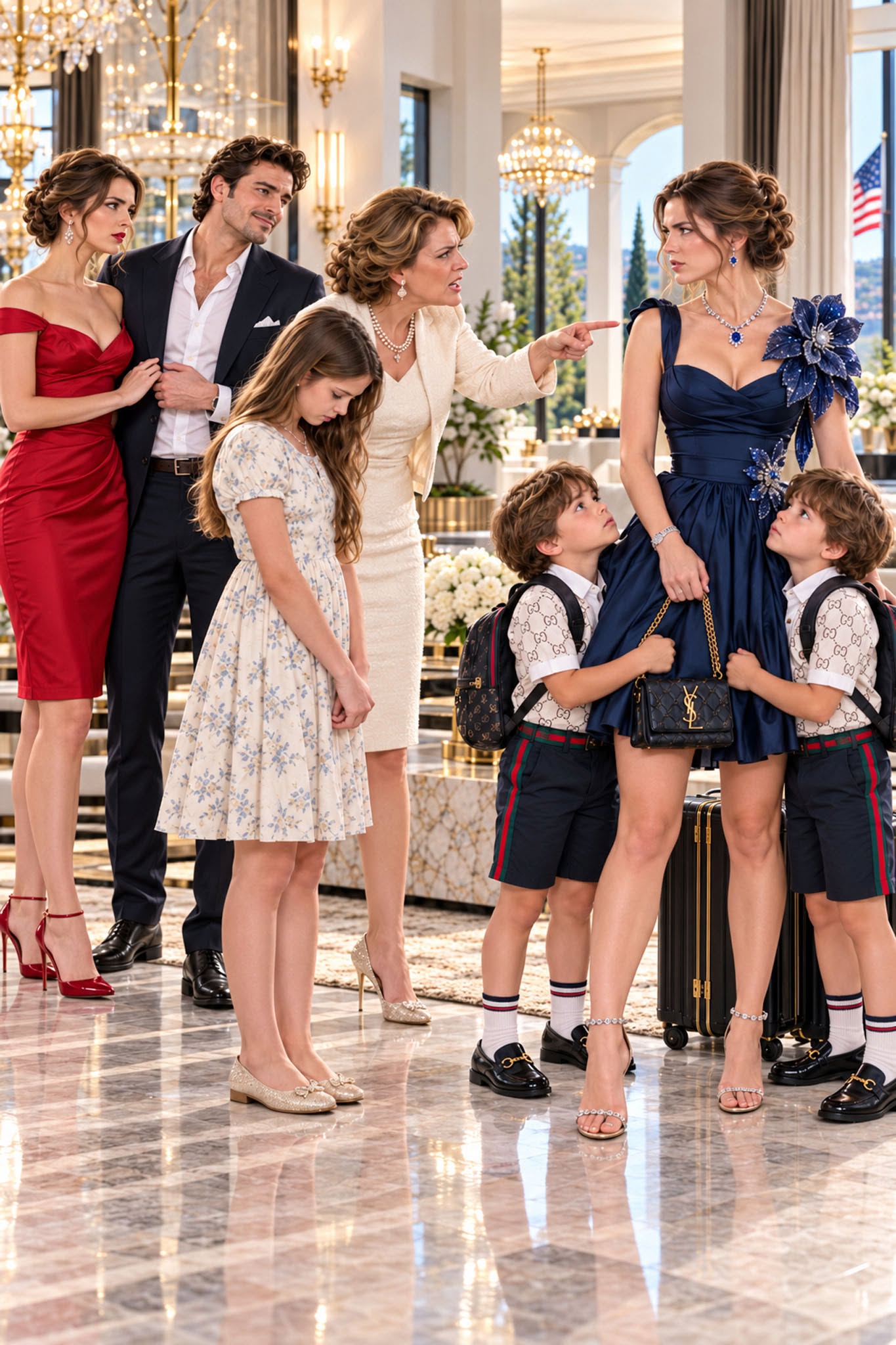 “Eventually.”
“And you took us.”
I smiled sadly.
“Not quite all at once.”
“You came back for me.”
“I was never going anywhere without you.”
She nodded.
Then she said something I will remember until the day I die.
“You know what I remember most about that morning?”
I expected her to say Grant throwing the glass.
Or Marjorie calling her useless.
Or learning who her biological father was.
Instead she said:
“When you told me I didn’t have to apologize anymore.”
I closed my eyes.
That was it.
That was the inheritance I wanted to leave my children.
Not money.
Not property.
Permission.
Permission to walk away from cruelty.
Permission to say no.
Permission to expect respect.
Permission to take up space at the table.
That autumn, Caleb graduated early and accepted a teaching position.
Mason entered college studying physical therapy.
Tessa earned a scholarship to a summer music program.
And I turned forty-nine.
For my birthday, all three children took me to dinner.
A real restaurant this time.
Nothing fancy, but nicer than anything we could afford during those first months after leaving Grant.
Halfway through the meal, the waiter brought out a cake.
Across the top, Caleb had asked them to write:
TO MOM — FROM ALL THREE OF YOUR KIDS.
Tessa saw my expression.
“What?”
“You three planned this?”
Mason grinned.
“Obviously.”
Caleb raised his glass.
“To the woman who finally scared Dad into learning how to use a washing machine.”
Tessa nearly choked laughing.
I pointed at him.
“That is not the toast.”
“Fine.”
He became serious.
“To Mom.”
The others lifted their glasses.
Caleb looked at me.
“You taught us family isn’t whoever has the loudest voice, owns the house, or controls the money.”
Mason continued.
“It’s the person who stays when staying matters.”
Then Tessa looked at me.
“And the person brave enough to leave when leaving matters more.”
I couldn’t speak.
We touched glasses.
Across the restaurant, another family was arguing softly.
A toddler was throwing crackers on the floor.
Someone was celebrating an anniversary.
Ordinary lives unfolding around us.
For nineteen years I had believed preserving a marriage meant preserving a family.
I had been wrong.
Sometimes the family survives only after the marriage ends.
Grant lost the obedient wife who protected his reputation.
He lost the sons who once feared disappointing him.
He lost the mother who once defended him blindly.
And for a long time, he nearly lost the daughter whose existence he had treated like evidence of a crime.
But the rest of us gained something.
Caleb gained his voice.
Mason gained the freedom to be a son instead of a protector.
Tessa gained the certainty that she deserved love without earning it.
And I gained myself.
Years ago, Marjorie had pointed at a frightened little girl and shouted:
“Take that useless girl with you.”
She meant it as an insult.
Instead, it became the best thing anyone in that house had ever told me to do.
Because Tessa was never useless.
She was never a burden.
She was never the shame of our family.
The shame belonged to the adults who had failed her.
And the greatest privilege of my life was becoming the mother who finally stopped failing her too.
THE END