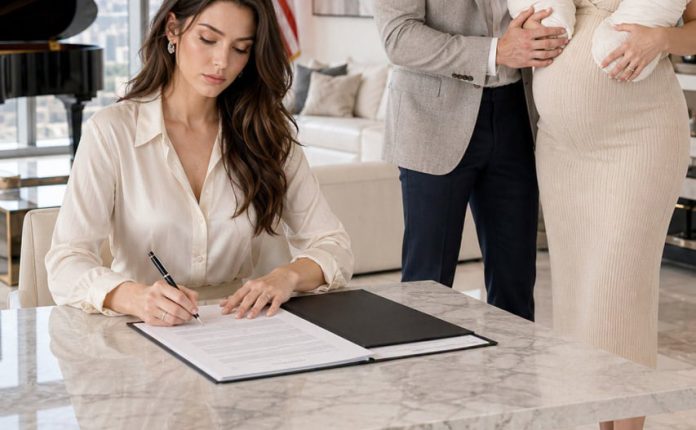
Grant waited until the waiter had served my dinner before telling me his mistress was carrying twins.
“We need to finish this tonight,” he said, setting a leather folder beside my plate.
Madison stood near the fireplace.
She had worked for him for eighteen months. Until six weeks earlier, I had still called her when I needed to know whether my husband would be home.
Now she stood in our dining room, seven months pregnant, wearing a dress the color of the lilies on the sideboard.
Evelyn occupied the chair at the head of the table.
I had chosen the chandelier above her in a small workshop in Venice. The glassmaker had let me hold one unfinished piece against the light. Grant had taken a photograph of my hands.
That was eight years ago.
He had looked at me then as though anything I touched deserved his attention.
“The settlement is fifty million,” he continued. “Your lawyer has the details.”
“I know.”
“We should make sure there’s no confusion.”
There had been months of confusion. The figure in the agreement was the clearest thing he had offered me.
Evelyn straightened a knife beside her plate.
“Madison needs stability before the children arrive.”
“Then perhaps you should let her sit down.”
All three looked at me.
I moved my chair back slightly, making room for Madison to pass.
She stayed beside the fireplace.
“I’m fine.”
Her hand rose to her collar.
The diamond brooch caught the light.
It was shaped like a branch, with one leaf angled slightly away from the others. I knew that tiny irregularity because I had once asked the jeweler whether it could be adjusted.
He had smiled and said living things were rarely symmetrical.
Grant had given it to me on my thirty-third birthday.
Six months later, he told me it must have disappeared during an exhibition where I had lent several pieces.
He had helped search the bedroom.
I remembered him kneeling beside the dressing table, reaching beneath it.
“Interesting,” I said.
Grant followed my gaze.
For a moment, he looked almost tired.
“Claire.”
“Did you tell her whose it was?”
Madison’s fingers closed around the branch.
“He said—”
“Leave it,” Grant interrupted.
I looked at him.
“You watched me call the exhibition organizer.”
“We can discuss personal belongings through counsel.”
“You watched me apologize to a woman because I thought her staff had lost it.”
Evelyn sighed.
“This is precisely why an orderly arrangement is necessary.”
I turned toward her.
“Because your son steals jewelry?”
“Because you insist on making unpleasant scenes.”
The waiter appeared at the doorway carrying a silver bowl of potatoes.
He stopped.
“Leave it on the sideboard, please,” I told him.
He did, keeping his eyes lowered.
When the door closed, Grant opened the folder.
“The money is in escrow. Execution releases it. The townhouse remains with me, you resign from the board, and the marital financial claims are settled.”
He spoke fluently now.
Numbers and conditions steadied him.
They always had.
“And I disappear.”
“You move forward.”
“With your mother’s approval?”
“With some dignity,” Evelyn said.
Her gaze flickered toward my abdomen.
“We have all spent years accommodating a difficult situation.”
I could feel the edge of my napkin beneath my thumb.
“A difficult situation.”
“Six years, Claire.”
I had counted those years differently.
By appointment cards.
By the soft snap of a needle cap.
By the number of times I had sat on a bathroom floor waiting for a wave of nausea to pass before joining a conference call.
During the first year, Grant had learned to give the injections.
He used to warm the vial between his palms.
By the fourth, he asked whether I could schedule everything around his travel.
By the sixth, he forwarded clinic messages to his assistant.
Evelyn called it perseverance when she wanted something.
When I wanted something, she called it an inability to accept reality.
“Madison is giving this family a chance,” she said.
Madison looked down.
Grant did not object.
I had spent so many years waiting for him to interrupt his mother that the habit survived even then. A small, foolish part of me listened for the sound of him saying my name with some tenderness.
Instead, he turned a page.
“The confidentiality provision is mutual.”
“And if I don’t sign?”
“We negotiate through litigation.”
“Meaning?”
He rubbed the side of his jaw.
“Meaning private matters stop being private. Medical histories. Treatment expenses. The reasons the marriage deteriorated.”
There was a pause.
“The unsuccessful transfers.”
I looked at Madison.
She was watching him now.
Perhaps she had expected a generous man caught in an unfortunate situation. Perhaps that was what he had sold her.
It had once been what he sold me.
I set my napkin beside the plate.
“Ruth reviewed the revision this afternoon.”
Grant frowned.
“I assumed she’d have comments.”
“She did. Your lawyer accepted them.”
“I meant additional comments.”
“No.”
He pushed the pen toward me.
Then, when I reached for it, he drew his hand back.
“Read it.”
“I have.”
Three days earlier, I had packed two suitcases.
The decision had felt less dramatic than I expected. I folded a gray sweater, placed it over my passport, and realized I could leave without taking the Venetian chandelier, the enormous bed, or the silver coffee service Evelyn had always insisted belonged downstairs.
I could leave without persuading them that I had been hurt.
That discovery had frightened me more than the packing.
For eleven years, I had thought departure required a final conversation in which Grant understood.
Ruth had looked across her desk and said, “Understanding is not a condition of your freedom.”
She was in her sixties, with reading glasses she kept losing in her own hair.
I had hired her six weeks earlier, after Grant told me about Madison.
He had expected me to use the family attorney.
Ruth’s first question had been whether I wanted a reconciliation.
“No,” I had answered.
Saying it aloud had left me shaking.
Her second question concerned my work.
Before the marriage, I had designed furniture and decorative lighting under my own name. Later, Whitmore Luxe licensed several collections through the small company I had kept.
Everyone treated that company as a quaint administrative detail.
Its contracts were less sentimental.
Ruth had read them.
So had Grant’s counsel.
I signed the settlement.
The pen moved smoothly.
A small mark of ink caught on the side of my finger.
Grant watched each page as though a different woman might appear between them.
When I finished, I removed my ring.
The skin beneath it looked strangely unfinished.
I placed it beside the agreement.
Evelyn leaned forward to inspect the last page.
“Good.”
Grant looked toward the doorway.
“Where will you stay tonight?”
“My luggage is in the car.”
“You’ve packed?”
“Three days ago.”
“Where are you going?”
“San Diego.”
He blinked.
“Who do you know in San Diego?”
I picked up my purse.
“A few people.”
That was more than I owed him.
Noah Parker had answered an email I sent after seeing a restoration project credited to his architecture practice. We had been friends in college, when I studied design and he spent nights constructing models from cardboard and coffee stirrers.
We had exchanged occasional messages after graduation, then none.
Fifteen years could disappear quietly if nobody fought to keep them.
Six weeks earlier, I had written to ask about studio spaces near the coast.
He had sent three suggestions.
Then he asked whether I was visiting or starting over.
I told him the truth.
He offered to collect me from the airport.
There had been no declarations, no rescue arranged in secret. Just an old friend who knew where I could buy a secondhand drafting table.
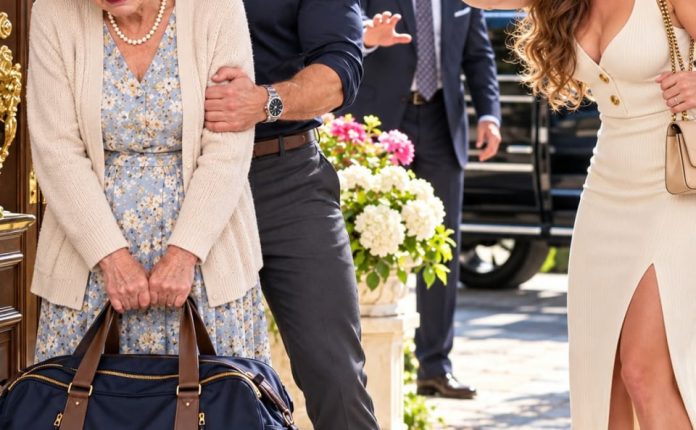
At the dining room doorway, Evelyn called after me.
“You should be grateful. Fifty million is considerable compensation for eleven comfortable years.”
I turned.
“Comfortable?”
Grant stood.
“Mother, let her go.”
But he had said it too late.
“Was it comfortable when I woke after surgery and found your driver waiting because Grant had another meeting?”
Evelyn’s mouth tightened.
“Was it comfortable when you told your Thanksgiving guests I had a body that couldn’t perform its only useful function?”
“That is not what I—”
“You said it while passing the cranberry sauce.”
Madison looked at the table.
I could still see that sauce, a dark red spoonful slipping onto Evelyn’s plate while everyone pretended not to hear.
“Was it comfortable when I lost our child in a hospital bathroom while your son was in Dallas?”
Grant’s chair scraped the floor.
“What child?”
The question took the strength out of my knees.
Not because I had expected him to know.
Because I had once expected that telling him would feel like coming home.
“The child you never asked about.”
“Claire. Wait.”
I opened the door.
He followed me into the hall.
“Were you pregnant?”
I put my hand on the brass knob of the front door.
Behind him, I could see Madison standing very still.
“Yes.”
“When?”
“During the trip you said couldn’t be postponed.”
His face lost its color.
I stepped outside.
The driver had the car running.
A few leaves were trapped in the stone drain beside the steps. I noticed them with absurd clarity, their red edges pressed flat by water.
My phone vibrated.
The transfer had completed.
I forwarded the confirmation to Ruth.
Grant appeared on the steps as the driver closed my door.
His mouth moved.
I did not lower the window.
By the expressway, he had called six times.
I watched buildings pass in the dark glass and remembered the clinic technician turning the monitor toward me.
“There.”
A sound like a small, hurried footstep.
I had laughed because I had not known what else to do.
After two failed transfers, I had wanted to wait before telling Grant. We had agreed once, long before the marriage became a series of arrangements, that we could keep good news to ourselves.
But he had stopped asking about treatment.
I told myself I would tell him after Dallas.
Then there was spotting.
Then a scan.
Then the doctor’s face changed.
The pregnancy had stopped developing.
At the hospital, I called Grant twice.
His assistant answered the second call.
I said I needed him.
I did not say it clearly enough. I knew that afterward. Pain had made me strangely polite.
The nurse called his office too, with my permission.
Nobody came.
I sat in a bathroom beneath a fluorescent light that buzzed and tried to understand how a future could leave so little evidence.
When Grant returned, he found me asleep in the guest room.
“Bad cycle?” he asked the following morning.
I nodded.
That nod became the thing I hated myself for.
As though his failure to ask relieved me of the need to speak, and my failure to speak relieved him of the need to notice.
For nine months, I lived inside that bargain.
At the airport, I stopped beside a charging station.
Grant’s name filled the screen again.
I wrote what I had not managed to say in the hall.
The third transfer had worked.
There had been a heartbeat at eight weeks.
The specialist had discussed his elevated sperm DNA fragmentation results with us before the transfer, though Grant later acted as if the consultation concerned me alone. After the loss, she said those results might have contributed.
In my message, anger stripped away that uncertainty.
I wrote as though I knew precisely why our child had died.
I told him I had protected him from his mother’s contempt while allowing her to turn it on me.
I told him he had been in Madison’s hotel room.
By then I had seen enough messages, dates, and hotel receipts to know.
Finally, I wrote that the money was a debt to the child he had abandoned without knowing.
I stared at that sentence.
No amount could pay such a debt.
I sent it anyway.
Then I switched off the phone.
On the plane, a woman across the aisle tucked a blanket around her sleeping husband.
I looked away.
I had thought leaving would feel like movement.
Instead, for six hours, I sat almost perfectly still.
When we landed, my phone filled with notifications.
Forty-three missed calls.
Thirty-one messages.
Grant’s latest said he had not known.
Evelyn’s arrived while I was waiting for my suitcase.
RETURN OUR MONEY OR RETURN TO MY SON. MADISON’S TWINS MAY NOT SURVIVE, AND THIS FAMILY STILL NEEDS AN HEIR.
I read it twice.
An heir.
Not a grandchild.
Not a frightened young woman in a hospital.
A position that needed filling.
My suitcase tipped against another bag, and someone steadied it.
Noah stood beside me with two coffees and the same slightly uneven smile I remembered from college.
“You made it,” he said.
His hair was shorter. There were lines beside his eyes.
I had known those eyes before anybody called me Mrs. Whitmore.
For a moment, I could not speak.
He looked at my phone, then back at me.
“Coffee first?”
I took the cup.
“I need to call my lawyer.”
“Then we’ll do that.”
He found a row of seats near the windows.
Ruth answered before the second ring ended.
I read Evelyn’s message.
“Send it,” she said. “Then stop answering her.”
“Can she take it back?”
“She is not a party to the settlement. The funds were released under the agreement. We’ll address any actual legal claim through counsel.”
“And I’m still married.”
“For now. Settlement and judgment are different things. Neither means you have to return to that house.”
I pressed the cup between my hands.
“She says the twins might die.”
“Do you know that from anyone else?”
“No.”
“Then we don’t treat her demand as a medical report.”
Noah shifted my suitcase as a cleaning machine passed.
Ruth waited until the noise faded.
“Grant’s counsel called during your flight.”
My stomach tightened.
“Your design rights,” she said. “They’re asking for clarification.”
“They received it before dinner.”
“They did. In writing.”
The company owned its name, stores, inventory, and manufacturing arrangements. My preexisting company owned the original designs covered by the license.
The marriage settlement released my marital financial claims.
It did not silently transfer intellectual property listed in an explicit exception.
“The license runs another nine months,” Ruth said. “They have time to make business decisions. You don’t need to make them tonight.”
I looked at the place where my ring had been.
Grant had told me to leave quietly.
Apparently, he had also expected my work to stay without me.
After I hung up, Noah stood.
“I’ve got a room ready. Separate entrance. No requirement to discuss anything before breakfast.”
“A room?”
“You asked for two nights until the apartment keys were available.”
I had.
Somewhere beyond the dining room, airports, and messages, I had made practical plans.
Remembering them steadied me.
Then an unfamiliar number appeared.
A photograph loaded.
My brooch lay on a pale blue hospital blanket.
Below it, Madison had written: There is something about that clinic appointment you need to know.
I called.
She answered with a thin, breathless hello.
“Are you all right?”
“They’re monitoring me. The contractions slowed.”
“Evelyn said—”
“Evelyn says things.”
I heard machinery in the background.
“Why did you send the photograph?”
“I took it off. I want you to have it back.”
“We can arrange that later.”
“I need to tell you something first.”
Noah quietly moved farther away.
Madison took a breath.
“When the clinic called the office nine months ago, I answered.”
“I remember.”
“They sent a folder afterward. By courier. You’d authorized them to send it for Grant.”
I remembered the nurse asking.
“Yes.”
“I didn’t give it to him.”
My fingers tightened around the cup.
“Who did you give it to?”
For a few seconds, I heard only the hospital around her.
Then she answered.
“His mother.”
END PART 1