At five seventeen on the morning I was supposed to take my daughter home, my phone told me someone had started my car.
Avery slept against my chest. One cheek lay flattened on the hospital gown, and her fingers kept opening as though she were trying to catch something in her sleep.
Another notification appeared.
My SUV had left the area around my condo.
Nolan had assured me the night before that it was parked downstairs, with the infant seat ready and the diaper bag on the floor behind the driver.
I opened the security app.
The blue marker moved through Columbus toward his mother’s apartment.
For a few seconds, I watched without blinking. A nurse had helped me out of bed an hour earlier. The effort of standing had left a hot, pulling ache beneath my bandage. I had not slept longer than forty minutes at a time since Avery’s birth.
I was tired enough to doubt an obvious fact.
Then the marker stopped outside Diane Mercer’s building.
I called Nolan.
“Hey,” he said softly. “What’s wrong? Is Avery all right?”
“Why is my SUV at your mother’s apartment?”
A little scraping sound came through the phone. A key against a door, perhaps.
“Mom has an appointment. Paige’s car is acting up, so I gave her the spare.”
“You gave Paige my key?”
“It was an emergency.”
“What kind?”
“Claire. A medical appointment.”
“That was already scheduled?”
He breathed out.
“I didn’t want to wake you.”
“You could have asked yesterday.”
He began telling me how difficult the past few days had been for everyone.
I looked at Avery. A pale line marked her wrist where the identification band rested against her skin.
“I want the spare back on its hook tonight. Send me a picture when it’s there.”
“You don’t have to treat me like a child.”
“Then don’t make decisions about my things while I’m unavailable to object.”
I ended the call.
The car mattered. So did the lie. But what held me still against the pillows was how easily he had said emergency, then appointment, then everyone.
Each word had moved the conversation farther from what he had done.
I knew that technique professionally.
As an independent collision appraiser, I listened to people describe accidents they wished had happened differently. A driver would tell me a truck had backed into his parked sedan. The scrape would run from front to rear, carrying the paint of a concrete parking barrier.
I did not need to call him a liar.
I needed to look closely.
My father had taught me that long before I began working.
When I bought the SUV five years earlier, Dad came along in his green pickup. He wore an old canvas jacket with a broken zipper and checked the spare tire while the salesman tried explaining financing I had already declined.
“She understands the numbers,” Dad told him. “You can answer her questions.”
Dad smelled faintly of beeswax that day. He had spent the morning repairing a hive frame.
People generally saw the pickup, the jacket, and the dirt beneath his thumbnail, then stopped wondering about him.
Nolan’s family certainly had.
They knew Walter Bennett repaired tractors and kept bees on a farm outside the city. They knew my mother, June, grew enough tomatoes to supply three neighboring households.
They did not know Dad had begun buying damaged vehicles with money earned operating a tow truck. Or that the little recovery yard had become a collision center, then a dealership, then a group of businesses managed by people whose judgment he trusted.
Bennett Automotive Holdings owned the dealership where Nolan worked.
It had acquired that particular location after Nolan and I married.
Dad’s name appeared in company records. Nothing about him was a legal secret. He simply had no interest in being photographed beside oversized checks or giving interviews about success.
Nolan knew my father’s name.
He had never been curious enough to connect it to anything beyond the old truck parked in our driveway.
I had not corrected his assumptions.
I did not want a husband auditioning for my inheritance.
More practically, I had built my business without Dad’s contracts. Once Bennett acquired Nolan’s dealership, I stopped accepting inspection assignments involving its inventory. My work came from insurers, attorneys, private buyers, and repair disputes.
Nolan knew that boundary.
We had discussed it more than once.
We first met before the acquisition, when I inspected a trade-in his sales team wanted to describe as exceptionally clean.
The hood told a different story.
He leaned against the next car while I took paint readings.
“You always this suspicious?”
“Only when someone calls body filler factory variation.”
He laughed, and to his credit, stopped arguing.
Later, he brought me coffee without asking for a different report.
That mattered to me.
For almost two years, he seemed interested in the parts of me other men found inconvenient. He asked how I decided whether a frame measurement could be trusted. He listened when I talked about shops cutting corners.
Once, during freezing rain, he helped me change a tire on the shoulder of a county road. We were both soaked by the time we finished.
I remembered that night too often afterward.
It became evidence I kept submitting on his behalf.
Diane’s first questions were about money disguised as conversation.
Was my condo rented? Was the SUV financed? Did independent work come with benefits?
Paige wanted the car for engagement pictures.
She was marrying Grant Holloway, whose family owned furniture stores, and had arranged a rented house, a photographer, and a dress that arrived in a garment box bigger than my coffee table.
“A silver SUV would look perfect out front,” she said.
“You could ask the photographer about a rental.”
“Oh, I meant yours.”
“I know.”
She looked toward Nolan.
He changed the subject.
Two days later, Diane appeared with a supermarket cake and explained that sharing things was how families showed love.
I left the cake on the counter and declined again.
Paige eventually rented a vehicle, then posted photographs that encouraged people to assume Grant had bought it.
I told myself vanity was irritating, not dangerous.
I told myself many things in those years.
When I became pregnant, Diane brought two suitcases to my condo and announced she would be staying until we found our rhythm.
I rolled the suitcases back to the elevator.
For once, Nolan supported me.
“Mom, you should have called.”
I was so relieved that I overlooked the difference between you should have called and you cannot move in without an invitation.
That evening, I heard his voice through the bathroom door.
“Give it a little time. Once the baby’s here, she’ll be worn out. It’ll be easier to get her to agree.”
I opened the door.
Nolan stood beside the sink with his phone against his ear.
“Agree to what?”
He ended the call.
For several seconds, the extractor fan was the only sound.
Then he said he had meant Diane would be easier to reason with after the pregnancy.
When I repeated his exact sentence, he said he had meant I would be more willing to accept help.
By the third explanation, he was irritated with me for remembering the first.
“If you’re counting on exhaustion to make me manageable,” I told him, “you need another place to live.”
He apologized.
Not immediately. But properly enough that I wanted to accept it.
Afterward, he cooked dinners, attended appointments, and spent a Saturday assembling the nursery dresser without once complaining about the instructions.
He remembered my water bottle.
He learned which side of the bed made it easier for me to stand.
He became attentive in ways that were ordinary and convincing.
Meanwhile, the dealership appointed him acting general manager.
He talked about staffing, inventory turnover, and the permanent role that might follow.
I was proud of him.
That fact would embarrass me later, though it should not have. Loving someone’s good work was not a failure of judgment. Believing promises required more care.
My labor began on a Sunday evening.
By Monday morning, the monitor beside my bed was making sounds that changed everyone’s faces.
The surgery happened quickly.
Nolan wore blue scrubs and held my hand near my shoulder while someone behind the curtain told me I would feel pressure.
When Avery cried, he cried too.
I do not believe those tears were false.
That made what followed harder to understand.
He stayed the first night. On Tuesday, he left for a meeting, returned with flowers, and spent most of his visit answering messages.
On Wednesday morning, my car was outside his mother’s building.
Dad and Mom arrived shortly after nine.
Mom took one look at me and pulled the chair close enough that I did not have to speak above a whisper.
Dad put a coffee on the table and unfolded a clean baby blanket.
“Your mother says this one washed softer.”
I told them about the vehicle.
Mom’s mouth tightened.
Dad asked a careful question.
“Do you want help from your father, or are you asking me to help recover the car?”
“I want to get Avery home without performing another argument in public.”
“Fine. We brought the spare infant seat. Your mother can drive you in your car once we have the keys.”
“And if we don’t?”
“We’ll arrange another vehicle.”
He did not say anything about Nolan’s employment.
At that moment, I did not know there was anything to say.
A little later, Dad stepped into the hallway to take a call. When he returned, he was carrying a printed sheet folded into quarters.
“There may be a work matter you need to look at,” he said. “It can wait until you’re settled.”
“What kind of matter?”
“Something submitted under your business name. I’ve asked them to send it directly to you.”
I frowned.
“I haven’t been working.”
“I know.”
A nurse came in with the discharge instructions before I could ask more.
There were feeding records to review, medication times to write down, warning signs to remember. Mom stood beside me while I dressed slowly in the bathroom.
I had packed clothes for a smaller stomach.
The dress caught against the bandage when I bent.
By the time I was ready, all I wanted was my own bed and a door I could close.
Dad went downstairs to bring his pickup around. Mom went with him to get the spare seat ready.
Nolan texted.
Outside. Ready when you are.
Relief came so quickly that I disliked myself for it.
Perhaps he had understood.
Perhaps the car had been returned and this was merely an unpleasant morning we would discuss after I had slept.
The nurse, Elise, accompanied me down. I carried Avery in her infant carrier because I did not want anyone else holding her while we crossed the pickup lane.
Then I saw the SUV.
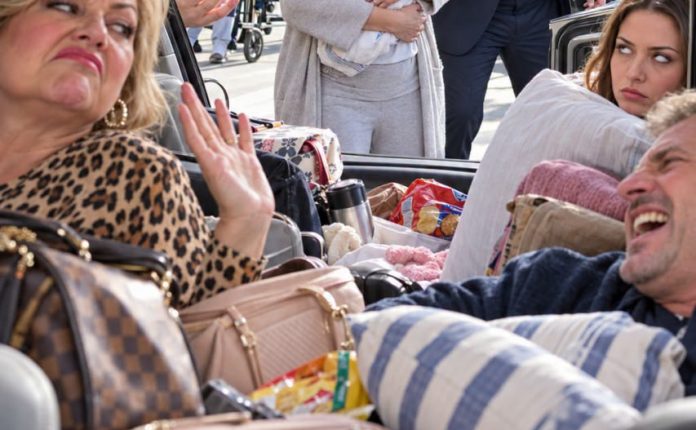
Diane sat in the front.
Paige and Lily occupied the back.
A garment bag lay across Paige’s knees, tied at the hanger with a pale blue ribbon. Shopping bags crowded Lily’s feet.
Nolan stood by the driver’s door.
As I approached, he held up one hand.
“What are you doing? There’s no space, idiot.”
Elise stopped beside me.
I looked at him.
I had heard him irritated, defensive, sulky. I had heard him turn a disagreement into a complaint about my tone.
He had never called me that before.
Not where someone else could hear.
Diane lowered her window.
“Claire, move away from the driveway.”
I looked past her.
Avery’s seat base was missing.
“Where is the base?”
“In the back,” Nolan said. “We needed the seat.”
“For whom?”
He made a small, impatient movement toward his family.
I knew the answer. I wanted to hear whether he would say it.
Diane supplied it.
“We’re going to a luncheon for Nolan. It’s an important day.”
“Our daughter is being discharged.”
“And your father is here. Everything doesn’t need to become a crisis.”
Paige lifted the garment bag.
“I can’t arrive at the dealership looking like I’ve spent the morning running errands.”
I had spent the morning learning how to stand without pulling my incision.
For a moment, the contrast was so absurd that I almost laughed.
“Put the base back,” I told Nolan. “Your family can arrange another ride.”
He stepped closer.
“Don’t start.”
“Give me my keys.”
“You’re making a scene.”
“I’m standing beside a car I own, asking to take my baby home.”
He reached toward my arm.
I shifted away. Pain caught sharply beneath my dress.
Elise stepped forward.
“She needs space. Please don’t touch her.”
Nolan glanced at the nurse’s badge.
“My wife’s had a rough few days.”
“I heard her,” Elise said.
Dad’s green pickup came around the bend.
He parked behind the SUV, far enough back to keep the exit clear.
Nolan saw him and gave a short laugh.
“There. Your ride.”
Dad approached slowly. His eyes moved from my face to the carrier, then through the SUV’s open window.
“Can you stand comfortably?”
“Not especially.”
He looked at Elise.
“Could you help her back to a chair?”
“I’m all right,” I said, though I was not.
Diane leaned across the console.
“Walter, perhaps you can explain that we’re not abandoning anyone. Claire’s determined to take this personally.”
Dad looked at her.
“Whose car is this?”
“Oh, honestly.”
“Her keys, Nolan.”
Nolan’s jaw moved.
“You don’t get to speak to me like an employee.”
It was a strange thing to say.
Dad did not react.
“She’s asked you to return them.”
Paige opened her door. The garment bag slipped, and Lily caught it before it fell.
“We need to be at Bennett North. They’re expecting us.”
Dad touched the folded paper in his pocket.
“What are you expecting to happen there?”
Paige looked surprised.
“Nolan’s announcement.”
Nolan cut in.
“That’s work. Claire doesn’t need to worry about it today.”
Then my phone vibrated.
The notification displayed my business name.
Bennett Collision Appraisals — verification required before management review.
The sender was a procurement manager at Bennett Automotive.
Beneath it, a preview of the forwarded message appeared.
Submitted on behalf of Claire Bennett Mercer.
Nolan saw it.
“Give me that.”
His voice had changed.
I moved the phone away.
“What did you submit?”
“You asked me to deal with your messages.”
“Two clients. I asked you to tell two clients I’d had the baby.”
“Don’t do this here.”
Dad took out his phone and called someone.
“The family issue can wait,” he said. “Keep the verification appointment. Claire needs the complete submission.”
Nolan looked from his face to mine.
“What appointment?”
Mom stepped out of the pickup carrying the spare infant seat.
I opened the email.
There were six attachments.
The first was an appraisal bearing my business header, my credential number, and an image of my signature.
I recognized the format.
I did not recognize the vehicle.
Under inspection date, someone had entered Monday.
While I was in surgery.
I opened the second attachment.
Another vehicle. Another completed inspection.
The assessment described prior damage as cosmetic and stated that no structural repair was required.
My name appeared beneath the certification.
For a moment, the hospital lane seemed to move farther away.
I could still hear Diane talking, but I could no longer make out the words.
I inspected the signature.
It had the same broken edge on the final stroke as the one on an old authorization form Nolan had scanned for me the previous winter.
Not similar.
The same.
“Did you use my signature?”
Nolan looked at Dad instead of answering me.
“This is preliminary. She doesn’t understand the context.”
“Then explain it,” Dad said.
Nolan’s fingers closed around my keys.
“You can’t understand a dealership operation from a tractor shed.”
Dad took the folded sheet from his pocket.
I saw the Bennett Automotive letterhead.
A review agenda.
Nolan saw it too.
His expression changed before Dad said anything.
“My operations team asked Claire to verify these reports,” Dad told him. “They were already flagged this morning.”
“Your operations team?”
“Yes.”
The wind lifted one corner of the paper.
Dad flattened it against his palm.
“I own Bennett Automotive, Nolan.”
Paige stopped adjusting the ribbon.
Diane’s mouth remained slightly open.
Nolan stared at the sheet as though the words might rearrange themselves.
My father did not raise his voice.
“There’s a management review at one. You’ll receive instructions from operations. Right now, give my daughter her keys.”
Nolan handed them over.
He did it without looking at me.
Dad passed them directly into my hand.
The metal was warm.
For the first time that morning, I understood that taking my car had not been the worst thing Nolan had done while I could not get out of bed.
I looked down at the six reports.
One carried a photograph of a rear body panel with a wrinkle no competent appraiser would describe as cosmetic without further measurements.
I knew that wrinkle.
I had written an article about that exact type of damage for a professional newsletter.
Nolan had proofread it.
He knew what those words meant.
I forwarded the email to an attorney whose number was already in my contacts from a business dispute.
Then I wrote a reply to procurement.
I did not inspect these vehicles. I did not prepare, sign, submit, or authorize these reports. Please preserve the original files and all associated records.
My hands shook while I typed.
I sent it anyway.
END PART 1