Judy told me to read our card aloud while Stacy was still crying over her twenty-thousand-dollar check. I opened the envelope a second time, certain something had caught inside the flap.
Across the table, Ron watched me do it.
“Nothing else in there, Leah,” he said. “Your mother put a lot of thought into that.”
He meant Nate’s mother. Ron had called her mine since our wedding, usually when he wanted me to accept something without making a distinction.
The envelope had been tucked beneath my plate. There was one beneath Kim’s, another beneath Jeff’s, another beneath Stacy’s. Judy had waited until the ham was carved and everyone had something on their plate before telling us to look.
Kim opened hers first.
Her hand went to her mouth, and her husband leaned close enough to wrinkle the shoulder of her blouse. Jeff let out a low whistle. Stacy started crying before she finished reading the number.
Twenty thousand dollars each.
Money toward a home. A beginning, Judy called it.
Our card showed a bluebird perched on a flowering branch.
Inside, in the rounded handwriting Judy used for recipe labels, she had written that we were capable, resourceful, a couple she knew could manage whatever life brought us.
There was no check.
Nate read it beside me. He made no sound, but the red spread from his ears toward his neck.
“Go on,” Judy said. “Read it.”
I did, though I shortened none of it and added nothing to soften the difference.
For a moment, we heard only the refrigerator motor and the tiny scrape of Kim setting her fork against her plate.
Ron raised his coffee.
“And every word is true. You ought to be proud of that.”
“Thank you,” I said. “The card is beautiful.”
Judy smiled with visible relief.
“I knew you’d understand.”
Nate folded the card along its original crease, slid it into the envelope, and put it in his shirt pocket. Then he asked Jeff whether he wanted the potatoes.
I watched his hand pass the bowl.
That was what I remembered afterward. Not the number on the checks or the little painted bird. His hand, steady because he was making it steady.
Kim and her husband had been looking at a three-bedroom house near the elementary school. They had two children and a lease ending in August. Jeff had made an offer on a townhouse and discovered that closing costs were more than he had expected. Stacy wanted to leave her apartment for somewhere with a small fenced yard.
Their reasons were ordinary and understandable.
So were ours.
Nate and I lived above a laundromat in a building with narrow stairs and windows painted shut. In winter, condensation collected along the bedroom sill. In summer, the whole apartment smelled faintly of dryer sheets and hot asphalt.
We had been saving for four years.
We had also replaced the transmission in my car, paid a hospital bill our insurance disputed for months, and helped my sister travel home when our father died. Every time our savings began to look promising, something took a bite out of them.
None of that was a secret. It simply wasn’t considered urgent.
“Leah’s got the steady hospital job,” Judy said as she passed the rolls. “And Nate can fix anything.”
She said it warmly.
I could hear the explanation arranging itself around us.
We were the couple with no children yet. The couple who paid bills on time, brought a dish without being reminded, and arrived early when somebody needed help moving.
If we struggled, we did it quietly. Quiet had somehow become evidence that we didn’t struggle at all.
Stacy reached across the table and squeezed Judy’s wrist.
“You don’t understand what this means to me.”
“I do, honey.”
I looked at my plate.
Nate had buttered a roll, but he wasn’t eating it.
When Judy began talking about a kitchen island in Kim’s possible house, the room found its rhythm again. Jeff joked about paint colors. Stacy asked whether Ron could help inspect a fence. Someone wanted more ham.
I answered when spoken to. I helped clear dishes.
At the sink, Judy handed me a towel.
“I hope you didn’t feel overlooked.”
The question startled me because it wasn’t quite a question.
“You’ve been cooking since morning,” I said. “Sit down. I’ll dry these.”
She accepted the escape I had given her.
I stood at her sink and dried the good plates while Nate carried folding chairs to the basement. Before we left, Ron asked whether he could look at the mower one evening.
“Sure,” Nate said.
Outside, the air smelled of wet soil and somebody’s woodstove. I got into our car and waited while Nate checked the oil, though he had checked it that morning.
He needed a minute where nobody could see his face.
We drove three miles before he spoke.
“How much have we saved?”
“Six thousand two hundred.”
He nodded.
The windshield held a pale reflection of his hands.
“I can take more repair jobs.”
“You already work Saturdays sometimes.”
“Harvest equipment. Evenings. People pay well when they need something running.”
I looked at the lunch container on the back seat, filled with Easter leftovers Judy had insisted we take.
“I’ll talk to Marlene.”
Nate glanced over.
“You’ve already got a full-time job.”
“So do you.”
He drove another half mile.
“I don’t want you doing this because of today.”
“I want a place where we can open the windows.”
His jaw moved once.
“Me, too.”
At home, I put the leftovers in the refrigerator. Nate hung his shirt on the back of the bedroom chair, careful of the envelope in its pocket.
Neither of us mentioned it.
That night, while he showered, I opened our savings spreadsheet. Six thousand two hundred dollars sat in a little square beneath the word HOUSE.
I changed the color of the square.
It was a foolish thing to do. Blue instead of gray. But I needed to have done something before I went to bed.
Marlene hired me at the truck stop the following Thursday.
She had known me when I worked there during community college, and she remembered that I could carry four mugs without spilling coffee on myself.
“Friday and Saturday nights,” she said. “Sunday breakfast if you’ve got the legs for it.”
“I’ve got them.”
“Ask them again after the first weekend.”
She gave me two aprons and told me where the staff kept their coats.
During the week, I handled insurance billing in a room at the hospital that had fluorescent lights and no view. I explained deductibles, corrected numbers, and called people who were frightened of envelopes with hospital letterheads.
On Friday afternoons, I changed in a restroom stall, folded my work blouse into my bag, and drove toward the highway.
The truck stop had a bell over the door that rang even when the wind moved it. By midnight, the glass pie case reflected more darkness than pie.
I learned which drivers wanted conversation and which wanted their food without an audience. I learned to tell somebody I couldn’t bend the kitchen rules without sounding as though I enjoyed refusing them.
At two in the morning, I counted tips with hands that smelled of coffee grounds.
Nate started taking repair calls almost immediately.
He worked at an agricultural equipment shop during the day. The evening jobs were the ones people couldn’t wait to bring in: a bearing failing in the middle of a field, a belt that had snapped at exactly the wrong time, a machine that had to be ready before a change in the weather.
He kept a spare shirt in his truck and invoices in an old clipboard.
Sometimes he came home with mud dried halfway up his calves.
We began leaving notes.
Chicken in oven. Don’t turn it on.
Paid water.
Your clean socks are in the basket, not the drawer.
At first, the notes were affectionate. Then they became efficient. By July, I realized I knew more about the condition of Nate’s work socks than I did about anything he had thought that week.
One Wednesday, I found him asleep at the kitchen table with a spoon in his hand.
The soup had gone cold.
I touched his shoulder.
“Come to bed.”
He opened his eyes and looked embarrassed.
“What time is it?”
“Late.”
“Did you eat?”
“Yes.”
I hadn’t, but I could eat after he was lying down.
That was how we cared for each other for a while. Small, useful lies that gave the other person ten more minutes of rest.
We ate eggs because eggs were cheap. Eggs on toast, eggs folded into leftover rice, eggs with potatoes and an onion if I had remembered to buy one.
Nate started making jokes about acquiring feathers.
I laughed until the joke wore thin, then bought a packet of sausages we divided across three meals.
Our savings grew.
Not quickly enough to make the work feel easy. Quickly enough that stopping felt impossible.
In August, Nate sold his fishing boat.
It was an old aluminum boat with a temperamental motor, hardly something luxurious. His grandfather had helped him buy it when he was nineteen. Every spring, Nate patched or tightened something and promised himself he would get out on the water more often.
The buyer arrived on a Saturday while I was leaving for work.
I stood beside my car and watched Nate explain the motor’s habits. He ran his hand along the gunwale as if checking for something he had forgotten.
After the buyer drove away, Nate stayed by the empty patch of gravel.
“You don’t have to sell every good thing we own,” I said.
He folded the bill of sale.
“I wasn’t using it.”
“That isn’t what I said.”
He looked toward the road.
“I know.”
I crossed the gravel and put my arms around him. He smelled of engine oil and the cheap bar soap he used in the garage sink.
“I loved that boat,” he said into my hair.
“I know you did.”
For once, neither of us tried to turn it into an encouraging moment.
We stood there until my phone reminded me I was going to be late.
The family saw pieces of our life but never the whole arrangement.
Kim knew I worked some weekends. Jeff knew Nate took repair calls. Stacy saw our apartment once when she dropped off a pan Judy had borrowed.
“Still here?” she said, then caught herself. “I mean, it’s cozy.”
“It’s close to work.”
She nodded too quickly.
When she left, I stood in the doorway with the pan against my hip and wondered how a place could be called cozy by someone who was grateful not to live in it.
We didn’t tell them about our savings target.
There was pride in that, though it wasn’t all pride. I didn’t trust myself to talk about money without referring to Easter, and I didn’t want every conversation to become a request I hadn’t made.
Nate seemed to feel the same.
Once, after Ron praised Jeff for negotiating a lower price on an appliance, Nate said in the car, “I should have asked.”
“About the checks?”
“About us.”
“You still can.”
He watched a red light change.
“I don’t want to hear him explain it again.”
That stayed with me.
It was easier to repair a machine with a visible break than to ask your father why you ranked below your brother and sisters at a table where everyone could see.
At Christmas, Judy gave us a slow cooker and told us we were an example to the younger couples she knew.
“You two never expect anybody to do things for you.”
Nate thanked her.
I wondered when accepting less had become a family trait we were obliged to keep performing.
Opal wasn’t at that Christmas gathering.
She was spending the winter with her sister in Arizona, where she claimed the dry air helped her joints and complained that nobody made proper gravy.
We spoke to her by phone.
She asked after our work, then told Nate to have a doctor look at his shoulder if it was still troubling him.
She had a way of remembering the small things people hoped would be forgotten.
Nate said the shoulder was fine.
“Fine is what people say when they want me to stop asking.”
He smiled for the first time that afternoon.
We didn’t tell her about Easter.
She was Ron’s mother. She loved her son. I assumed she would find a reasonable explanation for him, and I didn’t want to hand her something she would have to defend.
Our first year of saving ended with a larger bank balance and a conversation over a grocery cart.
Nate wanted to take another repair job on Sunday.
I had planned to sleep until noon.
“Then sleep,” he said.
“I meant together.”
He stared at me across a stack of discounted cereal.
“We’re trying to buy a house, Leah.”
“I know what we’re trying to buy.”
A woman with a toddler moved past us. I lowered my voice.
“I just don’t want to get there and discover we’ve spent two years living like people who share a utility bill.”
He looked down at the cart.
We bought the groceries. At home, we put them away without speaking.
Then Nate sat beside me on the kitchen floor because I was already there sorting potatoes into the bottom cupboard.
“What do you want me to do?”
The question sounded tired rather than angry.
“Keep one evening.”
“Every week?”
“Every week.”
We chose Wednesdays.
No extra repairs unless a machine was stranded somewhere dangerous. No diner shifts. No opening the spreadsheet during dinner.
Sometimes we were too worn out to do anything interesting. We took walks. We watched half a movie. We sat in the laundromat downstairs while our clothes turned behind scratched glass.
Those evenings did more for our plan than another few hundred dollars would have.
I began remembering what Nate’s face looked like when he wasn’t concentrating on a problem.
He began asking questions that took longer than a yes or no.
We made it through another winter.
Our car needed tires. The hospital changed insurance systems, which meant overtime I couldn’t refuse. Nate lost three days of work to the flu and tried to return too soon.
Money left the account.
Money went back in.
By the second spring, I had stopped imagining a perfect house. I wanted a dry bedroom, a kitchen with daylight, and a front door that opened directly onto ground we owned.
That was when Marlene slid a newspaper across the truck stop counter.
“You two still looking?”
Between an advertisement for storage units and a notice about a road hearing was a list of county properties scheduled for auction.
I recognized the Miller place.
Everyone around us did.
It sat six miles beyond Opal’s church, back from the county road behind a row of neglected lilacs. The last owner had died, the family had scattered, and the place had remained empty through six winters.
I remembered driving past it when the porch still held flowerpots.
Now the weeds reached the bottom windows.
“That house needs everything,” I said.
Marlene wiped a ring of coffee from the counter.
“Everything’s usually cheaper than somebody else’s idea of beautiful.”
I tore out the notice and took it home.
Nate read it while standing by the stove.
“I know the place.”
“Everybody knows the place.”
“No, I mean I worked on a tractor in their barn once. Years ago.”
He looked at the photograph.
“Let’s look.”
We went the next afternoon.
At first, I saw the porch.
One corner had sunk enough to make the railing look drunk. The screen door hung crooked. Something had nested in the letterbox, and an old vine disappeared through a split in the frame.
Then I saw Nate looking beyond it.
He walked around the house slowly, studying the roofline, the foundation, the way rainwater had moved through the soil.
A window was broken at the back. There were water stains beneath a gutter that no longer drained properly.
“This might be too much,” I said.
“It might.”
He didn’t argue. That made me trust the way he kept looking.
We arranged an inspection with a man who had spent forty years telling buyers things they didn’t want to hear. He brought a flashlight, a probe, and a folding stool he refused to lend anyone.
He found trouble.
Old wiring. Plumbing that needed attention. A porch requiring more than another board nailed over the soft one. Damage around the back door where water had been getting in.
He also found a sound main structure and less trouble in the roof than we had feared.
“Don’t confuse possible with easy,” he told us.
“We aren’t.”
He looked at Nate’s work boots and my hospital badge.
“Make sure you leave money for sleeping somewhere dry while you fix it.”
We checked the county’s sale documents, asked questions, and paid for help understanding what we were buying. We didn’t want our bargain to become a problem hidden in a paragraph neither of us had understood.
At night, we sat at our kitchen table with estimates.
Some things Nate could do. Some required tradespeople, permits, or inspection. Some could wait. Some absolutely couldn’t.
We argued about the bathroom sink and agreed about the wiring.
We listed materials without pretending labor was free just because it belonged to us.
Finally, I wrote a number at the top of the page.
Forty-two thousand.
That was our ceiling for the purchase. We would keep the rest for fees, insurance, the first urgent repairs, and a cushion small enough to frighten me if I looked at it too long.
“No auction fever,” I said.
Nate held up his hands.
“No auction fever.”
“If somebody bids over it, we leave.”
“We leave.”
We made a cashier’s check for forty thousand dollars. I put fifteen hundred in cash beside it, money from tips I had kept in separate envelopes before finally moving most of it into the bank.
The remaining room beneath our limit was not an invitation.
It was a hard stop.
On auction morning, my stomach felt as though I had swallowed a handful of coins.
Dobbs stood on the courthouse steps with a microphone that squealed whenever he shifted his grip. People held property sheets against the breeze.
An investor in a padded vest asked two questions, glanced at us, and returned to his phone.
I hated how quickly I decided he could afford more.
Nate stood beside me with his hands empty.
The opening bids came faster than I expected.
For a moment, the numbers seemed too low to be real. Then they climbed, and the bargain narrowed into exactly the danger we had discussed.
Thirty-eight thousand.
Thirty-nine.
The man in the vest raised his sheet without looking up.
Forty thousand.
Nate bid again.
I could feel my pulse behind my ears.
The investor said forty-one.
Dobbs turned toward us.
Nate looked at me.
We had agreed on the next number. We had said it aloud at home. Still, I had to make myself nod.
“Forty-one thousand five hundred,” he called.
The investor finally looked directly at us.
Then he looked down at his paper.
Dobbs waited.
The man shook his head and stepped back.
I remember the noise of traffic beyond the courthouse lawn. A truck changing gears. Somebody coughing. Dobbs asking once more whether anyone wanted to bid.
Then it was over.
We owned the Miller property.
At the clerk’s desk, I handed over the cashier’s check and the cash. She counted the bills, arranged them, and counted them again.
My hands had worked hundreds of hours to collect that money.
Hers needed less than a minute to confirm it.
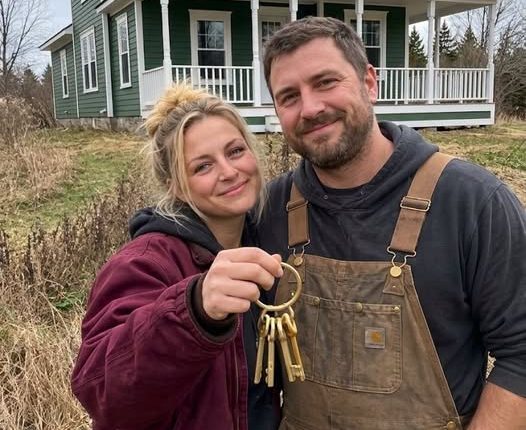
When she gave us the worn keys, Nate closed his fist around them and didn’t open it until we were outside.
We sat in the car.
Neither of us started celebrating.
“Did we just do that?” I asked.
He put the keys between us.
“I think we did.”
I laughed once, then covered my face because I was suddenly crying.
Nate waited, his hand against the back of my neck.
We didn’t call our families.
The house wasn’t ready to be shown. More honestly, we weren’t ready to hear someone explain what was wrong with it before we had stood inside long enough to believe it belonged to us.
We bought sandwiches from the truck stop.
Marlene added two pieces of pie and said they were a closing gift.
At the house, Nate worked the key carefully through the stubborn lock. The door opened onto stale air, dust, and the sour smell of old water damage.
I set our food on the kitchen counter.
A strip of wallpaper had peeled away beside the window, revealing an older pattern underneath: little brown squares, as stubbornly ugly as the flowers covering them.
We sat on the floor because we owned no chairs for this kitchen yet.
Rain began against the glass.
Near the back door, a drop landed in the bucket the inspector had told us to leave there.
“This place smells awful,” I said.
Nate took a bite of his sandwich.
“Yes.”
“There may be a dead mouse somewhere.”
“Probably.”
I looked around the room.
“We’ve spent all that money on a place with a possible dead mouse.”
He leaned his head against the cupboard and smiled.
“Our possible dead mouse.”
I started laughing again.
That first evening was not graceful, but it was ours.
For the next several weeks, we lived in the apartment and worked on the house.
Nate cut back on outside repairs because every evening now had another demand. He arranged the electrical work room by room, doing what he was qualified to do and bringing in the proper people for what he wasn’t.
The inspection appointments went on the calendar in red.
I learned wallpaper could have layers like a bad conversation. Flowers over squares over something pale that had been painted at least twice.
I soaked and scraped until my thumbs cracked.
When I washed my hands, the hot water found every split.
We kept receipts in a biscuit tin before transferring them to folders. Screws, wire, cleaner, masks, replacement glass. Purchases too small to fear individually became frightening when added together.
At the hospital, I unfolded rough room plans during lunch.
A coworker asked where our dining table would go.
I pointed.
For ten seconds, I could see it: plates, a bowl of apples, sunlight crossing a floor that didn’t yet exist beneath all that grime.
Then my break ended.
I began keeping a dish towel in the car.
It was striped yellow and white, bought years earlier from a clearance bin. I wanted it ready when the kitchen had a working sink and somewhere clean to hang it.
Nate noticed it one evening.
“Emergency towel?”
“Future towel.”
He didn’t tease me.
We cleared a path through the weeds. We found a rosebush struggling along the south wall and worked around it. I discovered three mismatched glass knobs in a drawer and kept them for no reason except that somebody once had liked them.
There were bad evenings.
A pipe fitting leaked after Nate had spent an hour believing it was fixed. The estimate for work near the back door increased. I cried over a patch of wall because I was hungry and tired and couldn’t get the paper off.
Nate held out the scraper.
“Put it down.”
“I’m nearly finished.”
“You’re scraping plaster now.”
I looked.
He was right.
We ate takeout in the car because the house was cold and I couldn’t stand looking at the wall.
Neither of us called the purchase a mistake.
Sometimes, we had to work hard not to.
We still hadn’t told Judy and Ron.
But a public auction leaves a public record, and the newspaper printed the sale in its legal notices.
Opal read those notices every week.
She said people skipped the most interesting part of the paper, then acted surprised by what happened in their own town.
Her call reached me on a Thursday afternoon while I was correcting an insurance code.
“I hear you bought the Miller place.”
I turned away from my computer.
“Who told you?”
“The newspaper. Very indiscreet publication.”
I smiled despite myself.
“We were going to tell everybody once it looked less alarming.”
“I’ve seen alarming houses before. Collect me after church Sunday.”
“We don’t have safe steps at the side door yet.”
“Then we’ll use the front.”
She paused.
“And don’t discuss the visit with Ronald.”
The smile left my face.
“Is something wrong?”
“I’d like to see you both first.”
After we hung up, I sat without moving until my screen dimmed.
I called Nate during his break.
“Your grandmother knows.”
“About the house?”
“She wants to come Sunday. She said not to tell your dad.”
He was quiet.
“Maybe she thinks we bought a wreck.”
“We did buy a wreck.”
“Maybe she wants to tell us privately.”
I spent Friday and Saturday trying to make the house look less like proof of poor judgment.
Nate scrubbed a porch chair we had bought for five dollars. I cleaned one mug three times.
On Sunday, Opal waited outside the church in a navy coat with large buttons. Her handbag rested over one forearm.
She had worn sensible shoes.
“You look tired,” she said as I helped her into the car.
“We’re very glamorous homeowners.”
“How much?”
“Forty-one thousand five hundred.”
She settled her handbag on her lap.
“How did you pay for it?”
“Our savings.”
“All from work?”
“Yes.”
She watched the passing fields for a while.
“Your mother used to say you could stretch a chicken over half a week.”
“She was being generous. It was three days.”
Opal didn’t laugh.
At the house, Nate came down the steps and offered his arm. She took it but stopped before they reached the porch.
“Before I admire anything,” she said, “I want to hear about that Easter dinner.”
He looked at me.
“Which one?”
“The envelopes, Nathan.”
Only his grandmother and a dentist who had retired years before called him Nathan.
We got her settled in the chair. I brought tea.
Nate stood beside the railing until she pointed toward the step.
“Sit. You’re making my neck hurt.”
He sat.
At first, he told the story lightly. His sisters, his brother, the checks, the surprise. He described it as though he had been an observer.
Opal waited until he stopped.
“What did you get?”
“A card.”
“Only a card?”
“Yes.”
“Do you have it?”
I expected him to say no.
Instead, he went inside.
When he returned with our metal document box, I felt something shift in my chest. He had moved the card from the shirt pocket without telling me. Kept it through two years, three cupboard reorganizations, and all those attempts to behave as if we were fine.
He handed it to her.
Opal read slowly.
Her expression didn’t change.
Then she read it again.
“Did you ask them why?”
I answered before Nate could.
“No.”
“Why not?”
“Because they weren’t obliged to give us anything.”
“That isn’t what I asked.”
I rubbed at wallpaper paste on my wrist.
Beside me, Nate examined the edge of a board.
“Dad said the others needed help,” he said. “We could manage.”
Opal looked at his hands. There was a cut beneath electrical tape near his wrist.
“How much extra work?”
He shrugged.
She looked at me.
“Weekends at the truck stop. Nate took repair calls.”
“For two years?”
“We were saving anyway.”
It sounded weak as soon as I said it.
Opal set the card across her knees.
“Keep next Sunday evening free.”
I automatically said we were working.
“Then change it.”
There was no anger in her voice. That made it harder to dismiss.
We showed her the house afterward.
She didn’t pretend the damaged places were charming. She asked what the electrician had said and whether the back door would keep out rain before winter.
At the kitchen window, she rested her fingers on the sill.
“Good light.”
“We thought so.”
“Somebody planted lilacs where they could smell them while washing dishes.”
I looked through the glass.
Until then, I had thought of the lilacs as something else we needed to cut back.
Upstairs, she paused at the smaller bedroom.
“What will you use this for?”
“We haven’t decided,” I said.
Nate smiled faintly.
“First we’ll turn it into a room.”
She patted his arm and didn’t ask the question other people usually asked when they saw an unused bedroom.
Before we left, she requested the card.
Nate hesitated.
“You’ll return it?”
“I will.”
In the car, she asked about his trade-school loan.
The question seemed to come from nowhere.
“Ron helped him with tuition,” I said. “Years ago.”
“Was that a gift?”
“No. A loan.”
“Paid?”
“Every penny.”
“How do you know?”
“Because we finished paying it after we married. I have the records.”
She turned toward me.
“Keep those handy.”
I tightened my hands on the steering wheel.
“What’s going on?”
“I want to check something before I speak.”
Outside her apartment, she opened her bag to put away the card. I saw a bank envelope and a folded page covered in handwriting.
Then she closed the clasp.
“Supper at Judy’s next Sunday,” she said. “Bring the loan records.”
“Opal, we don’t want a fight.”
“I believe you.”
She got out slowly, waiting for me to bring her cane.
At the building door, she turned.
“But you should have been allowed to ask a question.”
Nate was still at the house when I got back.
He listened while I repeated the conversation.
Then he sat on an overturned bucket in the kitchen.
“She asked Dad something last week.”
“What?”
“I don’t know. He called me and wanted to know whether Grandma had mentioned money.”
I stared at him.
“When?”
“Tuesday.”
“What did you say?”
“No. She hadn’t.”
He rubbed his palms together, though there was nothing on them.
“I thought she was changing something in her will.”
That evening, we opened the document box.
The trade-school loan had been eight thousand dollars. Ron had offered it when Nate’s financial aid came up short. He had called it a family arrangement, which meant no formal interest and monthly payments written in a notebook Judy kept.
Nate began paying after he started work.
When we married, there was still a balance. We paid it down while renting our first place, sometimes sending a little extra.
I remembered the last payment.
Nate had bought a grocery-store cake with yellow icing because being free of a debt felt like an occasion.
I had saved copies of the checks and the short note Judy wrote acknowledging the balance was cleared.
We found it beneath an old insurance policy.
Paid in full.
Judy’s handwriting again.
I laid the note beside the copies.
Nate stared at it.
“You think Dad told her I never paid?”
“I don’t know.”
“Why would he?”
I didn’t answer.
There were possibilities I didn’t want to put into a room until we had evidence they belonged there.
Judy called on Monday.
“Your grandmother wants everyone here Sunday.”
“So she told us.”
“She’s being very particular about it.”
I waited.
“Did something happen at your house?”
“We showed her around.”
“Nate mentioned you bought a place.”
“He did?”
“Your father asked him.”
Ron had apparently found time to call after Opal’s visit.
Judy spoke again before I could respond.
“We’re delighted, of course. It would have been nice to hear it from you.”
“We wanted to have some repairs finished.”
“You don’t have to be embarrassed.”
My hand tightened around the phone.
“We’re not embarrassed.”
“I only meant people might not understand buying something in that condition.”
“We understood it.”
She went quiet.
Then she asked whether I could bring a salad.
I almost said yes automatically.
“I’m working Saturday night. I can bring bread.”
“That’s fine.”
Afterward, I sat at the table and looked at the canceled checks.
The temptation was to call her back. To ask everything at once. To end the waiting.
But Opal had asked for time to verify something, and I wanted an answer that could survive being spoken aloud.
On Wednesday, Nate and I kept our evening.
We drove to the river with sandwiches and sat in the car because the wind was cold. He watched two men maneuver a boat toward the landing.
“Do you regret it?” I asked.
He knew I meant the house, the extra work, perhaps the boat too.
“No.”
“None of it?”
He leaned back.
“I regret thinking I had to act grateful for something that hurt.”
I unwrapped my sandwich but didn’t eat.
“I thought if we said anything, they’d call us greedy.”
“They might.”
“Even now.”
He turned toward me.
“Do you think we are?”
“No.”
“Then we have to let them be wrong.”
It sounded simple from the warm car beside the river. I knew it would be harder across Judy’s table.
But for the first time, I wanted to go.
On Friday, Opal called.
“I’ve checked what I needed.”
“And?”
“I would rather everyone hear it together. But I won’t have you walking in frightened of me.”
I waited with my pen suspended over a billing form.
“You and Nate have done nothing wrong.”
My eyes filled so suddenly that I put the pen down.
“Does this have to happen at supper?”
“The part that concerns everyone does.”
I could hear a clock ticking behind her.
“If I settle it quietly with Ronald, you’ll spend the next ten years hearing that I misunderstood.”
She let that sit.
“Would you prefer not to be there?”
I thought about the bluebird and the sound of everyone thanking Judy.
“No,” I said. “We’ll come.”
Sunday afternoon, Nate shaved carefully around a nick on his chin.
I put the loan records in a plain folder and set it beside the bread. We dressed as we usually did for family dinner. I didn’t want clothes chosen for courage to become another thing I could fail to carry off.
At the last minute, Nate checked the folder.
“Still there,” I said.
“I know.”
We drove without turning on the radio.
All the other cars were already outside Judy’s when we arrived.
Kim opened the door.
“I hear you bought a house.”
“We did.”
“Congratulations.”
She said it without the quick upward turn people used when they were preparing a concern.
“Thanks.”
She took the bread from me.
“I’d like to see it sometime. When you’re ready.”
In the living room, Jeff was helping Opal adjust the footrest on a chair. Stacy stood by the window looking at her phone.
Ron came in from the kitchen.
“There they are. Our secret land barons.”
Nate didn’t smile.
“Hi, Dad.”
Ron’s eyes flicked toward the folder beneath his arm.
“Business meeting?”
“Grandma asked us to bring something.”
For a fraction of a second, Ron’s expression went blank.
Then he took our coats.
Judy had made pot roast. The table looked almost exactly as it had at Easter: the same good cloth, the same silver bowl for potatoes, the same narrow vase with whatever was flowering in her yard.
There were no envelopes.
I noticed that before anything else.
Opal declined wine.
“Water will do.”
We sat down.
Judy began passing dishes with more attention than passing dishes required. She asked Kim about the children’s school, then interrupted the answer to offer Ron carrots.
Opal waited until everyone had food.
Then she put her napkin beside her plate.
“Before we get too far, there’s a question about the house money.”
Ron set down his fork.
“Mother, we can discuss family finances later.”
“We are the family.”
Jeff looked between them.
“What house money?”
“The money distributed at Easter two years ago.”
Stacy lowered her phone into her lap.
Judy said, “Everyone was very grateful.”
Opal turned toward Nate.
“Would you give Leah the folder?”
He did.
I took out the copies of the loan payments and Judy’s note. My hands were less steady than they had been when I handed over the auction money.
Ron glanced at the papers.
“What are those for?”
“Let’s start somewhere simpler,” Opal said.
She opened her handbag and removed the bank envelope I had seen.
“Twenty thousand dollars for each of my four grandchildren. Eighty thousand in total. That was what I asked you and Judy to distribute.”
Nobody moved.
I heard the clock in the hallway strike once for the half hour.
Ron’s eyes went to Judy.
She was looking at her plate.
Opal unfolded the handwritten sheet.
“We discussed it in my kitchen. You said a surprise at Easter would make it special. I agreed because I didn’t want the fuss of everyone thanking me.”
Kim’s face had changed.
“Grandma?”
Opal kept her eyes on Ron.
“I gave the money to your father to pass along.”
Nate’s chair creaked beneath him.
For two years, I had thought the worst part was knowing his parents had chosen differently for us.
Now I understood there had been a choice before that one. A choice made by someone who had included us.
Ron cleared his throat.
“It wasn’t quite as rigid an arrangement as you’re making it sound.”
Opal put a copy of the bank record on the table.
“The amount was rigid.”
“Mother—”
“And so were the names.”
She placed the handwritten page beside it.
There were four names.
Kim. Jeff. Stacy. Nathan.
Twenty thousand beside each.
Below them was a short acknowledgment signed by Ron and Judy. Opal explained that she had asked for it because she wanted a record of the distribution, not because she expected trouble.
Judy had added the date.
I recognized the handwriting before I could make myself read anything else.
Kim sat back.
“You told us it was from you.”
Ron looked at her.
“We organized it.”
“That isn’t what you said.”
Stacy’s voice came out small.
“I sent you flowers.”
Judy reached for her water glass, missed it slightly, and tried again.
“We were trying to make a nice day.”
Nate looked at the fourth name.
“Where is mine?”
The words were quiet.
Ron rubbed the side of his jaw.
“You received assistance years before the others.”
Nate didn’t move.
“The tuition loan?”
“We helped you get established.”
I slid the note across the table.
“Which we repaid.”
Ron didn’t reach for it.
Judy did.
She looked at her own words and closed her eyes.
For a moment, nobody tried to rescue her.
Nate opened the folder wider.
“Every payment. The last one was before Leah’s twenty-eighth birthday. You remember, Dad. You told me it was good to settle obligations.”
“I do remember.”
“Then why bring it up?”
Ron’s face had gone dark across the cheeks.
“Because money isn’t the only thing a parent gives.”
“That isn’t what Grandma asked you to distribute,” I said.
It was the first thing I had said since the conversation began.
Everyone looked at me.
My voice sounded unfamiliar, but it held.
“She gave you money for four people. We weren’t told there was anything to ask about.”
Judy pressed her fingers against the note.
“We always intended to put it right.”
Nate stared at her.
“What does that mean?”
She looked toward Ron.
He said nothing.
“What does that mean, Mom?”
“Our roof,” she said.
The room seemed to shrink around the word.
Ron pushed his chair back an inch.
“The roof needed replacing. You knew that. We couldn’t leave it through another winter.”
Jeff put down his fork.
“You used Nate’s twenty thousand on the roof?”
“Not all of it,” Ron said.
Judy’s mouth tightened.
“Ronald.”
He looked at her sharply.
“There were other expenses.”
Opal folded her hands.
“Tell them the amount you kept.”
Ron stared at the table.
Judy answered.
“Twenty thousand.”
The whole share.
The card in the bluebird envelope had not been a smaller gift chosen under different rules.
It had been an explanation made in advance for money they had already decided to use.
Nate took a long breath.
“You watched us open that.”
Judy began to cry.
“We didn’t know you’d react this way.”
He looked at her with such plain disbelief that she stopped speaking.
“I didn’t react.”
His voice stayed low.
“I thanked you. Leah washed your dishes.”
My throat tightened.
Ron reached for the edge of the table.
“You were doing well. The others were in a position to buy immediately. You weren’t.”
“Because we didn’t have the money,” Nate said.
“You had more earning capacity.”
“So you took it.”
“We borrowed it.”
“From whom?” Opal asked.
Ron turned toward her.
“We were going to replace it.”
“With what agreement?”
No answer.
“With whose permission?”
Judy wiped her eyes.
“We thought we could manage it before anyone needed to know.”
Nate looked at the tablecloth.
“What happened when you couldn’t?”
Ron opened his mouth, then shut it.
I thought about the second Christmas. Judy admiring our work ethic. Ron telling us people expected too much. Both of them knowing what we were working toward.
I had pictured their indifference as a failure to notice.
The knowledge that they had noticed was harder to absorb.
Kim stood and went to the kitchen.
For one terrible second, I thought she was leaving the conversation because she couldn’t bear to hear it.
She returned with the box of tissues and put it between Judy and me.
Then she sat down.
“I asked about Nate that afternoon,” she said.
Ron looked up.
“What?”
“At Easter. In the kitchen. I asked if you were helping him later.”
I turned toward her.
She swallowed.
“Mom said you’d worked something out privately. She said Leah didn’t like discussing money.”
Judy stared at her daughter.
“I didn’t want everybody involved.”
“You already involved us,” Kim said. “You put our checks under the plates.”
Jeff rubbed both hands over his face.
“I thought the same thing. That there was some arrangement we didn’t know about.”
Stacy began crying again, but this time she looked angry at herself.
“I thought you didn’t need it.”
Nate leaned back.
“I know.”
Those two words had no accusation in them. That made Stacy cry harder.
Ron looked from one child to another.
“So now I’m a thief at my own table.”
Nobody had used the word.
Opal’s expression hardened.
“You can dislike what this looks like after you finish describing what you did.”
He turned toward her.
“You know how expensive that roof was.”
“Yes.”
“We couldn’t get a decent rate on a loan.”
“Then you could have asked me.”
Ron looked away.
“Or told Nate,” she said. “Or delayed the surprise. Or distributed the money yourself without pretending it came from you. There were several choices before this one.”
Judy shook her head.
“It wasn’t all pretending.”
I looked at her.
She seemed smaller than she had at the beginning of dinner. I didn’t enjoy it.
“I did mean what I wrote,” she said. “You are capable.”
“Yes,” I answered. “We are.”
She looked relieved for an instant.
“That doesn’t explain the envelope.”
Her face crumpled again.
I let the silence remain.
For years, I had softened difficult moments before anyone could feel them fully. I carried plates, changed subjects, made the joke that let a room breathe again.
That evening, I left my hands in my lap.
Opal took the bluebird card from her handbag.
She set it beside the page with our names.
“I’m not asking these two to prove how hard they worked,” she said. “The money was theirs whether they bought a house, stayed in the apartment, or put it away.”
Nate’s eyes lifted.
I saw what it cost him to hear that.
The past two years had taught us to measure deserving in shifts and invoices. Opal was refusing the measurement.
“They shouldn’t have had to buy a wreck to make you notice,” she added.
“It isn’t a wreck,” Nate said automatically.
For the first time that evening, something like a smile touched her face.
“I know. You showed me.”
Then she looked back at Ron.
“What is your plan for repayment?”
Ron spread his hands.
“You think I have twenty thousand sitting in a drawer?”
“No.”
“Then what do you want me to say?”
“The truth would be a useful beginning.”
Judy stared at the bank record.
“We have some savings.”
Ron turned toward her.
“Not twenty thousand.”
“No. But some.”
“Judy.”
She looked at him then, really looked.
“We said we were going to fix it.”
The anger in his face wavered.
For the first time, I saw what they had done to each other as well. Every month they hadn’t repaid the money had required another month of agreement that saying nothing was acceptable.
It had become easier to praise us than to face us.
Nate closed the folder.
“We don’t need to settle the schedule over dinner.”
Opal started to object, but he raised one hand.
“We need a written plan. Dates. Amounts. We’ll talk after we’ve had a chance to think.”
Ron seized on the pause.
“Good. We can all calm down.”
Nate looked at him.
“I am calm.”
Ron stopped.
“That’s why you should listen.”
Judy pressed a tissue between both palms.
“Can we at least finish eating?”
I looked at the food on my plate.
The gravy had developed a skin.
“I can’t,” I said.
Nate stood with me.
Opal began gathering her papers.
“You don’t have to leave, Grandma,” he told her.
“I came with Jeff. I can leave with him.”
Jeff was already reaching for her handbag.
At the door, Judy touched Nate’s sleeve.
“We love you.”
He looked at her hand.
“I know you believe that.”
Her fingers loosened.
“Please don’t do this.”
“Do what?”
“Pull away from us.”
He stood there a moment.
“Mom, we’ve been coming to dinner for two years. You knew what was between us. We didn’t.”
She had no answer.
Outside, the light had begun to fade.
Kim followed us onto the front walk.
“I’m sorry.”
Nate shook his head.
“You didn’t know.”
“I knew enough to ask once. Then I accepted an answer because it made things less uncomfortable.”
I could not tell her she was wrong.
She looked at me.
“If you want help at the house, I can come. No photographs. No family announcement.”
“Not this week,” I said.
“Whenever.”
She went back inside without trying to hug us into forgiveness.
In the car, Nate put the folder on the back seat.
His hands rested on the wheel, just as they had after Easter.
This time, I waited for him to choose where we went.
“Home?” I asked.
He looked through the windshield.
“The house.”
We drove out past the church.
The porch light wasn’t connected yet. We used our phones to find the front door, then switched on a work lamp in the kitchen.
Its glare made every flaw look deliberate.
Nate sat on the floor.
I sat beside him.
For a while, we heard only the little settling noises of the house.
“I thought,” he began, then stopped.
I waited.
“I thought if we managed without them, it would stop bothering me.”
“Did it?”
“No.”
He leaned forward, elbows on knees.
“Then I thought maybe I was being childish. Keeping score.”
I looked at the floorboards between my shoes.
“It hurt me, too.”
“I know.”
“Not just because we could have bought sooner. Because they decided we could bear it, then expected us to help make it look kind.”
He nodded slowly.
“I’m glad you didn’t wash any dishes tonight.”
I laughed once, though nothing felt funny yet.
“So am I.”
Later, when we went back to the apartment, I slept badly.
The truth had not changed the hours we had worked or returned the boat to the gravel. It didn’t erase the way Nate had looked at our savings spreadsheet as if every shortfall reflected a personal failure.
But it had removed something.
We no longer had to wonder whether asking would have made us greedy.
The first message arrived from Judy the next morning.
I’m sorry you were hurt.
I read it twice, then set down my phone.
Nate received the same message.
He didn’t answer.
That afternoon, Ron called. Nate let it go to voicemail.
We listened together after dinner.
His father sounded irritated and tired.
“I think there are things being misunderstood. Call me when you’re ready to talk reasonably.”
Nate deleted it.
On Tuesday, Judy sent another message.
I’m sorry we used the money. I’m sorry we let you think you had been left out. Those were our decisions, and they were wrong.
Nate held the phone out to me.
“Better,” I said.
He nodded.
He replied that we needed time and that any repayment discussion should happen in writing.
Ron disliked that.
He said paperwork between family members was insulting.
Nate wrote back, We have already seen what happens without clarity.
I expected the message to start another argument.
Instead, there was silence for two days.
During that silence, we worked.
The back door finally closed without needing a shoulder against it. The inspector approved another stage of the electrical work. I got the last of the flowered wallpaper off the kitchen wall.
Ordinary progress felt strange after the dinner.
Part of me wanted every good thing to mean something. Proof, perhaps, that we had been right.
But the house did not care about our family argument. It needed a drain cleared and a section of rotten trim removed.
That was a relief.
Opal called on Thursday.
“Have they sent a proposal?”
“Not yet.”
“Do you want me to speak to them?”
“No,” Nate said from beside me.
I put her on speaker.
“All right,” she said.
He looked surprised.
“You’re not going to argue?”
“I’m eighty-eight, Nathan. I try to conserve effort.”
He smiled.
Then her voice softened.
“I should have asked each of you myself whether the money arrived.”
“You trusted your son.”
“Yes.”
She didn’t dress it up.
“I did.”
We sat quietly with that.
“I’m sorry for my part,” she said.
I looked at Nate.
He swallowed.
“Thank you, Grandma.”
She asked about the porch before she hung up.
The next evening, Jeff came by with two folding chairs and a cooler.
He stood at the bottom of the steps until Nate waved him up.
“I’m not here to explain Dad.”
“Good.”
“Or ask you to make Mom feel better.”
“Also good.”
Jeff nodded toward the house.
“Show me what’s trying to fall down.”
Nate gave him a look.
“What?”
“I’ve never heard you volunteer for work without asking how long it’ll take.”
Jeff set down the cooler.
“I was hoping you wouldn’t mention that.”
They spent two hours clearing debris near the old shed.
I heard them talking while I cleaned the kitchen window. Not about the money at first. Work, a neighbor’s dog, the strange grinding noise in Jeff’s washing machine.
Then Jeff said, “I’m sorry I didn’t call after that Easter.”
Nate stopped moving.
“You don’t owe me your check.”
“I know. That’s not what I’m saying.”
I stepped away from the window.
Some conversations deserve to happen without a witness, even a loving one.
When Jeff left, Nate looked less exhausted.
Not healed. Less alone.
Kim came the following Saturday with lunch and gloves.
She didn’t take over or tell me how she would arrange the rooms. She asked what I wanted done, then washed glass while I scraped paint from hardware.
At noon, we sat on the porch.
“I keep remembering your face,” she said.
“At dinner?”
“At Easter.”
I unwrapped my sandwich.
“I was trying not to make it everybody’s problem.”
“It already was.”
“Yes.”
She rested her elbows on her knees.
“I don’t know how to make that less awful.”
“You don’t have to.”
After a while, she asked about the lilacs.
We talked about pruning.
That was the first visit that felt as though it might belong to our future instead of our argument.
Stacy needed longer.
She sent messages full of upset, then apologized because she realized most of them required us to reassure her.
Eventually, she called.
“I thought having a house meant I had done well,” she said. “I liked thinking that.”
“You did plenty of things well,” Nate answered.
“But I had help.”
“So did other people.”
She was quiet.
“I said something about your apartment.”
“I remember.”
“I’m sorry.”
He accepted that apology without making her suffer for it.
I was grateful he could.
The repayment proposal arrived in an envelope addressed to both of us.
Judy and Ron offered six thousand immediately and monthly payments toward the remaining fourteen thousand.
The first draft contained a sentence about accepting the arrangement as a final resolution of all family misunderstandings.
Nate drew a line through it.
We weren’t signing away our feelings in exchange for money that should already have been ours.
He sent back a short response.
We agree to discuss repayment. We do not agree that repayment determines when or whether trust is restored.
The revised version arrived three days later.
No sentence about misunderstandings.
Ron signed it.
Judy signed it.
We checked the numbers and accepted.
Opal offered to replace the money herself while they paid her.
Nate refused.
“You already gave it once.”
“I can afford it.”
“That isn’t the point.”
“I know.”
She sounded proud and sad at the same time.
The first six thousand went into an account separate from our renovation money until it cleared.
I stared at the balance longer than I expected.
I had imagined receiving it would feel like winning something.
Instead, I thought about the number of Friday nights it represented. The way Nate’s head had dropped forward over cold soup. The boat moving down the road behind someone else’s truck.
Then I closed the banking page.
“What should we do first?” Nate asked.
I looked at his shoulder.
“Have that checked.”
He opened his mouth.
“Nate.”
He shut it again.
“All right.”
We used some of the money for appointments we had delayed and work at the house that we had been trying to stretch too far ourselves.
I gave up Sunday breakfast shifts at the truck stop.
Marlene studied me when I told her.
“Good.”
“I thought you’d be annoyed.”
“I’m annoyed when people quit ten minutes before a shift. This is notice.”
She leaned against the counter.
“You look like somebody’s been wringing you out.”
I laughed.
“That bad?”
“You’ve been telling me you’re fine for so long I’ve stopped asking.”
I looked down at my hands.
“Things are getting better.”
“I hope so.”
She let me keep Friday nights until we were ready for me to stop those, too.
Ron sold the camper before the end of summer.
We heard about it from him, not from anyone else.
He called Nate and asked whether they could meet at a café near the equipment shop.
Nate went alone.
I waited at the house, painting a cupboard door more slowly than necessary.
When he came back, he set an envelope on the counter.
“Eight thousand.”
“From the camper?”
He nodded.
“What did he say?”
Nate washed his hands, though they were already clean.
“That he’s angry with Grandma.”
I stopped painting.
“Still?”
“Then he said he knows that’s easier than being angry with himself.”
I waited.
“He said he didn’t think I’d ask. He knew I wouldn’t make a scene.”
The brush felt heavy between my fingers.
“What did you tell him?”
“That knowing that about me should have made him more careful.”
Nate dried his hands.
“He cried.”
I didn’t know what to say.
“I’ve never seen that before.”
“How did you feel?”
He looked toward the unfinished window trim.
“Like I wanted to help him stop.”
“And did you?”
“No.”
He stood beside me for a moment.
“I’m not sure I’ve ever let him be unhappy without trying to fix the practical part.”
I set the brush down and took his hand.
He didn’t need me to decide whether his father’s tears were sincere. He needed a place to leave the conversation without being asked to turn it into a conclusion.
We deposited the money.
Six thousand remained.
The monthly payments arrived on time.
Judy asked to visit in September.
By then, the house had a safe porch, reliable power, and a kitchen sink that made an ordinary, beautiful rushing sound when I turned the tap.
The yellow-and-white towel hung from a hook beside it.
We had moved in.
Not every room was finished. One upstairs door had no handle, and the hallway floor waited for sanding. But we no longer drove away at night.
I told Judy she could come on Saturday afternoon.
“Just you and Ron,” I said. “We aren’t doing a gathering.”
“All right.”
She asked what to bring.
“Nothing.”
She brought a small pot of chrysanthemums anyway.
At the door, she hesitated.
“Is this all right?”
I took the plant.
“Yes.”
Ron stood behind her with his hands in his jacket pockets. He looked at the repaired porch, then at Nate.
“You did good work.”
“Thanks.”
No invitation to inspect. No immediate discussion of what he would have done differently.
They came inside.
Judy looked around the kitchen.
I watched her notice the cupboards, the old glass knobs I had used on a small pantry door, the place where the wall was still waiting for paint.
“It feels like you,” she said.
I didn’t know whether it was a compliment she had practiced.
I decided I didn’t have to know yet.
We sat at the table we had bought secondhand and repaired.
For several minutes, we discussed things that were true and safe: the weather, Jeff’s washing machine, Kim’s children starting school.
Then Judy put down her cup.
“I’ve been thinking about what I said at the sink.”
I knew exactly what she meant.
“I asked whether you felt overlooked,” she said. “But I didn’t want you to answer.”
Nate looked at her.
She kept her eyes on me.
“I wanted you to say something that would let me feel better.”
“You got it.”
“Yes.”
She pressed her lips together.
“I’m sorry.”
I looked at the towel beside the sink.
“I believed you thought we mattered less.”
Judy began to shake her head, then stopped herself.
“That’s what we showed you.”
The answer was plain enough that I could hear it.
Ron shifted in his chair.
“I told myself it was temporary,” he said. “Then every month we didn’t fix it, I had to keep believing you were fine.”
Nate rested his forearms on the table.
“We were working.”
“I know.”
“No. You saw us working and called it proof.”
Ron looked at him.
“You’re right.”
Nobody spoke for a while.
Outside, a car passed slowly. The house had become interesting to neighbors now that the weeds were gone.
Judy asked whether we could ever get back to how things had been.
Nate looked at me before answering.
“I don’t want to.”
Her face changed.
He continued.
“I want something where I can tell you I’m struggling without you hearing a bill. Where Leah can say she’s hurt without being told to admire the intention.”
Judy nodded, but slowly.
“I don’t know how to do that all at once.”
“Neither do we,” I said.
They stayed another half hour.
When they left, Judy asked whether she should take her cups to the sink.
“Yes, please,” I said.
She carried all four.
After the car disappeared down the road, Nate stood on the porch with me.
“How was that?”
“Tiring.”
He smiled without much humor.
“Same.”
“But better.”
“Same.”
We went inside and ate leftovers standing at the counter because neither of us wanted to sit at the table again.
The money was fully repaid the following spring.
Twenty thousand dollars, returned in amounts we could match to the written schedule.
With the last payment came a note from Ron.
No advice. No claim that everything was settled.
Only an acknowledgment of the amount and a short apology for having made Nate ask for what should have reached him without a question.
Nate read it, then gave it to me.
We put it in the document box.
The bluebird card was there, too.
Opal had returned it after that Sunday dinner in an envelope with our names on the front.
For a while, I wanted to throw it away.
Then I wanted to burn it.
Nate said he wasn’t ready.
So we kept it without displaying it and without opening it every time something reminded us of Easter.
Eventually, it became a piece of paper we knew where to find.
The house became less of a project by degrees.
We finished the hallway. We painted the smaller bedroom and put a desk beneath its window. We cut back the lilacs after they flowered, careful not to take too much.
Sometimes there were still eggs for dinner.
Now we ate them because neither of us wanted to cook anything complicated.
Nate began fishing from the bank with Jeff.
He didn’t buy another boat right away. We talked about it, priced a few, and decided wanting something didn’t mean we had to hurry toward it.
The difference was that we could choose.
My last Friday shift at the truck stop ended in November.
Marlene gave me a slice of pie and refused to let me pay for it.
“Don’t become a stranger.”
“I’m only quitting the apron.”
“Good. You can still carry your own coffee.”
I drove home before midnight.
The porch light was on.
I sat in the car for a moment with the engine off, looking at the warm square of the kitchen window.
For two years, coming home had meant calculating how much energy remained for the next thing.
That night, there was no next shift waiting inside.
Nate had left a plate for me.
He was awake, reading at the table.
“You’re early,” he said.
“I’m done.”
He closed the book.
“Done done?”
“Done done.”
He stood, and I put my face against his shirt.
We stayed like that long enough for the food to go cold.
I ate it anyway.
When we finally invited the whole family over, we chose an ordinary Sunday.
No holiday. No announcement. No reason for anybody to bring an envelope.
Opal arrived first.
Jeff helped her from the car while Nate opened the front door. She paused on the repaired porch and pressed her cane against a board.
“Solid.”
“I’d hope so,” Nate said. “You supervised enough of it.”
“I’m thorough.”
Inside, she looked toward the kitchen window.
The lilacs had begun to bud.
I had set the table with mismatched plates, the ones we owned before the house and a few Kim had helped me find at a thrift store.
Judy brought bread because I had asked her to.
Ron carried it inside without making a joke about admission fees or family accounts.
Stacy asked before moving a chair.
Small things, but I noticed.
Over dinner, Jeff told a story about installing a shelf crooked enough to hold nothing but disappointment. Kim’s younger child asked why the hallway door had a different knob from the others.
“Because I liked it,” I said.
The child considered this a satisfactory answer.
Halfway through the meal, Judy began to clear a plate before everyone had finished.
Then she looked at me.
“Should I wait?”
“Yes,” I said. “We’re still eating.”
She sat back down.
Nate’s knee touched mine beneath the table.
Later, while the others were outside looking at the rosebush we had saved, Opal stayed in the kitchen with me.
She watched me wrap the remaining bread.
“Are you happy here?”
I looked around.
There was a mark on the wall we still needed to fix. The cupboard beneath the sink squeaked. Through the open window came Ron’s voice, then Nate’s, answering without strain but without the old eagerness to agree.
“Yes,” I said.
Opal nodded.
“You’re allowed to be happy about what you built and angry about what happened.”
“I know.”
It had taken me a long time to know it without feeling disloyal to one feeling or the other.
She reached for her cane.
“Good. Help me outside before Jeffrey decides I’ve gone to bed.”
On the porch, Nate moved a chair into the sun for her.
I stood beside him as our family settled into the space we had made.
There had been no single moment when trust returned. Some of it hadn’t returned at all. We no longer confused affection with permission to handle us carelessly.
But Judy asked questions now and waited for answers. Ron sometimes listened without offering an explanation. Nate could refuse a favor without giving a speech about why.
And when one of us said we needed help, we tried to say what kind.
After everyone left, we carried the dishes inside together.
Nate washed. I dried.
The kitchen window was open, and the evening air moved the edge of the yellow-and-white towel.
“Was it worth it?” he asked.
“The dinner?”
“The house.”
I looked toward the doorway, beyond it to the stairs and the rooms we had worked our way into.
“Yes.”
He rinsed a plate.
“Even knowing what we know?”
I thought about Easter. The empty envelope. The years we had spent trying to earn our way out of the hurt, as if enough work could make us stop caring how we had been treated.
Then I thought about Opal asking a question on an unfinished porch.
“I wish we’d known sooner,” I said.
“So do I.”
He handed me the plate.
Outside, the last light rested on the repaired railing. There were still things to finish, and in the morning we would make another list.
For that evening, we put away the dishes, locked our own front door, and left the work until tomorrow.
Mom watched me read the words in the margin.
“Your father thought if we all explained it together—”
“What did he think you needed to explain?”
She lowered herself into a chair.
“That you wouldn't really be losing anything.”
I looked around my apartment.
One bookshelf. A secondhand dining table. Curtains I had shortened myself because the right length cost more.
“What did he think I had?”
“He said the bank owned most of the house anyway.”
I turned the page toward her.
“The bank has a mortgage. That doesn't mean my share is imaginary.”
“I know.”
“Do you?”
She pressed her lips together.
It was the first question I had asked that she couldn't soften by making Dad the subject.
I gave her time.
“No,” she said eventually. “I don't think I let myself.”
The printed emails began six weeks earlier.
Tyler had found a workshop unit with enough room for two repair bays. He wanted a lift, diagnostic equipment, shelving, insurance, and working capital.
The proposal wasn't absurd.
That made it worse in a way.
There was work he understood, customers he might attract, and a chance to build something. But every time his figures ran short, he filled the gap with something of mine.
House equity.
My salary.
My credit.
In one email, he described “family-owned residential security.”
In another, the lender asked who currently held title.
Tyler answered that the house was in his sister's name for financing purposes and would shortly be transferred back to his father.
The phrase sat on the page as calmly as a street address.
For financing purposes.
Five years of payments reduced to a clerical inconvenience.
“Did Dad tell you I'd promised this?” I asked.
Mom nodded.
“When?”
“After Tyler went to see you.”
“What did he say?”
“That you needed a little time to get comfortable.”
“I told Tyler I wouldn't sign that night. That was all.”
She looked toward the window.
“I should have asked you.”
“Yes.”
I didn't rescue her from the silence that followed.
My phone lit up.
Tyler.
I let it ring.
Then a message arrived.
You need to answer. People have money tied up in this.
I took a screenshot.
Mom saw me do it.
“Are you going to the police?”
“I don't know of a crime to report. I need to know what they've actually done.”
That distinction mattered to me.
I wasn't going to turn their assumptions into imaginary forged documents just because the real ones were ugly enough.
Nothing in the folder showed an approved loan. Nothing bore my signature.
There was, however, a plan built on my eventual surrender.
I scanned every page and sent the files to Nora.
Mom sat without removing her coat.
“Why did you bring this?”
She rubbed one finger over the seam of her handbag.
“Your father told Tyler to get rid of the extra copies. He said you wouldn't understand them in the right spirit.”
“And that bothered you?”
She nodded.
“More than yesterday?”
Her eyes filled.
I didn't want tears. I wanted an answer.
“Yesterday I thought if you sat down again, we could get through dinner.”
“You mean if I changed clothes and pretended.”
“Yes.”
The honesty was small and late.
It was also the first honest thing either of us had said about that room.
Nora called while Mom was still there.
The documents appeared preliminary, she said. We should verify that no application or guarantee had been submitted with my authorization falsely represented as complete.
My own mortgage servicer confirmed there had been no approved transfer, no additional loan secured through them, and no change to my account.
They couldn't tell me about a business lender's separate dealings with Tyler.
Nora contacted that lender with a narrowly written statement from me: I owned the property, had not agreed to transfer it, and had not consented to guarantee Tyler's business debt.
She asked that my name and property not be treated as available support.
The lender acknowledged receipt.
There were no flashing lights.
No dramatic freeze on an account.
A proposed loan simply encountered the owner whose permission had been presumed.
I thought that might end the pressure.
By midafternoon, Tyler had put the story on Facebook.
A cousin sent me the link with a question mark.
His post included a photograph of the house and a paragraph about an aging couple being thrown out by a daughter who wanted to cash in.
He described Mother's Day as a minor disagreement over seating.
Dad commented beneath it.
Some people forget who raised them.
Under that, a woman from church wrote that my parents deserved better.
I sat at my desk in the hospital billing office, reading words about my life while an account with a duplicate anesthesia charge waited on my monitor.
My colleague Marisol looked over from the next desk.
“You all right?”
“Not particularly.”
She rolled her chair closer.
I gave her the short version.
When I finished, she asked whether I wanted advice or somewhere to put my phone.
“Somewhere to put it.”
She opened her bottom drawer.
I left it there until lunch.
For years I had thought the worst thing my family could do was stop speaking to me.
I hadn't considered how much damage they could do by speaking for me.
By five, three relatives had called.
Aunt Denise began with, “I know there are two sides.”
Then she explained Dad's side for seven minutes.
I asked whether she wanted to hear mine.
“Of course, honey.”
“I bought the house from them. They signed a purchase contract and an occupancy agreement. They were paid the proceeds due at closing.”
A pause.
“Your father said you just helped with the bank.”
“I did help. By buying it.”
“Well. These arrangements get complicated.”
“Only if people change the description.”
She said she didn't want to get involved.
I asked her not to pass on claims she hadn't checked.
She sounded offended by the modesty of the request.
That evening, Dad called from Mom's phone.
I answered because I thought it was her.
“You've embarrassed this family.”
I sat on the edge of my bed.
“You put my name in a loan proposal.”
“Your brother was getting an estimate.”
“Then why was a notary booked?”
“To finish what we discussed.”
“You discussed it.”
He breathed hard into the receiver.
“A daughter shouldn't make her parents tenants.”
“I didn't. We agreed you could live there rent-free.”
“You hear yourself?”
“Yes.”
He seemed to have no reply ready for that.
I asked him to remove the public accusation.
He refused.
“Let people know what kind of person they're dealing with.”
After we hung up, I wrote down the conversation as accurately as I could.
Then I went for a walk.
The evening was warm enough that people had opened their windows. Someone was frying onions. A child rode a scooter in careful circles outside my building.
Nobody on that block knew I was supposedly ruining my parents.
I needed to remember there were places where my family wasn't the authority on who I was.
The next morning, Nora sent the proposed notice and a letter explaining how she intended to handle the occupancy arrangement.
We discussed the agreed notice period, the anticipated sale schedule, and the practical need for a move that my parents could actually accomplish.
I chose a date seventy-five days away.
It gave them more than the minimum in their agreement.
It also gave the date an end.
We would offer prospective buyers a later closing and vacant possession, rather than pretend the house was empty.
Nora arranged proper delivery of the notice.
I didn't hand it to Dad across his dinner plate.
I didn't attach the photograph of my jeans.
The notice wasn't a punishment for spilling tea.
It was the formal end of a financial arrangement I could no longer continue.
Ruth called to discuss interior photographs.
“I won't send anyone into a confrontation,” she said.
“Neither will I.”
She proposed a scheduled visit with me present, written notice beforehand, and no buyers.
Dad refused by text.
Then, an hour later, he changed his mind.
Come Saturday. Bring your papers. We will settle this in person.
Nora advised me not to debate legal documents without her.
I told Dad we could discuss practical arrangements, but I would sign nothing and all sale questions would go through Ruth or Nora.
He replied with a thumbs-up.
I didn't trust it.
Saturday morning, Ruth met me at the curb.
The sign was still standing.
Someone had turned it slightly away from the road.
On the porch, Mom's carnations sat in a glass jar. She hadn't put them in the good vase.
Tyler's pickup blocked most of the driveway.
Dad opened the door before we knocked.
“Come in. Everybody's here.”
I stopped.
In the living room sat Aunt Denise, Pastor Harlan, and Tyler. Mom stood beside the doorway to the kitchen.
Ruth glanced at me.
“We can leave.”
Dad heard her.
“Nobody needs to leave. We're having a family conversation.”
“Then why is my realtor here?” I asked.
“Because she seems to be the one encouraging this.”
Ruth didn't rise to it.
“Claire asked me to sell a property she owns.”
Pastor Harlan stood.
“I was told you wanted someone to help everyone talk calmly.”
“I didn't ask for that,” I said.
His expression changed.
Dad spread his hands.
“Since we're all here.”
“No,” I said. “Being here doesn't mean agreeing.”
I remained near the front door.
Ruth stayed beside me.
Mom looked at the dining room table.
The oak armchair was at its head.
Dad had arranged the envelopes there again.
Something about that detail steadied me.
He had planned the seating, the witnesses, the papers.
I had spent years mistaking preparation for authority.
Pastor Harlan asked whether I wanted him to leave.
“You can stay if you listen to what's actually being discussed. I won't sign anything.”
He nodded.
Dad began with the house's history.
He described planting the maple tree, bringing Tyler home from the hospital, building the shelves in my childhood room.
I remembered all of it.
That was why his speech hurt.
He wasn't lying about loving the house.
He was using that love to erase the purchase.
When he finished, he looked at me as though the only decent response was obvious.
I put my folder on a small table by the door.
“I bought this property five years ago. You received a closing statement and the money due to you. We signed an agreement allowing you to stay.”
Aunt Denise leaned forward.
“I don't think anyone disputes that you helped.”
“I bought it.”
The distinction came out sharper than I intended.
I let it stand.
Tyler pushed away from the mantel.
“You keep using that word like we're strangers.”
“What word would you like?”
He looked at Dad.
I opened the purchase contract.
Pastor Harlan held up one hand.
“You don't need to show me private financial information.”
“I'm not going to. But I need you to understand that I wasn't holding it temporarily on Dad's behalf.”
Dad laughed without amusement.
“You knew what the intention was.”
“I know what we signed. I also know what I've paid.”
“Here comes the list,” Tyler said.
I looked at him.
“You poured a drink on me.”
His mouth twisted.
“It was tea, Claire.”
“I know what it was.”
“You were sitting there making a point.”
“Mom told me to sit there.”
Mom gripped the doorway.
“Yes,” she said.
It was quiet, but everyone heard.
Tyler turned.
“You said she'd be fine moving.”
“No. I told you to take the other chair.”
He stared at her.
I could see him trying to decide whether anger would work with an audience.
Dad stepped in.
“We're not here to discuss every little thing that happened at dinner.”
“That dinner is the reason you gave people for my decision,” I said. “You called it a disagreement over seating.”
Pastor Harlan looked at Dad.
“Did Tyler deliberately pour the drink?”
Dad adjusted his watch.
“Things got out of hand.”
“Did he?”
“Yes,” Mom said.
The word was steadier this time.
Ruth remained still beside me.
I hadn't realized until then how much effort it took to stand in that house without joining the old argument.
My body wanted to explain faster. To make them comfortable enough to agree.
Instead, I turned to the documents.
“I also need the public claim that I promised Tyler ownership to stop.”
Tyler's face changed.
“I never said ownership.”
“You told Ruth I promised you an interest in the property.”
“I meant family interest.”
“That's not what the financing emails say.”
Silence moved through the room.
Dad looked at Mom.
She didn't look away.
I took out one page, with the private financial details covered.
“This describes an expected transfer to Dad and my participation as an additional guarantor. I never agreed to either.”
Tyler reached toward it.
I held it back.
“You have your own copy.”
“It was a proposal.”
“Yes. A proposal you represented as something the family had agreed to.”
“I said expected.”
“You expected my signature.”
“Because we were going to discuss it.”
“With a notary already booked.”
Dad's voice rose.
“Your brother is trying to work. For once in his life he's trying to build something.”
“I hope he does.”
“Then help him.”
“I've been helping this household for five years.”
“And now you want applause?”
I looked at the man who had taught me to say thank you when somebody passed the salt.
“I wanted you to stop when he poured tea on me.”
Nobody spoke.
Outside, a truck passed slowly enough for the house windows to rattle.
Pastor Harlan sat down.
“I wasn't given an accurate account of why I was being asked here.”
Dad turned toward him.
“You know our family.”
“I know what I was told.”
Aunt Denise studied her hands.
Tyler said the lender had withdrawn its preliminary offer.
I hadn't known that yet.
“Because of you,” he added.
“Because the proposed security wasn't available.”
“They could have worked it out.”
“With whose permission?”
He ran a hand across his mouth.
He looked younger for a moment. Not innocent. Frightened.
“I already paid a deposit on the workshop.”
“How much?”
He didn't answer.
Dad did.
“Twelve thousand.”
Ruth inhaled softly.
I kept my eyes on Tyler.
“Was any of that mine?”
“No.”
“Then you made a business decision before you had financing.”
“I thought my family would stand behind me.”
Mom stepped away from the kitchen doorway.
“Your sister isn't a line in your budget.”
Tyler stared at her.
She looked frightened by what she had said, but she didn't retract it.
Dad told her to stay out of it.
“No,” she said.
One syllable.
After thirty-eight years of marriage, it seemed to cost her more than the entire conversation had cost him.
She walked to the dining table and picked up the manila envelope.
“This is not being signed.”
Dad reached for it.
She held it against her chest.
“It's Claire's decision.”
For the first time that morning, I felt something besides vigilance.
Not relief yet.
There were too many years behind that one sentence.
But space.
Enough to breathe without asking.
We didn't resolve the sale arrangements that day.
Ruth and I left before the room could turn into another debate about my tone.
On the porch, Pastor Harlan caught up with us.
“I owe you an apology.”
“You didn't know.”
“I should have asked.”
I nodded.
He said he would correct anyone to whom he had repeated Dad's account.
I asked him not to make a sermon out of it.
That produced the smallest smile.
“I won't.”
By evening, Tyler's post was gone.
A screenshot had already traveled farther than the original.
I knew deleting it wouldn't put the story back in its box.
After discussing it with Nora, I wrote one brief statement on my own page.
I said I had purchased the property in a documented sale, my parents had been living there rent-free under a written agreement, and they had received proper notice and time to relocate.
I said I had never promised ownership or business financing.
I shared no account numbers, no purchase proceeds, and no photograph of my stained clothes.
I finished by asking people to direct property questions to the professionals handling the sale.
Then I closed the comments.
I didn't want a crowd cheering while my family fell apart.
I wanted the false version to stop being the only one available.
Mom called the next morning.
“I wrote something under your father's post.”
Dad had made his own after Tyler removed his.
I opened it.
Her comment was short.
Claire purchased the house. We signed the agreement. She did not agree to Tyler's loan. The account of Mother's Day being shared here is incomplete, and I helped allow that.
Below it, Dad had replied.
We should discuss this privately.
Mom's answer came underneath.
We should have treated her properly privately.
I sat on the floor beside my bed.
For years I had wanted her to defend me.
Now that she had, I found I couldn't decide whether to cry for what it meant or for how long it had taken.
My phone rang again.
Ruth.
“We have an interested couple,” she said. “They're comfortable with the later closing.”
I looked toward my kitchen table, where the purchase documents were still spread beneath a lamp.
“Schedule the viewing.”
The first viewing was on a Thursday afternoon.
Dad refused to be present.
Tyler said he had work.
Mom told Ruth where the light switches were and asked whether she should put the bread maker away.
“You can leave your kitchen as it is,” Ruth said.
Mom put it away anyway.
I stayed in Des Moines.
There was nothing useful about standing in the hallway watching strangers assess the rooms where I had learned to walk.
Ruth called afterward.
“They like the house. They have questions about the roof and furnace.”
I sent the invoices.
For once, those records answered ordinary questions.
How old was something? Who had installed it? Was the warranty transferable?
No one accused me of keeping score.
The couple made an offer the next evening.
It was below asking, but reasonable.
We negotiated for two days and agreed on $312,000, subject to inspection and the usual conditions. The proposed closing date allowed time for my parents to leave before the buyers took possession.
I signed at my own table.
There was no pie.
No father explaining what the family needed.
Just an email, a careful review, and my hand moving across the page.
Afterward, I expected to feel victorious.
Instead, I felt tired enough to lie down in the middle of the afternoon.
For five years, the house had occupied a room in my head.
Even when nothing was wrong, I had listened for the next call.
A pipe. A bill. A warning light.
Now that room was beginning to empty, and I didn't yet know what to do with the space.
The inspection found a deteriorating section of basement plumbing and an electrical issue near the garage.
Neither was a surprise.
I negotiated a credit rather than organize more work around an occupied house.
Dad called after hearing about it from Mom.
“They're trying to steal it.”
“The price accounts for the inspection.”
“I could fix that wiring.”
“You told me last winter your shoulder wouldn't let you work overhead.”
“Don't throw that at me.”
“I wasn't.”
He went quiet.
I waited.
Eventually he said, “You could still stop this.”
“Yes.”
The honesty caught him.
“You'd admit that?”
“Of course. I'm choosing to continue.”
He had spent weeks arguing with the sign, the realtor, the documents, as though any of those things had taken control away from me.
I wanted him to understand that I was responsible for the decision.
It was mine.
He ended the call without saying goodbye.
A week later, Mom asked me to meet her at a café halfway between Pella and Des Moines.
I nearly refused.
Part of me resented the possibility of a conversation over coffee that would make everything look normal from the next table.
But she hadn't asked to meet at the house.
She hadn't said Dad wanted something.
I agreed.
She was already seated when I arrived, turning a spoon over on a folded napkin.
There was an empty chair opposite her.
For a second, neither of us moved.
Then she said, “I ordered tea. You don't have to.”
It wasn't a joke.
I sat down.
She had brought a notebook.
“I've been looking at apartments.”
I glanced at it.
There were addresses, phone numbers, square footage, whether a building had stairs.
“Dad went with you?”
“Not yet.”
“Does he know?”
“Yes.”
“How did that go?”
She looked at her spoon.
“About as you'd expect.”
I ordered coffee.
Mom opened the notebook.
One apartment was too expensive. Another had no laundry access. A third was a two-bedroom duplex at the edge of Pella, single story, a little farther from church than she preferred.
“The kitchen window faces east,” she said.
It was the first detail she had offered that sounded like desire rather than defense.
“Did you like it?”
“Yes.”
“Can you afford it?”
She took a breath.
“Between Social Security, my pension, and what we have saved. Yes.”
I looked at her.
“What savings?”
“The money from the house sale. Some of it. And what I've put aside since.”
I remembered the closing statement.
For years I had assumed the proceeds were gone. Dad had spoken so often about how little they had that I stopped separating an impression from a fact.
“How much is left?”
She told me.
Not enough to make them wealthy. Enough for deposits, movers, and a buffer.
Enough that I had not needed to feel personally responsible for every unexpected household expense.
“Why didn't you tell me?”
She pressed the spoon flat against the napkin.
“I liked knowing it was there.”
“So did I like knowing mine was there.”
“I know.”
“No. You know now.”
She nodded.
A waitress passed with two plates of toast. Mom waited until she had gone.
“I came to apologize.”
I said nothing.
“Not because the house is selling.”
Her fingers moved toward the spoon again, then stopped.
“I told you to sit in that chair. When Tyler did what he did, I wanted the afternoon to go back to normal. I treated you like the thing preventing that.”
My coffee arrived.
I held the cup without lifting it.
“Why?”
“Because asking you to be quiet usually worked.”
There it was.
No theory about stress. No mention of Tyler's divorce.
A plain description of a choice she had made often enough to trust its usefulness.
“I don't know what to do with that,” I said.
“You don't have to do anything for me.”
I looked at her then.
She seemed older than she had at Mother's Day dinner, although only weeks had passed.
Maybe I was looking more closely.
“You brought the folder,” I said.
“I should have brought it before.”
“Yes.”
“I should have stopped him before.”
“Yes.”
She cried quietly.
I let her.
I didn't reach across the table and tell her it was all right.
After a while, she wiped her face and opened the notebook again.
“Would you look at the duplex listing?”
That I could do.
We discussed the steps at the front door, the lease term, and whether the second bedroom would hold Dad's desk.
I didn't offer to pay.
She didn't ask.
It was an ordinary conversation conducted under extraordinary strain, and perhaps that was the first useful thing we built.
Tyler contacted me near the end of June.
By then, the buyers' financing was progressing and the appraisal had come back without a problem.
He sent a message asking to meet.
I told him I would talk by phone.
He called at seven.
For the first minute, he described the workshop.
The landlord had kept part of his deposit under the agreement he had signed. A potential business partner had backed away when financing fell through. Tyler was negotiating to recover some equipment money.
I listened.
Then he said, “I hope you understand what this cost me.”
I stood in my kitchen.
A pan of vegetables was cooling on the stove.
“I understand that you paid money before you had an approved loan.”
“You make it sound so stupid.”
“It was a risk.”
“I thought you were on my side.”
I leaned against the counter.
“What would being on my side have looked like at dinner?”
He exhaled.
“I shouldn't have done that.”
“Done what?”
“You know.”
“I want to hear you say it.”
For a moment I thought he would hang up.
“I shouldn't have poured the tea on you.”
“Why did you?”
“Because you were sitting there.”
I said nothing.
He corrected himself.
“Because I thought you'd move if I pushed.”
The answer was ugly.
It was also recognizable.
All three of them had counted on some version of that.
I asked him about the emails.
He admitted he had described the transfer as further along than it was because he thought Dad could persuade me.
“Did you tell him I agreed?”
“I said you hadn't said no.”
“I hadn't said yes.”
“I know that now.”
“You knew it then. You hoped it wouldn't matter later.”
He didn't answer.
The vegetables had gone cold.
I turned off a burner that was already off.
“What happens now?” he asked.
“With your business?”
“With us.”
“I don't know.”
“Are you going to hate me forever?”
“I don't have to hate you to stop financing things.”
He made a small sound of frustration.
“I didn't call for money.”
“Then let this conversation be about what happened.”
We spoke for another ten minutes.
He didn't produce a perfect apology.
He said he was sorry, then tried to explain, then caught himself once without my prompting.
I noticed that.
I also noticed how relieved he seemed when I said I hoped he found a way forward.
He wanted my good wishes to mean something had been restored.
I made sure he understood they didn't include the house, a guarantee, or a promise to cover his losses.
Two days later, he moved into a room a coworker was renting.
Mom told me afterward.
I didn't drive over to help him pack.
My parents signed the duplex lease in early July.
Dad resisted until the landlord had another applicant.
Then he looked at the place.
Mom said he measured the second bedroom and asked about snow removal.
I knew enough about him to recognize practical questions as a kind of concession.
He didn't call me to announce it.
Mom forwarded the lease confirmation because the move affected our sale schedule.
For once, useful information arrived without an emotional invoice attached.
Ruth arranged the buyers' final visits through the agreed process.
The house looked different in the photographs she sent.
Not empty yet. Less defended.
Mom had taken down some family pictures. The dining room sideboard had a pale rectangle where a frame had protected the wallpaper from sunlight.
I stared at that rectangle longer than I meant to.
Selling a house didn't mean I stopped loving pieces of it.
I remembered sitting under the table with Tyler during thunderstorms, our knees touching, Dad telling us it was only weather.
I remembered Mom hemming a school costume at midnight.
Dad teaching me how to find a wall stud.
Tyler leaving the last corner of a brownie because he knew I liked the crunchy edge.
The memories weren't canceled by what happened later.
That was part of the difficulty.
There was no clean way to divide the people who had loved me from the people who had hurt me.
They had used the same hands.
I began seeing a counselor through my employee assistance program.
At the first appointment, I talked mostly about mortgage payments.
She waited until I stopped listing amounts.
“What did you hope buying the house would preserve?”
I nearly answered, The house.
Then I began to cry.
We didn't solve anything in an hour.
But I left understanding that I had made an investment no closing statement could show: I had hoped saving the property would make my parents feel safe enough to treat me differently.
They had accepted the safety.
The rest had never been part of a contract.
Moving day fell on a Saturday.
My parents hired movers.
I arrived after the large furniture had gone, as agreed, to collect maintenance records, check the appliances included in the sale, and walk through with Ruth.
Mom stood in the kitchen wrapping the last mugs.
Dad was on the porch.
The dining table had been dismantled.
Without it, the room seemed oddly shallow.
I could see the marks on the floor where chair legs had stood, and the repaired area near the sideboard where the wood grain changed.
There was no stain from the tea.
Of course there wasn't.
The floor had been wiped clean within minutes.
I stood there remembering how much had happened that left no visible damage.
Mom came in carrying a small box.
“Do you want the blue mixing bowl?”
It was the bowl she had used for birthday cakes.
I touched the chipped edge.
“Are you keeping any?”
“Two others.”
“Then yes.”
She put it in the box.
There was no speech about family traditions.
I was grateful.
Dad came inside while I checked the basement window latch.
He waited at the bottom of the stairs.
I felt my shoulders tighten before he spoke.
“Your mother says you won't come to the duplex if I'm there.”
“I didn't say that.”
“She said you need time.”
“I do.”
He nodded toward the stairs.
“House held up pretty well.”
“Yes.”
“You kept on top of it.”
The compliment was so cautious I nearly missed it.
I closed the latch and turned.
“I paid for people who knew what they were doing.”
He almost smiled.
Then it disappeared.
“I shouldn't have kicked your bag.”
The words sounded rehearsed.
I didn't mind.
Sometimes rehearsal meant a person had finally spent time on what needed saying.
“No,” I said. “You shouldn't have.”
He rubbed his injured shoulder.
“I was angry.”
“At what?”
He looked past me toward the furnace.
“At being told what was happening to my house.”
“It wasn't your house by then.”
“I know what the paper says.”
“I'm asking whether you know what happened.”
He looked tired.
For a moment I could see the familiar escape available to both of us. I could say I understood. He could nod. We could carry the conversation upstairs and let Mom turn it into progress.
I stayed where I was.
“You sold it to me,” I said. “I took on the debt. You received what was left after closing. I let you stay because I loved you. None of that gave you the right to treat me as if I owed you the house again.”
He swallowed.
“I didn't like needing you.”
The answer was quiet enough that I almost asked him to repeat it.
I didn't.
“I didn't like being treated badly because you needed me.”
He looked at me.
There was no sudden transformation in his face.
No recognition large enough to repair five years, much less thirty-six.
But he didn't argue.
After a while, he said, “I took the post down.”
“I saw.”
“I spoke to Denise. And Harlan.”
“Did you tell them I hadn't agreed to the transfer?”
“Yes.”
I nodded.
He seemed to want something then.
A hand on his arm. A promise about Sunday dinner.
I had offered those things too quickly for most of my life.
“Thank you for correcting it,” I said.
Then I went upstairs.
In the kitchen, Mom was taping the box shut.
She handed me two keys.
“One's mine. Your father's spare is on the counter.”
“Tyler's?”
“He left it.”
I counted them against the list Ruth had made.
It felt impersonal.
It also meant that for once I wasn't relying on a family assurance when a practical check was available.
Outside, Dad stopped beside the oak armchair.
The movers had returned for the last few pieces.
“Where do you want this?” one asked.
Dad looked at Mom.
“Second bedroom,” she said.
He nodded.
I watched them carry it down the front steps.
An ordinary chair.
The wood didn't know what anyone had made it stand for.
After they left, Ruth and I walked through the empty house.
The kitchen smelled of cardboard and lemon cleaner.
Upstairs, pale squares marked where pictures had hung. In my old bedroom, a small groove remained in the windowsill from the year I tried to grow beans in a jar and dropped it.
I had forgotten that.
I stood beside the window.
Ruth waited in the hall.
“You need a minute?”
“Yes.”
She moved away.
I put my hand on the sill.
I didn't forgive anybody in that room.
I didn't make a promise about what family would mean next.
I let myself be sad that a place could hold so much good and still become somewhere I needed to leave.
Then I shut the window.
The buyers' final walk-through was uneventful.
That word became one of my favorites.
The plumbing credit was documented. The rooms were empty. The agreed appliances worked. The keys were ready.
Closing took place on a Thursday morning.
I read every page.
The attorney explained the disbursements. The mortgage would be paid from the proceeds. The remaining funds would come to me after sale expenses.
My parents weren't entitled to another payment from this sale.
They had received theirs five years earlier.
Knowing that and accepting it were separate tasks.
When the final confirmation arrived, I checked the account twice.
Then I called my bank about moving most of the money into savings while I decided what came next.
I didn't buy a car.
I didn't book an expensive trip to prove I was free.
That afternoon, I went back to work and helped correct a bill for a patient who had been charged for two identical scans when only one had been performed.
Marisol asked how closing went.
“Uneventful.”
She smiled.
“Sounds expensive to achieve.”
“It was.”
A month later, I bought a dining table.
Nothing grand. Solid maple, six chairs, one slightly darker than the rest because the set had been assembled from two estate sales.
I chose it because I liked the way the wood felt beneath my palm.
For years, purchases had required an argument in my head.
What if the roof failed? What if Dad's shoulder worsened? What if Tyler needed a deposit?
The questions still appeared.
I no longer treated every one as an instruction.
Mom visited in September.
She asked first.
She brought soup in a container she said I could keep, then took off her shoes without looking around for evidence of how I had spent the sale proceeds.
We sat at the new table.
“Which chair should I use?” she asked.
“Whichever you like.”
Her hand paused on the back of one.
Then she sat.
We talked about the duplex. Dad had planted tomatoes in two pots. Tyler was working regular hours at a repair shop and saving for tools he could afford without a loan.
Mom didn't describe any of that as an appeal.
When she mentioned Dad, I listened until I didn't want to anymore.
Then I changed the subject.
She allowed it.
That was new.
Before leaving, she asked whether I might come for coffee sometime.
“Maybe,” I said. “Not dinner yet.”
“All right.”
She didn't add that life was short.
She didn't ask me to consider how Dad felt.
She put on her shoes and thanked me for having her.
After the door closed, I stood beside my table for a while.
There had been no great family reconciliation.
Tyler and I exchanged occasional messages. Dad's apologies remained brief and uncomfortable. Mom was learning how often she reached for peace before asking who would have to pay for it.
I was learning too.
Sometimes I still composed explanations no one had requested.
Sometimes a ringing phone made my stomach tighten.
Selling the house had ended the mortgage.
It hadn't finished the rest.
But that evening, I reheated soup in the blue bowl and sat by the window.
A chair scraped in the apartment above mine. Somewhere downstairs, someone laughed.
I ate slowly.
When I finished, I carried the bowl to the sink and left my purse on the chair beside the table.
It stayed where I put it.
I had no speech prepared.
My hands were steady, which surprised me. Earlier, I had needed to concentrate just to keep my face composed.
Now I could see individual people again.
A server waiting with plates.
Martin beside his wife.
Priya near the window.
Evan at the edge of the group, looking at the carpet.
My family.
“I appreciate everyone coming,” I said. “But I need to correct something besides the sponsorship.”
Mom's face changed.
Dad kept his eyes on me.
“Earlier tonight, my clothes became a reason to speak about me as though I didn't belong here. Some people laughed.”
Nobody moved.
“I haven't changed since Daniel arrived. The sweater is the same. So am I.”
I heard someone inhale.
There were many things I could have said.
I could have described the warehouse. The years of building. The people whose work kept Phoenix going. I could have offered enough achievements to make the room feel ashamed of misjudging me.
But that would have left the central error untouched.
“It shouldn't take knowing my job to make that treatment unacceptable,” I said.
Daniel stood quietly beside me.
“I would have deserved a decent birthday if I were out of work. I would have deserved it if the clothes were all I could afford.”
Mom looked down.
Lauren's eyes were wet.
“I don't want another argument tonight. I do want us to stop pretending it was harmless.”
The room stayed silent.
Then I picked up the knife.
“Now I'd like some cake.”
A few people smiled uncertainly.
The server moved forward, grateful for a task.
I cut the first slice badly. The silver thirty tipped sideways. A small piece of icing broke loose and stuck to the blade.
It was an ordinary little failure.
I found that comforting.
Daniel took a plate from the server and handed it to me.
“Corner piece,” he said.
“You remembered.”
“You complain when anybody gives you the middle.”
“I make an observation.”
“A recurring observation.”
I laughed again.
This time, it sounded like me.
We stayed long enough to eat cake by the windows.
I did not go from table to table reassuring people. I did not explain that everything had been resolved. The adults who felt uncomfortable could carry their own discomfort for once.
Martin came over to wish me a happy birthday without mentioning business.
Priya told me she would ask her team to send a short note about documentation the next morning.
Victor approached with the careful expression of a man reconsidering whether the moment offered an opportunity.
“I always knew you were formidable,” he said.
I looked at him.
“Tonight isn't a pitch, Victor.”
He smiled sheepishly.
“Understood.”
For the first time all evening, someone accepted a boundary without making me defend it.
Mom found me while Daniel was fetching the frame.
“Are you leaving?”
“Yes.”
“We haven't had dinner.”
“The party has. I wasn't there for it.”
She glanced toward Lauren.
“Your sister is upset.”
“So am I.”
“I know.”
I waited.
She opened her mouth, closed it, then tried again.
“I didn't realize.”
“Which part?”
The question made her uncomfortable.
“All of it.”
“That isn't specific enough, Mom.”
Her eyes shone.
“I thought the party would be good for everyone. Lauren needed contacts. Your father wanted to help. I thought you'd enjoy seeing people.”
“You didn't ask.”
“No.”
The admission was barely audible.
I nodded.
“That's somewhere to start.”
She touched my sleeve, then stopped before closing her fingers around it.
That small hesitation mattered more than another polished sentence.
“Will you call tomorrow?”
“Not about fixing Lauren's budget.”
Mom looked down.
“All right.”
Daniel returned with the photographs.
Dad waited by the entrance.
For a moment, I thought he might hold the door and let that gesture stand in for a conversation.
Instead, he said, “I owe you an apology.”
“You do.”
He swallowed.
“I shouldn't have repeated an assurance without speaking to you.”
“No.”
“And I should have stopped what was happening when I arrived.”
I looked at him.
He seemed older under the doorway light than he had beside the chandeliers.
“Yes,” I said. “You should have.”
He nodded once.
“I'll call when you're ready.”
I did not promise a date.
Lauren was standing behind him.
Her emerald dress was still immaculate. The expression above it was not.
“Claire.”
I waited.
“Can we talk?”
“Not tonight.”
“Please.”
My whole life, that word had often meant that the person who hurt me needed immediate relief from the consequences.
“I'll read anything you want to write,” I said. “But I'm leaving now.”
Her face tightened.
For a second, I saw the familiar protest forming.
Then she said, “Okay.”
Daniel and I walked outside.
The rain had stopped. Water shone along the curb, and the air smelled of wet leaves.
I stood beneath the entrance canopy and took a full breath.
Daniel held the frame against his side.
“Pasta?”
I turned to him.
“Bellini's will be closing.”
“Kitchen's open another forty minutes.”
“You checked?”
“While you were cutting cake.”
I looked at him, then laughed.
We drove separately because my car was still in the visitor lot. Ten minutes later, I was sitting beneath a wall covered in photographs of people I did not know, eating lemon pasta from a wide chipped bowl.
My sweater sleeve rested against the table.
Nobody commented.
The owner came out to ask whether we wanted dessert. Daniel told him it was my birthday.
He brought a small dish of tiramisu with a single candle.
“There,” Daniel said. “Correct number of guests.”
“Two?”
“Two people who know why they're here.”
I looked at the candle.
The wax had begun to drip onto the edge of the plate.
That birthday did not become a happy memory all at once. I did not leave Riverside free of every old hurt. I still felt embarrassed. I still wondered whether speaking beside the cake had made me look dramatic.
Then I remembered that I had been worried about looking dramatic while my name was being used to secure money I had not promised.
The doubt loosened.
It would return.
I knew that.
But it no longer got the only vote.
The next morning, I woke to nineteen messages.
Evan had written first.
Sorry if you were offended. Didn't know you were such a big deal.
I put the phone down.
A second message arrived twenty minutes later.
That was a bad apology. I was mean because I thought you wouldn't push back. I'm sorry.
I read that one twice.
Then I answered.
Thank you. Don't do it again.
I did not add a smiley face to soften the instruction.
Dad's message was short.
I have sent Harriet a correction in writing. I copied everyone to whom I repeated the sponsorship claim. I am not asking you to fund anything.
He attached the email.
I checked it.
It was accurate.
He did not describe an unfortunate misunderstanding. He said he had offered an assurance without authorization and that Phoenix had not committed funds.
I appreciated the absence of decoration.
Mom asked whether I had got home safely.
I told her yes.
Lauren sent nothing.
At nine, Daniel and I met with our controller, Miriam Holt.
We reviewed the documents, preserved the originals, and wrote directly to Harriet confirming that Phoenix had not authorized the sponsor sheet or the typed use of my name.
Miriam would handle any future application.
I would have no role in assessing a proposal involving Lauren.
Priya reviewed the wording before it went out.
It was brief, factual, and enough.
We did not post anything online.
We did not contact people uninvolved in the gala.
I wanted our records protected, not an audience for punishment.
Harriet replied before lunch.
She thanked us, confirmed that further commitments had been paused, and said the committee would review its event budget with verified funding only.
Over the next week, the gala became smaller.
The production company moved to a reduced package. The caterer adjusted numbers before its cancellation deadline. A planned decorative installation disappeared entirely.
The scholarship component stayed.
That mattered to Harriet more than keeping the original scale, and I respected her for it.