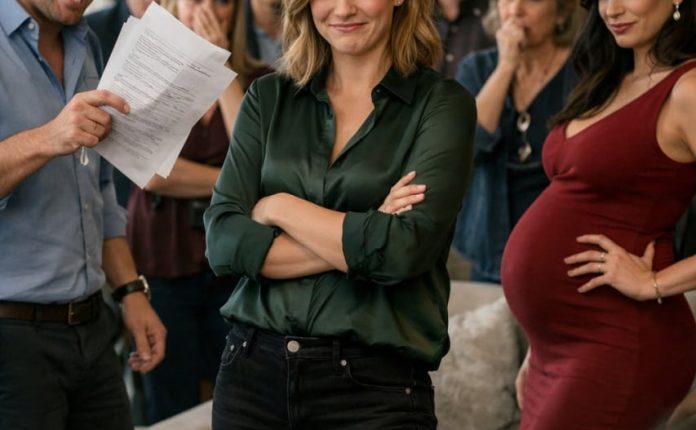
“Put your name where the yellow tabs are,” my father said. “We need to get this house on the market.”
He had let himself into my kitchen without knocking, three weeks after I buried my husband.
I stood beside the sink with a prenatal vitamin dissolving against my tongue. The smell of his coffee turned my stomach. Courtney came in behind him, her heels ticking across the floor Lucas had refinished the previous winter.
Neither of them asked whether I had slept.
I hadn't, much.
There was a T-shirt beneath my pillow that still smelled faintly of Lucas's deodorant. Every night I promised myself I would stop reaching for it. Every morning I tucked it farther inside the pillowcase.
“What are you talking about?” I asked.
My father set a blue folder on the kitchen table.
“Your situation.”
He pulled out a chair and sat down.
Courtney stayed standing. She was twenty-four, with a new haircut I had complimented at the funeral because I couldn't think of anything else to say when she asked whether I liked it.
Now she studied our kitchen as if she were waiting for a real estate agent.
I rinsed my mouth and lowered myself into the chair opposite Charles. At thirty-five weeks and two days pregnant, sitting had become a small engineering problem.
“What situation?”
“Lucas's debts.”
He said my husband's name without looking at the empty chair beside me.
Lucas had died near Syracuse when a truck crossed into his lane during heavy rain. The investigator had explained the sequence twice. I remembered the officer's wet coat more clearly than his words.
There was no illness to prepare for, no last conversation I recognized as one.
That morning, Lucas had kissed my temple and told me to stop buying baby socks.
“She only has two feet, Vic.”
I had bought another pack after his funeral.
“What debts?” I asked.
Charles opened the folder.
“Business obligations. Personal guarantees. You don't need to understand all of it.”
“Then start with something I can understand.”
He lifted his eyes.
I knew that look. As a child, I used to hear it before I saw it: a spoon placed carefully beside a plate, a newspaper folded along its existing crease.
It meant I was approaching the limit of what he considered acceptable.
Courtney pulled the sleeve off her coffee cup.
“Your dad is doing you a favor. You have enough to deal with.”
I looked at the folder.
Several pages had yellow tabs. One referred to the sale of real property. Another appeared to grant authority over financial accounts. There was a line beneath my printed name.
“Is this a power of attorney?”
“It's permission to handle things.”
“For how long?”
“For as long as necessary.”
I put both hands beneath the table.
“No.”
Charles leaned back.
“Victoria.”
“Send it to Samantha.”
He let out a short breath through his nose.
Samantha Vance had worked with Lucas for years. She had helped us prepare our wills and trusts when we started trying for a baby. I remembered her asking questions that made me uncomfortable: who should make medical decisions, who should raise our child if neither of us survived, who could be trusted with money.
Lucas had answered carefully.
I had wanted to finish before our parking meter expired.
After he died, Samantha told me the immediate bills were covered and that we could review the larger arrangements when I was ready. She called again the previous afternoon, but I had fallen asleep after an obstetric appointment. I hadn't returned the message yet.
My father tapped the folder.
“Every conversation with that woman costs money.”
“Then email her once.”
“I'm trying to keep this private.”
“Private from whom?”
Courtney set her cup on the counter, beside the ceramic bowl holding Lucas's keys.
“People are asking questions.”
“Who?”
She glanced at Charles.
“People.”
The refrigerator clicked on. From somewhere upstairs came the hollow knock of a loose window latch.
I had spent three weeks listening to this house settle without Lucas in it. I knew every sound. My father had no right to make it unfamiliar.
“This is my home,” I said.
“It was Lucas's house.”
“He added me to the deed after our second anniversary.”
Charles stopped moving.
Only for a moment.
But I saw him look down at the folder as if one of its pages had disappointed him.
“When?”
“Three years ago.”
“Ownership doesn't make debts disappear.”
“Neither does saying there are debts make them real. Show me a statement.”
He closed the folder.
That frightened me more than if he had shouted.
My father had started the company that became Baldwin-Gallagher Logistics. In his telling, he had built it with determination and an old truck. My mother occasionally mentioned the money her father had lent him, but never when Charles was in the room.
Lucas had joined seven years earlier, bringing investment money and experience managing regional freight contracts. The company had been struggling then. I knew that much.
I also knew Charles hated hearing the word “rescued.”
At family dinners, he called Lucas his employee.
Lucas usually let it pass.
Once, in the car afterward, I asked why.
“Because correcting him over mashed potatoes won't improve the potatoes.”
I had laughed.
I wished now that I had asked a second question.
Charles stood.
“Pack a bag. Courtney can help.”
I stared at him.
“I'm not going anywhere.”
“You can stay with your aunt until we've sorted this out.”
“Have you spoken to Aunt Ruth?”
“We will.”
Courtney opened a cupboard.
“What are you doing?” I asked.
“Getting you a glass of water. You're getting worked up.”
She chose Lucas's chipped blue mug.
Something inside me went very still.
“Put that down.”
She blinked.
“It's a cup.”
“Put it down and leave.”
Charles moved around the table.
“You don't speak to my wife that way.”
“Then both of you can leave.”
I reached for my phone beside my plate.
He caught my wrist.
His fingers closed hard enough that I felt each one separately.
“Sit down.”
“I am sitting down.”
“Then stop this.”
I twisted my arm toward the table, trying to pull free without tipping the chair.
It scraped sideways and struck the refrigerator.
Courtney picked up her coffee.
That tiny movement stayed with me afterward. Not alarm. Not a step toward us. Just protecting the drink from spilling.
“Let go.”
Charles jerked me upright.
For an instant I thought he was only trying to frighten me, the way he had when I was fifteen and wanted to spend a school holiday with a friend instead of attending a company dinner.
Then I pulled backward.
His other hand went into my hair.
The pain was immediate, bright across my scalp.
“Dad!”
He started toward the hall.
I had to follow or fall.
One hand held my belly. The other gripped his sleeve, not fighting anymore, only trying to keep my feet underneath me.
Courtney said something behind us.
I couldn't understand the words.
“Please. You're hurting me.”
He pulled harder when I stumbled against the hall table.
Lucas's keys fell from the bowl.
I heard them scatter across the floor.
The front door was already open. Charles shoved it wider with his shoulder and released me on the porch.
I dropped onto one knee.
My palms hit the boards.
For a few seconds, I could hear nothing but my own breath.
Then warmth ran beneath my dress and down my legs.
I looked at the spreading water.
“My water broke.”
Charles stared at me.
“Get up.”
“Call an ambulance.”
Courtney stood in the doorway.
She put a hand over her mouth, and I mistook the movement for horror.
Then I heard her laugh.
It was a small sound, almost surprised, as if I had done something embarrassing at a restaurant.
Charles went back inside.
He returned with my purse and dropped it beside me.
“Call someone yourself.”
The purse fell open. A receipt blew toward the steps.
I watched it lodge against a flowerpot.
Lucas had planted marigolds there in the spring. He had put too many seeds in one pot and refused to thin them because, he said, they all seemed committed.
I reached for my phone.
I didn't argue about the house again.
I didn't try to follow Charles when he headed into Lucas's study.
I called Samantha.
She answered with my name, warmly enough that for a second I couldn't speak.
Then everything came out in pieces.
My father. My hair. The porch. The water.
Her voice sharpened.
“Victoria, call 911 now.”
I pressed my hand flat against my stomach.
“Do you understand?”
“Yes.”
“Tell them you're pregnant and you've been assaulted. Give them the address. Then call me back if you can.”
The dispatcher asked questions slowly.
I answered as well as I could.
No, I hadn't landed directly on my stomach.
Yes, the person who hurt me was still inside.
No, he wasn't holding a weapon that I could see.
My father appeared at the study door and watched me for a moment.
Then he went back to the desk.
The dispatcher told me not to go inside.
Across the street, Mrs. Alvarez was kneeling beside a flower bed.
I raised my hand.
She shaded her eyes, looked at me, and stood so quickly she left a trowel stuck upright in the soil.
“Victoria?”
I couldn't shout.
She came anyway.
By the time she reached the porch, I was shaking hard enough that my teeth knocked together.
“Oh, sweetheart.”
She looked at the water, then the open door.
“Is help coming?”
I nodded.
She went to the linen cupboard just inside the hall and returned with a clean towel. Charles said something to her.
She didn't answer him.
She folded the towel beneath me and took off one gardening glove.
“Give me your hand.”
I called Samantha back.
Mrs. Alvarez held the phone steady when my fingers slipped.
“My father says there are creditors,” I whispered.
“Right now, I need you to stay outside.”
“He's in Lucas's desk.”
“I heard you.”
There was a pause.
“Victoria, he contacted my office yesterday. He said you'd authorized him to liquidate estate assets.”
I looked toward the study.
“I never did.”
“I know. My assistant told him we needed to speak directly with you.”
“Then why is he here?”
“I can't answer that yet.”
A drawer scraped open.
Samantha asked whether he had brought documents.
I told her about the blue folder.
“Did you sign anything?”
“No.”
“Good.”
I heard her moving, a door closing, the tap of a keyboard.
“Lucas was concerned about pressure from your father. He made arrangements for that possibility.”
“What arrangements?”
“The house is yours. I've verified the recorded deed. The investment accounts and the trust also have protections. And there are provisions concerning the controlling shares in Baldwin-Gallagher Logistics.”
I tightened my grip on Mrs. Alvarez's hand.
“My father's company?”
“The company Lucas owned the majority of.”
The sentence didn't fit anywhere in my understanding of the morning.
Before I could ask another question, Charles stepped into the hall carrying Lucas's brown leather document wallet.
He had given it to me for Christmas.
Inside were our insurance papers, the deed copy, and a list of contacts Lucas had insisted we keep on paper as well as in our phones.
“Who is that?” Charles asked.
“Samantha.”
“Give me the phone.”
Mrs. Alvarez stood up.
“You stay inside.”
“This is none of your business, Elena.”
She had lived across from him when I was a teenager. He used her first name as though familiarity might turn her back into someone manageable.
She planted her feet.
“A pregnant woman asked me for help. That's enough business for me.”
A siren sounded beyond the next street.
Courtney moved closer to Charles.
He looked from my phone to the road.
“I can explain this.”
I bent over a tightening pain across my abdomen.
Mrs. Alvarez called out before the paramedics reached the path.
One of them knelt in front of me.
Her badge said ERIN.
“Victoria? How many weeks?”
“Thirty-five. And two days.”
“Any bleeding?”
“I don't know.”
“That's okay. We're going to check.”
She asked where I hurt.
When I said my scalp and wrist, her expression changed without becoming frightening.
“Did someone pull you?”
I nodded.
“Who?”
I looked at my father.
Erin followed my gaze, then returned her attention to me.
“Keep looking this way.”
Charles's phone rang.
He checked the screen.
Courtney whispered, “Answer it.”
He did.
I heard him say a man's name.
“Martin, this isn't a good time.”
A pause.
Then: “That's not possible.”
Samantha was still on my phone.
“If a forged authorization has been submitted, the fraud provisions require an immediate independent review,” she said. “There are temporary restrictions while that happens.”
Across the porch, Charles turned away.
“I am still the president.”
It was the first thing he had said that morning that sounded like an appeal.
A patrol car stopped behind the ambulance.
An officer approached Mrs. Alvarez, while another asked Charles to step away from the door.
Courtney began talking quickly.
“She slipped. They were arguing, and she—”
“I saw him standing over her,” Mrs. Alvarez said. “I came when she raised her hand. I did not see the fall.”
Her precision steadied me.
She wasn't trying to make the story worse to make it believable.
What had happened was enough.
Erin asked whether I could stand with help.
A contraction answered before I could.
She and her partner eased me onto the stretcher.
The straps felt absurdly ordinary.
People were walking dogs at the far end of the street. A delivery van stopped two houses away. Somewhere, someone was mowing a lawn.
My life had split open, and Tuesday kept happening around it.
An officer leaned close enough that I didn't have to raise my voice.
“Do you consent to us going into the house?”
“Yes.”
“Is there anything we should know?”
“The blue folder is in the kitchen. He was searching my husband's desk. He took a brown wallet out.”
The officer wrote it down.
Charles heard me.
“Victoria, think carefully.”
I had spent most of my childhood responding to those words.
This time, I turned toward Erin.
“Please take me.”
In the ambulance, she asked who should be contacted.
“My husband—”
I stopped.
She waited.
There was room in her silence for the mistake.
“Mrs. Alvarez,” I said finally. “Her number is in my phone.”
“Anyone else?”
“Samantha.”
At the hospital, the lights above the stretcher passed in pale squares.
Someone cut away the wet fabric at my knees. Someone placed monitors across my stomach. An obstetrician introduced herself as Dr. Mehta and explained what they needed to check.
I kept asking about the baby's heartbeat.
A nurse turned the sound up.
The quick, steady rhythm filled the room.
I cried then, awkwardly, with my mouth open and no sound coming out.
Dr. Mehta waited until I could listen.
My membranes had ruptured. Labor was beginning early. They would monitor us closely, involve the neonatal team, and make decisions as things developed.
“Did the fall cause it?” I asked.
“I can't tell you that from what we know,” she said. “We will document the sequence and your injuries. Right now, we're caring for both of you.”
I appreciated her for not promising certainty she didn't have.
A nurse photographed the marks on my wrist with my permission.
When she moved my hair to examine my scalp, I flinched.
“I'll tell you before I touch you,” she said.
I nodded.
Mrs. Alvarez arrived carrying my charger, a sweater, and one of Lucas's T-shirts.
She had asked an officer before taking anything from the house.
“I thought you might want this.”
I held the shirt against my chest.
For several minutes, nobody mentioned my father.
Then Samantha called.
Mrs. Alvarez put the phone on speaker beside the bed.
“The police have the folder,” Samantha said. “They also have the document wallet.”
“Did he steal anything?”
“We're still accounting for things.”
“What happened with the company?”
“The finance director followed the restrictions in the shareholder agreement after I reported what you'd told me. Charles cannot authorize transfers by himself during the review.”
I closed my eyes.
“He'll say I overreacted.”
“Tell the officers what happened. You don't have to argue his version with him.”
A contraction built slowly and took the room away from me.
Mrs. Alvarez counted breaths beside my shoulder.
When it passed, Samantha asked whether I could hear one more thing.
“Yes.”
“An email arrived at my office early this morning. I hadn't opened its attachment before your call.”
“What attachment?”
“A document giving Charles authority to act for you. It appears to carry your name.”
I looked down at the bruises forming around my wrist.
“I didn't sign it.”
“I believe you. We'll preserve the original email and let the investigators examine it.”
Beyond the curtain, a newborn began to cry in another room.
For the first time, I understood that my father hadn't come to ask me for control.
He had come expecting me to confirm something he had already claimed.
My daughter was born at 6:43 the following morning.
For a second, she made no sound.
There were people around her whom I couldn't see past, and Dr. Mehta was speaking to me, but I heard only the pause where I expected a cry.
Then Nora objected to the world in a thin, furious voice.
I said her name before anyone asked.
Lucas and I had chosen it in a grocery store parking lot after arguing gently about names for twenty minutes.
“Nora Gallagher,” he had said, trying it aloud.
Then he had nodded once, as if she had introduced herself.
A nurse brought her close enough for me to see a small crease between her eyebrows.
“She looks annoyed,” I whispered.
Mrs. Alvarez laughed through tears.
“She has had a difficult morning.”
Nora needed extra support and observation because she had arrived early. They let me touch her before taking her to the neonatal unit.
Her fingers caught the edge of mine.
I wanted to keep every person in that room there until Lucas came through the door.
Instead, I watched them wheel my daughter away and asked when I could follow.
The hours after her birth were made of interruptions.
Blood pressure. Medication. Questions about pain. A pump I couldn't assemble correctly. An officer returning to clarify whether Charles had released my hair before or after we crossed the threshold.
I answered, then asked him to repeat what he had written.
It mattered that the record was right.
He did not tell me what I should have done.
That mattered, too.
Charles had been arrested at the house after the officers spoke with me and examined my injuries. The documents and attempted financial transactions were being investigated separately.
Courtney had left with a relative after giving a statement.
By noon, my aunt Ruth had called six times.
I let the first five go.
On the sixth, I answered because I needed to know whether someone else in my family understood what had happened.
“Your father says you're refusing to speak to him,” she began.
I stared at the plastic pitcher beside my bed.
“My daughter is in neonatal care.”
“I know, sweetheart. We're all worried.”
“Then ask about her.”
There was silence.
“How is she?”
“Small. Breathing with help. Being looked after.”
“Oh, Victoria.”
I almost let the conversation settle there.
Then Ruth said, “He insists he was trying to stop you from falling.”
I watched a drop of condensation travel down the pitcher.
“He dragged me through the hall by my hair.”
“He says things got out of hand.”
“He put his hand in my hair and pulled me outside.”
Ruth took a breath.
“I wasn't there.”
“No,” I said. “You weren't.”
She started talking about stress, grief, how Charles had never known how to handle emotion.
I ended the call before she finished.
Afterward, I shook so hard I couldn't fasten the ties of my hospital gown.
A nurse named Louise did it for me without asking why.
Samantha came that afternoon.
She brought no briefcase into the room, only a thin notebook and an envelope.
“Do you want to talk today?” she asked.
“Are things being taken away while I wait?”
“No. The immediate protections are operating.”
“Then tell me enough to stop imagining everything.”
She sat in the visitor's chair.
“Lucas owned sixty percent of Baldwin-Gallagher Logistics. Charles owns forty.”
I looked at Mrs. Alvarez, who was quietly folding a blanket near the window.
She kept folding.
My surprise was mine to have.
“Sixty?”
“His initial investment kept the company operating. Later capital contributions increased his holding. Those transactions were documented, approved, and reflected in the company records.”
“Why didn't he tell me?”
“He did tell you he held the majority. I was present for one conversation.”
I searched my memory.
A meeting. A long table. Lucas saying that whatever happened to him, I wouldn't have to depend on Charles for money.
I had heard reassurance.
I hadn't heard the mechanics.
“I thought he meant our savings.”
“That's understandable.”
“No. I signed documents.”
“You signed your own estate documents after we reviewed them. You weren't signing away this protection. And understanding every business arrangement was never a condition of keeping what belongs to you.”
I looked at the envelope in her lap.
“What's that?”
“A letter. We can leave it.”
“From Lucas?”
She nodded.
I reached for it, then stopped.
“First tell me the rest.”
The shares were held through the trust Lucas had established. I was its primary beneficiary, with provisions for Nora. His investments were organized there, too.
An independent trustee would administer it under the terms we had discussed years earlier.
“Daniel Ross?” I asked.
“Yes.”
I remembered a patient man with silver glasses asking whether I wanted distributions for ordinary living costs to require a request every month.
I had said no.
Lucas had said, “Especially no.”
At the time, it had seemed like unnecessary planning for a distant possibility.
Now those dry conversations were buying formula, paying the electric bill, and preventing my father from walking into a bank as if he were me.
“Charles cannot become trustee because he's your father,” Samantha said. “He cannot direct the investments because Lucas is gone. And he cannot sell your house.”
“Even if Lucas owed something?”
“Any legitimate obligation would be reviewed and handled through the proper process. Charles doesn't get to invent a debt and collect it by taking your keys.”
I pressed the heel of my hand against my forehead.
“He sounded so certain.”
“He knew enough to understand where he lacked authority.”
That was harder to hear than anything else.
My father's confidence hadn't come from a mistake.
He had relied on mine.
Samantha explained the company safeguards next.
After a disputed transaction the previous year, Lucas had insisted on tighter financial controls and revisions to the shareholder agreement. Charles had signed them because the alternative was losing access to additional funding.
Alleged fraud involving a shareholder's authority required an independent review. Certain officer powers could be temporarily restricted while evidence was preserved.
“His shares don't disappear,” Samantha said. “There isn't a sentence in a contract that makes us judge and jury. But he cannot move assets out the door while everyone argues.”
“What did he do last year?”
“He tried to pledge company inventory for a personal loan without the required approval.”
I remembered that winter.
Charles had stopped coming to Sunday dinner for a month. Lucas said they were having a disagreement over boundaries.
I had brought my father soup when he claimed to have the flu.
“Lucas lent him money afterward?”
“A separate personal loan. Four hundred eighty thousand dollars. Secured against part of Charles's shareholding.”
My father had bought a new car that spring.
Courtney had posted photographs from a resort in the Bahamas.
I closed my eyes.
“Did Lucas know?”
“He knew the loan was risky. He chose to secure it rather than leave the company exposed to another attempt to borrow against its assets.”
“Why help him at all?”
Samantha looked toward the hospital door.
“I think he hoped there was still a way to keep your family and the business from hurting each other.”
That sounded like my husband.
Not a man predicting every betrayal.
A man trying several reasonable things before accepting that one person might keep choosing badly.
“What happens if Charles forged the document?”
“The criminal investigation is one matter. The company review is another. A proven fraud can support removal for cause under the agreement. It can also create a default under that secured loan. Enforcing any remedy takes the process the documents require.”
“So it isn't all over because he got a phone call.”
“No. That call meant he could no longer proceed unchecked.”
I let that settle.
Somehow it was more comforting than a story in which Lucas had hidden a button that would destroy my father.
What he had left was work other people could carry out.
Names. Records. Instructions that did not depend on whether I could stand on a porch and argue.
I took the envelope.
Lucas's handwriting covered one side.
For Vic, if she needs it.
Inside were two pages.
He wrote about the trust in ordinary language, including where to find the household account information and which person to call about the company.
Then the letter changed.
I know your father makes help feel like something you have to earn. You don't have to prove you're overwhelmed before you let someone assist you. You also don't have to hand them the steering wheel.
I put the page down.
Samantha waited.
There was no description of a future attack. No promise that he would somehow be watching.
Only a paragraph explaining why Charles had not been given a role in the trust.
Lucas referred to the unauthorized borrowing and to an argument in which Charles had demanded I persuade my husband to “remember who brought him into the family.”
I remembered that evening.
Lucas had taken a walk afterward.
I had apologized for my father.
He had asked me to stop doing that.
At the bottom of the page was a sentence so familiar I could hear the tired amusement in it.
Ask the second question, Vic. You are allowed.
I folded the letter along its existing creases.
“I want to see Nora.”
Samantha stood.
“We can finish another day.”
The neonatal unit smelled of disinfectant and warm plastic.
A nurse helped me settle into a chair and arranged Nora against my chest, carefully working around the leads.
Her cheek rested above my heartbeat.
I read Lucas's letter again later, after they put her back in the incubator.
This time I noticed the practical details more than the grief.
He had listed the electrician because the nursery outlet needed replacing.
He reminded me that the good snow shovel was behind the workbench.
He had expected me to continue living.
I wasn't sure how to do that yet.
But I could make the next phone call.
The financial review took weeks.
It did not unfold in one triumphant meeting at my bedside.
Investigators asked for documents. Samantha answered questions. Daniel Ross explained the trust without rushing when I needed him to repeat something.
I signed releases from a hospital chair while milk leaked through my gown.
Sometimes I hated every sheet of paper.
Sometimes paper was the only reason I slept.
The blue folder contained an unsigned property-sale authorization and a broad power of attorney.
The document sent to Samantha's office was different.
It bore a reproduction of my signature.
I recognized its slight upward tail.
I also recognized the small blot beside the first letter.
I had made that blot signing an insurance beneficiary update the previous year, when a pen started leaking.
The investigators obtained the earlier form through the appropriate records request.
The mark appeared in exactly the same place.
Samantha didn't announce that this settled the case.
She told me it was one piece of evidence among several.
The email had come from Charles's account. The attachment had been prepared on his home computer. Records later obtained from that computer showed the insurance document had been opened before the authorization was created.
There was also an attempted loan application.
Charles had represented that he would be authorized to act for the trust holding Lucas's shares. He had offered that supposed authority as part of a bridge financing proposal.
He was not merely trying to sell my house.
He was trying to regain command of the business without purchasing the shares he didn't own.
“He intended to use my name?”
“Yes,” Samantha said.
“And the folder?”
“The genuine authorization he hoped you'd sign would have helped him support the authority he'd already claimed.”
I remembered the yellow tabs.
The pen positioned beside them.
His anger when I asked to send everything to Samantha.
He hadn't lost his temper because grief made me difficult.
I had interrupted his timetable.
Mrs. Alvarez visited almost every day.
Her doorbell camera had captured the porch and part of the open doorway from across the street. It could not see inside the hall. The audio was imperfect.
It showed my father releasing me onto the porch.
It showed him dropping my purse.
It showed Courtney standing in the doorway while I remained on the ground.
The investigators took the original recording.
Mrs. Alvarez refused to send copies to curious neighbors.
“This isn't entertainment,” she told one woman who asked.
I loved her for that.
Nora stayed in the neonatal unit for ten days.
I learned how to read the monitors without staring at them constantly. I learned which nurse would warm a blanket before settling it over my lap.
I learned that being terrified and being useful could happen at the same time.
My wrist faded from purple to yellow.
My scalp stopped hurting when I washed my hair.
None of that meant I wanted to see my father.
A temporary protective order kept him from contacting me directly or coming to the house.
Messages still reached me through relatives.
He was worried.
He was devastated.
He had made a mistake.
A mistake was leaving the freezer open.
I did not know what word he expected me to use for the decisions that followed my first request to let go.
Courtney's first public version appeared in a message to family.
She said I had become hysterical during an effort to discuss “financial realities.” She said her laughter had been a nervous reaction.
Ruth forwarded it to me.
For once, she included no advice.
I sent it to Samantha and deleted it from my phone.
A few days later, Courtney gave investigators a further account through her lawyer.
I didn't see the full statement then. I learned its substance later.
She acknowledged helping prepare the electronic document at Charles's direction.
She said he told her I had already agreed and that the paperwork merely recorded my wishes.
Investigators also recovered messages that complicated that explanation.
One from Courtney asked what would happen if I refused to sign the originals.
Charles replied that he would handle me.
I sat with those five words for a long time.
Not because they surprised me.
Because they were so close to what he had said for years, only written somewhere he hadn't expected me to read.
We brought Nora home on a Friday.
Mrs. Alvarez carried the car seat while I worked the new lock.
A locksmith had changed every exterior cylinder. Samantha had arranged it with my permission while we were still in the hospital.
Lucas's keys still lay in the ceramic bowl.
I picked them up.
For three weeks before the attack, I had left everything where he put it, as though disorder might make his absence harder to reverse.
Now I moved the keys into a drawer.
The house did not punish me.
In the nursery, afternoon light fell across the empty rocking chair.
I sat down with Nora and listened to the small noises she made while sleeping.
For the first time since the porch, I cried without checking whether anyone needed a statement from me.
Six weeks after her birth, Samantha called about the company.
The independent review was complete. The directors would meet to consider Charles's removal as president. Daniel would represent the trust's controlling interest under its terms.
“You don't have to attend,” she said.
“Does he?”
“He's been given an opportunity to respond.”
“What has he told the employees?”
“That the restrictions are temporary. That you're being influenced by advisers who don't understand the business.”
I looked at Nora asleep against my shoulder.
Charles was still explaining me to people.
Still making my choices sound like somebody else's work.
“I want to come.”
“We can arrange for you to observe. You won't be expected to make a speech.”
“I need to know what happens to the people who work there.”
“So does Daniel.”
That helped.
I bought a plain navy blouse because nothing in my wardrobe fit comfortably.
Mrs. Alvarez offered to stay with Nora in an office nearby so I could feed her during breaks.
On the morning of the meeting, I stood in the bedroom with one sleeve rolled wrong and almost called to Lucas for help.
Then I fixed it myself.
At the company building, familiar photographs lined the corridor: trucks, ribbon cuttings, Charles shaking hands.
Lucas appeared in three.
In one, he stood at the edge of the frame holding a paper plate, laughing at someone outside the picture.
I stopped in front of it.
Then a voice came from the conference room.
“If my daughter has something to accuse me of, she can say it to my face.”
Charles.
I looked at Samantha.
She waited for my decision.
I shifted the strap of my bag higher on my shoulder and walked through the door.
Charles sat at the head of the conference table as if the placement of his chair could decide the meeting.
He wore the dark suit he had worn to Lucas's funeral.
For a moment, that detail nearly undid me.
Then I noticed he had set his phone beside a company pen, aligned precisely with the edge of his folder.
The same controlled movements.
The same expectation that everyone else would adjust.
There were six people in the room when I entered: Charles, Samantha, Daniel Ross, finance director Martin Hale, an independent director named Pat Mercer, and the company's outside attorney.
Courtney wasn't there.
Neither were employees, reporters, or an audience my father could charm.
Daniel pulled out a chair for me near the window.
“Would you like water?”
“Yes, please.”
Charles watched him fill the glass.
“Very considerate.”
I set my bag beside my feet.
Samantha sat next to me.
Before the meeting began, the company attorney confirmed the arrangements that allowed Charles and me to be present at the same time. Our lawyers had handled that beforehand. There would be no direct approach and no conversation outside the meeting.
Charles gave a small, irritated nod.
He wanted the restrictions treated as a discourtesy.
Pat opened the meeting.
He had a quiet voice and a habit of checking the page before speaking.
“We're here to consider the findings of the independent review and the proposed action concerning your position as president.”
Charles leaned back.
“I'm aware of the agenda.”
“Then we'll proceed.”
The first finding concerned the forged authorization.
The attorney summarized the evidence without drama.
The email. The source document. The copied signature. The statements made to Samantha's office. The representations in the financing application.
Charles interrupted at the mention of the loan.
“A proposal isn't a transaction.”
“No funds were advanced,” the attorney agreed. “The lender's decision not to proceed doesn't make the representations immaterial.”
“I was trying to protect the company.”
Martin looked up.
“From what?”
“Instability.”
“The payroll reserve was funded. Our credit line was current. You did not bring this proposal to me.”
“You're an accountant, Martin.”
“I'm the finance director.”
My father turned toward Daniel.
“This is what happens when outsiders think a logistics company is a stack of documents.”
Daniel folded his hands.
“I'm here because Lucas required the trust's interest to be represented independently. The business still needs trucks dispatched and people paid. Neither of those tasks requires accepting a false authorization.”
Charles glanced at me.
“Did you understand any of that before they told you what to think?”
My mouth went dry.
Samantha moved slightly beside me, but I put my hand flat on the table.
“I understand that I didn't sign it.”
He looked away first.
Pat continued.
The review also addressed Charles's attempt to bypass restrictions on pledging company assets. There were earlier records, including the inventory incident Lucas had confronted him about.
Not every bad business decision was fraud.
The report made that distinction.
Some things my father had done were merely expensive, stubborn, or poorly judged.
Others involved stating that he possessed authority he did not have.
Hearing those categories separated helped me trust the people in the room.
They weren't piling every dislike of Charles into one conclusion.
They were deciding what the records supported.
When it was his turn, Charles stood.
He walked halfway toward the window before the attorney reminded him of the agreed seating arrangements.
He returned to his chair.
“I built this company,” he said.
He spoke about his first truck, his long hours, the winter he drove an overnight route himself because two drivers had called in sick.
Some of it was true.
I knew because I had been there for parts of it.
My mother keeping dinner warm.
Me asleep on a stack of moving blankets in an office while he finished dispatch.
There had been a time when my father's effort was something I admired without qualification.
I grieved that, too.
“Lucas came into an existing business,” he continued. “He didn't create it.”
“No one disputes your early work,” Pat said.
“Then perhaps remember it.”
“We also have to consider your present conduct.”
Charles tapped the table.
“My son-in-law is dead. My daughter has just had a baby. I took steps to prevent everything falling apart.”
Martin's face tightened.
“Lucas had already made continuity arrangements.”
“And look how quickly you all used them.”
There it was.
The complaint beneath the others.
They had followed Lucas's instructions instead of waiting for Charles to decide which ones should count.
My father turned toward me again.
“You could stop this.”
I heard a chair creak in the silence.
He had not asked whether my wrist healed.
He had not said Nora's name.
“What exactly do you want me to stop?” I asked.
“This spectacle.”
“There are seven people in this room.”
“You know what I mean.”
“I don't think I do.”
He glanced at Samantha.
“Of course you don't.”
I took a sip of water because I needed something to do with my hands.
Then I put the glass down.
“You came into my home and told me to leave. When I asked to have the papers reviewed, you hurt me.”
His jaw shifted.
“I was getting you away from the argument.”
“You were the argument.”
“Victoria—”
“I asked you to let go.”
Nobody spoke.
I could hear a forklift reversing somewhere beyond the office wall, its distant warning beep moving through the warehouse.
Ordinary work continuing.
My father looked at the table.
“You were upset.”
“Yes.”
“You weren't listening.”
“No. I wasn't agreeing.”
His eyes lifted.
For years, I had blurred that distinction for him.
It had made family occasions easier.
It had also brought him to my kitchen carrying a pen.
The company attorney intervened before Charles could answer.
The meeting returned to the report.
There was a motion to remove him as president for cause under the governing documents. Daniel and Pat voted in favor. Charles voted against.
The outcome was recorded.
Martin would serve as interim chief executive while a search was conducted.
Charles remained a shareholder, with the rights and obligations attached to the shares he actually owned. His personal loan and any enforcement against its collateral would proceed separately.
Nobody announced that I now owned everything my father possessed.
Nobody needed to.
He had lost the office he had tried to recover through my name.
Pat asked him to surrender his company access card.
Charles stared at him.
“You can't seriously expect—”
“The access arrangements are in the resolution.”
He took the card from his wallet.
For a moment, he held it between his thumb and forefinger.
Then he set it down.
I thought I would feel satisfaction.
Mostly, I felt tired.
As the attorney gathered the papers, Charles looked toward me one last time.
“After everything I've done for you.”
I waited for the old reflex.
The inventory of rides, school fees, childhood holidays. The urge to demonstrate gratitude before I was allowed to say anything painful.
It came.
But it did not have to determine my answer.
“What happened at my house was your decision,” I said.
He said nothing.
Samantha and I left first.
In a small office down the hall, Mrs. Alvarez sat beside the window with Nora asleep in her arms.
“How did it go?” she asked.
“He's no longer president.”
She nodded.
“Do you want to talk?”
“Not yet.”
“Then eat something.”
She pointed to a sandwich wrapped in waxed paper.
I laughed once, unexpectedly.
It hurt a little.
The company announcement went out that afternoon.
It stated that Charles had been removed following an independent review of unauthorized conduct and that Martin would lead operations during the transition.
It did not describe the porch.
It did not name Nora.
A separate statement confirmed that the business remained financially stable, payroll would continue, and the shareholder changes did not alter existing employment arrangements.
Charles had spent years making his authority sound inseparable from everyone else's livelihood.
The next morning, the trucks left on schedule.
That quiet fact meant more to me than any triumphant headline could have.
The criminal proceedings took much longer.
There were hearings, revised dates, negotiations I understood only after Samantha explained them in smaller pieces.
A prosecutor met with me in a room with a printer that kept jamming.
She asked what I wanted her to know.
I had prepared sentences about accountability.
Instead, I told her that I still checked the front lock three times before bed.
She wrote that down.
I told her Nora had been early, but the doctors could not say with certainty what caused labor to begin when it did.
“I don't want anyone saying more than we know,” I said.
“We'll rely on the medical evidence.”
I told her about the laughter.
Then I cried, because somehow that was the detail I could not make ordinary through repetition.
Courtney's lawyer sought an agreement.
Her further account, supported by electronic records, established her role in preparing the forged authorization. She admitted she knew my genuine permission had not been obtained.
She had chosen to believe Charles when he said that permission could be secured afterward.
That distinction did not erase what she had done.
It did explain why the investigators treated their roles separately.
Her case ended in a guilty plea to a reduced offense related to the attempted fraud, with probation, community service, and financial obligations under the agreement.
She did not go to prison.
When I heard, I sat at my kitchen table until my coffee cooled.
I wanted punishment to make the sound of her laughing disappear.
It couldn't.
She sent an apology through her attorney.
It was three paragraphs.
The first described Charles's influence. The second described her fear. In the third, she wrote that she should have helped me.
I put it in the file Samantha had told me to keep.
I did not answer.
Charles fought longer.
His public account narrowed as the evidence accumulated.
At first, he had not touched me.
Then he had held my arm.
Then he had been moving me away from an argument.
The video did not show the hallway, but it showed enough of the porch to contradict parts of his story. My injuries, my immediate statements, the emergency call, the documents, and the electronic records formed a picture that did not depend on one perfect recording.
Eventually, he entered guilty pleas to assault and a felony offense involving the forged document.
The agreed sentence included eighteen months of incarceration, followed by supervision. The final protective order continued to restrict his contact with me.
At sentencing, I read a statement.
I did not describe him as a monster.
That would have made the childhood photographs too difficult to explain.
I said he was my father.
I said I had trusted that relationship to place limits on what he would do, even when I distrusted his temper.
I described the moment I realized he could hear me asking for help and still choose to walk inside.
Then I said what I wanted entered into the record.
“My daughter does not owe him access because he is related to her. I do not owe him silence because I am.”
My voice shook.
I finished anyway.
Charles looked older than he had at the company meeting.
For a moment, I wanted to go to him.
The desire frightened me until Samantha reminded me that attachment did not disappear on command.
“You can miss your father,” she said afterward. “That doesn't require putting him back in charge.”
The financial matters ended through a separate negotiated resolution.
The loan was in default under its terms. Rather than continue a costly dispute over enforcement, Charles agreed to a sale of his remaining company interest at an independently assessed value, with the debt and other obligations accounted for.
I did not sit across from him for that negotiation.
Daniel represented the trust. The company had its own advisers. I received explanations and asked questions until I understood the choices.
The business continued under professional management.
A portion of the trust's income supported Nora and me. Other funds stayed invested for future needs.
I hired an independent financial adviser and asked him to explain every fee.
The first time I stopped a meeting to ask what a term meant, I felt embarrassed.
The second time, less so.
Lucas had not left me a reason to avoid learning.
He had left me time to learn without being cornered.
At home, recovery was less orderly.
I startled when someone knocked too hard.
Once, while washing my hair, I began crying so suddenly that I had to sit on the bathroom floor.
There were days I resented Lucas for being dead, then felt ashamed of the thought.
A counselor told me I could say it aloud in her office.
So I did.
“I needed him.”
She nodded.
“Yes.”
No correction.
No lesson hidden inside the loss.
I kept going back.
Ruth eventually asked to visit.
I agreed to meet her at a café first.
She arrived carrying a knitted baby cardigan and no husband, cousin, or intermediary.
“I kept thinking of him as my brother,” she said.
I waited.
“I should have thought about what you were telling me.”
“Yes.”
She rubbed her thumb across the edge of the cardigan.
“I don't expect you to make this easier for me.”
That was the first useful thing a relative had said about it.
We rebuilt slowly.
She learned not to bring me updates about Charles unless I asked. When other family members complained that I was keeping Nora from her grandfather, Ruth stopped forwarding their messages.
Some relationships survived the boundary.
Others depended on my removing it.
I let those go.
On the first warm Saturday after winter, I finally had the porch railing repaired.
The carpenter asked whether I wanted the old boards replaced completely.
I stood at the door with Nora on my hip.
For months, I had avoided looking at the spot where I fell.
Now there was only weathered wood, a stain from a flowerpot, one nail working loose.
“Replace what needs replacing,” I said.
He did.
I chose the paint myself.
Mrs. Alvarez came over with lemonade and watched Nora investigate the corner of a clean dish towel.
“Lucas would have used the wrong brush,” she said.
I looked at her.
“He would.”
“He borrowed mine twice.”
“He told me he'd bought one.”
“He bought one after I asked for mine back.”
I laughed.
It was the first memory of him in months that arrived without knocking the breath out of me.
I started keeping a notebook for Nora.
Not a record of what my father had done. Those papers existed elsewhere.
This book was for Lucas.
His terrible singing in the car. His habit of labeling leftovers with increasingly dramatic warnings. The way he checked the back door and then returned upstairs to ask whether I wanted anything before bed.
I wrote about his investment in the company, too.
Not as a grand rescue.
As work he had taken seriously, with consequences for people whose names rarely appeared on ownership papers.
I wanted Nora to know that care could be practical.
It could look like a good joke or a repaired step.
It could also look like making an uncomfortable appointment and insisting that the documents be finished.
Near the anniversary of his death, I read his letter again.
For a long time, I had treated it as the last thing he would ever say to me.
That made every sentence heavy.
Now I could see the man who wrote it more clearly.
He had probably been at the dining table, annoyed by the printer, drinking coffee he had reheated twice.
He had been worried.
He had also expected to come home.
I put the letter away and opened the nursery door.
Nora was standing in her crib, gripping the rail, pleased with herself.
“Look at you,” I said.
She bounced on her knees.
I lifted her, and she pressed her open mouth against my cheek.
Outside, a truck passed at the end of the street.
For once, I did not tense at the sound of an engine slowing.
That evening, Mrs. Alvarez joined us on the porch.
The marigolds had come back unevenly. I had thinned them, apologizing to Lucas under my breath as I worked.
Nora sat between my feet on a blanket, examining a wooden spoon.
The railing was dry beneath my hand.
Across the lawn, Mrs. Alvarez's sprinkler ticked around in a slow circle.
“What are you thinking?” she asked.
I watched my daughter lift the spoon toward the light.
For months, I had thought surviving meant reaching a day when nothing from that morning could hurt me.
Now I knew I could be hurt and still have a home. Still raise my daughter. Still decide who crossed the threshold.
“I'm thinking we should eat before she does,” I said.
Mrs. Alvarez smiled and stood.
I carried Nora inside.
Lucas's keys remained in the drawer. His letter was upstairs. The front door had a lock my father had never held a key to.
I turned it behind us, once, and went to make dinner.
THE END
This is a work of fiction inspired by real events. The characters, dialogue, and specific incidents are fictionalized and do not describe a verified real-world case.
I had no speech prepared.
My hands were steady, which surprised me. Earlier, I had needed to concentrate just to keep my face composed.
Now I could see individual people again.
A server waiting with plates.
Martin beside his wife.
Priya near the window.
Evan at the edge of the group, looking at the carpet.
My family.
“I appreciate everyone coming,” I said. “But I need to correct something besides the sponsorship.”
Mom's face changed.
Dad kept his eyes on me.
“Earlier tonight, my clothes became a reason to speak about me as though I didn't belong here. Some people laughed.”
Nobody moved.
“I haven't changed since Daniel arrived. The sweater is the same. So am I.”
I heard someone inhale.
There were many things I could have said.
I could have described the warehouse. The years of building. The people whose work kept Phoenix going. I could have offered enough achievements to make the room feel ashamed of misjudging me.
But that would have left the central error untouched.
“It shouldn't take knowing my job to make that treatment unacceptable,” I said.
Daniel stood quietly beside me.
“I would have deserved a decent birthday if I were out of work. I would have deserved it if the clothes were all I could afford.”
Mom looked down.
Lauren's eyes were wet.
“I don't want another argument tonight. I do want us to stop pretending it was harmless.”
The room stayed silent.
Then I picked up the knife.
“Now I'd like some cake.”
A few people smiled uncertainly.
The server moved forward, grateful for a task.
I cut the first slice badly. The silver thirty tipped sideways. A small piece of icing broke loose and stuck to the blade.
It was an ordinary little failure.
I found that comforting.
Daniel took a plate from the server and handed it to me.
“Corner piece,” he said.
“You remembered.”
“You complain when anybody gives you the middle.”
“I make an observation.”
“A recurring observation.”
I laughed again.
This time, it sounded like me.
We stayed long enough to eat cake by the windows.
I did not go from table to table reassuring people. I did not explain that everything had been resolved. The adults who felt uncomfortable could carry their own discomfort for once.
Martin came over to wish me a happy birthday without mentioning business.
Priya told me she would ask her team to send a short note about documentation the next morning.
Victor approached with the careful expression of a man reconsidering whether the moment offered an opportunity.
“I always knew you were formidable,” he said.
I looked at him.
“Tonight isn't a pitch, Victor.”
He smiled sheepishly.
“Understood.”
For the first time all evening, someone accepted a boundary without making me defend it.
Mom found me while Daniel was fetching the frame.
“Are you leaving?”
“Yes.”
“We haven't had dinner.”
“The party has. I wasn't there for it.”
She glanced toward Lauren.
“Your sister is upset.”
“So am I.”
“I know.”
I waited.
She opened her mouth, closed it, then tried again.
“I didn't realize.”
“Which part?”
The question made her uncomfortable.
“All of it.”
“That isn't specific enough, Mom.”
Her eyes shone.
“I thought the party would be good for everyone. Lauren needed contacts. Your father wanted to help. I thought you'd enjoy seeing people.”
“You didn't ask.”
“No.”
The admission was barely audible.
I nodded.
“That's somewhere to start.”
She touched my sleeve, then stopped before closing her fingers around it.
That small hesitation mattered more than another polished sentence.
“Will you call tomorrow?”
“Not about fixing Lauren's budget.”
Mom looked down.
“All right.”
Daniel returned with the photographs.
Dad waited by the entrance.
For a moment, I thought he might hold the door and let that gesture stand in for a conversation.
Instead, he said, “I owe you an apology.”
“You do.”
He swallowed.
“I shouldn't have repeated an assurance without speaking to you.”
“No.”
“And I should have stopped what was happening when I arrived.”
I looked at him.
He seemed older under the doorway light than he had beside the chandeliers.
“Yes,” I said. “You should have.”
He nodded once.
“I'll call when you're ready.”
I did not promise a date.
Lauren was standing behind him.
Her emerald dress was still immaculate. The expression above it was not.
“Claire.”
I waited.
“Can we talk?”
“Not tonight.”
“Please.”
My whole life, that word had often meant that the person who hurt me needed immediate relief from the consequences.
“I'll read anything you want to write,” I said. “But I'm leaving now.”
Her face tightened.
For a second, I saw the familiar protest forming.
Then she said, “Okay.”
Daniel and I walked outside.
The rain had stopped. Water shone along the curb, and the air smelled of wet leaves.
I stood beneath the entrance canopy and took a full breath.
Daniel held the frame against his side.
“Pasta?”
I turned to him.
“Bellini's will be closing.”
“Kitchen's open another forty minutes.”
“You checked?”
“While you were cutting cake.”
I looked at him, then laughed.
We drove separately because my car was still in the visitor lot. Ten minutes later, I was sitting beneath a wall covered in photographs of people I did not know, eating lemon pasta from a wide chipped bowl.
My sweater sleeve rested against the table.
Nobody commented.
The owner came out to ask whether we wanted dessert. Daniel told him it was my birthday.