Daniel was halfway out of his seat when I caught his sleeve.
“Sit down,” I whispered.
He kept looking toward the chapel doors. I followed his gaze and saw Theo standing beneath the little glass window, rain darkening the shoulders of his coat.
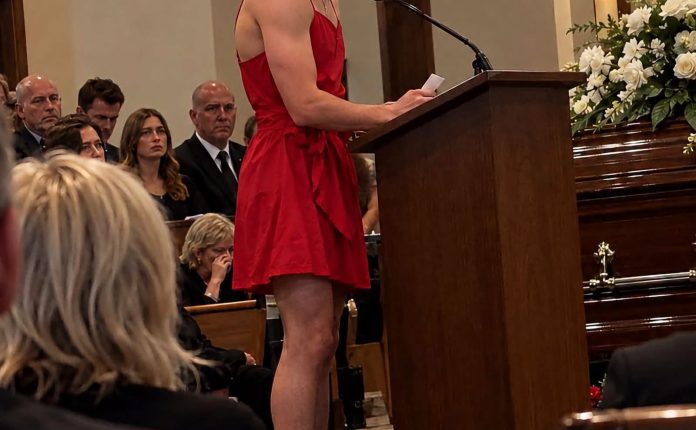
Underneath it was a red dress.
Not burgundy. Not a dark shade that might disappear among the funeral clothes. Bright red, with short sleeves, a narrow waist, and a hem just above his knees.
For a moment, my mind refused to put the pieces together.
Theo. Our Theo. The boy whose trainers had lived beneath our radiator for eleven years.
My son's coffin at the front of the chapel.
That dress.
Daniel eased his sleeve out of my fingers.
“I'm going to speak to him.”
“Please don't.”
A woman behind us stopped whispering halfway through a sentence. The silence that followed told me other people had noticed.
Theo stood very still while his sister took his coat. He was holding a folded sheet of paper. His black shoes looked painfully formal beneath the red hem, and I recognized them because Daniel had taken him shopping for them before a job interview.
He looked toward the front.
Our eyes met.
Then he lowered his head.
I should have gone to him.
That is one of the things I remember most clearly now: there was still time to get up, walk down the aisle, and put my arms around a boy who had just lost the closest thing he had to a brother.
Instead, I sat there wondering what he meant by it.
Five days earlier, I had watched the home-care nurse remove the little plastic tube from beneath Jack's nose.
She had asked whether I wanted a few minutes alone with him.
I had almost said that I had spent eighteen years wanting more minutes.
Now people were gathering to say goodbye, and I could not bear anything I hadn't prepared for.
The flowers were as ordered. The photograph was the one Jack had chosen. The music had been checked.
Theo's dress had not been discussed.
In the exhausting confusion of that morning, surprise felt almost like an injury.
“Maybe he's upset,” I whispered.
Daniel turned to me.
“We're all upset, Helen.”
His voice was low, but there was something in it that made me tighten my grip again.
Across the aisle, Theo's sister guided him toward a pew.
Mara had a hand between his shoulder blades. He moved when she moved, as though remembering each step only after somebody showed him.
I had known her since she was a sharp-eyed thirteen-year-old collecting her little brother from our kitchen. She was twenty-four now, with her own flat and a way of looking directly at people that reminded me of who she had needed to become.
She caught me watching.
There was no challenge in her expression.
Only worry.
Theo sat down.
The red fabric settled around him.
I looked away.
There are versions of grief people can describe afterward with grace. They speak of love, gratitude, precious memories.
Some of mine was ugly.
I was jealous of people who could still answer their children's messages. I resented the woman at the florist who asked whether I wanted a receipt. I had stood in a supermarket staring at a bag of the cereal Jack liked, furious that the company was still making it.
And at his funeral, for several minutes, I suspected his best friend of wanting attention.
I wish that were not true.
But the rest of what happened matters only if I tell that part honestly.
Theo first came into our house carrying one shoe.
He was seven.
Jack had the other shoe and an explanation that involved a puddle, a dog, and a decision neither boy could defend once they said it aloud.
I put newspaper on the kitchen floor and told them to stand still.
Theo did exactly as he was told.
Jack began negotiating.
“If we take our socks off, can we still have biscuits?”
“The socks aren't the issue.”
“Right. So that's a yes?”
Theo made a small choking sound. I thought he was crying until I realized he was trying not to laugh.
His parents lived four houses away. We knew them well enough to exchange parcels and talk about the weather, but not well enough to know what went on when their front door closed.
The boys had been classmates for three weeks.
By the end of that first afternoon, Jack had decided they would sit together at lunch forever.
Forever was a word he used easily then.
Two months later, he brought Theo home without asking.
I was draining pasta when they appeared.
“We need another plate,” Jack said.
“Does Theo's mum know he's here?”
Theo stared at the tiled floor.
“They're doing the loud talking,” Jack explained.
I turned off the tap.
There was nothing theatrical about the way he said it. He was reporting a practical problem. Rain meant wet shoes. Loud talking meant an extra place at our table.
I called Theo's mother. She sounded relieved.
That evening, he ate slowly and thanked me twice for the same glass of water.
When I asked whether he wanted another spoonful of pasta, he glanced at Jack before answering.
Jack pushed the serving bowl toward him.
“You can just say yes here.”
I have remembered that sentence longer than many things I was determined never to forget.
You can just say yes here.
The overnight stays came gradually.
First there was a late argument at home. Then a weekend when one parent was moving out and neither seemed able to explain where Theo should put his school things.
We kept a toothbrush for him.
Then pajamas.
Then a drawer.
The room at the back of the landing had been full of things we were postponing decisions about. A bicycle nobody used. A broken lamp Daniel intended to repair. Boxes from a computer we no longer owned.
One Saturday, Jack dragged the bicycle into our bedroom.
“What are you doing?”
“Making space.”
“For what?”
“Theo.”
That was how the spare room stopped being spare.
No ceremony. No discussion about what we were becoming to one another.
Just a boy deciding his friend ought to have somewhere to put his belongings.
Theo spent three consecutive Christmases at our table.
The first year, he arrived with a small bag and said his mother would collect him after lunch. By evening, she had called twice to change the arrangement.
I found him beside the front window, watching headlights.
Jack came up behind him carrying two crackers.
“You're on my team for charades.”
“I might have to go.”
“You can leave after we win.”
They did not win. Jack's attempt to mime a washing machine resulted in Daniel asking whether he needed the bathroom.
Theo laughed so hard that his paper crown split.
After that, I started buying six crackers instead of four without thinking about it.
Daniel was less demonstrative than I was, but he had his own ways of making room.
He taught Theo to mend a puncture. He checked the oil in the old car Theo eventually learned to drive. He pretended not to notice when the boys emptied the biscuit tin, then bought the same biscuits again.
Before Theo's first interview, he arrived holding a tie like a length of rope.
“Could you show me?”
Daniel stood behind him in the hallway mirror.
“Watch my hands.”
Theo watched so carefully that Daniel had to tell him to breathe.
I could see that mirror from where I sat in the chapel.
Not the actual mirror, of course. The memory of it: a scuff near the bottom of the frame, Daniel's broad hands, Theo trying to make himself look like somebody a stranger might employ.
And I could not reconcile that memory with the hard line of my husband's mouth.
“Did something happen between them?”
I had turned toward the boys behind us before I quite knew I was speaking.
Both had been in Jack's classes.
One was called Ben. The other, Lewis, had once broken our garden chair during a barbecue and offered to pay for it with money he did not have.
They looked startled.
“What do you mean, Mrs. Harris?”
“A disagreement. Before Jack—”
I could not finish.
Ben shook his head.
“No.”
Lewis leaned closer.
“They were fine. Theo was there constantly.”
“I know.”
Of course I knew.
That was why I was asking a question that made no sense.
“Did he say anything about what he was going to wear?”
They glanced at each other.
“No,” Ben said.
Then Lewis added, “Jack wanted him to speak. He told us that.”
I faced the front again.
Yes. Jack had told us, too.
The officiant, Anna, had come to the house ten days before he died.
I had expected her to discuss music gently and perhaps ask whether we wanted a reading.
Jack had a list.
He had written it on the back of an appointment letter because, he said, the hospital owed him some useful paper.
“No photograph with the braces.”
Anna nodded.
“Understood.”
“No one saying I lost a battle.”
I looked up.
Jack kept his eyes on her.
“I don't want people thinking I could have tried harder.”
Daniel made a noise in his throat.
Anna waited until he had swallowed.
“We won't use that language.”
“And Theo speaks.”
“Of course.”
“Nobody checks what he's saying first.”
I smiled then. A reflex, because it sounded like Jack anticipating Theo might include an embarrassing story.
“What are you two planning?”
“Excellent public speaking.”
Theo, sitting by the window, did not smile.
I noticed.
I did not ask.
By then, there were so many things I had learned to notice without asking. A pause before an answer. A tray returned untouched. The way a nurse stayed a little longer in the doorway.
I thought allowing silence was sometimes kindness.
It was. Sometimes.
Other times, I was simply afraid.
The diagnosis had come fourteen months before the funeral.
Jack had been tired. Then he had been in pain. Then the pain had acquired explanations that seemed manageable until they weren't.
A pulled muscle.
Growing pains.
Something to review if it persisted.
By the time the scans gave it a name, the doctors were speaking carefully about treatment rather than certainty.
I remember the consultant's pen.
He clicked it once, realized he had done it, and put it down.
That was the moment I understood he was preparing to tell us something he could not soften.
Jack listened with both feet planted on the floor.
Then he asked whether he could still finish school.
I asked questions about survival.
Daniel asked about specialists.
Jack asked about Thursday's coursework deadline.
We each reached for the part of the problem we thought we might still control.
Theo came over that evening carrying a packet of crisps and a notebook.
I opened the door and began telling him what we knew.
He listened.
Then he asked, “Does he want me upstairs?”
“I think so.”
“Could you ask him?”
It was such a small distinction.
Most people asked us how Jack was.
Theo kept asking Jack.
The treatments changed his appearance before they changed our expectations.
His hair came away on the pillowcase. His face grew round from one medication and thinner when another made eating difficult. His familiar sweatshirt hung differently every month.
Theo carried on arriving.
Sometimes he was noisy. Sometimes he sat on the floor and worked through equations while Jack slept.
When visitors used a bright voice and talked about staying positive, Theo waited until they left before asking Jack whether he wanted to complain about them.
They watched terrible films and gave them elaborate ratings.
One star for dialogue. Four stars for an explosion that made no physical sense. A separate category for how obvious the villain's haircut was.
I used to stand on the landing with clean towels, listening.
Their laughter relieved me so much that I was ashamed of the relief. I would think, He can laugh; perhaps things aren't as bad as the doctors are saying.
But laughter was never a scan.
It was something Theo helped Jack keep when so much else was being taken.
There were days when Jack was unkind.
Illness did not turn him into a saint, and he would have hated us pretending it did.
Once he snapped at Theo for opening the curtains.
Theo shut them.
Then he said, “You can be angry. You still don't get to talk to me like I'm furniture.”
I stopped outside the bedroom.
Jack said nothing for a while.
Finally: “Sorry.”
“Fine. Do you want the curtains half open, or are we living in a cupboard today?”
“Half.”
I went downstairs without interrupting.
That evening, Jack ate a little more.
I cannot prove those things were connected.
I remember them together.
At the chapel, a child near the back asked a question in a voice too clear for the room.
An adult hushed him.
Theo's shoulders tightened.
I looked at the red dress again and felt a hot, irrational anger.
Hadn't he known what people would do?
Hadn't he known this would be difficult for us?
Even as I thought it, I saw his hand moving against the paper in his lap.
He was smoothing the same corner over and over.
He had always done that when he was frightened. Homework instructions. Medical leaflets. The envelope holding his interview appointment.
Eleven years of knowing somebody ought to have counted for more than the color of his clothes.
Still, I did not get up.
Ruth leaned toward me.
“Would it help if I spoke to Mara?”
“No.”
“I only mean she could perhaps—”
“No, Ruth.”
She sat back.
Daniel heard the exchange.
“You can't pretend you understand this.”
“I don't.”
“Then why are you defending it?”
I looked at Theo's bent head.
“Because I know him.”
But my voice did not sound as certain as I wanted.
The morning had begun with the kettle clicking off in an empty kitchen.
For fourteen months, mornings had involved a question.
Was Jack awake?
Had he slept?
Was he in pain?
That morning, I made three cups of tea.
I put one down beside his usual chair before I realized what I had done.
Daniel saw it.
Neither of us moved the cup.
Theo had not been at the house when we left. I assumed he was getting ready with Mara. He had spent the previous afternoon upstairs, carrying things from one room to another.
I had heard drawers opening.
When I asked whether he needed help, he said he was sorting a few bits.
I thanked him.
I thought he was tidying.
Grief had reduced my attention to whatever stood directly in front of me. A telephone call. A flower arrangement. A cup I could not pick up.
Even now, sitting beside Daniel, I was thinking about whether somebody had remembered to lock the back door.
Then Anna stepped to the lectern.
She welcomed everyone.
She said Jack's name.
I had heard his name hundreds of times that week, but spoken into a microphone it sounded newly final.
Daniel took my hand.
The first piece of music began.
On the screen beside the coffin, a photograph appeared of Jack at nine, leaning out of a cardboard castle with a wooden spoon raised like a sword.
Theo was beside him.
Both boys had paint on their faces.
I remembered taking that photograph.
They had insisted the castle needed a moat. Daniel had explained several reasons why we could not flood the living room.
Theo had offered to use a washing-up bowl.
Practical, even in conquest.
Another photograph followed.
A beach. A birthday cake. The boys bent over a bicycle wheel.
People made the quiet sounds they make when memory catches them unprepared.
I looked across at Theo.
He was watching the photographs with his mouth slightly open.
Not smiling.
Not performing.
Just watching his friend grow up and disappear one picture at a time.
My anger loosened.
In its place came something worse.
The possibility that I had been looking at him all morning and failing to see him at all.
Anna read a few lines Jack had approved.
Then she closed her book.
“Jack asked that his friend Theo speak next.”
Daniel's hand changed in mine.
Not a squeeze. A movement, as though he were about to stand before he had decided.
I caught his sleeve again.
“Remember who he is.”
He turned toward me.
I had not planned the words. They were simply the only thing I knew.
Not remember what he's wearing.
Not remember who's watching.
Remember who he is.
Theo stood.
His folded paper slid from his hand.
Mara caught it against her knee and gave it back. She said something too softly for me to hear.
He shook his head.
Then he walked forward.
His shoes made a small, hard sound on the chapel floor.
Halfway up the aisle, he looked toward our pew. Daniel's face was closed, and I saw Theo look away before reaching us.
I wanted to undo that moment immediately.
There was no way to reach back and change what he had seen.
At the lectern, he touched the microphone.
A dull thump came through the speakers.
“Sorry.”
He adjusted it again.
There was a small bandage on his thumb.
I remembered standing in Jack's bedroom a week earlier while Theo tried to open a stubborn packet of batteries with the kitchen scissors.
Jack's bedside fan had stopped.
“Give it here,” I had said.
“I've nearly—”
Then the scissors slipped.
Jack, propped against his pillows, had opened one eye.
“Excellent. Now Mum has two patients.”
Theo had held a tissue around his thumb.
“Mine's a dramatic injury.”
“Yours is incompetence.”
I had laughed.
At the chapel, I pressed my fingers hard against my lips.
That little bandage had survived my son.
Theo unfolded his paper.
“I wrote something,” he said. “It's probably too long.”
A few people shifted.
“He always said my essays had unnecessary introductions.”
The faintest smile passed over Ben's face.
Theo looked toward the coffin.
“So I'm already doing badly.”
His voice broke on the last word.
He waited.
Nobody hurried him.
Then he glanced down at himself.
“I know this needs explaining.”
Daniel's shoulders were rigid.
“The dress belongs to my sister. She said I could borrow it, but if I damage it, she will still charge me.”
A few people let out uncertain breaths.
Mara wiped her cheek without looking up.
Theo gripped the lectern.
“I'm not here to make this about me.”
I felt something inside me flinch.
Because I had thought exactly that.
“And I know some of you would rather I hadn't come like this.”
His eyes passed across our pew.
Daniel sat very still.
“There is a reason.”
The paper shook.
“Six months ago, Jack asked me to promise him something.”
I leaned forward.
“I didn't realize at first how serious he was. He started it like he started most difficult conversations. By making it sound like we were going to argue about something stupid.”
Theo swallowed.
“He said there might be a day when everyone who loved him would be together, and he wouldn't get to tell us what he wanted us to understand.”
The chapel seemed to contract around his voice.
“He asked me to do something that people might misunderstand.”
Daniel's hand found mine again.
“And he asked me not to explain until I was standing here.”
Theo looked down at the bright red fabric.
For the first time, I understood that the dress was not an interruption to Jack's goodbye.
Somewhere, in a conversation we had never heard, our son had chosen it.
And the boy standing in front of us had been carrying that knowledge alone.
“I put my suit on this morning,” Theo said.
Daniel looked up.
“I did the tie properly. Mr. Harris taught me, so there wasn't even an excuse to get it wrong.”
His attempt at a smile barely lasted.
“I stood in front of Mara's mirror and thought I could leave it at that. Come here looking like everybody expected. Nobody would know.”
Mara pressed a tissue beneath her nose.
“Then I remembered what Jack had actually asked me.”
Theo flattened the sheet against the lectern.
He was not reading yet.
“It was a Thursday. Six months ago. Your mum was collecting a prescription, and your dad was outside with the porch light.”
He had turned slightly toward the coffin.
“You said the flickering made the house look like somewhere people would get murdered in a terrible film.”
Daniel made a sound I had not heard from him in days.
Almost a laugh.
He had spent an entire afternoon changing bulbs before discovering a loose connection. Jack had offered technical advice through the bedroom window, none of it useful.
“Theo,” he had called. “Tell him hitting it isn't an electrical qualification.”
I had forgotten that.
Or perhaps I had put it somewhere I couldn't reach without hurting myself.
Theo continued.
“I was on the floor doing maths. He had a film on, but he wasn't watching it. He kept turning the volume down.”
I knew the room as he described it.
The notebook on his knees.
Jack's water glass leaving another white mark on the bedside table.
The little pause before somebody says the thing they have been rehearsing.
“He asked whether I'd ever been afraid of looking foolish.”
Theo glanced toward the back pews.
“I said that was most of my personality.”
This time, several people laughed softly.
“He said he meant properly afraid. Afraid that if people misunderstood something about you, you wouldn't know how to put it right.”
Theo rubbed the edge of his bandage.
“I thought he meant the way people looked at him when we went out.”
Jack had hated that.
The quick glance at his head. The deliberate glance away. The stranger whose sympathetic smile arrived before either of them had spoken.
Once, after a short trip into town, he had said, “I miss being somebody people ignore.”
Theo told the chapel about that afternoon.
Not as a lesson.
As a conversation between two eighteen-year-olds who should have been arguing about exams and bus fares.
“He asked me what I was going to wear.”
Theo paused.
“I said, ‘To what?’”
The answer seemed to cost him.
“He said, ‘You know what.’”
Daniel let go of my hand and covered his mouth.
I stared at the grain of the pew in front of me.
Six months.
Six months before we lost him, Jack had been discussing the clothes somebody would wear to his funeral while I queued at the pharmacy.
At that point, the doctors were still trying another treatment.
We were still measuring possibility in small changes.
A better morning.
A little appetite.
A blood result we were told was encouraging in one respect, though not in another.
And upstairs, my son had known enough to ask the question we kept steering away from.
“Theo told him to stop,” Theo said.
He caught himself.
“I told him. Sorry.”
He waited until his breathing steadied.
“I said we didn't have to talk about that.”
I had said the same thing.
Different words. Same refusal.
We can think about it later.
Let's get through this week.
Don't upset yourself.
I had believed I was protecting him from despair.
Now I wondered how often he had been protecting us from a truth he needed company to face.
“Jack said, ‘I know we don't have to. I'm asking if we can.’”
Theo's voice was quiet.
“So I shut the laptop.”
I looked at him.
That was all.
He had shut the laptop.
No grand assurance. No promise that everything would be fine.
He had made himself available for the conversation my son wanted.
I could not stop crying after that.
Not loudly. Not in the way films make room for.
Tears simply kept falling while I sat upright and listened.
“The first thing I said was that I'd wear a suit. Black, obviously.”
Theo glanced down at himself.
“And Jack said, ‘That sounds grim.’”
A few people shifted, uncertain whether they were allowed to find Jack funny in that room.
Theo went on before the uncertainty could settle.
“I pointed out there were usually reasons for that at funerals.”
“He told me he wasn't objecting to anyone else's clothes. He just didn't want the whole day to look like the color had been drained out of the world.”
Daniel's face crumpled.
Our son had disliked beige walls with an intensity most people reserve for personal enemies.
When we painted the kitchen, he had campaigned for yellow.
I chose cream.
For three weeks, he left pieces of yellow paper around the house labeled EVIDENCE OF A BETTER DECISION.
I could see him in that conversation.
Thin. Tired. Still appalled by our taste.
“The dress came up because of a photograph,” Theo said.
Mara looked at him then.
“She'd sent me one from a friend's wedding. She was wearing this.”
He touched the skirt lightly.
“Jack said she looked like an emergency flare.”
Mara gave a small, broken laugh.
“He meant it as a compliment. Jack thought an emergency flare was probably the most useful person at most weddings.”
Theo waited.
Then he looked toward us.
“He asked if I would wear it.”
The silence returned.
“I thought he was winding me up. I told him he could ask for a song, or a reading, or one of those candles with a battery in it.”
His mouth trembled.
“He said he'd already got enough batteries.”
The fan.
The little fan by the bed.
I pressed my eyes shut.
Theo drew a breath.
“He wasn't asking because he thought there was something wrong with a man wearing a dress. That wasn't the joke. The joke was that I spent ten minutes choosing between two identical dark blue jumpers, and he wanted me to wear the loudest thing either of us had ever seen.”
Ben bent his head.
He knew that version of Theo.
We all did.
A boy who chose the edge of the photograph. A young man who offered to wash up rather than risk having nothing to do at a party.
“He said if anybody could disappear at his own best friend's funeral, it would be me.”
Theo looked out over the room.
“And he didn't want me disappearing.”
I felt the words before I understood them.
Theo had always been present in our house.
But being present and believing you belonged were different things.
“He said I would come here, make sure everyone else was all right, carry something heavy, and then go away before anybody asked how I was.”
Mara began crying harder.
I remembered Theo gathering cups in the kitchen after the nurse left on the morning Jack died.
I remembered thanking him for being helpful.
I had not asked him to sit down.
“He said, ‘You'll think you haven't got the right to make a fuss because you're not my mum or dad.’”
Theo's eyes found mine.
“And I said that wasn't what I thought.”
He swallowed.
“He said, ‘You're a rubbish liar.’”
I heard a muffled sob behind us.
Not Theo's.
Someone else had recognized something.
Theo lifted the paper, then put it down again.
“There was more.”
Of course there was.
Jack had never asked one question when he could ask three.
“He asked what I thought would happen afterward.”
Theo kept his eyes on the lectern.
“I said I didn't know what he meant.”
He stopped long enough that Anna moved a little closer, without touching him.
“I knew.”
Daniel was staring at him now.
“He meant your house.”
My stomach tightened.
Theo took a breath through his mouth.
“I'd been wondering whether it would hurt you too much to have me there. Whether you'd hear someone on the stairs and think it was him. Whether I'd be taking up space when you needed quiet.”
I remembered the drawers opening the previous afternoon.
The soft thud of something being set on the landing.
Sorting a few bits.
Beside me, Daniel whispered, “Oh, son.”
Theo did not hear him.
He was still inside the conversation.
“Jack said I wasn't a school bag he'd leave behind for somebody to collect.”
A few people smiled through their tears.
“He said if I wasn't sure whether I was welcome, I should ask you. He said I was allowed to need an answer.”
I looked at Daniel.
We had called the room Theo's for years.
We had assumed the name did the work.
We had never considered that a frightened child might grow into a frightened young man who still believed comfort could be temporary.
“So I asked why a red dress would help with any of that.”
Theo gave the smallest shrug.
“And he said, ‘Because for once you won't be able to stand at the back and pretend nobody needs to notice you.’”
Daniel bent forward, elbows on his knees.
I laid my hand between his shoulders.
“He also said your mum liked red.”
I looked up.
Theo's voice softened.
“The kitchen towels. The ribbon she keeps putting on the Christmas wreath even after your dad says it looks tired.”
A small sound escaped me.
The ribbon was in the drawer beneath the oven.
I had meant to replace it for years.
“He said you wore a red cardigan whenever you thought he needed cheering up, even though you never said that was why.”
I had not known he noticed.
The cardigan had been folded on the back of my chair for months, ready to pull on before I took his breakfast upstairs.
I thought bright clothes might make the room feel less like a sickroom.
I had been doing something so small that I never named it.
He had seen it.
“He said he knew there would be a lot of black. He knew why. He wasn't trying to tell anybody how to be sad.”
Theo looked carefully around the chapel.
“He just wanted one bit of the room to look like love had been there before today.”
Daniel was crying openly now.
I had seen him cry at the bedside.
But those tears had come in short, private bursts, as though even his grief needed somewhere sheltered to stand.
This was different.
He had no hand left over to hide it.
Theo waited before going on.
“I asked him what I was supposed to say if people got angry.”
His eyes moved briefly toward our pew.
I could not make myself look away.
“He said, ‘Tell them I asked.’”
Theo's chin shook.
“I told him that wouldn't be enough for everybody.”
The chapel remained still.
“Jack said, ‘Then tell them they can be angry with me.’”
There were tears everywhere I looked.
Ruth had taken off her glasses.
Lewis held a hand against his face.
Anna stood beside the lectern with her book pressed to her chest.
My son had known there might be whispers.
He had known his request would be misunderstood.
And in the only way left to him, he had tried to stand beside his friend when it happened.
Theo took a long time to speak again.
“He said I could say no.”
That mattered.
I knew it as soon as he said it.
“He wasn't making me prove I loved him. He told me twice. If it felt too much, wear the suit. Come anyway. That was the important part.”
Theo looked toward the coffin.
“I asked if I could tell people beforehand.”
A faint, familiar affection entered his voice.
“He said I could if I needed to. But he hoped I'd let him get one last decent opening.”
A small laugh passed through the room.
This time, it did not stop halfway.
“And then he made me promise that if I did wear it, I wouldn't apologize.”
Theo glanced at the microphone.
“I've already ruined that bit.”
More laughter.
Tears with it.
There was nothing disrespectful in the sound. It did not lighten the loss or interrupt it.
For a few seconds, we were remembering the person we were losing rather than only the fact that he was gone.
I had not known those two things could happen together.
Theo finally lifted his page.
“This isn't Jack's letter,” he said. “These are my words. I wrote them because I knew I'd forget everything if I tried to do this without something to hold.”
He looked at his hands.
“And I've still forgotten most of it.”
Anna said gently, “Take your time.”
Theo nodded.
Then he read.
He did not make Jack perfect.
He talked about the way my son borrowed pens and became indignant when people asked for them back.
He described losing at a video game because Jack insisted illness entitled him to questionable shortcuts.
He told everyone that Jack once gave a remarkably convincing argument for why cleaning a bedroom was bad for the immune system.
“That one didn't work,” he said.
“No,” I whispered.
A woman beside Ruth smiled at me.
For the first time all morning, I did not feel that being seen meant having to hold myself together.
Theo spoke about the days Jack was frightened.
Not every detail.
He protected what belonged to his friend.
But he refused to let us turn him into a brave face pasted over an illness.
“Sometimes he hated all of it,” Theo said. “Sometimes he wanted to talk about being scared. Sometimes he wanted to talk about whether the people making films had ever seen an actual human being run.”
A soft laugh.
“I could do those conversations. I wasn't very good at the ones where he asked what would happen to us.”
He stopped reading.
“That's the part I kept trying to change.”
My chest hurt.
“I'd tell him we'd manage, or that he didn't need to worry. Then he'd look at me, and I'd know I'd given him another answer that didn't answer anything.”
Theo folded the paper along its old crease.
“One night, near the end, he said he didn't need us to manage neatly.”
I remembered the last week.
How effortful every sentence had become.
How we waited while Jack gathered the breath to finish a thought.
“He said we were allowed to be bad at it.”
Theo pressed the page flat again.
“He asked me not to vanish because I thought staying might make people sad.”
I looked at my son's coffin.
I had spent so long trying to protect him.
I had not understood how much of his remaining strength he was using to think about us.
“The last proper conversation we had,” Theo said, “wasn't about the dress.”
His voice thinned.
“It was about breakfast.”
Several heads lifted.
“He wanted to know if your dad was still making toast too dark.”
Daniel lowered his hands.
“And I said yes.”
A breath of laughter moved through us.
“He said somebody needed to do something about that.”
Theo's mouth worked around the next sentence.
“Then he asked whether I'd come back after today.”
The room went quiet again.
“I said I would.”
He looked straight at us.
“I meant it. I just haven't worked out what coming back is supposed to look like.”
I could not remain still.
I started to rise, but Daniel put a hand gently on my wrist.
Not to stop me.
To ask me to wait one moment while Theo finished what he had come to say.
Theo looked at the coffin.
“I kept the promise about the clothes.”
His voice broke completely.
“The other one might take me a while.”
He stepped away from the lectern.
For several seconds, nobody moved.
There was no applause.
I am grateful for that.
Applause would have asked Theo to receive something when he could barely stand.
Daniel got up.
I felt a brief, absurd flash of the same fear I had felt when Theo first arrived.
Then my husband walked into the aisle and stopped in front of him.
He did not pull him into an embrace immediately.
He stood close enough that Theo had to look at him.
“I was wrong,” Daniel said.
The microphone was still on.
He was not using it, but his voice carried.
“When you came in, I was going to ask you to leave.”
Theo's face changed.
Daniel swallowed.
“I saw what you were wearing, and I forgot what you had done for our boy.”
He glanced toward the pews.
Nobody looked away quickly enough to pretend the moment belonged only to them.
“I owe you an apology.”
Theo shook his head.
“You didn't know.”
“No,” Daniel said. “I didn't. I could have asked.”
The simplicity of that answer cut through me.
No defense.
No grief offered as a reason Theo should overlook what had happened.
Daniel opened his arms.
This time, Theo stepped into them.
My husband held him with one hand at the back of his head.
The red skirt folded against Daniel's black trousers.
I went to them.
Theo's shoulder was shaking beneath my hand.
I said his name.
That was all I managed at first.
Then, close to his ear, “I'm sorry I sat there.”
He shook his head, but I did not let him release me from it.
“I should have come to you.”
His breath caught.
“I didn't know if you'd want me to.”
That was the sentence I carried through the rest of the service.
Not the speech.
Not even the promise.
I didn't know if you'd want me to.
Anna gave us time.
When we sat down again, Theo sat with us.
Mara came too.
Nobody discussed the arrangement.
Ruth moved her bag.
Daniel put his hand over Theo's on the pew between them.
The final music played.
I watched the coffin and tried to understand that the person who had organized this moment could not stay to see how badly we needed him in it.
At the gathering afterward, people approached Theo differently.
Some were kind in ways they had been kind all along.
Others looked ashamed.
One of Daniel's cousins began, “I have to admit, when you first came in—”
Daniel interrupted him.
“Then don't ask Theo to make you feel better about it.”
His cousin stopped.
Daniel's voice stayed level.
“You can tell him you're sorry. That's enough.”
The man did.
Theo nodded.
I saw the effort that nod cost him.
For once, he did not have to smooth the conversation for everybody else.
Ruth found him by the tea table.
“I was going to interfere,” she said.
Theo glanced toward me.
“I heard a bit.”
Ruth's face tightened.
“I'm sorry.”
He looked at her for a moment.
“Thank you.”
No automatic reassurance.
No pretending it had been fine.
I was proud of him for that, though pride felt like the wrong word for something he should never have had to do.
The afternoon passed in fragments.
A cup cooling in my hands.
A plate I could not remember accepting.
People telling me things about Jack that I wanted to keep and could not possibly take in.
Theo stayed until the end.
He helped stack chairs.
Daniel asked him to leave them.
“Sit with us.”
“In a minute.”
“Theo.”
He stopped.
Daniel pulled out a chair.
This time, Theo sat.
Mara brought him tea.
There were four of us at the table while the room emptied around us.
I could finally see how exhausted he was.
The dress had a damp mark near one pocket where he had kept pressing his hand.
His hair had fallen across his forehead.
He looked eighteen.
Not a symbol of anything.
Not the person who had saved the funeral.
A bereaved young man who had done something difficult because his friend had asked, and now had no idea what to do with the rest of the day.
“Come home with us,” I said.
Theo looked at Mara.
She did not answer for him.
“I need to get my things first.”
“Your coat's here.”
“No. At the house.”
Something moved unpleasantly inside me.
“What things?”
He looked down at his tea.
“I packed yesterday.”
The drawers.
The sounds upstairs.
Sorting a few bits.
I set my cup down too hard.
Daniel's chair scraped.
“Packed for where?”
“Mara said I could stay with her for a while.”
“Of course he can,” Mara said quietly. “But I told him he should talk to you.”
Theo rubbed his thumb over the bandage.
“I thought you might need the room.”
I could not speak.
He reached into the pocket of his coat and took out his key.
It had a blue plastic cover Jack had once marked with a crooked T.
Theo put it beside the untouched sugar bowl.
“I wasn't trying to leave without saying anything.”
Daniel stared at the key.
“I just didn't know when there'd be a good time.”
There could never have been a good time.
But he had spent the previous afternoon packing, and I had thanked him for tidying.
Theo looked from one of us to the other.
“Jack told me to ask.”
His voice was almost gone.
“I don't know how to belong in your house without him.”
I picked up the key.
For one foolish second, I wanted to put it straight into Theo's hand and tell him that settled everything.
The house was his.
The room was his.
Nothing had changed.
But something enormous had changed, and all three of us knew it.
I closed my fingers around the blue plastic cover.
“You don't have to know tonight,” I said.
Theo looked at me.
“Neither do we.”
Daniel sat back down.
Mara moved her chair a little closer to her brother.
The empty room around us smelled of tea and furniture polish. Someone was washing cups in the little kitchen. Beyond the windows, the afternoon had darkened into an early, colorless evening.
I wanted Jack so badly that I could barely breathe.
I also wanted the boy in front of me to understand that my wanting Jack did not mean I wanted him gone.
Those truths needed to fit into the same sentence.
I could not find it.
Daniel spoke first.
“You were welcome before he got ill.”
Theo nodded faintly.
“You weren't staying because we needed help.”
“I know.”
“Do you?”
It was not an accusation.
Theo stared at the sugar bowl.
After a moment, he shook his head.
Daniel put both hands on the table, palms down.
“When you were seven, you left a dinosaur in my shoe.”
Theo blinked.
“It was Jack's.”
“I know whose idea it was.”
A tiny movement touched Theo's mouth.
“You stayed before we needed somebody to bring food upstairs. Before there were prescriptions to collect. Before any of this.”
His voice thickened.
“You didn't have to earn the room.”
Theo pressed his lips together.
Mara turned away and wiped her face.
I put the key beside his hand.
“Would you come home with us tonight?”
He looked toward his sister.
“You can still come to mine,” she said. “Tomorrow. Next week. Whenever you want.”
He nodded.
Nobody asked him to make a permanent decision while his funeral clothes were still damp.
That was the first thing we got right.
The drive home was quiet.
Daniel drove. I sat beside him.
Theo was in the back with his coat over his knees and the folded eulogy in one hand.
We passed the turning for the hospital.
For fourteen months, that road had been part of our lives.
I looked straight ahead.
At the house, the porch light came on before Daniel reached the step.
Steady.
No flickering.
He stopped beneath it.
Theo stopped too.
I knew they were both thinking about the Thursday afternoon six months earlier, when one had been outside with a screwdriver and the other had been upstairs hearing what Jack could not bring himself to say to us.
Daniel unlocked the door.
No one went in immediately.
I had imagined coming home from the funeral would feel like falling.
Instead, I stood on the mat looking at a letter on the floor.
A window company.
Somebody still thought we might want new windows.
I picked it up.
Theo reached for it, perhaps out of habit.
“I've got it,” I said.
He pulled his hand back.
I touched his arm.
“I mean you don't need to do anything.”
He nodded.
But habits built over years do not disappear because someone finally names them.
He took off his shoes and lined them carefully beside the radiator.
I saw the bag at the bottom of the stairs.
A sports bag, a cardboard box, and a carrier holding the old blue blanket from his bed.
He had made himself portable.
There was something unbearable about the neatness of it.
No dramatic departure.
No complaint.
Just the minimum number of objects a person could carry away without inconveniencing anybody.
Daniel saw them too.
“Do you want those upstairs?”
Theo stood with one hand on the banister.
“I can do it.”
“I didn't ask if you could.”
There was no sharpness in his voice.
Only an offer.
Theo looked at the box.
Then he said, “All right.”
Daniel carried it.
I took the blanket.
Theo lifted the sports bag.
We went upstairs together.
His room looked wrong.
The shelf was almost bare. The photograph of the boys at the beach lay face down on the desk, ready to be packed. His toothbrush was in a plastic bag beside a phone charger.
The bed was stripped.
I had washed the sheets the previous week.
Blue stripes.
He had folded them so carefully that they looked new.
“Why did you take the bedding off?”
The question came out more painfully than I intended.
Theo looked stricken.
“I thought it would help.”
I sat on the edge of the mattress.
He stood in the doorway, still in the red dress, holding the bag by both handles.
At seven, he had asked permission to take a second slice of toast.
At eighteen, he had packed the sheets because he believed leaving a clean room might make his leaving easier for us.
I put my face in my hands.
Nobody spoke.
Then Daniel set the box on the desk.
“Helen.”
I looked up.
He was holding the striped sheet.
“Which end?”
An ordinary question.
I stood.
We made the bed.
Theo stayed by the door for a moment, then put down his bag and came to help.
He tucked in the corner nearest the window.
Daniel fitted the pillowcase inside out and had to start again.
Jack would have commented.
All three of us knew exactly what he would have said.
None of us tried to say it for him.
When the bed was made, Theo sat down.
He looked at the photograph on the desk.
I turned it upright.
The boys were thirteen in it, both holding melting ice creams. Theo had looked away just as I took the picture. Jack was laughing at him.
“I don't need you to be Jack,” I said.
Theo's eyes filled.
The sentence had arrived without preparation.
I knew suddenly that it needed to be said before any of us could mistake what we were doing.
“I don't know if you've been worrying about that.”
He looked at his hands.
“A bit.”
Daniel sat in the desk chair.
“You won't disappoint us by being yourself.”
Theo gave a small, exhausted shake of his head.
“I don't even know what that is just now.”
“That's all right,” Daniel said.
I looked toward the landing.
Across from us, Jack's door was partly open.
We had left it that way when we went to the funeral.
His dressing gown still hung on the hook.
The room held the indentation of his life so completely that I could not imagine entering it and surviving the fact that he wasn't there.
Theo followed my gaze.
“I've got something.”
He reached into his bag and took out an envelope.
My body tightened.
The whole day had been full of things our son had said without us.
For an instant, I wanted to refuse one more revelation.
Then Theo held it out.
On the front, in Jack's uneven handwriting, were our names.
Mum, Dad, Theo.
Underneath, smaller:
When the chairs have been put away.
I stared at it.
“Is that why you waited?”
Theo nodded.
“He gave it to me the week before.”
“Have you read it?”
“No.”
Daniel took off his glasses.
“Do you want to?”
Theo looked at me.
“Yes.”
We went downstairs because none of us wanted to read it sitting opposite Jack's bedroom.
I put the kettle on.
Daniel switched it off again.
“Tea afterward.”
We sat at the kitchen table.
There was a pale circle near the window where Jack had once left a plant pot without a saucer.
He had blamed Theo.
Theo had blamed the plant.
I slid one finger beneath the envelope flap.
Inside were two sheets.
The writing was cramped at the top and larger toward the bottom, as though Jack's hand had grown tired.
I began reading aloud.
“Mum, if you're reading this first, don't skip ahead and tell everyone it's nothing to worry about.”
I stopped.
Daniel rubbed his forehead.
“He knew you.”
“Yes.”
I went on.
Jack had not written a perfect farewell.
He apologized for the state of the drawer beside his bed, then admitted he wasn't sorry enough to sort it out.
He told Daniel that the little torch he had been looking for was behind the books.
He asked me not to give away his favorite mug immediately.
Then he crossed something out.
Below it, he wrote:
“Actually, do what you want with the mug. I just realized it's a mug.”
I laughed.
It hurt.
I laughed anyway.
Theo leaned forward with his elbows on his knees.
The next section was for him.
“Theo, if you did the dress, thank you. If you didn't, thank you for coming. I meant what I said.”
Theo's head dropped.
I waited.
Daniel put a hand on his shoulder.
When Theo nodded, I continued.
“You don't owe me a particular version of today.”
I had to stop again.
All morning, people had been afraid of doing grief incorrectly.
Too quiet.
Too emotional.
The wrong clothes.
The wrong words.
Jack had known enough to leave room for us to fail.
The letter went on.
He knew we might feel awkward together.
He knew the house might be difficult.
He knew Theo would try to help by becoming less noticeable, and that Daniel and I might be too tired or too frightened to recognize what was happening.
“He shouldn't have had to think about this,” I said.
“No,” Daniel answered.
We sat with that for a while.
I was angry then.
Not at Theo. Not at the letter.
At the illness. At the extraordinary unfairness of a boy using his remaining energy to make arrangements for the adults who were supposed to be arranging a future for him.
There was no useful place to put that anger.
I laid my hand over Jack's handwriting until I could read again.
He had written:
“Please ask each other instead of asking me in your heads.”
Daniel looked at Theo.
Theo looked at the table.
“He knew,” I said.
Theo gave a tired, wet smile.
“He was annoyingly good at that.”
The final paragraph was shorter.
Jack did not ask us to be happy.
He did not tell us everything happened for a reason.
He asked us to keep telling stories about things he had actually done.
The stupid things too.
Especially the stupid things.
Then:
“I was here before I was ill. Don't lose that part.”
Below it, a line squeezed into the margin:
“Dad, watch the toast.”
I could not finish aloud.
I passed the page to Daniel.
He read those last words silently.
Then he laid the letter between us, got up, and filled the kettle.
We had tea.
It was not a beautiful ending.
Theo's cup shook against the saucer.
Daniel forgot to put a teabag in his.
I cried because there was a fourth mug on the draining board.
But nobody left.
For that evening, it was enough.
The days afterward were harder than the funeral in ways I had not expected.
At the service, we had known where to sit and when to stand.
At home, there were no instructions for half past three on a Tuesday.
People returned to work.
Flowers began to smell wrong.
The food in the freezer became an inventory of other people's kindness.
Theo stayed three nights.
On the fourth morning, he told us he was going to Mara's.
The old panic rose immediately.
I heard myself say, “Why?”
He looked wary.
“I said I'd help her put up some shelves.”
“Oh.”
“And I think I need a night somewhere else.”
I wanted to say the wrong thing.
I wanted to ask whether we had upset him, whether the room was too painful, whether he was leaving in a way we had failed to prevent.
Instead, I took a breath.
“All right.”
He picked up his jacket.
“I'm coming back.”
“You don't need to promise every time.”
He looked at me.
I was not sure he believed it yet.
Neither did I.
We were learning.
Daniel had his own apology to finish.
The one in the chapel had been necessary, but it had happened in front of everybody.
A week later, I came home from a walk and found them in the kitchen.
Theo was in jeans and one of his nearly identical blue jumpers.
Daniel had a plate of sandwiches between them.
He told me later what he had said.
That he was ashamed.
That grief had made him quick to anger, but Theo had not caused that anger and should not have been made to carry it.
That seeing the dress had given him something small and immediate to object to when the thing he truly wanted to protest could not hear him.
“I wanted something I could make leave,” Daniel admitted.
Theo sat quietly.
“And I nearly chose you.”
My husband cried telling me about it.
Theo had not told him it didn't matter.
He said, “I saw you stand up.”
Daniel answered, “I know.”
For a long time, that was all they said.
It was a more difficult conversation than the embrace in the chapel.
It mattered more because there was nobody watching.
I spoke to Ruth too.
She called to say she could not stop thinking about how she had wanted Theo quietly removed from view.
“I thought I was protecting you.”
“I know.”
“It wasn't my place.”
“No.”
She let the answer stand.
A few days later, she came over with bread and asked Theo whether he would like to tell her about Jack.
Not the speech.
Not the dress.
Jack.
He told her about the time they had tried to mend a speaker and somehow disabled the television.
She listened.
There were changes we made that had nothing to do with the promise.
Daniel and I went to a bereavement group.
At the first meeting, I said almost nothing.
At the second, I became angry with a stranger for using a phrase he had probably meant kindly.
At the third, I apologized.
Theo went to see a counselor through a local service.
He told us only because he wanted to.
I did not ask what he discussed.
After fourteen months of knowing appointments, doses, symptoms, and schedules, I had to relearn the difference between caring for somebody and keeping track of them.
Theo was not another person for me to manage.
He was allowed a private life.
He was allowed evenings when he did not want to talk about Jack.
He was allowed to laugh somewhere we couldn't hear him.
So were we.
That last part took longer.
The first time Daniel laughed at something on television, he stopped so abruptly that I turned to him.
He looked guilty.
I knew the feeling.
As though, somewhere, Jack might be keeping a tally of the moments we forgot to suffer.
We talked about that at the group.
I did not find a sentence that solved it.
But a month later, when Daniel laughed again, he let himself finish.
Mara's dress went back to her cleaned and carefully hung.
Theo brought it downstairs in a garment bag.
I touched the plastic, then pulled my hand away.
For a moment, I had wanted to keep it.
Not to wear.
To preserve.
A piece of the day when Jack had managed, impossibly, to make himself heard.
But it was Mara's dress.
It had a life beyond our grief.
I thanked her when she collected it.
She looked surprised.
“I only lent him something to wear.”
“You stood beside him when he thought everybody would hate him.”
She glanced toward Theo, who was outside helping Daniel carry garden chairs into the shed.
“I knew why he was doing it.”
“We didn't.”
“No,” she said gently. “But you knew him.”
I carried that sentence for a long time.
There was no cruelty in it.
Only the part we could not undo.
We had known him.
We should have allowed that knowledge to slow our judgment.
The room remained Theo's.
We did not put up a plaque or make a promise about forever.
His books returned to the shelf.
His toothbrush came out of the plastic bag.
The blue blanket went over the end of the bed.
Sometimes he slept there.
Sometimes he stayed with Mara.
Sometimes he spent an evening with friends and sent a message saying he would be late.
I had to resist replying with questions that belonged to a much younger boy.
One night, he called from the front door, “It's me.”
The words were ordinary.
I began crying over the washing-up.
Daniel came in and found me standing with a plate in my hand.
“What happened?”
“Nothing.”
He waited.
“He didn't knock.”
Daniel stood beside me.
After a while, he took the plate.
“No,” he said. “He didn't.”
Winter came.
The first Christmas without Jack was not redeemed by anybody's good intentions.
I could not bear some of the music.
Daniel took the decorations down from the loft and then left the boxes unopened for three days.
Theo asked whether we wanted him there.
I said yes.
Then I asked what he wanted.
He thought about it.
“Some of the day.”
“All right.”
He went to see his mother in the morning and came to us in the afternoon.
Mara came too.
We used the old red ribbon on the wreath.
It was frayed near one end.
Daniel held it up.
“Still got some life in it.”
I looked at him.
He looked back.
Neither of us pretended we were talking only about ribbon.
We put a photograph of Jack on the sideboard, where we could see him without placing an empty chair at the table that none of us could bear.
After lunch, Theo told a story about a Christmas present Jack had secretly opened and rewrapped because he wanted to know whether it was worth acting surprised.
Daniel stared at him.
“The headphones?”
Theo nodded.
“I spent an hour choosing those.”
“He did like them.”
“He said he had no idea.”
“He practiced.”
For a few seconds, I could hear my son's voice so clearly that it was almost a physical sensation.
Then I missed him with a force that bent me forward.
Theo stopped talking.
“Don't,” I said.
He waited.
“Don't stop because I'm crying.”
So he finished.
That was how we began to keep the part of Jack the illness had nearly crowded out.
Not by insisting on cheerful memories.
By letting a funny story remain funny even when it hurt.
In spring, Theo found work nearby.
He bought another pair of black shoes because the old ones were splitting at the side.
Daniel went with him.
When they came home, Theo complained that my husband had interrogated the assistant about the soles.
“I asked one question.”
“You bent the shoe.”
“To see if it was any good.”
I listened from the kitchen.
For a moment, the house sounded familiar.
Then the missing voice returned to my attention, as it always did.
There was room for both things now.
That was the difference.
Near the first anniversary of Jack's death, we went to the cemetery together.
No arrangements beyond a time.
No speech.
Theo brought flowers.
Daniel brought a cloth to wipe the stone.
I brought nothing because I had stood in the kitchen unable to decide what a mother was supposed to carry to that visit.