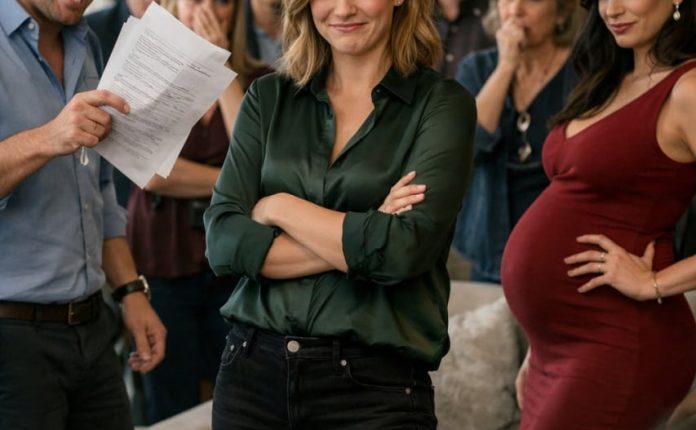
At 6:14 in the morning, my husband came through our front door with another woman and told me to pack.
“By Sunday,” he added, setting his suitcase beside the umbrella stand. “That gives you enough time.”
I had been awake all night deciding how to give him the best news of our lives.
The winning ticket was in my handbag. My hand rested against it as though I could feel the numbers through the leather.
Mark moved aside to let the woman enter.
She was tall, blonde, and dressed for warmer weather than our chilly front hall. An overnight bag hung from her shoulder. One of its little gold feet caught the light when she lowered it.
“This is Vanessa.”
I looked from her to him.
“Why is she here?”
“Because I'm done pretending.”
Outside, a delivery truck rattled past. Somewhere upstairs, our bathroom tap dripped into the sink Mark had promised to repair.
I remember those sounds because the words themselves seemed to arrive without any sound at all.
“I want a divorce, Claire.”
Vanessa's fingers tightened around the handles.
“You told me you'd already talked.”
“We're talking now.”
He took off his jacket and hung it on the hook beside mine.
That small, habitual movement hurt more than his announcement. He could dismantle our life and still remember where his coat belonged.
Twelve hours earlier, I had been standing in a gas station, trying to decide whether a second coffee would keep me awake or simply make me miserable.
My mother had spent the afternoon searching for an insurance letter she believed she had thrown away. We found it beneath a supermarket circular after nearly three hours.
Her kitchen smelled faintly of burnt dust. The furnace had started making a noise like a spoon trapped in a garbage disposal.
“It's fine once it gets going,” she had said.
She had been saying that since February.
I left with the letter copied, her paperwork organized, and a promise to call someone about the furnace.
At the gas station, the cashier recognized me.
“Long day?”
“You could say that.”
He nodded toward a little display beside the register.
“Want to see whether tomorrow improves?”
The scratch ticket cost two dollars. I bought it with my change and tucked it under the coffee sleeve.
At home, I heated soup, answered two client emails, and washed the bowl before I noticed the ticket beside my keys.
Mark was away on what he called a regional planning trip. He had texted a photograph of a hotel lobby that afternoon and said he would be home Friday.
I scratched the ticket with a quarter from the bowl near the stove.
The first match made me lean closer.
The second made me turn on the light above the counter.
By the third, I had stopped breathing normally.
I read the instructions. I read them again. Then I opened the official lottery website and compared the game information.
The printed prize was seventy-three million dollars.
I understood, even then, that a printed prize was not the same as money already sitting in a bank. There would be validation, payment choices, taxes, questions I had never needed to ask.
But those details floated beyond the thing directly in front of me.
A two dollar ticket.
Our kitchen counter.
A number that could remove every ordinary fear I had carried for years.
My phone slipped from my fingers and struck the rubber mat.
For a moment, I was absurdly worried that I had cracked the screen.
Then I began laughing.
I laughed into my hand because the house was so quiet, and the sound coming out of me seemed to belong to somebody else.
I nearly called Mark.
His last message had said he was exhausted. I pictured him asleep beneath a hotel duvet, his phone charging on the wrong side of the room.
I decided to wait.
I wanted to see his face.
That was the part I would remember afterward: I had wanted to share it before I wanted anything for myself.
I found a plastic document sleeve in the drawer where I kept warranties and placed the ticket inside.
Then I made coffee I did not need and began writing on the back of an electricity bill.
Mortgage.
Mom's furnace.
Studio.
A holiday.
I drew a small line beneath the last item and wrote, Somewhere warm.
For six years, Mark's career had been the thing around which we arranged our lives.
When his company transferred him, I left a design position I liked.
When his next employer folded, I picked up evening shifts at a home furnishing store while keeping my freelance clients.
When he finally found steady work, he asked me to wait before taking on a studio lease.
“One more year,” he said. “Let me get established.”
A year became another year.
My drafting table stayed in the corner of our guest room beneath a shelf of his old training binders.
I had told myself we were being sensible.
That night, looking at the ticket, I thought I could finally stop being patient without making him feel I had stopped believing in him.
At dawn, I set out two cups.
When his headlights swept across the window, I stood so fast my chair bumped the radiator.
He was early.
For one foolish second, I thought that was part of the good fortune.
Then Vanessa climbed out of the passenger seat.
Now she stood in my hallway, looking past me toward the stairs.
Mark rubbed his forehead.
“I don't want a scene.”
I almost asked what he thought he had brought into our home.
Instead, I said, “How long?”
He glanced at Vanessa.
“That isn't useful.”
“How long, Mark?”
“Since the spring.”
It was October.
I thought of our anniversary in May. The restaurant he said was too expensive. The supermarket flowers he brought home three days late.
Vanessa looked down.
“I'm going to put my bag somewhere.”
“Not upstairs,” I said.
My voice surprised all three of us.
She stopped.
Mark gave an impatient breath.
“Claire, don't be difficult.”
“Then don't ask her to unpack in my bedroom.”
“Our bedroom.”
“Apparently that depends on who's standing in it.”
He looked away first.
For a few seconds, none of us moved.
The coffee machine clicked off in the kitchen.
Mark began explaining the arrangement he had apparently made without needing my involvement.
I could stay with my mother. He would cover the storage unit if I needed one. We could sort out furniture once the immediate unpleasantness was over.
“I'm being fair.”
“You've given me three days.”
“You don't need longer to pack clothes.”
Vanessa studied a framed photograph on the hall table. My grandmother stood between us in that picture, holding her handbag with both hands.
It was the last photograph I had of her standing without a walking stick.
“Mark told me the house was mostly his,” Vanessa said.
I watched my husband's expression.
He did not correct her.
“The mortgage is in my name,” he said.
“That isn't what she said.”
He spread his hands.
“I'm not doing this with an audience.”
I looked at Vanessa.
“Then you should have come alone.”
A faint flush moved up her neck.
For the first time, she seemed to understand that being chosen was not the same as being welcomed.
Mark stepped closer.
“Pack your bags. This house is mine.”
I felt the sleeve inside my handbag bend beneath my fingers.
All night, I had imagined a larger version of our future.
He had spent the same night choosing which parts of our past he could erase.
My grandmother's money had paid the down payment. Not a gift from his parents. Not a bonus from his work. An inheritance left to me by a woman who repaired her own clothes and kept bus tickets in envelopes.
The transfer had gone directly from her estate account to the closing attorney.
Both our names were on the deed.
I had the records.
I had every record.
“Are you sure?” I asked.
Mark smiled.
“Yes, Claire. I'm sure.”
He thought I was asking whether he loved her.
I was looking at the wall behind him, where sunlight had begun to reach the corner of the wedding photograph.
Then I closed my bag.
“I need to make some calls.”
“Your mother can help you move.”
I went upstairs.
I did not run. I counted the steps because if I concentrated on numbers, I could keep my feet beneath me.
In our bedroom, his side of the bed was still made.
I locked the door.
Then I sat down and cried so abruptly that I had to press a pillow against my face.
There was no dignity in it. My nose ran. My shoulders shook. I wanted him to knock and say something had gone terribly wrong.
He did not knock.
Downstairs, I heard Vanessa ask where the glasses were.
I stood up.
My grandmother used to say that you did not stand ankle deep in water arguing with a broken pipe. You found the valve.
The first number I called was on the official lottery website.
The woman who answered spoke with the calm of someone accustomed to people being unable to finish sentences.
She asked which game I had purchased.
I read the information from the ticket.
She explained that nothing was final until validation, that I should secure the original, and that the claims team could guide me through the required steps.
I wrote everything down.
My handwriting looked like a child's.
The second call went to a divorce lawyer whose office had represented one of my freelance clients.
I told the receptionist my husband had brought another woman home and ordered me out.
She did not ask whether I was certain I wanted advice.
She asked whether I was safe.
“Yes.”
“Can you come at ten?”
“Yes.”
The third call went to Peter Wells, the accountant who had helped administer my grandmother's estate.
He heard something in my voice.
“Are you somewhere private?”
I looked at the locked door.
“For now.”
“Start there.”
I told him about Mark.
I told him about Vanessa's bag.
I told him about Sunday.
When I stopped, Peter let me breathe.
Then I said, “There's something else.”
He listened without interrupting while I described the ticket.
Afterward, he asked when I had bought it.
“Yesterday evening.”
“And you are still legally married.”
It was not a question.
“Yes.”
“Then we need to be careful about assumptions.”
I stared at the sleeve.
For the first time, a thought I had been avoiding became clear.
The ticket did not exist outside my marriage merely because my husband had been cruel.
Peter did not pretend otherwise.
“Tell your lawyer everything. Don't make decisions based on something you wish the law would say.”
A shadow moved beneath the bedroom door.
“Claire?”
I covered the phone.
“What?”
“Where are the house papers?”
“What do you need?”
“The deed. Closing stuff.”
“Why?”
The handle moved.
“Because somebody has to be practical.”
I looked at the brass latch and remembered installing it after a contractor had walked into our bedroom without knocking.
Mark had teased me about it.
Now I was grateful for the small, inexpensive boundary I had once felt silly wanting.
“I'll talk to you after my appointment.”
“What appointment?”
“I'll be downstairs soon.”
He waited long enough for me to hear him breathe.
Then he left.
Peter remained on the line.
“No deleting messages,” he said. “No panicked transfers. Preserve what you have.”
I promised.
I photographed the ticket, following the precautions I had been given, and secured it again.
I took identification, medication, my laptop, and the blue folder from the shelf behind our winter blankets.
The folder contained my grandmother's estate statements, the transfer confirmation, the closing documents, and the deed.
I laid them on the bed.
My name had not become smaller because Mark said it with contempt.
My phone vibrated.
The email subject read: Final authorization needed.
I nearly dismissed it.
Then I saw our address.
The lender's name meant nothing to me, but the attachment was unmistakable. It referred to an eighty thousand dollar home equity application.
Mark was listed as the applicant.
I appeared as an owner whose consent remained outstanding.
The application had begun nine days earlier.
Nine days.
He had asked about planting tomatoes that weekend. We had stood beside the garage discussing sunlight while he was arranging to borrow against our home.
There was no signature in my consent field.
That detail mattered.
I did not know whether he had planned to ask me, pressure me, or pretend the form meant something else. I knew only that he had started a process involving our house without telling me.
I forwarded the message to the lawyer's office.
I wrote: I have not approved this application.
Then I went downstairs.
Mark was at the kitchen table with his laptop open.
Vanessa held my graduation mug.
It was yellow, chipped near the handle, and slightly too small for the amount of coffee my mother believed a working woman required.
“Where are you going?” Mark asked.
“To speak to somebody.”
“Let's not bring lawyers into this.”
I looked at him.
“You brought Vanessa.”
He pushed the laptop lid down an inch.
A photograph of our house disappeared beneath his hand.
“Did you apply for a home equity loan?”
His face changed so quickly that Vanessa turned toward him before he answered.
“It was an inquiry.”
“Eighty thousand dollars?”
“An amount on a form isn't a loan.”
“Then the lender won't mind hearing that I haven't agreed.”
Vanessa put the mug down.
“You said that money was settled.”
Mark looked at her.
“We'll talk later.”
“No. You said it was from your share of the house.”
I held my keys so tightly the metal cut into my palm.
“My share,” Mark repeated. “Which we haven't worked out yet.”
He was speaking to both of us now, trying to make the contradiction sound like a scheduling problem.
At the front door, Vanessa asked, “What did you actually tell me about Claire?”
I left before I heard his answer.
The lawyer's office was above a pharmacy.
I sat in my car for seven minutes because I could not work out how to cross the pavement carrying my whole marriage in a handbag.
A woman outside the pharmacy was arguing cheerfully with a child about cough drops.
I envied them with a force that felt unreasonable.
At ten, I met Elena Ruiz.
She wore a dark cardigan and reading glasses on a cord. Her desk held no theatrical pile of impressive books, just files, a plant with one yellow leaf, and a cup of tea gone cold.
She asked me to begin with the morning.
I told her in order.
When I finished, she said, “You do not have to accept your husband's account of what belongs to whom.”
I opened the blue folder.
She read the deed first.
Then the inheritance transfer.
Then the loan email.
“Has he threatened you physically?”
“No.”
“Has he restricted access to money?”
“He handles the bills. I have my own account, but most of my earnings go into our joint one.”
“Can you access that account?”
“I think so.”
“Let's establish that today.”
I kept the ticket in my bag for another minute.
I am not proud of that minute.
A part of me wanted a clean answer before I complicated it.
Then I heard Peter's voice.
Everything means the good news too.
“I bought a lottery ticket yesterday.”
Elena looked up.
“I believe it's a winner.”
“How much?”
I put the sleeve on her desk.
She did not reach for it immediately.
“Has this been validated?”
“No.”
“Who knows?”
“The lottery employee. Peter Wells. You.”
“Does Mark?”
“No.”
She folded her hands.
“Then we have two urgent jobs. Protect the ticket and preserve full, accurate financial disclosure.”
I swallowed.
“Does he get half?”
“We are not going to answer a major property question from a headline or a feeling. But you acquired it during the marriage. His affair does not automatically remove a possible marital claim.”
The office seemed to shrink.
I looked down at the number I had spent the night imagining could solve everything.
Elena waited.
“So I still have to be fair.”
“You have to be honest. We can argue for your rights without pretending he has none.”
For several seconds, I hated that answer.
Then I trusted her because she had given it.
She explained that the advertised prize might represent payments over time, and that the cash alternative would be different. No plans should be built on the printed figure alone.
She would coordinate with Peter and appropriate lottery counsel. Mark needed independent representation. The house records required their own analysis.
“Nothing gets signed in your kitchen,” she said.
I nodded.
“And nobody gets to set your legal deadline by pointing at a staircase.”
That was the sentence that finally let me breathe.
We contacted the lender through independently verified information.
A representative confirmed that no money had been advanced. The application could not proceed in its current form without resolving the required owner authorization.
My objection was recorded.
The file was placed on hold.
It was an ordinary administrative action. No dramatic accusation. No police arriving at Mark's office.
Still, when the confirmation email reached my phone, my hands stopped shaking.
For the first time that morning, something had happened because I said it should.
Elena helped me identify the immediate records to preserve.
Bank statements. Mortgage history. Credit accounts. Relevant messages.
She also told me not to empty the joint account or change access to shared property on impulse.
“Protection isn't the same as punishment.”
By noon, the ticket was secured under arrangements made with professional guidance. Copies of the necessary records existed somewhere Mark could not casually misplace them.
I called my mother from the pharmacy car park.
She listened.
When I told her about Vanessa, she made a little noise that seemed to come from far back in her throat.
Then she asked whether I had eaten.
“No.”
“Come here.”
“I need to check the house first.”
“Then I'll meet you there.”
She did not ask whether she should bring boxes.
When I arrived, Vanessa's car was in the drive.
Mark's suitcase was open beside the stairs.
Two cardboard cartons stood outside the guest room. One contained my sketchbooks.
My mother reached them before I did.
“Who packed these?”
Mark came out of the kitchen.
“I was trying to help.”
She lifted a sketchbook by its bent cover.
“Try stopping.”
He looked at me.
“Can we speak privately?”
I put the book back flat.
“You can speak to me here.”
Vanessa stayed near the window.
Her bag was still closed.
Mark began again, slower this time, as though the morning had failed because he had used the wrong tone.
“We don't have to turn this into a fight.”
“Then don't pack my work.”
“I assumed you wanted your things together.”
“You assumed I would leave.”
His jaw tightened.
“What exactly did that lawyer tell you?”
“That we should both get advice.”
“And the house?”
“That we'll deal with the records.”
I did not mention the ticket.
Not because it would remain hidden. Elena was preparing formal disclosure once the necessary steps and representation were arranged.
I simply would not announce it to a room where my sketchbooks were being used as packing material.
Mark's phone rang.
He looked at the screen and stepped outside.
Through the window, I watched him turn away from us.
When he came back, his face was darker.
“You contacted the lender.”
“Yes.”
“You've frozen something that wasn't even finalized.”
“Then nothing has been lost.”
Vanessa looked at him.
“Except the money you told me was available.”
“Can you give us five minutes?”
“No,” she said.
It was quiet, but it was the first unqualified refusal I had heard from her.
My mother carried the sketchbooks back into the guest room.
I followed her.
For several minutes, we did nothing more consequential than straighten paper.
At one point, she touched the edge of my drafting table.
“I always wondered why this was still in here.”
“So did I.”
She did not say she had warned me.
That kindness nearly broke me.
We left the cartons empty.
I chose to sleep at my mother's that night because I could not bear the thought of listening for voices through our bedroom wall. Elena had explained the considerations, and I made the choice with advice, not because Mark had ordered it.
I took an overnight bag.
Before I left, I photographed the rooms and the location of important belongings, as Elena had recommended.
Mark watched from the kitchen.
“You're making me sound dangerous.”
“I'm keeping a record.”
“Of what?”
“What is here.”
He had no answer for that.
At my mother's, I ate toast standing over the sink.
She found clean sheets for the bed in my old room.
The radiator hissed. A branch tapped the window. Everything was smaller than I remembered.
At nine, Peter called.
He and Elena had spoken. There were tasks, appointments, documents. He would help me make a plan once the claim was properly assessed.
“Don't spend tonight calculating your life,” he said.
“What should I do?”
“Sleep, if you can.”
I could not.
Around ten, I remembered the list on the electricity bill.
Mortgage. Mom. Studio. Somewhere warm.
I had left it on the kitchen counter.
I was still staring at my hands when my phone lit up.
Mark had sent a photograph.
The back of the bill filled the screen.
Beneath it, he had written: Is this a joke?
A second message followed.
I called the number written at the top. It's the lottery office.
Then a third.
Claire, how much did you win?
No one laughed after that.
Martin Voss turned toward Preston. His youngest associate stopped writing with the pen still touching the page.
Behind them, Richard sat forward.
Judge Morrison held out a hand.
“Let me see the records.”
I provided the copies in the manner we had arranged, identifying the certified documents and the passages relevant to my location.
My voice sounded steady.
My body had not received the message. A muscle beneath my shoulder blade kept tightening, and I pressed my thumb against the edge of the folder to stop myself rubbing it.
The judge read.
Martin read.
Preston stared at the table.
“This record identifies you as Captain Amelia Carter,” Judge Morrison said.
“Yes, Your Honor. Carter is my name before marriage. The accompanying records establish the connection.”
“And you served as an Army attorney?”
“Yes.”
A chair moved in the gallery.
I knew without looking that it was Richard.
Martin asked for time to confer.
The judge allowed a brief pause.
Preston leaned toward him immediately. Richard began to rise, but Martin held up a palm without turning.
That small gesture kept my attention longer than it should have.
For seven years, Richard had entered every conversation whenever he wished. He interrupted contractors, servers, doctors, his wife, his son.
Now someone had told him to remain seated.
Martin stood again.
“Your Honor, we need to investigate this discrepancy.”
“Discrepancy is one word for it,” the judge said. “The document identifies a specific place, a specific date, and a witness. Mrs. Hale has provided records directly contradicting that account.”
“We are not asking the court to disregard those records.”
“Then the proposed agreement cannot be treated as an established basis for relief today.”
He nodded.
She turned to the underlying application.
The hearing continued.
That was the part no one would have imagined from the silence after my sentence.
There was no sudden declaration that I had won the divorce. No bailiff approached Preston with handcuffs. No one awarded me his family’s company.
Instead, the judge asked practical questions.
What funds were available?
What payments were due?
What had happened to the joint account?
Why was an alleged family debt being used to describe a transfer that had initially been presented to me as an investment?
Some answers were incomplete.
Others contradicted the papers.
When Martin requested a chance to obtain instructions, Judge Morrison allowed it but made clear that the disputed agreement would not control her interim decisions.
By the end of the hearing, the application to rely on that agreement had been denied.
The court directed preservation of relevant records and set a schedule for production and further proceedings.
Temporary arrangements addressed household expenses and access to funds. The issue of fees would be considered on proper submissions.
I wrote down each direction.
I had imagined relief as warmth.
It felt more like realizing a door had been unlocked while I was still too tired to push it.
In the corridor, Vivian reached me first.
“Amelia.”
I kept walking toward the benches beside the elevators.
“Why didn’t you tell us?”
I stopped.
“Tell you what?”
“That you were an actual lawyer.”
A woman carrying a sleeping toddler passed between us.
I waited until she had gone.
“I did.”
Vivian looked wounded.
“Not in a way we understood.”
Richard joined us before I could answer.
“You ambushed your husband.”
“The document was filed in court.”
“You knew what I meant.”
“Yes,” I said. “I do.”
His face reddened.
Martin approached and asked to speak with Preston privately.
Richard turned toward him.
“I can clear this up.”
“Please send any relevant records to my office,” Martin said.
It was courteous.
It was also a boundary.
Preston stood several feet away, staring at my briefcase.
“You were planning this.”
“I was preparing for the hearing.”
“For weeks?”
“Since you gave me the papers.”
He looked almost offended that I had used the same time he had used.
I left before the conversation could become another debate about whether I was entitled to remember what had happened.
Outside, the rain had stopped.
Water dripped from the courthouse awning onto a dark patch of pavement.
I sat in my car and called Nora.
“How did it go?”
“They’re not relying on the agreement for now.”
“Good.”
“I was shaking.”
“Of course you were.”
“I thought I’d feel different.”
“You probably need lunch.”
I laughed then, unexpectedly and without grace.
She stayed on the phone while I found somewhere to eat.
Two days later, I returned to Lila Serrano’s office.
This time there were enough temporary funds available to begin putting the case in proper hands. We agreed on a scope of work and reviewed what remained unresolved.
She studied the hearing notes.
“You did what you needed to do.”
“I keep thinking I should have asked him another question.”
“Which him?”
That stopped me.
There were too many men whose explanations had become my responsibility.
Lila placed a clean pad between us.
“Let’s separate what you know from what you suspect.”
We spent the next hour doing exactly that.
I knew I had not signed the agreement.
I knew I had been overseas on its stated date.
I knew four hundred eighty thousand dollars had left our joint savings.
I knew Richard’s name appeared beneath a witness statement.
I suspected my name had been lifted from a household authorization.
I suspected the debt schedule concealed the true purpose of the transfer.
I did not yet know who created the document, who instructed them, or what Preston had told his attorneys.
Lila drew a line beneath the last point.
“We will find out through records.”
I moved out that weekend.
Not because the court ordered me to leave. Because I could no longer sleep in a house where every floorboard announced Preston’s movements.
A friend from my licensing course had a furnished apartment above her detached garage. The kitchen contained two pans, three mismatched mugs, and a refrigerator that hummed whenever I tried to sleep.
The first night, I opened every cupboard.
I don’t know why.
Perhaps I needed to establish that nothing inside belonged to someone who could use it against me.
When I packed the house, Preston appeared in the guest room doorway.
“You’re taking the footlocker?”
“Yes.”
“I thought most of that was old paperwork.”
“It is.”
He looked at the bare mattress.
“You could have told me you were unhappy.”
I folded a sweater.
“I told you I wanted to work.”
“That isn’t the same thing.”
“I told you I needed access to our accounts. I told you I wanted your father to stop speaking for both of us.”
“We had a good life.”
I set the sweater in the suitcase.
“We had good furniture.”
He looked away.
For a moment I felt the familiar urge to soften what I had said.
Then I remembered him moving the butter dish to protect his papers.
I finished packing.
The first substantial financial production arrived two weeks later.
Lila engaged a forensic accountant named Samuel Ortiz.
Samuel wore reading glasses on a cord and asked questions in a voice so mild people sometimes answered before realizing what they had admitted.
He began with the transfer.
Four hundred eighty thousand dollars had moved from our savings to a business account controlled by Richard’s development company.
The bank description called it a capital contribution.
The divorce schedule called it repayment of family advances.
“That distinction matters,” Samuel said.
“Can it be both?”
“Not without a clear explanation and supporting records.”
He asked for the company ledger, the related investment documents, and the records supporting the alleged loan.
Richard objected through counsel.
The objections described privacy, commercial sensitivity, burden, and irrelevant family affairs.
Lila narrowed the requests where appropriate and pursued the rest.
It took time.
During that time I learned how often exhaustion masquerades as doubt.
On good mornings, I could read an email and see exactly what needed answering.
On bad mornings, a request for one more statement made me want to return to bed.
I wasn’t ashamed of the work.
I was ashamed of how much of myself I had spent avoiding it for years.
Nora visited one Saturday with groceries and a screwdriver.
“Why the screwdriver?”
“You said the chair wobbles.”
“I could fix a chair.”
“I know. Sit down.”
While she tightened the legs, I unpacked tomatoes and bread.
She had silver at her temples now. I had missed the gradual arrival of it.
“How did I let this happen?”
She kept working.
“What part?”
“All of it.”
“That’s too large a question.”
“The money. The way they spoke to me. Preston deciding I was someone who couldn’t read her own life.”
Nora tested the chair.
“You were married to him. You weren’t investigating him.”
“I knew better.”
“You knew documents could be false. You didn’t know your husband would hand you one over breakfast.”
I stood with a tomato in my hand.
She looked up.
“Put that down before you turn it into sauce.”
I did.
We ate at the repaired table, and for an hour she told me stories about people whose problems had nothing to do with mine.
I had forgotten how restful ordinary conversation could be.
The electronic records were less restful.
Martin’s office confirmed that the purported agreement had reached them as a PDF supplied by Preston.
The firm had relied on his account of its origin.
Once the military records emerged, they requested the original and clarification. Neither arrived.
The firm subsequently sought to withdraw, explaining only what it could properly place before the court. Lila told me not to interpret the withdrawal as proof of any particular private conversation.
“We don’t need to guess what his lawyer told him,” she said. “We need what he did.”
Preston retained different counsel.
His new attorney, Calvin Reed, was quieter than Martin and less inclined to describe the case as straightforward.
Meanwhile, an independent examiner assessed the files produced under the preservation process.
The scanned page had no traceable original.
The visible image of my name matched the household authorization I had located, including the slight slope and the small printing defect.
The relevant electronic material also showed that the agreement file had been assembled shortly before Preston served me.
A recent file date, by itself, could reflect scanning or routine handling. The examiner was careful about that.
The stronger finding concerned the page’s construction and the matching image.
Lila read the report twice.
“Now we ask who supplied the source.”
I remembered the authorization.
Two years earlier, Preston had asked me to sign it so he could deal with a household account while I was visiting Nora.
I had signed at the kitchen counter.
He had scanned it with his phone.
Nothing secret.
Nothing unusual.
A small act of trust that had outlived the purpose for which I gave it.
That evening, Preston called.
Under Lila’s guidance, I was keeping financial discussion in writing or through counsel. I answered because his message said he wanted to arrange collection of some books.
He didn’t mention the books.
“Dad’s company has private records in that production.”
“I’m not discussing the requests.”
“You don’t understand what this could affect.”
“Then have your lawyer explain it to mine.”
“Amelia.”
I recognized the tone.
It had once made me feel chosen. In later years it meant he expected me to rescue him from the consequences of a conversation he didn’t want to finish.
“There’s a financing review coming up,” he said.
I looked at the small kitchen window. A moth kept striking the glass from outside.
“What are you asking me?”
“Just think about who else could be hurt.”
I waited.
“Employees,” he added. “People who had nothing to do with us.”
“Neither did I, apparently.”
“That’s unfair.”
I closed my eyes.
“No. What happened to me was unfair. This is a request for records.”
I ended the call.
I told Lila about it the next morning.
She made a note, then returned us to the financial documents.
“His father’s business problems do not establish your claim,” she said. “They also don’t erase it.”
Samuel’s next findings explained why Preston was worried.
The alleged six-hundred-twenty-thousand-dollar family loan was supported by a schedule assembled from several unrelated expenses.
Some were costs Richard’s company had paid on a development project.
Some were transfers between business entities.
A smaller group concerned gifts his parents had made during our marriage: a vacation, furniture, repairs they insisted on paying for.
There was no consistent loan agreement, repayment history, or accounting that matched the debt Preston wanted attributed to us.
Then Samuel found something more concrete.
After the four-hundred-eighty-thousand-dollar transfer, an internal investment schedule credited Preston with a corresponding economic interest in one of the projects.
It had not appeared in his initial disclosures.
The investment might prove valuable or worthless. That required examination.
But it existed.
The money had not simply vanished into expenses.
It had been exchanged for something Preston claimed in his own name.
I sat very still while Samuel explained it.
For months, I had worried that the missing savings represented a mistake we would have to absorb.
Now I understood that Preston had expected me to accept both the disappearance of the money and an alleged debt that diminished what remained.
“Does this mean he owns more of the company?” I asked.
“It means he has an interest we need to value and classify,” Samuel said. “We should not jump beyond the documents.”
His restraint helped.
Every precise answer made it easier to bear the next question.
Richard’s deposition took place on a Tuesday in a conference room with windows that could not be opened.
He arrived wearing the suit he used for bank meetings.
Vivian came with him but waited outside.
I sat beside Lila.
I was not there to conduct the questioning. That was one of the hardest useful decisions I made.
I knew the facts. I knew how to ask questions.
I also knew Richard could still make my pulse climb by looking at me as though I had disappointed a roomful of reasonable people.
Lila began with ordinary background.
His role in the company.
His involvement in the transfer.
The records supporting the claimed debt.
Richard answered expansively whenever he could remain general.
Families helped one another.
Business arrangements were complicated.
Preston had always been expected to assume more responsibility.
Lila let him finish.
Then she placed the alleged agreement in front of him.
“Is that your name on the witness line?”
“Yes.”
“Did you see Amelia Hale sign this document?”
“I saw a number of documents around that time.”
“Did you see her sign this one?”
“It was six years ago.”
“Where were you?”
“At my office, as it says.”
“Who else was present?”
“Preston.”
“And Amelia?”
“Obviously.”
Lila allowed the answer to settle.
Then she showed him the certified record of my appearance in Germany.
He read the top half.
“I can’t speak to military paperwork.”
“Can you speak to whether you saw her in Virginia that day?”
“I’ve already answered.”
“You have given two answers. One describes uncertainty. The other places her in your office.”
His attorney objected to the form.
Lila rephrased.
“Do you have an independent memory of Amelia signing this document?”
Richard looked at me.
There it was again: the expectation that I would help him through an awkward moment.
I kept my hands still.
“No,” he said finally.
“Did you have that memory when you represented yourself as a witness?”
“I believed it reflected our understanding.”
“Whose understanding?”
“The family’s.”
“Was Amelia part of that understanding?”
“She benefited from everything we built.”
“That wasn’t my question.”
He shifted in his chair.
By the end of the session, he had stopped describing an event he witnessed.
He described a document he believed should exist because, in his view, its terms were fair.
Those were different things.
Outside, Vivian stood when the conference room door opened.
“How long can this possibly take?” she asked.
No one answered her.
Preston’s deposition followed two days later.
He looked tired.
For months I had imagined exhaustion might make him honest.
It did not.
At first he said the agreement came from his father’s records.
Then he said he remembered discussing something similar during our first year of marriage.
Then he said he might have confused a draft with a signed copy.
Lila asked whether he had read the version submitted with his application.
“Yes.”
“Did you believe Amelia signed it?”
“At the time.”
“What caused that belief?”
“My father said it was in the records.”
“Did you ask Amelia?”
“I didn’t think I needed to.”
“You were married to her during the overseas assignment described in these records?”
“Yes.”
“You communicated with her during that assignment?”
“Yes.”
“Did you know she was an Army attorney?”
He looked at me.
“Yes.”
The word landed more heavily than I expected.
Not because it revealed something new.
Because he had been willing to let everyone else treat it as something I had concealed.
Lila turned to the household authorization.
“Did you scan this document?”
“I might have.”
“Did you send a copy to your father?”
“I don’t remember.”
She showed him the recovered email.
His address.
Richard’s address.
The attachment.
A message written nine days before he placed divorce papers beside my breakfast plate.
Preston read it.
Calvin Reed leaned forward, then settled back.
“Does that refresh your memory?” Lila asked.
Preston rubbed his palms together beneath the table.
“Yes.”
“Why did you send it?”
He glanced toward his attorney.
“You can answer the question,” Calvin said.
Preston’s throat moved.
“Dad said he needed an example.”
“An example of what?”
For several seconds I heard only the ventilation above us.
Then my husband looked at the scanned page bearing the name I had trusted him with.
“My signature wasn’t enough,” he said. “He asked me to send hers.”
Lila did not move.
“Tell me exactly what you mean.”
Preston stared at the table.
“He said he needed something showing how she signed.”
“Why?”
“To complete the paperwork.”
“What paperwork?”
“The agreement.”
Calvin requested a break.
The room emptied in careful stages.
The court reporter stopped her machine. Lila closed the folder but kept one finger between the pages.
I remained seated until Preston and his attorney had left.
There was a half-empty bottle of water in front of him. He had worried the label loose during the questioning.
I watched the strip of paper curl upward.
All those years, I had thought understanding would arrive as a feeling.
Some unmistakable force that would settle every question at once.
Instead, it arrived through ordinary objects.
A copied page.
A date.
A loose water bottle label beside the place where my husband had admitted supplying my name.
Lila turned toward me.
“We can take a longer break.”
“No.”
“You don’t need to decide immediately.”
“I’m all right to continue.”
She waited.
“I’m not all right,” I corrected. “But I can continue.”
When Preston returned, he looked at me before sitting.
There was something pleading in his expression.
For years, that look had drawn an answer from me before he asked the question.
I faced the documents.
Under further questioning, he described the conversations that preceded the filing.
Richard had told him the family should have protected its assets years ago.
There had been discussions about an agreement during our first year of marriage, but no completed agreement signed by me.
Preston remembered the subject.
I remembered it too.
He had mentioned his father’s suggestion during a late-night call while I was overseas.
I said any financial agreement would require time, disclosure, and independent advice.
Preston said we would discuss it after I came home.
We never did.
A conversation about a possible agreement had become, in Richard’s telling, an agreement that should have been completed.
Then an agreement everyone supposedly understood.
Finally, a document with my name on it.
Preston said he had not watched the page being assembled.
Lila asked whether he knew I had not signed it in his father’s office on the stated date.
He lowered his head.
“Yes.”
“Before it was submitted to your attorneys?”
“Yes.”
“Before it was filed?”
“Yes.”
I pressed both feet against the floor.
There was no misunderstanding left to preserve.
He had not been careless with a fact he failed to check.
He had known the central fact was false and relied on my exhaustion to keep it from being examined.
“Why did you proceed?” Lila asked.
Preston’s answer was almost inaudible.
“I thought she would settle.”
She asked him to repeat it for the record.
He did.
That evening, I walked through the neighborhood around my apartment until the streetlights came on.
I passed a little house with an open window. Someone inside was chopping vegetables. A radio played softly.
I wanted that ordinary life so badly it embarrassed me.
A room where someone’s hands could be occupied with dinner instead of hiding a transfer, drafting an accusation, or searching a statement for the next problem.
When I reached home, Nora had left a message.
I called her back.
“He knew.”
She didn’t ask which part.
“I’m sorry.”
“I keep going back through everything.”
“Of course.”
“The trip he canceled. The account password. The questions he stopped answering.”
“Amelia.”
“What?”
“You don’t have to solve the whole marriage tonight.”
I sat on the kitchen floor.
For the first time since the breakfast papers, I cried without trying to keep the sound small.
Nora stayed.
She didn’t fill the silence with lessons.
When I could breathe properly, she asked whether I had locked the door.
I checked.
Then I made tea.
The next stage took months.
There were supplemental disclosures, amended positions, contested requests, and negotiations that failed because Richard still believed repetition could repair the record.
The alleged debt changed shape.
First it was a formal family loan.
Then a collection of advances.
Then a moral obligation Preston felt toward his father.
Samuel followed the numbers without trying to decide what sort of men they were.
That was useful work.
The company expenses could not reasonably be treated as loans made to our household merely because Richard had paid them.
The gifts had been described as gifts at the time.
And the transfer from our savings had purchased an interest that needed to be included in the marital financial picture.
There were legitimate distinctions too.
Some of Preston’s business interests predated our marriage.
Some family assets were not mine and never had been.
Lila explained those boundaries without hesitation.
I did not want Richard’s life.
I wanted the court to stop accepting his account of mine.
The project connected to our missing savings was in trouble, but it was not worthless.
A valuation required more than taking the original transfer and dividing it in half. There were obligations, changing market conditions, and documents concerning the interest Preston held.
For a while, I hated hearing qualifications.
Then I realized they were part of what I had asked for.
An accurate record included facts that did not flatter me.
At the evidentiary hearing, the courtroom looked smaller than it had the first time.
Perhaps I was less occupied with measuring the distance between our tables.
Lila sat beside me.
Calvin sat beside Preston.
Richard had separate counsel because his own conduct and records had become part of the dispute.
Vivian came too.
She wore a plain dark suit and no bracelet.
I noticed the absence before I noticed her face.
Judge Morrison began by defining what would be addressed.
The authenticity and attempted use of the purported agreement.
The disputed financial disclosures.
Requests for appropriate remedies and fees.
The court would not decide every remaining detail of the divorce that day.
There was comfort in knowing where the proceeding began and ended.
The document examiner testified first.
She explained the matching image of my name, the printing defect, the relationship between the source authorization and the purported agreement, and the limitations of her conclusions.
Calvin questioned her about what an electronic file could establish.
She answered without defensiveness.
She could identify features inconsistent with an independently signed page.
She could explain the recovered file history.
She could not tell the court what every person had been thinking.
The distinction made her more convincing.
Then the certified military records were addressed.
There was no dispute left about where I had been.
There had never been a second Amelia Carter wandering through Richard’s office while I sat in Germany.
No remote signing arrangement had been described in the document.
No alternative execution date was supported by an original.
No original appeared.
Preston testified.
He did not deny sending the authorization to his father.
He did not deny knowing I had been overseas.
At one point Calvin asked whether he had relied on Richard’s assurances.
“Yes,” Preston said.
Lila stood for questions.
“Did your father tell you that Amelia had signed the agreement?”
“Yes.”
“Did you know that the stated event had not occurred?”
Preston looked toward the gallery.
Richard sat rigidly.
“Yes.”
“So whatever assurances you received, you knew the document did not accurately describe its execution.”
“Yes.”
There was no triumph in hearing it.
I had once loved the sound of his voice saying my name.
Now I was listening for whether he would tell the truth when a truthful answer cost him something.
He managed it in pieces.
Richard was harder.
He spoke as though the court had been summoned to misunderstand him.
The agreement reflected the family’s longstanding expectations.
Preston had contributed the meaningful income.
I had enjoyed a comfortable standard of living.
There were business realities outsiders would not appreciate.
Judge Morrison interrupted once.
“Mr. Hale, answer the question you were asked.”
His attorney touched his arm.
He pulled it away.
Lila asked whether he witnessed me signing the agreement.
“No.”
“Did you know your name appeared as a witness?”
“Yes.”
“Did you authorize that representation?”
“I approved the document.”
“Knowing you had not witnessed Amelia sign it?”
“I believed it put in writing what was fair.”
Lila paused.
“You understood that your belief about fairness was not the same as Amelia’s consent?”
Richard glanced at me.
For a moment I saw genuine anger without the coating of manners.
“She was leaving the family.”
I felt Lila’s stillness beside me.
“Your son initiated the divorce,” she said.
“That doesn’t change what she was trying to take.”
“What had she demanded when you approved this document?”
He said nothing.
“At that point, had she made any property demand?”
“No.”
“Had she filed any claim against you personally?”
“No.”
“Had she even received the divorce papers?”
“No.”
The ventilation hummed.
Richard looked toward Vivian.
She was watching her hands.
Lila asked one final question.
“When you approved a page falsely representing that Amelia agreed to surrender rights, what opportunity did you give her to agree or refuse?”
Richard’s attorney objected.
After a short exchange, the question was permitted in a narrower form.
“Did you ask Amelia to sign the agreement you approved?”
“No.”
Lila sat down.
I had imagined him shouting.
Part of me had wanted that. It would have made his conduct easier for everyone to recognize.
Instead, he folded his hands and looked offended.
The ordinary appearance of him was harder to bear.
This was the man who had carved Thanksgiving turkey while telling me to stop worrying about the savings.
The man whose prescriptions I had collected.
The man who had accepted my company in waiting rooms, my cooking, my careful remembrance of the foods he could no longer eat.
He had known how to receive care from someone he did not consider entitled to an answer.
When it was my turn, I spoke about the marriage.
Not as a closing argument.
As a sequence of things I could truthfully describe.
My service during our first year.
The move after I left active duty.
The work I postponed.
The contributions to the accounts.
The requests for information after the transfer.
The conversation at breakfast.
Calvin asked whether I was legally trained.
“Yes.”
“Experienced in investigating documents?”
“Yes.”
“Would it be fair to say you were better equipped than many people to recognize a concern?”
“Yes.”
He nodded.
“So you were not unable to protect your interests.”
Lila objected to the characterization.
The judge allowed him to rephrase.
“Were you capable of reading financial documents during your marriage?”
“Yes.”
“Then why didn’t you insist on reviewing the underlying business records before this dispute?”
I looked at Preston.
He was watching me.
“Because I believed the person I married when he told me the money was safe and the records would follow.”
I turned back toward Calvin.
“I should have insisted. That does not mean I agreed to what happened.”
He asked a few more questions.
I answered them.
When I returned to my seat, my knees were unsteady.
Lila slid the water toward me without looking away from the judge.
The decision was not a speech.
Judge Morrison discussed the evidence, the admitted facts, and the matters still requiring resolution.
She found that I had not executed the purported agreement.
It could not be enforced against me.
She found that Preston knowingly relied on a materially false account when presenting it.
She addressed the incomplete financial disclosures and the need to correct the treatment of the transferred funds.
There would be appropriate consequences for the unnecessary expense and proceedings caused by that conduct.
Specific fee and sanction amounts required further submissions.
Questions about any separate investigation would be handled through proper channels, not decided by an accusation in the divorce courtroom.
I listened closely.
The care of it mattered.
No one was being asked to believe me because I had worn a uniform.
The evidence had been tested.
The people who submitted the page had been asked what they did.
The answer was now part of the record.
When we stood to leave, Richard remained seated.
Vivian waited beside him.
Preston walked past my table, stopped, and looked as though he might speak.
Calvin quietly directed him toward the door.
Outside, Lila asked whether I needed a minute.
“Yes.”
We sat on a bench away from the elevators.
A clerk wheeled a cart of files past us.
Somewhere down the corridor, a child asked when they could go home.
“I thought that would feel like an ending,” I said.
“It is an ending to one question.”
“And the rest?”
“We finish it.”
That was what we did.
The financial settlement came later, after corrected disclosures and independent analysis.
We sold the house.
The investment interest was included in the overall accounting at a negotiated value informed by the records and valuation work.
The supposed family loan was not assigned to me as though I had accepted it.
Preston made concessions on allocation, liquidity, and fees that reflected the evidence and the damage his conduct had caused.
I did not receive a second share of the same money by counting both the transferred savings and the investment as separate assets.
Samuel made certain of that.
There was enough complexity without adding a victory that existed only on paper.
When the final schedules arrived, I checked them with him line by line.
He waited while I asked questions.
Nobody sighed.
Nobody said a man who understood money had already handled it.
That experience was so simple I nearly missed its importance.
Richard’s consequences extended beyond our case, though not because I set out to destroy his company.
The recovered documents and corrected accounts exposed inconsistencies relevant to a pending financing review.
The lender required additional information and independent verification.
An expansion Richard had been discussing for months was delayed.
He told people I had damaged the business out of spite.
But other people had seen the orders.
The accountant could read the ledger.
The lender could compare what it had been told with what existed.
Richard’s habit of calling scrutiny disloyalty did not work as well outside his dining room.
Some business relationships cooled.
Others continued under stricter terms.
Employees went to work. Projects still required attention. There was no convenient collapse that punished everyone in proportion to their guilt.
What changed was Richard’s ability to make an unsupported statement and expect everyone to arrange their lives around it.
Preston stepped away from an anticipated role in the family’s next expansion.
Whether that was his decision or a condition imposed by others, I never learned.
For once, I allowed a question about the Hales to remain unanswered.
Vivian contacted me near the end of the summer.
She asked to meet at a café.
I nearly declined.
Then I realized I wanted to hear her without a dinner to serve or a husband beside me.
She arrived early.
Her bag rested on the chair where she expected me to sit.
When she saw me, she moved it quickly.
“I’m sorry,” she said before the server came.
I put my keys on the table.
“For what?”
She looked toward the window.
“For how everything happened.”
I waited.
“I wish the families could have handled it privately.”
“There weren’t two families negotiating, Vivian.”
She pressed her lips together.
“You know what I mean.”
“I used to tell myself that all the time.”
The server approached.
We ordered tea.
Vivian watched the spoon beside her cup.
“I didn’t know about the document until after Preston had it.”
“Before the filing?”
“Yes.”
“What did you do?”
She swallowed.
“I told Richard it seemed risky.”
I sat back.
“Risky for whom?”
She didn’t answer.
I had not expected a complete apology. Still, the absence hurt.
“You laughed at me in court,” I said.
Her eyes filled.
“I was nervous.”
“So was I.”
She looked up.
That seemed to reach her more directly than anything about the money.
“I thought Preston had made arrangements,” she said.
“He had.”
“I didn’t understand how bad it was.”
“Did you ask me?”
“No.”
The tea arrived.
For a while, we let it cool.
Then she said, “I kept thinking, if I contradicted Richard in front of everyone, I would make it worse.”
“For me?”
She looked down.
“No.”
It was the first answer she gave without protecting herself.
I appreciated it.
It did not restore the years.
“I don’t know what you want me to say,” she whispered.
“I’m not here to give you the words.”
She nodded slowly.
When we left, she did not reach for a hug.
I was grateful for that small recognition of distance.
Preston wrote a letter after the divorce became final.
He sent it through the arrangement our lawyers had established for remaining personal property.
No demand for a call.
No suggestion that his father had forced his hand.
For the first time, he wrote that he had known I did not sign the agreement.
He wrote that he had expected pressure to succeed because it had succeeded before.
I read that sentence several times.
It explained more of our marriage than the expensive reports.
There were things I still wanted to ask him.
When had disappointment become contempt?
Had he ever missed the person I was before I began accommodating everyone?
Did he understand that leaving me alone at a table was not the same as finding me helpless?
But I no longer believed every question required his participation before I could move forward.
I wrote a short reply.
I acknowledged that he had finally described his own choice accurately.
I told him the remaining matters could continue through counsel.
Then I put his letter away.
I did not forgive him on a deadline.
I did not make anger the only thing I carried.
In September, I rented a small office two afternoons a week.
Not a grand return.
I began with professional refreshers, local requirements, conversations with practitioners who knew the work I wanted to do, and the uncomfortable task of admitting where my knowledge needed updating.
Lila introduced me to a clinic serving veterans and military families.
I started under the clinic’s structure, taking matters suited to my competence and seeking supervision where I needed it.
My first client arrived with documents in a grocery bag.
He apologized for how disorganized they were.
“It’s all right,” I told him.
He looked at the framed photograph on the shelf.
The one outside the military courthouse.
“Were you Army?”
“Yes.”
“What did you do?”
“I was a lawyer.”
I heard the ease in my answer.
No apology for the past tense.
No effort to make it smaller.
We emptied the bag onto the desk and began putting the papers in order.
That afternoon, Nora came to see the office.
She brought the dented mug from my footlocker. I had left it at her house during the move.
“You need something ugly in here,” she said.
“I have a secondhand filing cabinet.”
“That’s respectable. This is ugly.”
She put it on the shelf beside the photograph.
I bought a modest house the following spring.
Two bedrooms. A narrow porch. Kitchen windows overlooking a yard that needed work.
The inspection report was longer than I wanted.
I read every page.
When the contractor explained the repairs, he looked directly at me.
I chose what to do first.
There was no revelation in that, no audience, no polished sentence that stopped a room.
Just a person asking what I wanted done in my own home.
On the first night, I ate at a small table near the kitchen window.
The furniture truck had not yet arrived. My plate sat on a folded dish towel.
Rain began after dark.
For a moment the sound took me back to the guest room, the jacket on the towel, the briefcase waiting beside the door.
I could see the courtroom exactly.
Vivian hiding her smile.
Richard looking at the empty chair.
Preston touching his watch.
I had once imagined that remembering them would always make me feel exposed.
That night, the memory settled differently.