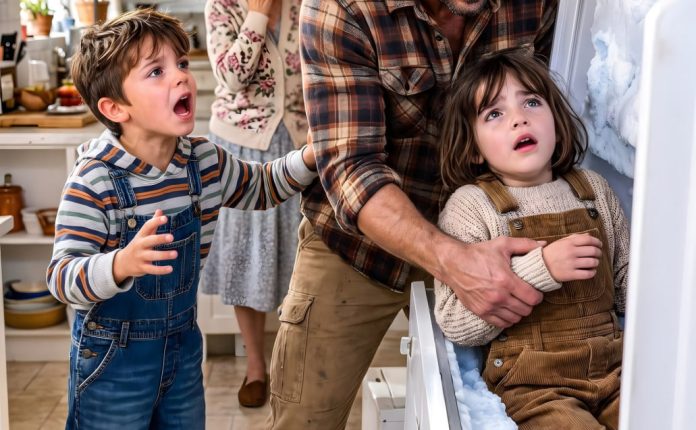
My father was discussing the placement of a flowerpot when I asked why my daughter’s wheelchair ramp was in a dumpster.
“Your mother has people coming Saturday,” he said. “We needed to improve the entrance.”
He didn’t stop pointing at the flower bed.
For a moment, I looked past him, convinced I’d missed something. A temporary ramp. Some plywood. Anything that would explain why the way into our home had disappeared while we were at the rehabilitation clinic.
Four concrete steps rose from the driveway to the porch.
On either side stood a ceramic planter large enough to hold a small tree.
Behind me, Rosie knocked lightly on the car window.
I lifted a hand to let her know I’d heard.
My father, Gordon Rowe, glanced at his watch. He wore khaki shorts and a golf shirt with a small embroidered sailboat over the pocket. There wasn’t a blade of grass on his shoes.
“Where’s the replacement?” I asked.
“For what?”
I pointed toward the dumpster.
A railing lay across its top, bent in the middle. A strip of yellow nonslip tape fluttered from the edge. Farther down, beneath a torn bag of mulch, I could see the small sunflower sticker Rosie had pressed onto the rail the previous summer.
“For the ramp, Dad.”
“We aren’t replacing it.”
The man beside him lowered his clipboard.
I remember that movement with peculiar clarity. Until then, the clipboard had been upright against the man’s chest. When Dad spoke, it dropped to his side.
“Rosie lives here.”
“I know where my granddaughter lives.”
“Then how is she supposed to get inside?”
“Jenna. Pick her up.”
He said it with the weary patience people use when explaining something to a child.
Rosie was nine. She had spina bifida, strong shoulders, a sharp ear for nonsense, and a competitive streak that emerged whenever someone suggested she might need help with something she could already do.
She could manage her chair. She could transfer with very little assistance. She could get her own cereal from the low cupboard and make her bed by moving around it in a way I’d never quite mastered.
She could not roll a wheelchair up four concrete steps.
That was why I’d paid forty-eight hundred dollars for the ramp.
My mother appeared in the doorway carrying hydrangeas.
“Is there a problem?”
I looked from her face to the vase.
“Did you agree to this?”
Vivian Rowe glanced toward the empty space beside the porch, then back at me.
“We’ve talked about improving this entrance for months.”
“You and Dad.”
“It’s our house.”
“And our home.”
Her mouth tightened. A drop of water slid over her fingers onto the sleeve of her blue blouse.
“Please don’t start.”
I had heard those words throughout my childhood. Before an explanation. Before a disagreement. Occasionally before I had said anything at all.
Please don’t start meant the conversation had already been decided somewhere I wasn’t invited.
Rosie called, “Mom?”
I went to her.
Her cheeks were pink from the warm car. She’d been cheerful on the drive, talking about a new exercise she’d managed at the clinic and whether banana bread counted as cake if we added chocolate chips.
I helped her position herself for the transfer.
She checked her brakes. I steadied the chair.
Then she turned toward the house.
At first, she looked puzzled.
Her eyes moved from the porch to the flowerpots, then along the driveway until she found the dumpster.
“That’s mine.”
I crouched.
“I know.”
“Did it break?”
“No, sweetheart.”
My father approached, apparently realizing that standing beside his landscaping contractor while his granddaughter studied the trash didn’t create the impression he wanted.
“We’re making the yard presentable,” he told her. “Your mother will sort things out.”
Rosie looked at him.
“How do I get in?”
The contractor looked away.
My mother shifted the vase against her hip.
“It’s only four steps, darling.”
Rosie lowered her eyes to her wheels.
Something in me went very still.
For years, I’d believed that if I explained things clearly enough, my parents would understand. I sent articles. I described therapy milestones. I corrected people gently when they spoke to me instead of Rosie.
I’d even explained why carrying her wasn’t an acceptable substitute for making her home usable.
They had nodded.
Now I understood that nodding and listening could look exactly alike.
“We’re leaving,” I said.
Rosie turned toward me.
“Where?”
“Somewhere you can get through the door.”
Dad gave a disbelieving little laugh.
“Don’t make a scene.”
I stood.
“You removed her way inside.”
“You’re perfectly capable of lifting her.”
“And when I’m in the shower? When she wants to go outside? When there’s an emergency?”
“We’re not discussing imaginary disasters.”
I looked at the railing in the dumpster.
There was nothing imaginary about it.
My mother stepped down onto the porch.
“You’re frightening her.”
Rosie’s hands remained firmly on her wheels. She wasn’t crying. That almost undid me.
“She asked how she gets home,” I said. “You still haven’t answered.”
I took out my phone.
Dad told me photographs were unnecessary.
I photographed the bare steps, the clean outline on the concrete, the broken ramp, the railing with the sunflower. I moved closer to capture the bent connections.
“Jenna.”
I took another picture.
The contractor stepped toward me as I returned to the car.
“My name’s Luis,” he said. “Call our office if you need the time the crew arrived.”
He offered a business card.
Dad cut in. “There’s no reason for that.”
Luis kept his hand extended.
I took the card.
For the first time since arriving, I looked directly at him.
“Thank you.”
He nodded once.
We left without a bag.
Rosie’s medication, school things, pajamas, favorite pillow, and the unfinished library book she’d left open beside her bed were all inside.
My father watched us from the driveway.
My mother stayed on the porch with her flowers.
At the first traffic light, Rosie asked whether she had done something wrong.
“No.”
“Because Grandpa sounded mad.”
“He’s mad at me.”
“Because of the ramp?”
“Because I wouldn’t agree with him.”
She considered that.
Then she said, “I wasn’t trying to make it look bad.”
I pulled into a pharmacy parking lot before I answered.
There were things I could not safely say while driving.
I turned around.
“Rosie, your ramp didn’t make anything look bad.”
She rubbed her thumb over the seam of her sweatshirt.
“It took up a lot of space.”
“So does a staircase.”
She glanced at me.
I waited until she met my eyes.
“You don’t have to apologize for needing a way inside.”
We used the pharmacy’s accessible restroom. I bought toothpaste, two toothbrushes, and the smallest package of laundry detergent I could find.
Standing in the checkout line, I called Mara.
She answered on the fourth ring.
“Can I call you back? I’m wrestling a fitted sheet.”
“Can we come over?”
The sound on her end stopped.
“What happened?”
“They took out the ramp.”
A pause.
“Come now. I’ll clear the hall.”
Mara lived fifteen minutes away in an apartment building with an elevator. We’d met at work eight years earlier, when she’d shown me how to fix a billing error without making the patient wait another month.
We had been friends ever since.
Her apartment wasn’t spacious. A narrow bookcase crowded the entry, and her bathroom door opened at an inconvenient angle.
By the time we arrived, the bookcase had been moved into her bedroom.
She didn’t announce it.
She simply held the door while Rosie rolled in.
“Tea?” she asked me.
“Maybe.”
“Something stronger?”
“It’s two in the afternoon.”
“Then definitely tea.”
Rosie smiled.
That smile got me through the next hour.
I called our pharmacy about an emergency medication supply, then arranged a time to collect the rest of our belongings. My father replied to that message immediately.
You have keys. Stop behaving like you’ve been thrown out.
I stared at the screen.
Mara set a mug beside me.
“What did he say?”
I handed her the phone.
She read it, exhaled through her nose, and gave it back.
“Save that.”
“I have keys.”
“You don’t have an entrance Rosie can use.”
I knew that. Still, hearing someone else say it loosened something in my chest.
We’d moved into my parents’ converted first-floor apartment almost three years earlier. It had a bedroom, a small kitchen, and a living room with a window overlooking the side yard.
The front porch led to a shared vestibule. Our apartment door was on the left; my parents’ part of the house was on the right.
When we moved in, Dad described the arrangement as mutually helpful.
I would have family nearby. They would have dependable rental income.
The written lease set the rent at nine hundred fifty dollars, plus an agreed share of utilities.
At first, that was what I paid.
Then the furnace needed work.
Dad’s investment account had underperformed.
Mom’s insurance premium increased.
There was always another bill arriving at a difficult moment.
Could I cover it until next month?
Could I send a little extra?
We were family, weren’t we?
I worked in medical billing, and I was good at tracking numbers for people I’d never met. Somehow, at home, I’d stopped keeping track of my own.
While Mara and Rosie argued about whether chocolate chips belonged in banana bread, I opened my banking app.
Nine hundred fifty.
Two hundred eighty.
Six hundred.
Four hundred twenty.
A transfer marked house help.
Another marked catch up.
Dad had suggested those descriptions because he didn’t want Mom worrying.
I began adding.
My phone rang.
Mom.
I went into the hallway.
“Your father is very upset.”
“How is the ramp being stored?”
“What?”
“The pieces. Are they still in the dumpster?”
“Jenna, there’s a party in two days. We can’t have workmen coming back and forth because you’ve decided to turn this into an argument.”
“I’m asking about my property.”
“It was attached to our house.”
“I paid for it.”
“And we’ve given you a very affordable place to live.”
From the kitchen came the clink of a spoon against a bowl.
I pictured Rosie measuring flour.
Mom continued.
“We need to know the house payments will continue.”
I sat on Mara’s narrow hallway bench.
“What house payments?”
“The usual arrangement.”
“My rent?”
“You know what I mean.”
I looked down at the banking screen still open behind her call.
“Send me what you mean in writing.”
“Since when do we need to do that?”
“Since today.”
She said I was using money to punish them.
I said I needed to go.
When I returned to the kitchen, Rosie was carefully scraping batter from the side of the bowl. Mara asked me to grease a loaf tin.
For ten minutes, I did something with a beginning and an end.
That evening, Dad agreed by text that I could collect necessities at seven.
Mara stayed with Rosie.
I drove back alone.
The front yard looked even more finished than before. Small glass lanterns had appeared along the walkway.
Dad opened the door before I reached it.
“There. See how easy that is?”
I walked past him.
Our apartment smelled faintly of the laundry I’d run before leaving for the clinic. Rosie's purple pillow lay on her bed. Her library book was still open, facedown, though I was always asking her not to leave it that way.
I packed two bags.
Dad stood in the doorway.
“You’re teaching her to be oversensitive.”
I folded a pair of pajamas.
“She wanted to enter her home.”
“You can’t expect the world to rearrange itself for her.”
I looked at him.
“This wasn’t the world. This was you.”
He stepped back, offended by the distinction.
Mom waited in the vestibule.
“You’ll be back once you calm down.”
I zipped the bag.
“I’m calm enough to know she can’t get in.”
“We could have managed tonight.”
“And tomorrow?”
She didn’t answer.
I asked for the dumpster collection date.
“Monday,” Dad said.
“Don’t let anyone take the ramp pieces before I arrange an inspection.”
His eyebrows lifted.
“Inspection?”
I picked up the bags.
“I want someone who knows what they’re looking at to see them.”
Outside, I reached into the dumpster with an old pair of gardening gloves from my trunk.
I couldn’t safely free the railing. It was pinned beneath a broken wooden planter.
But the sunflower was near the top.
I worked at one corner with my thumbnail.
It tore slightly.
I stopped, breathed, and tried again.
By the time I returned to Mara’s, the sticker was stuck to a scrap of waxed paper from her kitchen.
Rosie examined it at the table.
“One petal’s missing.”
“I’m sorry.”
“That’s okay.”
She put it beside her pillow that night.
At bedtime, she asked how long we were staying.
“A little while.”
“Will Grandma’s party be over by then?”
“Yes.”
“So we can go back?”
I sat on the edge of the sofa bed.
“We’re going to find somewhere that works for us.”
She pulled the sheet over her knees.
“I like my room.”
“I know.”
“And the window.”
“I know that, too.”
She turned onto her side.
I waited until her breathing evened out before I went into the kitchen.
Mara was rinsing the loaf tin.
“I don’t have a plan,” I whispered.
“You have tonight.”
“I can’t build a life out of tonight.”
“No,” she said. “But you can sleep before you try.”
I slept badly.
In the morning, I called the ramp company.
Denise, the office manager, found the invoice while I waited.
“Forty-eight hundred,” she said. “Paid in full. We have the property owner’s consent form here as well.”
“My father signed it.”
“Yes.”
“Could you email everything?”
Her voice softened.
“Has there been damage?”
I sent a photograph.
She called back within ten minutes.
“Please don’t agree to have someone bend those sections back into shape.”
“Dad hasn’t offered.”
“Still. Let our installer inspect them first.”
I wrote her words down.
Denise also pointed out the equipment details on the invoice. The ramp was a modular system I had purchased. The consent form permitted its installation; it didn’t describe it as a gift to my parents.
I remembered Dad signing that page at our kitchen table.
He’d borrowed my pen.
Then Luis returned my call.
He sounded uncomfortable.
“I wanted to explain something. We were told it wasn’t being used.”
I pressed the phone closer.
“By whom?”
“Your father.”
I watched Rosie draw at Mara’s table.
“He said it belonged to a previous tenant,” Luis continued. “That’s how the removal was written up.”
For several seconds, I could hear only the refrigerator motor.
Rosie had lived there for nearly three years.
She had breakfast with Dad twice a week.
He knew exactly whose ramp it was.
“Can I get a copy of that?”
“I need to check with the office.”
“Please.”
At ten, Dad sent a message telling me to stop contacting people about his property.
I saved it.
Then I created a folder on my laptop and named it Rosie—Housing.
The practical work began.
I called apartment listings during my lunch break. I asked about thresholds, bathroom doors, parking spaces, and whether “ground floor” meant an actual level entrance.
One agent said there were only three steps.
I thanked her and ended the call.
Another said they could probably find a maintenance worker to help carry Rosie.
I ended that call, too.
At the third place, I asked for photographs.
The woman sounded surprised.
“Of the doorway?”
“Yes.”
While I waited for replies, I printed the bank statements.
There was the rent.
There were the agreed utilities.
Then there was everything else.
Over the previous year, I had sent my parents more than fourteen thousand dollars beyond the rent and our utility share.
I checked the total twice.
Mara sat opposite me.
“Were you lending it?”
“Sometimes he said he’d pay it back. Sometimes he didn’t.”
“What did you think it was?”
“Helping.”
That word looked terribly small beside the number.
I wasn’t destitute. I had savings. I’d protected a modest emergency fund because Rosie needed me to.
But I’d been putting off our own move while paying for my parents’ emergencies, one after another.
And somehow there had been money for flowerpots.
On Saturday morning, Mom sent a photograph of the garden.
White chairs stood in neat rows. Napkins were folded into little fans on the refreshment table.
Her message read: We’d still like you both here.
No mention of the entrance.
No mention of the broken ramp.
I didn’t answer.
At noon, the landscaping office emailed a copy of the job sheet, released after reviewing my photographs and installation receipt.
The instruction was short.
Remove obsolete aluminum access structure left by previous tenant. Dispose of components.
Below it was Gordon Rowe’s approval.
I read the line three times.
Until that moment, some part of me had still been trying to imagine a misunderstanding. A careless worker. An unspoken plan to reinstall it later.
Dad had told the crew we were gone before we had ever decided to leave.
I closed the apartment listings and opened a blank email.
This time, I wrote to a lawyer.
END PART 1