MY MOTHER-IN-LAW SECRETLY DRUGGED MY 4-YEAR-OLD DAUGHTER TO KEEP HER QUIET—BUT THE PAPER SHE PULLED FROM HER PURSE EXPOSED A SECRET THAT DESTROYED OUR FAMILY
When my four-year-old daughter whispered, “Mummy, can I stop?” I thought she was simply tired. Hours later, doctors were examining a medicine bottle my mother-in-law had secretly used to make her sleep. But the most devastating discovery wasn’t what Grandma had given her. It was the document she pulled from her purse—and the terrible truth about how long my husband had known.
The paper looked ordinary.
Just a folded white sheet with a hospital logo in the upper corner.
My mother-in-law, Patricia, placed it on the examination-room counter with the confidence of someone who believed she had just won an argument.
“There,” she announced. “Read that before you start accusing me of poisoning my own granddaughter.”
My husband, Daniel, reached for it.
I watched his expression change.
First confusion.
Then disbelief.
Then something that looked painfully close to fear.
“Mom,” he whispered. “What is this?”
Patricia crossed her arms.
“A doctor’s recommendation. I’ve been telling you people that Emma has trouble settling down. Now maybe you’ll listen.”
Daniel unfolded the paper completely.
“That’s not what this says.”
The clinician, Dr. Rebecca Ellis, stepped forward.
“May I see it?”
Daniel handed her the document.
She examined it quietly.
Then she looked at Patricia.
“Mrs. Bennett, where did you obtain this?”
“From a medical professional.”
“Which medical professional?”
Patricia hesitated.
“A specialist.”
“What kind of specialist?”
“Someone who understands children.”
Dr. Ellis looked back at the paper.
“This isn’t a prescription. It’s an educational information sheet about sleep difficulties in young children.”
Patricia opened her mouth.
But the doctor continued.
“And someone has handwritten medication instructions at the bottom. There’s no prescriber’s signature, no patient identification, and no indication that a clinician approved these directions for Emma.”
I felt my stomach turn.
“What instructions?”
Dr. Ellis glanced toward Emma, who was sitting with a nurse nearby.
Then she lowered her voice.
“The handwritten note refers to giving a sedating medication to manage unwanted behavior.”
For several seconds, nobody spoke.
Then Daniel turned the paper over.
And that’s when he saw it.
A handwritten schedule.
Emma’s name appeared across the top.
Underneath were dates, times, and short descriptions.
Crying after breakfast.
Refused afternoon nap.
Asked for Mommy repeatedly.
Wouldn’t stop talking.
Beside several entries, Patricia had written one word.
Given.
Daniel stared at the page.
“Mom… you’ve been keeping track?”
Patricia lifted her chin.
“Of course. Someone has to be responsible around here.”
I couldn’t believe what I was hearing.
“You made a schedule for drugging my daughter?”
“Oh, stop being dramatic,” she snapped. “You make everything sound ugly.”
I stepped toward her.
“She’s four years old!”
Dr. Ellis moved between us.
“Mrs. Bennett, I’m going to ask you to step outside while we continue Emma’s assessment.”
Patricia looked offended.
“I have every right to be here. I’m her grandmother.”
“No,” I said.
My voice was barely above a whisper.
“You don’t.”
And for the first time since I’d married into that family, I saw Patricia realize she was losing control.
My name is Olivia Bennett.
I’m thirty-two years old, and until that evening, I believed the biggest problem in my marriage was my mother-in-law’s constant interference.
Patricia had always been controlling.
She criticized how I dressed Emma.
How much sugar I allowed her.
Whether she watched cartoons.
What time she went to bed.
She even corrected the way I hugged her.
“You’re making her dependent,” she would say.
Or, “Children need discipline, not endless affection.”
Daniel usually responded with the same tired sentence.
“That’s just how Mom is.”
For years, I had accepted that explanation.
Now my daughter was sitting in a clinic with heavy eyelids, struggling to stay awake, because the woman we’d trusted to care for her had been giving her medicine without my knowledge.
And my husband had seen it happen.
At least once.
That was the part I couldn’t stop thinking about.
Dr. Ellis arranged for Emma to be transferred to the children’s emergency department for further evaluation.
I rode with her.
Daniel followed in his car.
Patricia was told not to accompany us.
She protested loudly enough that people in the waiting room turned to stare.
“This is ridiculous!” she shouted. “I raised three children! None of them died from taking medicine!”
I turned around.
“That’s supposed to make me feel better?”
Patricia pointed at me.
“You’ve turned that child into a little tyrant. She cries, you come running. She refuses to sleep, you let her stay awake. She knows exactly how to manipulate you.”
I stared at her.
“My daughter was asking you to stop giving her something that made her feel sick.”
“She was being difficult!”
Those words echoed through the clinic.
Even Patricia seemed to hear how terrible they sounded.
But she didn’t apologize.
Instead, she looked at Daniel.
“Tell your wife she’s overreacting.”
Daniel remained silent.
Patricia’s expression hardened.
“Daniel?”
He looked at her.
“Mom, go home.”
She blinked.
“What?”
“Go home.”
For once, he didn’t defend her.
But as I watched him standing there, I couldn’t forget what Emma had said.
Daddy watched Grandma give it to me once.
He had finally spoken up.
But why had it taken our daughter ending up in a medical clinic?
At the hospital, Emma was placed under observation.
The medical team checked her breathing, heart rate, and level of alertness while reviewing the medicine bottle and the information we’d brought.
They explained that without knowing exactly what she’d received and when, they needed to be cautious.
Nobody promised she would be fine.
Nobody dismissed what had happened.
And that frightened me more than anything.
Emma lay beneath a soft hospital blanket with her bunny tucked against her cheek.
I sat beside her, holding her tiny hand.
Every few minutes, she opened her eyes.
“Mummy?”
“I’m here, sweetheart.”
“Can we go home?”
“Not yet, baby.”
She looked worried.
“Is Grandma angry?”
I felt something inside me break.
“Grandma isn’t here.”
“Did I make trouble?”
I leaned over her.
“No, Emma. You did exactly the right thing by telling me.”
Her lower lip trembled.
“But Grandma said good girls don’t tell secrets.”
I swallowed hard.
“Listen to me, sweetheart. Grown-ups should never ask you to keep secrets about medicine or things that make your body feel strange.”
Emma blinked.
“Even Grandma?”
“Even Grandma.”
She thought about that for a moment.
Then she whispered, “I didn’t like the spoon.”
I kissed her forehead.
“You never have to take Grandma’s spoon again.”
She closed her eyes.
And I sat there, trying not to cry loudly enough to wake her.
Daniel arrived twenty minutes later.
He stood in the doorway holding two paper cups of coffee.
He looked exhausted.
I didn’t want anything from him.
Not coffee.
Not apologies.
Not explanations.
But I wanted the truth.
“How many times?” I asked.
He stared at me.
“Olivia—”
“How many times did you see your mother give Emma that medicine?”
He set the cups down.
“Once.”
“Are you sure?”
He nodded.
“She was watching Emma while I worked from home. Emma was crying because you were at the grocery store. Mom gave her something from a spoon.”
“And what did you think it was?”
“She said it was vitamins.”
I looked at him.
“Vitamins?”
He rubbed his forehead.
“I know how that sounds.”
“Then why did Emma get sleepy afterward?”
Daniel didn’t answer.
“Daniel.”
He stared at the floor.
“Mom said she was tired.”
I felt my chest tighten.
“You saw our four-year-old daughter being given an unknown liquid. You watched her become unusually sleepy. And you never thought to ask me?”
He looked up.
“I didn’t know.”
“But you knew enough to remember it when Emma said something.”
His eyes filled.
“I thought Mom knew what she was doing.”
There it was.
The sentence that had shaped our entire marriage.
Mom knows best.
I sat back in my chair.
“Your mother knew how to frighten our daughter into silence. That’s what she knew.”
Daniel began crying.
For the first time since I’d known him, he looked completely helpless.
But I couldn’t comfort him.
Not yet.
Because Emma was the one who needed protecting.
The following morning, a hospital social worker came to speak with us.
She explained that because a young child may have been given medication inappropriately by a caregiver, the hospital had safeguarding obligations.
The circumstances would need to be documented and reported to the appropriate child-protection authorities.
I agreed immediately.
Daniel hesitated.
“Does this mean my mother could be arrested?”
The social worker answered carefully.
“Any criminal investigation would be handled by law enforcement. Our priority is Emma’s safety and medical care.”
Daniel lowered his head.
I turned toward him.
“Are you seriously worried about your mother right now?”
“No,” he whispered.
But his hesitation had told me enough.
That afternoon, I received a telephone call from an unfamiliar number.
“Mrs. Bennett? My name is Lauren Hayes. I’m a nurse practitioner. I believe your mother-in-law has been using my name.”
I sat upright.
“What?”
Lauren explained that she worked at a community health clinic where Patricia had attended a public information session several months earlier.
Patricia had received a general handout about childhood sleep routines.
Lauren had not prescribed anything for Emma.
She had not examined Emma.
And she had certainly never recommended medicating a preschooler to stop her from crying.
“Your mother-in-law called our office yesterday,” Lauren said. “She told the receptionist she needed us to confirm that she’d received medical approval.”
My hands went cold.
“What did you tell her?”
“That we had no such record.”
I looked toward the hospital window.
Patricia hadn’t simply misunderstood a medical handout.
She had tried to turn it into proof of permission.
And when challenged, she’d attempted to make a healthcare professional support her story.
I asked Lauren to provide that information to the investigators.
She agreed to cooperate with any lawful request.
When I ended the call, my hands were shaking.
But the worst discovery was still waiting.
Three days later, Emma was discharged from the hospital after her condition had stabilized.
The doctors arranged follow-up care and advised us to keep all medications secured and ensure Patricia had no access to Emma.
I took my daughter straight to my sister’s house.
Daniel returned home to collect our clothes and Emma’s favorite books.
I told him Patricia was not to enter the house.
He agreed.
That evening, he called me.
His voice sounded strange.
“Olivia, I found something.”
I was sitting beside Emma while she colored a picture of a yellow butterfly.
“What?”
“Mom’s notebook.”
I went completely still.
“What notebook?”
“The one she kept in the guest room.”
He swallowed.
“There are more entries.”
“More medicine?”
“Yes.”
I closed my eyes.
He continued.
“And there are notes about you.”
I opened them again.
“What notes?”
Daniel hesitated.
“Mom wrote that Emma’s attachment to you was unhealthy. She said she needed to teach Emma independence.”
My stomach turned.
“What else?”
There was a long silence.
“She wrote that you were emotionally unstable.”
I almost laughed.
“Of course she did.”
“No, Olivia. You don’t understand.”
His voice began shaking.
“She was documenting things she thought could be used against you.”
I gripped the phone.
“What are you saying?”
“There’s a folder.”
“What folder?”
He exhaled.
“It’s labeled ‘Emma Custody.'”
I drove to the house without Emma.
My sister stayed with her.
When I arrived, Daniel was sitting at the dining-room table.
In front of him lay a thick blue folder.
He looked as though he hadn’t slept in days.
I sat across from him.
“Show me.”
He opened the folder.
Inside were printed photographs of our home.
Screenshots of messages I’d sent Daniel during disagreements.
Notes about days when I worked late.
A list of alleged parenting failures.
Most were absurd.
One entry claimed I had neglected Emma because I’d allowed her to eat cereal for dinner when she had a fever.
Another described me as unstable because I cried after my father’s funeral.
But one page made me stop breathing.
It was titled:
Proposed Temporary Guardianship Arrangement.
Patricia had drafted a document suggesting she should become Emma’s primary caregiver if I was found unable to parent.
My name appeared throughout the text.
And Daniel’s name was listed as the parent supporting the arrangement.
I looked at him.
“Did you know about this?”
His eyes widened.
“No.”
“Your name is on it.”
“I swear I never saw it.”
I studied the document.
There was no valid signature, court order, or legal authorization.
But the intention was unmistakable.
Patricia had been preparing to challenge my ability to care for my own daughter.
Daniel leaned forward.
“Olivia, there’s something else.”
He pulled out a handwritten letter.
It was addressed to him.
The first line read:
Daniel, eventually you’ll have to accept that Olivia isn’t capable of raising Emma properly.
My stomach tightened.
I continued reading.
The child is becoming defiant because Olivia rewards every tantrum. She needs stability, discipline, and a stronger adult influence.
Then came the sentence that made me feel physically sick.
Once Emma becomes accustomed to my care, the separation will be much easier.
I put the letter down.
Patricia hadn’t just wanted Emma quiet.
She’d wanted Emma dependent on her.
And she’d been preparing to remove me from the picture.
The next morning, we handed copies of the notebook, letter, and folder to the authorities.
Our attorney also advised us to preserve the originals and avoid confronting Patricia ourselves.
Investigators interviewed Daniel separately.
They interviewed the clinic staff.
They obtained relevant hospital records through the proper procedures.
They also reviewed Patricia’s notes about the medicine.
I couldn’t believe how ordinary some of her entries sounded.
Like she was tracking a gardening schedule.
Not a little girl’s distress.
One note read:
Much calmer today. No crying for mother during afternoon rest.
Another:
Very sleepy. Easier to manage.
When the investigator showed me those words, I had to leave the room.
I stood in the hallway, breathing slowly, while my sister held my hand.
All I could picture was Emma squeezing her bunny.
Trying to stay awake.
Trying to be good.
Trying to understand why being quiet mattered more to Grandma than feeling safe.
A week later, Patricia called Daniel.
He put the conversation on speaker after telling her I was present.
She sounded furious.
“Have you lost your mind? Your wife has turned this family into a public spectacle!”
Daniel sat beside me.
“Mom, you gave Emma medicine she wasn’t supposed to have.”
“I helped her sleep!”
“Without telling us.”
“I told you!”
“You told me it was vitamins.”
Patricia went silent.
Then she changed tactics.
“Daniel, I’m your mother. I sacrificed everything for you.”
He closed his eyes.
“I know.”
“Then how can you let that woman treat me like a criminal?”
I reached for his hand, not to comfort him, but to remind him that he needed to make a choice.
Daniel looked at me.
Then he spoke.
“Because Emma is my daughter.”
Patricia scoffed.
“And I’m your mother.”
“I know.”
His voice cracked.
“But Emma needed me to protect her.”
There was a long silence.
Then Patricia said something I will never forget.
“Children get over things.”
Daniel’s face changed.
“No, Mom.”
He swallowed.
“Sometimes they don’t.”
And he ended the call.
Over the following months, Emma began working with a child therapist experienced in helping young children after frightening experiences.
We never forced her to talk.
Sometimes she drew pictures.
Sometimes she played with dolls.
Sometimes she simply sat quietly beside me and held her bunny.
One afternoon, she asked whether the pink spoon was gone.
I told her it was.
“Forever?”
“Forever.”
She thought about that.
Then she asked, “Am I good now?”
I felt tears fill my eyes.
I gathered her into my arms.
“Emma, you were always good.”
She frowned.
“But Grandma said I was difficult.”
I brushed her hair away from her face.
“Being sad doesn’t make you bad. Crying doesn’t make you bad. Wanting Mommy doesn’t make you bad.”
She studied my face.
“Even if I don’t want to nap?”
I smiled through tears.
“Even then.”
She wrapped her arms around my neck.
And for the first time since that terrible afternoon in our kitchen, I felt a little piece of my daughter returning.
Daniel and I started marriage counseling.
I hadn’t forgiven him.
I wasn’t even certain I wanted to stay married.
But I wanted to understand why he had spent so many years defending his mother, even when doing so meant ignoring obvious warning signs.
During one session, our counselor asked him what happened when he disagreed with Patricia as a child.
Daniel stared at his hands.
“She stopped talking to me.”
“For how long?”
“Sometimes days.”
“And what did you do?”
He swallowed.
“Whatever she wanted.”
I looked at him.
For the first time, I saw the frightened little boy behind the grown man.
It didn’t excuse what he’d failed to do for Emma.
But it helped explain why he’d struggled to confront Patricia.
The counselor asked him another question.
“What happens now when protecting your daughter means disappointing your mother?”
Daniel looked at me.
Then he answered.
“I disappoint my mother.”
I wanted to believe him.
But trust wasn’t something he could repair with one sentence.
He would have to prove it through his actions.
Patricia was eventually charged in connection with the inappropriate administration of medication to Emma.
The precise allegations depended on the evidence gathered during the investigation.
She initially denied wrongdoing.
Then, when confronted with her own written records, she acknowledged that she’d repeatedly given Emma the medicine without obtaining medical approval for that purpose.
She continued insisting she’d been trying to help.
Her attorney argued that she hadn’t intended to cause harm.
But the court heard about Emma’s symptoms, Patricia’s secret dosing records, and her attempts to conceal what she’d been doing.
The judge also heard that Emma had repeatedly expressed distress.
At sentencing, Patricia tried one final time to portray herself as a loving grandmother who’d made an innocent mistake.
“I only wanted what was best for my granddaughter,” she said.
The judge looked at her.
“Mrs. Bennett, wanting a child to be quiet is not the same as acting in that child’s best interests.”
Patricia lowered her eyes.
She received a custodial sentence, and protective restrictions prevented her from contacting Emma.
I felt no triumph.
Only relief.
Because the court had finally made clear what Patricia had refused to accept.
Emma was a child.
Not a problem to be controlled.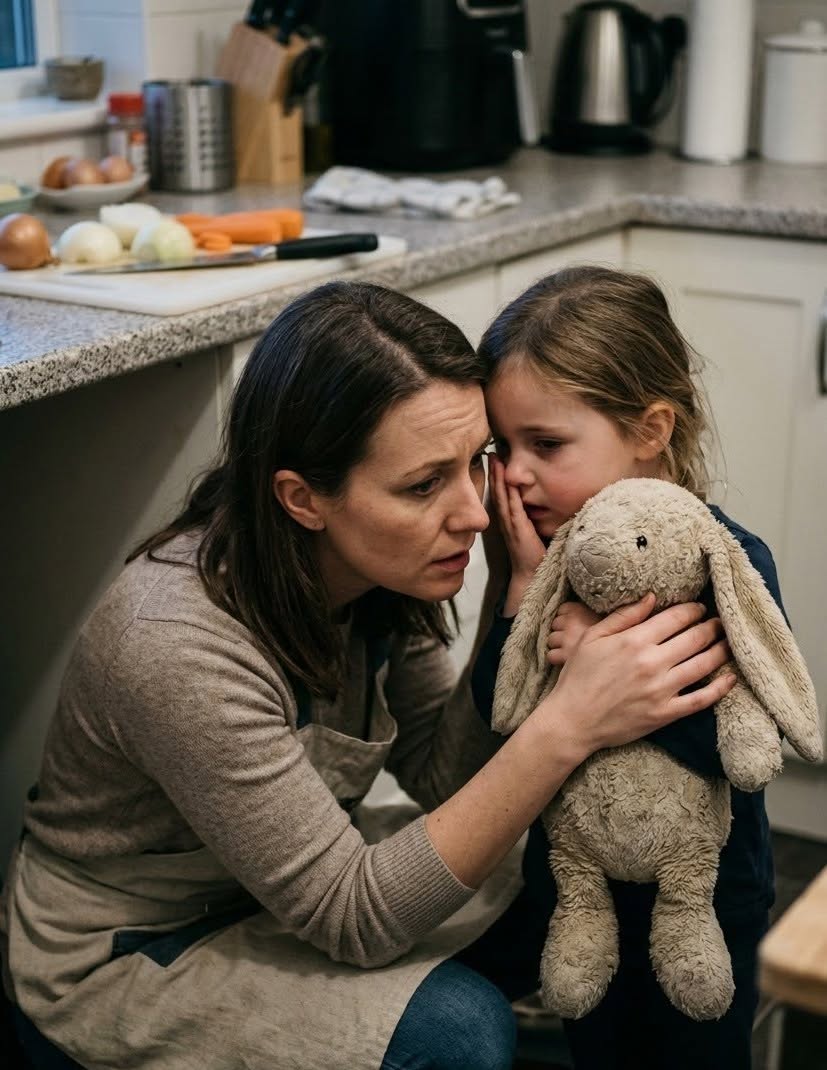 Not a possession to be claimed.
Not an inconvenience to be medicated into silence.
Almost a year after the day Emma whispered those terrible words in my kitchen, I was preparing dinner again.
The house smelled of roasted chicken and warm bread.
Emma sat at the kitchen table coloring.
Daniel was washing vegetables beside me.
Things between us were still complicated.
We were rebuilding slowly.
Some days were easier than others.
But he had stopped making excuses for his mother.
And he had learned that being a father meant speaking up, even when it frightened him.
Emma climbed down from her chair and walked toward me.
“Mummy?”
I turned.
“Yes, sweetheart?”
She held up a picture.
It showed three stick figures standing beneath a bright yellow sun.
One was tall.
One wore a purple dress.
And the smallest held a rabbit.
“That’s us,” she said proudly.
I smiled.
“It’s beautiful.”
She pointed to the smallest figure.
“That’s me.”
“I know.”
She pointed to the tall one.
“That’s Daddy.”
Then she pointed to the woman in purple.
“And that’s you.”
I kissed her cheek.
“Thank you, sweetheart.”
She studied the picture for a moment.
Then she asked, “Can I put it on the fridge?”
“Of course.”
She ran toward the refrigerator.
Daniel followed her and helped secure it with a butterfly magnet.
I watched them laughing together.
And suddenly I remembered the first time Emma had asked me whether she could stop.
Her tiny trembling voice.
The frightened expression on her face.
The way she’d clutched her bunny like it was the only thing keeping her safe.
Then I looked at the child standing in front of me now.
Her cheeks were pink.
Her eyes were bright.
She was laughing because her father had accidentally stuck the picture upside down.
She was four years old.
And she was finally free to act like it.
That evening, after Emma had fallen asleep, I went into her bedroom to check on her.
Her bunny rested beneath her chin.
The night-light cast little stars across the ceiling.
I sat on the edge of her bed.
For a long time, I simply watched her breathe.
I thought about all the times I’d dismissed Patricia’s criticism as ordinary family tension.
All the times I’d told myself that grandparents and parents simply had different ideas.
All the times I’d ignored my own discomfort because I didn’t want to create conflict.
And I realized something.
I hadn’t failed because I trusted someone.
Patricia had betrayed that trust.
But I could learn from what happened.
I could stop minimizing my instincts.
I could teach Emma that her body belonged to her.
That medicine was never supposed to be a secret.
That adults didn’t automatically deserve obedience just because they were older.
And that telling the truth would never make her difficult.
Emma stirred.
Her eyes opened slightly.
“Mummy?”
“I’m here, baby.”
She reached for my hand.
“Do I have to be quiet?”
I felt tears burn behind my eyes.
“No, sweetheart.”
She blinked sleepily.
“Even if I’m sad?”
“Even if you’re sad.”
“Even if I’m angry?”
“Even then.”
Her fingers curled around mine.
“What if I cry?”
I leaned down and kissed her forehead.
“Then I’ll listen.”
Emma smiled.
A tiny, sleepy smile.
Then she whispered, “I love you, Mummy.”
“I love you more than anything.”
She closed her eyes.
And I stayed beside her until she fell asleep again.
Because I’d finally understood something Patricia never had.
A child who feels safe doesn’t need to be perfectly behaved.
She needs to be heard.
She needs to be comforted.
She needs adults who care more about her well-being than their own convenience.
And most of all, she needs to know that love isn’t something she earns by staying quiet.
Love should be the place where she is allowed to speak.
The next morning, Emma woke me at six-thirty.
She climbed into my bed, carrying her bunny.
“Mummy?”
I opened my eyes.
“Yes, sweetheart?”
She grinned.
“Can we make pancakes?”
I laughed.
“Of course.”
“And can I help?”
“Absolutely.”
She thought for a moment.
“Even if I make a mess?”
I pulled her close.
“Especially if you make a mess.”
She giggled.
And as we walked toward the kitchen together, I realized that after everything we’d been through, the most beautiful sound in the world wasn’t silence.
It was my daughter laughing.
Talking.
Asking questions.
Making noise.
Being wonderfully, gloriously four years old.
And nobody was ever going to punish her for that again.
THE END.