The first sound I heard was breaking glass.
It came through my telephone while I sat in my office, forty miles away from the house being destroyed.
“Nora, somebody's tearing your place apart.”
June Whitcomb spoke so quickly that I barely recognized her voice.
I pushed my keyboard aside.
“June? What happened?”
“There are construction workers in your yard. They've taken out the windows along the east side. Your brother says it's all been arranged.”
For a moment, I couldn't process the words.
My brother.
Construction workers.
My house.
“Is anyone hurt?”
“Not that I've seen. But they're pulling furniture outside, and there's a bulldozer parked by your hydrangeas.”
I stood so quickly that my chair rolled into the filing cabinet.
“Did Owen tell you who hired them?”
“He said your father was handling everything.”
I looked at the framed photograph beside my monitor.
The cottage stood against a brilliant October sky, its cedar siding weathered silver near the roofline. The sunroom windows reflected Briar Lake, and a small blue canoe rested upside down beside the dock.
I had taken the photograph the previous autumn.
It was my favorite place in the world.
“June, please don't confront anybody. I'm coming.”
“Drive carefully, honey.”
She paused.
“And Nora?”
“Yes?”
“I don't think they know I've called you.”
I thanked her and disconnected.
My computer still displayed the proposal I was preparing for a regional hospital network.
It was the largest prospective contract my marketing agency had pursued that year.
I saved the document, sent my office manager a brief message, and grabbed my coat.
My name is Nora Bennett.
I was thirty-five, unmarried, and the owner of a small branding agency in Grand Rapids, Michigan.
Fourteen people depended on the business I had built from a rented desk, a borrowed laptop, and more determination than financial sense.
My parents liked to describe me as fortunate.
My younger brother, Owen, preferred the word comfortable.
Neither word captured the nine years of weekends, canceled vacations, and sleepless nights behind my business.
I had earned enough to purchase a modest downtown condominium.
Three years earlier, I had also bought the cottage on Briar Lake.
That purchase meant more to me than anything else I owned.
When I was little, my grandmother used to take me fishing at a public landing not far from the property.
We never caught much.
Mostly, we sat together watching boats pass.
She drank coffee from a chipped blue ceramic mug and told me that every person needed somewhere the world couldn't demand anything from them.
I thought about that sentence often.
When I finally had enough money for a down payment on the cottage, I bought it without asking anyone's opinion.
It needed plumbing repairs, new exterior paint, and a roof that could survive another Michigan winter.
I loved it anyway.
On weekends, I carried old boards to the dumpster, stripped paint from doorframes, and learned how to replace leaking faucets.
I hired professionals for the work I couldn't safely do myself.
Gradually, the house became mine in a way that went beyond the deed.
My grandmother's blue mug sat on a shelf in the sunroom.
A battered wicker chair stood beside the windows.
I kept notebooks there, along with a small collection of books I never seemed to finish.
My parents had visited often enough to know how much the place mattered.
They also knew exactly who owned it.
That was what made June's call so difficult to understand.
I tried my father while walking toward the parking garage.
Straight to voicemail.
I called my mother.
No answer.
Then Owen.
He answered on my fourth attempt.
“What?”
“Why are there construction workers at my lake house?”
A pause.
“Dad's dealing with it.”
“Dealing with what?”
“Nora, I'm busy.”
“Are they tearing down my sunroom?”
He sighed.
“You're going to turn something good into a huge problem.”
“Owen.”
“What?”
“Tell those workers to stop.”
“Talk to Dad.”
The line went dead.
I stared at the screen.
Owen had always been skilled at making an unreasonable request sound like an obligation I had failed to meet.
At thirty-one, he had started three businesses.
The first sold customized fitness equipment.
The second involved residential drone photography.
The third was an online consulting service whose purpose changed depending on who was asking.
Each venture had ended with unpaid bills and an explanation involving somebody else's failure.
Our parents called him inventive.
They called me rigid when I suggested he might benefit from keeping a steady job.
When Owen married Paige two years earlier, I tried to establish a better relationship with both of them.
Paige worked at a dental practice.
She was quieter than Owen, more practical, and usually uncomfortable during arguments about money.
When they announced her pregnancy, I was genuinely pleased.
I sent flowers and offered to help them search for a larger rental.
Their apartment was small, but affordable housing near Grand Rapids was difficult to find.
I understood their worries.
I simply hadn't realized their solution involved taking my property.
The drive toward Briar Lake usually relaxed me.
The road curved past orchards, farmhouses, and stretches of forest beginning to change color.
That afternoon, I barely noticed the scenery.
I remembered a conversation with my mother three weeks earlier.
We had been eating lunch when she mentioned that the cottage wasted too much space.
“Such a big place for one person,” she said.
“It isn't very big.”
“Still, you only visit on weekends.”
“That doesn't mean it isn't being used.”
She had changed the subject.
A week later, my father asked whether the garage foundation was strong enough to support an apartment.
I told him I had no plans to build one.
He smiled and said he was only curious.
Then Owen asked whether I would consider letting him and Paige stay at the cottage for a month after the baby arrived.
I told him we could discuss an occasional visit, but not a long-term arrangement.
He didn't argue.
He simply stopped talking to me for several days.
Now those conversations seemed less casual.
I turned onto my gravel driveway shortly after three.
The first thing I saw was the dumpster.
It sat directly across the flower bed where I had planted white hydrangeas the previous spring.
A construction pickup blocked the garage.
Another truck carried stacks of lumber.
Orange extension cords ran across the porch.
My heart sank when I saw the house.
The eastern wall of the sunroom was missing.
Not damaged.
Missing.
Its tall windows had been removed, and several lay shattered beside the steps.
A blue tarp flapped against exposed framing.
Insulation hung from the ceiling.
The wicker chair was upside down beneath a pile of debris.
Someone had placed my books in cardboard boxes that were already damp from the afternoon mist.
My mother sat beneath the maple tree.
She wore a cream cardigan and held a plastic cup of iced tea.
When she saw my car, she raised her hand.
That small, ordinary gesture made me angrier than anything else.
She greeted me as though I had arrived for a family picnic.
I parked behind the contractor's pickup.
Before I reached the porch, a worker carrying a sheet of drywall stepped aside.
“Excuse me,” he said.
I barely heard him.
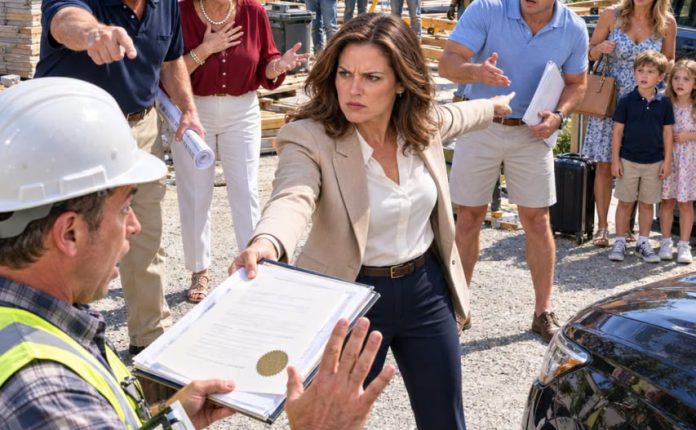
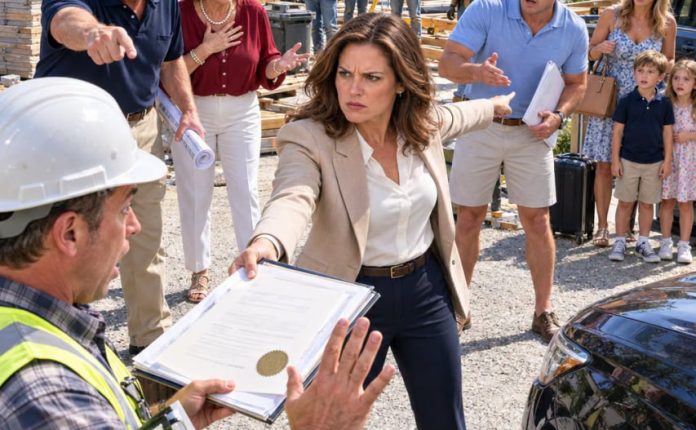
My father was standing beside a man holding construction drawings.
Owen leaned against the porch railing.
He smiled.
“Well, somebody spoiled the surprise.”
I looked past him into my house.
A section of the interior wall had been opened.
Electrical wiring hung from the studs.
Dust covered the pine floor.
“What have you done?”
My father stepped forward.
“Nora, there's no reason to get upset.”
I stared at him.
“No reason?”
“We're making improvements.”
“Without telling me?”
Owen shrugged.
“Paige is pregnant. We need somewhere appropriate to raise the baby.”
I turned toward him.
“And what does that have to do with my house?”
His smile thinned.
“Come on. You know we need more room.”
My father unfolded the drawings.
He pointed at a section marked FAMILY SUITE.
“We're expanding the main living area. Owen and Paige will have three bedrooms, and your mother and I will move into a small apartment beside the garage.”
I looked at the drawing.
The plans included a larger kitchen, an enclosed nursery, two additional bathrooms, and an expanded garage.
My existing bedroom had been labeled GUEST ROOM.
“Where do you expect me to live?”
My mother joined us.
“You have your condominium.”
“This is also my home.”
“Nora, don't be selfish.”
That word landed with the force of something familiar.
Selfish.
I had heard it whenever I refused to lend Owen money.
Whenever I couldn't attend a family dinner because I was working.
Whenever I declined to pay for something my parents considered necessary.
I looked at the cottage again.
“Who authorized this?”
My father lifted a clipboard.
“I did.”
“Why?”
“Because somebody needed to make a decision.”
“It wasn't yours to make.”
He gave me the patient expression he used when explaining household repairs to me as a teenager.
“Sweetheart, family property benefits the whole family.”
“It's not family property.”
“Don't start splitting hairs.”
I couldn't believe he had said it.
Splitting hairs.
As though recorded ownership were a technicality.
As though my name on the deed mattered less than his judgment.
I turned to the contractor.
“Are you in charge?”
The man nodded.
“Rick Mallory. Mallory Residential Construction.”
“Who hired you?”
Rick looked at my father.
“Mr. Bennett arranged the contract.”
“And did he tell you he owns this house?”
Rick hesitated.
“He said he manages the property for the family.”
“He doesn't.”
My father moved closer.
“Nora, we can discuss this privately.”
“We're discussing it now.”
Owen pushed away from the railing.
“Why are you acting like we're stealing something?”
“Because you're dismantling a house that belongs to me.”
“It's still going to be your house.”
“Then why is my bedroom labeled guest room?”
He looked at the plans.
For once, he had no immediate answer.
My mother stepped between us.
“The baby needs stability.”
“I understand that.”
“Then show it.”
I looked directly at her.
“Being happy about a baby doesn't give anyone permission to move into my home.”
Her expression hardened.
“You spend your life working. Your brother is building a family.”
I had no children.
I knew what she meant.
It wasn't the first time she had suggested that my life was somehow unfinished because I lived alone.
But hearing that judgment beside my demolished sunroom made it impossible to ignore.
I took out my phone.
“What are you doing?” my father asked.
“Getting my ownership documents.”
He laughed once.
“Nora, we're not in court.”
“No. We're standing in the wreckage of my house.”
My recorded deed was stored in an encrypted folder with the rest of my important documents.
I opened it and showed Rick the first page.
He read my name.
Then he looked at my identification.
“Your father isn't listed here.”
“No.”
“Is there anyone else on the title?”
“No.”
Rick studied the document again.
I opened the current property tax record and the mortgage statement.
Both identified me as the owner.
His face changed.
“Mr. Bennett, we were told this was a family-owned property.”
My father folded his arms.
“It is.”
“Legally,” Rick said carefully, “your daughter appears to own it.”
“I'm her father.”
“That doesn't give you authority to approve demolition.”
I held out my hand.
“Show me the contract.”
Rick hesitated.
Then he handed over the clipboard.
The first pages described the project.
The work had been estimated at $186,400.
I stared at the figure.
Nearly two hundred thousand dollars.
The agreement listed Martin Bennett as the client and authorized family representative.
I turned another page.
There was my full name.
Below it, a signature.
It looked vaguely like mine.
The capital N was too upright.
The final stroke was missing the downward curl I had used since college.
I hadn't written it.
“That's not my signature.”
My mother looked over my shoulder.
“Maybe you signed something and forgot.”
I turned slowly.
“Mom.”
“What?”
“Are you saying I forgot authorizing a renovation that costs almost two hundred thousand dollars?”
She looked away.
Owen stepped forward.
“It's just paperwork.”
Rick took a closer look.
“Mr. Bennett, who supplied this authorization?”
My father answered without hesitation.
“I did.”
“Did your daughter sign it in front of you?”
“She agreed in principle.”
“No,” I said.
“I didn't.”
A worker appeared behind Rick.
“Boss, are we continuing?”
Rick raised his radio.
“All crews, stop work immediately.”
The worker looked surprised.
“Everything?”
“Everything.”
A moment later, the saws stopped.
The hammering stopped.
Someone shut down the compressor.
The sudden quiet made the wind coming off the lake seem louder.
I could hear loose plastic snapping against the exposed wall.
Owen stared at Rick.
“You can't just stop halfway through.”
Rick kept his eyes on me.
“Until ownership and authorization are resolved, we aren't touching anything else.”
My father snatched the drawings from the hood of the truck.
“This is ridiculous.”
“No,” Rick said.
“This is a serious problem.”
My father began talking about expenses.
Mobilization costs.
Materials.
Deposits.
The inconvenience of sending workers home.
I barely listened.
I was looking at the document again.
One paragraph said the renovated property would be reserved for the permanent residential use of Owen Bennett and Paige Bennett.
Another made the property owner financially responsible if the client failed to pay.
I read that paragraph twice.
Then I looked at my father.
“You intended to make me responsible for the bills.”
His face reddened.
“It's your property. Naturally the improvements benefit you.”
“I didn't request improvements.”
“You'll appreciate them eventually.”
I thought of the wicker chair.
The windows.
The quiet mornings with my grandmother's mug.
There wasn't enough money in the world to make me appreciate what they had done.
I called my attorney.
Leah Morgan had handled my agency's contracts for six years and reviewed the purchase documents when I bought the cottage.
She answered on the second ring.
“Nora?”
“My family hired contractors to demolish part of my lake house.”
For a moment, there was no response.
Then she asked, “Are you safe?”
“Yes.”
“Is the work still happening?”
“No. The contractor stopped.”
“Good. Tell me exactly what you're seeing.”
I described the documents, the false signature, and the occupancy provision.
Leah asked whether anyone was injured.
Then she told me to photograph the site without moving construction materials.
“Ask the contractor to preserve his original documents and correspondence,” she said.
“Don't sign anything. Don't agree to reimburse anyone. And don't let the family remove records.”
My father overheard.
“She's making a legal matter out of a family discussion.”
Leah's voice came through the speaker.
“Mr. Bennett, if you're listening, I'd advise you not to destroy or alter any paperwork.”
His mouth tightened.
“Who is this?”
“Nora's attorney.”
I ended the call after arranging to send Leah the documents.
My mother began crying.
Not loudly.
Just enough to make Owen turn toward her.
“Look what you're doing,” he told me.
I stared at him.
“You demolished my house.”
“We're trying to give our child a decent beginning.”
“Then start by making decisions about things you own.”
His face darkened.
“You always think money makes you better than everybody.”
“No, Owen. I think owning something means I get to decide whether somebody tears it down.”
He walked away.
My father followed him, muttering about lawyers and ingratitude.
I remained beside Rick's truck.
He looked deeply uncomfortable.
“Ms. Bennett, I owe you an apology.”
“Did you know?”
“That you owned the property?”
I nodded.
“No. I should have verified it independently.”
He rubbed a hand across his forehead.
“Your father told me his daughter handled the financing but that he managed the family properties. He said you'd already approved the changes.”
I looked at the document bearing my name.
“Who prepared this?”
“He gave it to us.”
“Did you witness the signature?”
“No.”
“Did anyone from your company speak to me?”
He shook his head.
That should have reassured me.
Instead, I felt sick.
Someone had created the appearance of permission using my identity.
And a professional company had accepted it without contacting me.
Rick explained that his crew would secure the exposed structure before leaving if I approved temporary weather protection.
I did.
There was rain in the forecast.
I wasn't about to let the remaining house suffer further damage just to make a point.
He agreed to send photographs, preserve all records, and coordinate with my attorney about the unauthorized work.
As we spoke, June appeared at the end of the driveway.
She wore a faded blue jacket and carried a manila folder beneath one arm.
June was seventy-eight and had lived beside the cottage for nearly thirty years.
She knew every family along the road.
She also knew when somebody was lying.
“Nora,” she said quietly, “I've got something you should see.”
My father heard her.
His head turned immediately.
“June, this is private.”
June looked at him.
“Then you shouldn't have discussed it where people could hear.”
He started toward us.
She stepped closer to me instead.
Her hand trembled slightly as she offered the folder.
Inside were photographs.
The earliest had been taken three weeks earlier.
They showed Owen and my father standing beside a surveyor's tripod near the garage.
Another photograph showed my mother walking through the sunroom with a woman I didn't recognize.
A third showed a construction company truck parked outside.
I had never been told about any of those visits.
There was also a printed notice from a local permitting office.
The notice identified proposed alterations to my property and listed Martin Bennett as the applicant's representative.
Its mailing details were wrong.
The cottage address was correct, but the correspondence address belonged to my parents.
Finally, there was a sheet of lined paper.
June had written several sentences in her careful handwriting.
I read the first one.
Martin said Nora would be furious if she learned before the walls came down.
Below it was another.
Owen asked what happened if she refused.
June had written my father's reply.
Once the place is opened up, she'll have to come around. She won't leave it unfinished.
I looked up.
My father was standing only a few feet away.
“You knew I'd say no.”
He said nothing.
“You planned it anyway.”
My mother wiped her cheeks.
“We knew you would misunderstand.”
I held up the paper.
“What part am I misunderstanding?”
My father glanced toward Rick, then June.
“People take conversations out of context.”
June's face flushed.
“I heard you clearly, Martin.”
“June, stay out of it.”
“No,” she said.
“You brought strangers here to break open her home.”
For the first time, my father's certainty appeared to weaken.
I looked at the photographs again.
Then at the permit notice.
Then at the document bearing my false signature.
There had been planning.
Multiple visits.
Paperwork.
A deliberate effort to keep me away until the damage was done.
This wasn't an impulsive favor for Owen.
It was an operation designed to make my refusal inconvenient.
My phone rang.
Leah.
I answered.
“Nora, I've reviewed the photographs you sent.”
“What did you find?”
“First, the authorization is questionable. Second, I need you to check something unrelated to the cottage.”
I felt a new wave of dread.
“What?”
“The bungalow where your parents live.”
I looked toward my father.
“Why?”
“Because you told me he described himself as manager of the family properties. I want to know whether he's been using that representation elsewhere.”
I remembered the words on the construction paperwork.
Authorized family representative.
Then I remembered my father's questions about the insurance on the bungalow.
Three months earlier, he had asked me for copies of several documents.
He claimed he needed them to compare homeowners insurance quotes.
I had emailed him a copy of the policy declarations and a previous year's tax statement.
Nothing that gave him ownership.
Nothing that gave him power to act for me.
At least, nothing that should have.
“Nora?” Leah asked.
“I'm here.”
“Can you access your other property records?”
“Yes.”
“Do that tonight.”
I looked at the cottage.
At the opened wall.
At my parents standing together beneath the maple tree.
For the first time that day, the damage in front of me seemed smaller than what I feared might already be happening elsewhere.
I turned to Rick.
“I need a copy of every document my father gave you.”
“You'll have it.”
Then I faced my parents.
“Both of you need to give me your keys.”
My mother stared.
“What?”
“The lake house keys.”
“Nora, don't be ridiculous.”
“Now.”
My father laughed.
“You're evicting your own parents from a house they don't live in?”
“I'm ending your access.”
Owen stepped between us.
“Over one renovation?”
I looked him straight in the eye.
“Over the fact that you knew I would refuse and did it anyway.”
My mother slowly removed the cottage key from her ring.
She placed it in my hand.
My father refused.
“I won't be treated like a criminal.”
I closed my fingers around my mother's key.
“Then don't behave like someone who has something to hide.”
I told him the locks would be changed regardless.
He looked at me for a long moment.
Then he turned away.
I stayed until Rick's crew installed temporary protective panels and weatherproof covering over the exposed area.
Rain began falling while the workers secured the last sheet.
My father and Owen stood near the driveway, speaking in low voices.
My mother remained in her SUV.
Nobody offered to help move my furniture.
Nobody asked whether I had somewhere to sleep.
When the crew finished, Rick handed me his business card.
“I'll cooperate with your attorney,” he said.
“Thank you.”
He hesitated.
“There's another thing.”
I looked at him.
“Your father asked us to accelerate the demolition.”
“When?”
“Yesterday. He said it was important that the walls come down before Friday.”
I felt my stomach tighten.
“Did he say why?”
Rick shook his head.
“He said the family couldn't afford another delay.”
I thanked him.
After the trucks left, I walked through what remained of the sunroom.
The evening air smelled of wet cedar, exposed insulation, and sawdust.
I found my grandmother's mug beneath a folded drop cloth.
Its handle had broken off.
I picked up both pieces.
For several minutes, I stood there holding them, unable to decide whether I was more angry about the cup or the house.
Then I opened the records for my parents' bungalow.
The property was still titled in my name.
The mortgage was current.
But something else caught my attention.
An unfamiliar financing inquiry had recently been associated with the address.
I looked closer.
The name of a private lending company appeared beside a date from the previous month.
I had never applied for a loan through that company.
I hadn't authorized anyone to use the bungalow as collateral.
I called Leah again.
She listened without interrupting.
Then she said, “Send me that information immediately. I'll arrange for a title review and investigate the inquiry.”
I sent the records.
Outside, my parents' SUV started.
I watched it pull away through the rain.
Owen followed in his truck.
For years, I had assumed their demands stopped wherever I drew a firm enough line.
Now I was beginning to understand something far more troubling.
They hadn't simply ignored my boundaries.
They had been searching for a way around them.
And the construction at Briar Lake might only be the first part of their plan.
END PART 1