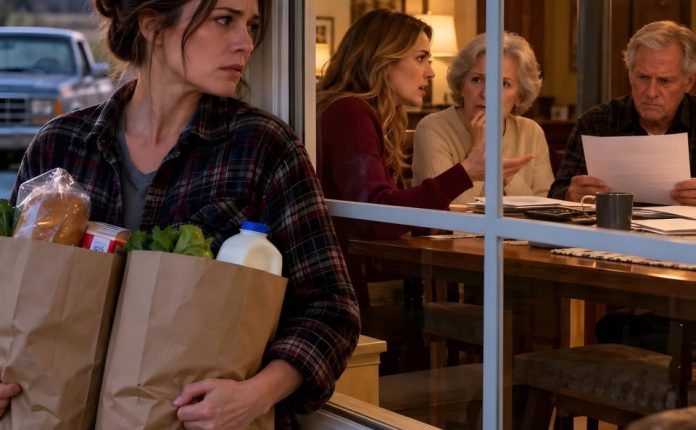
Four minutes before my wedding ceremony, I noticed something that made the floor seem unsteady beneath my satin shoes.
My groom had a brown mole beneath his right ear.
Adrian Vale's mole was beneath his left.
I knew that detail intimately.
For eighteen months, I had lived with the assumption that I knew Adrian just as intimately.
Now I stood beside a man wearing his clothes, his wedding ring, and his face.
And the man was terrified.
“Are you feeling all right?” I whispered.
He turned toward me.
His lips moved without producing a sound.
Across the aisle, his mother watched us with an expression I had mistaken for nervous excitement.
Celeste Vale sat perfectly upright on the first oak bench.
Her silver-blue dress shimmered beneath the courthouse windows.
The pearls around her throat were large enough to attract attention without appearing vulgar.
She had spent the previous three weeks managing every detail of our ceremony.
Now she was watching her son's hands.
Not our flowers.
Not my dress.
Not my face.
His hands.
One remained clenched beside his hip.
The other gripped the edge of his jacket.
“Just breathe,” I murmured.
He stared at me with startled eyes.
That was when I understood something else.
The man beside me wasn't simply afraid of being discovered.
He was afraid of what would happen after someone discovered him.
My name is Claire Bennett.
At thirty-one, I worked as a speech-language pathologist at a rehabilitation clinic outside Poughkeepsie.
Most of my patients were children, although I also worked with adults recovering from strokes or neurological injuries.
My profession had taught me to pay attention to details that other people sometimes dismissed.
A delayed answer didn't necessarily indicate confusion.
A trembling hand could indicate fear rather than inability.
And difficulty producing words said very little, by itself, about a person's ability to understand them.
Those distinctions mattered to me professionally.
On my wedding day, they became personal.
The courthouse was nearly full.
Eighty guests occupied polished wooden benches beneath tall windows overlooking the Hudson Valley.
White lilies stood along the aisle.
Sunlight touched the brass fixtures and made small pools of gold across the floor.
Someone had opened a window.
I could smell wet leaves from the courtyard after an early afternoon shower.
My bouquet felt heavy.
The officiant turned toward us.
And I realized I would have to make a decision before I understood what was happening.
To explain why I made that decision, I have to explain how Adrian entered my life.
We met two years earlier at my grandmother's funeral.
Grandma June Bennett had raised me after my parents died in a highway accident when I was nine.
She was the person who taught me how to tie my shoes, make biscuits without measuring cups, and recognize when somebody needed patience instead of advice.
She had also been a speech therapist.
For more than thirty years, she worked with children whose families couldn't afford private care.
Every summer, she held a small communication program at our riverside house.
Children came to practice speech sounds, read stories, make drawings, and spend afternoons in a place where nobody hurried them.
Grandma insisted that a child shouldn't have to speak easily to be heard.
Her house was a narrow, weathered Victorian with carved porch brackets, crooked shutters, and an old wooden rooster fastened above the front steps.
The roof needed replacing.
The kitchen floor dipped near the sink.
But it had survived floods, blizzards, and three generations of Bennetts.
When Grandma died, she left it to me.
Adrian appeared at her funeral wearing a black wool coat.
He introduced himself as the son of a man who had admired her work.
His father, Charles Vale, had died several years earlier.
Adrian said Charles had once sent children to Grandma's programs and had spoken warmly of her.
I was exhausted that morning.
The funeral director needed answers.
A relative of Grandma's former colleague had misplaced the memorial photographs.
The caterer had delivered the wrong flowers.
Adrian quietly resolved two of those problems before I could explain them.
He seemed attentive without being intrusive.
When he called a week later, I accepted his invitation to dinner.
He took me to a small restaurant overlooking the river.
He listened while I talked about Grandma.
He asked intelligent questions about my work.
He didn't interrupt.
I remember thinking how unusual that felt.
Six months later, he told me he loved me.
A year after we met, he proposed.
The ring was beautiful.
The proposal was private.
I believed both choices proved he understood me.
In retrospect, what I remember most clearly is what happened immediately afterward.
He asked whether I planned to keep Grandma's house.
“Of course,” I told him.
He smiled.
“I thought you might want somewhere more practical.”
“It is practical. It's home.”
He kissed my forehead.
“We'll talk about it later.”
And we did.
Repeatedly.
Adrian came from one of the wealthiest families in our part of the Hudson Valley.
Vale Timberworks designed and built luxury timber homes, vacation lodges, and enormous lakeside estates.
Their projects appeared in architectural magazines.
Their headquarters occupied a renovated mill building near Kingston.
Adrian oversaw sales, clients, and marketing.
His mother, Celeste, controlled the company's finances.
His father had founded the business.
And somewhere inside that impressive family story was Adrian's identical twin brother.
Theodore Vale.
Theo.
Adrian rarely spoke about him.
When I first asked, he looked uncomfortable.
“It's complicated.”
“How?”
“He has substantial intellectual disabilities.”
I asked whether Theo lived at home.
“Mostly. Mother looks after him.”
“Does he work?”
Adrian gave a small laugh.
“Claire, he doesn't understand business.”
It wasn't the answer I had expected.
I tried again.
“What does he enjoy?”
“Drawing things, mostly.”
“That's lovely.”
“He draws the same buildings over and over. He gets fixated.”
I worked with children whose families described their interests that way.
Sometimes those descriptions were fair.
Sometimes they revealed more about the family's impatience than the child's abilities.
I wanted to meet Theo.
Adrian kept finding reasons to postpone it.
Eventually, I saw him at Celeste's birthday party.
He was sitting beneath a maple tree behind the Vale estate.
A shallow patch of gravel lay beside the garden path.
Using a twig, he had drawn an intricate arrangement of intersecting lines.
At first, I thought it was an abstract pattern.
Then I recognized a roof plan.
There were symmetrical wings, interior supports, and a carefully proportioned central hall.
I stopped to look.
“Is that yours?” I asked.
Theo raised his head.
His features were identical to Adrian's.
But his expression wasn't.
Adrian's smiles were quick and practiced.
Theo studied me quietly before responding.
He nodded.
“It looks like a building.”
Another nod.
“May I sit?”
Before he could answer, Adrian appeared.
“Claire.”
His hand closed around my elbow.
“Come inside. Mother wants photographs.”
“I was talking to your brother.”
“He doesn't really understand conversations.”
Theo lowered his gaze.
I followed Adrian reluctantly.
Later, I asked why his brother had been alone.
“He likes it that way.”
I thought about the drawing.
But I didn't challenge him.
I wish I had.
On our wedding morning, Celeste called at eight.
Her voice sounded unusually strained.
“Darling, a dreadful thing has happened.”
My stomach tightened.
“What?”
“Adrian has lost his voice completely.”
“Is he sick?”
“Laryngitis. The doctor says he mustn't speak.”
“Does he have a fever?”
“No, no. He's perfectly well otherwise.”
I offered to postpone the ceremony.
She refused immediately.
“Absolutely unnecessary.”
“Celeste, if he's uncomfortable—”
“He's insisting we go ahead.”
I asked to speak with him.
“That defeats the purpose of vocal rest.”
She gave a little laugh.
“Please don't worry. Everything will be lovely.”
I believed her.
I had no reason to suspect an entire family would conspire to substitute one son for another.
At least, I thought I had no reason.
Now, inside the courthouse, I saw those earlier conversations differently.
The officiant began the vows.
My supposed fiancé stared straight ahead.
His breathing became shallow.
I noticed that he favored his left hand.
Adrian was right-handed.
I remembered how Adrian held his pen.
How he cut steak.
How he reached for his phone.
The man beside me moved differently.
Then the officiant asked him to accept me as his wife.
He closed his eyes.
Raised two fingers.
Tapped his opposite wrist twice.
And breathed.
A memory struck me so sharply that I nearly dropped my bouquet.
I was fifteen again.
Grandma's porch smelled of summer rain and freshly sharpened pencils.
A quiet boy sat beside me with a drawing pad on his knees.
He was struggling to pronounce a word.
I showed him the technique Grandma had taught us.
Two gentle taps.
A measured breath.
Then another attempt.
He practiced until he could say what he wanted.
That boy had been named Theo.
He loved buildings.
He could draw the house from memory after walking around it once.
His father was a carpenter with rough hands and a gentle voice.
Theo had difficulty reading aloud.
Speaking under pressure was especially hard.
But he listened carefully.
He noticed things other children overlooked.
He could remember measurements after hearing them once.
On his last afternoon at the program, he told me he wanted to design houses.
I asked whether he would design one for me.
He smiled.
Tapped his wrist.
And promised he would.
I had forgotten the sound of his voice.
I hadn't forgotten the promise.
His mother took him away unexpectedly the following morning.
Grandma refused to discuss the family's private circumstances.
She didn't reveal his surname.
Over the years, the memory faded.
Now the boy from the porch stood beside me as a grown man.
And he was pretending to be Adrian.
The officiant turned.
“Claire?”
The room became quiet.
I looked toward Celeste.
Her smile looked painful.
Then I looked at Theo.
I could expose him.
Stop the ceremony.
Demand explanations.
But something prevented me.
I remembered Adrian mentioning residential placement whenever he considered Theo troublesome.
I remembered Celeste's determination to control her son's movements.
And I saw that Theo's fear was not theatrical.
He was genuinely frightened.
I didn't know whether he had agreed to this impersonation freely.
I didn't know where Adrian had gone.
I didn't know what would happen if I embarrassed the Vale family in front of eighty witnesses.
So I made a decision I would question many times afterward.
“I do.”
Theo turned toward me.
For the briefest moment, he forgot to hide his astonishment.
The officiant smiled.
Our guests applauded.
The marriage register was placed before us.
Theo accepted the pen in his left hand.
I watched him hesitate.
Then he copied the name Adrian Vale.
His handwriting was deliberate, awkward, and unmistakably left-handed.
I signed my own name.
The photographer took several pictures.
When we were invited to kiss, I offered my cheek.
Theo's lips touched it lightly.
He whispered something.
I barely heard him.
“Sorry.”
It was the first honest word spoken to me that afternoon.
At the reception, Celeste approached before I could get him alone.
“Such a beautiful ceremony.”
She kissed the air beside my face.
“Adrian looks exhausted. We must protect his voice.”
“Which doctor examined him?”
Her smile stiffened.
“His physician.”
“What's the doctor's name?”
“Claire, honestly.”
I glanced at Theo.
A red mark circled his wrist.
It looked as though something narrow had pressed against his skin.
Celeste noticed my attention.
She pulled his jacket sleeve lower.
“He's been terribly nervous.”
I took his hand.
“Then he should sit somewhere quiet.”
Celeste stepped forward.
“I'll take him.”
“No,” I said.
Both of them looked at me.
“I'd like a moment with my husband.”
Celeste's expression became carefully blank.
There was a pause.
Then she smiled.
“Of course.”
I guided Theo away from the reception room.
He walked beside me without speaking.
At the corridor outside the records office, we stopped.
I waited until the noise from the reception became distant.
Then I said his name.
“Theodore.”
He froze.
His face lost color.
“You know.”
It wasn't a question.
“Yes.”
He looked toward the door.
“I'm sorry.”
“You don't have to apologize for being yourself.”
He made a pained sound.
“Not supposed to tell.”
“Who told you that?”
He squeezed his eyes shut.
I didn't press him.
I spoke in the calm voice I used when someone needed time to find words.
“I'm not asking you to perform. Just tell me what you can.”
He tapped his wrist.
Twice.
“Adrian left.”
“When?”
“Morning.”
“Where?”
“Airport.”
A terrible thought came to me.
“Did he leave the country?”
Theo nodded.
“Bali.”
I stared at him.
“Why Bali?”
His eyes filled.
“Vanessa.”
Vanessa Hart.
I knew the name.
She was a wealthy real-estate investor whose family owned several resorts and commercial developments.
Adrian had introduced her as an important client.
She was attractive, confident, and always impeccably dressed.
At our engagement dinner, she had complimented my ring.
Two weeks earlier, Adrian told me he was negotiating a substantial partnership with her.
Now I understood what kind of partnership he might have meant.
“Vanessa went with him?”
Theo nodded.
I leaned against the cold plaster wall.
My fiancé had abandoned our wedding.
He had flown to Bali with another woman.
And he had sent his identical twin in his place.
For a moment, the situation seemed too absurd to be real.
Then I looked at Theo's wrist again.
“Did somebody hurt you?”
He became very still.
“Please,” he whispered.
I stepped closer.
“What?”
“Don't let them take me back.”
Footsteps sounded behind us.
Celeste appeared at the entrance.
Her expression changed when she saw us holding hands.
“What exactly has Theodore been saying?”
I turned toward her.
“Enough.”
Her eyes narrowed.
“Theodore, come here.”
He flinched.
I didn't release his hand.
“He's staying with me.”
Celeste stepped closer.
“You don't understand his condition.”
“Then explain it.”
“He becomes confused.”
“Does he?”
“He tells stories.”
“Did he invent Adrian's trip to Bali?”
The silence that followed was more revealing than any confession.
Celeste looked down the corridor.
“Lower your voice.”
“Where is Adrian?”
“Handling business.”
“With Vanessa Hart?”
“Claire.”
“Is he in Bali?”
She closed her eyes briefly.
When she opened them, her voice was cold.
“You have no idea how much trouble you could cause.”
“Apparently enough for you to lie about your own son's identity.”
“Theodore volunteered.”
I looked at him.
“Did you?”
He began shaking his head.
Celeste snapped his name.
He stopped.
I turned toward her.
“Don't do that.”
“You can't manage him.”
“He isn't a piece of equipment.”
Her lips tightened.
“I'm his legal guardian.”
“Then you should be protecting him.”
Celeste leaned closer.
“You're making assumptions about circumstances you don't understand.”
Theo suddenly whispered something.
“Papers.”
I looked at him.
“What papers?”
“Blue folder.”
Celeste's head turned sharply.
“Theodore.”
His breath caught.
I gently touched his arm.
“Go on.”
“House.”
My grandmother's house.
I remembered the documents Adrian had brought me the previous week.
He said his accountant needed my signature on several forms before our honeymoon.
I had seen references to property rights and development arrangements.
I refused to sign until I could review them.
Adrian became irritated.
Then he apologized.
He told me it was only administrative paperwork.
Now I wondered what those papers contained.
Theo reached into his jacket.
Celeste moved immediately.
“Don't.”
I stepped between them.
He withdrew a folded drawing.
I recognized the building before he opened it completely.
Grandma's house.
Every porch bracket was present.
Even the crooked rooster above the steps.
But around the house were measurements, boundary lines, and neighboring parcel numbers.
At the top someone had written:
NORTH BANK DEVELOPMENT.
Along the bottom was a date.
Three weeks before Adrian proposed.
My throat tightened.
“Where did you get this?”
Theo looked at Celeste.
She was staring at the drawing.
I had never seen her frightened before.
“Give me that,” she said.
I folded it and placed it inside my handbag.
“No.”
“That's company property.”
“It depicts my property.”
“You don't understand.”
“Then tell me.”
Her face hardened.
“Not here.”
From the reception room came the sound of silverware against glasses.
Someone called for the newlyweds.
I looked at Theo.
He had retreated into silence.
But his hand remained steady in mine.
I made another decision.
I would not expose him to the crowd simply to satisfy my anger.
I would get him somewhere safe.
Then I would find out what Adrian and Celeste were hiding.
“Come on,” I told him.
Celeste blocked our path.
“Where are you taking my son?”
“Somewhere he can speak without being threatened.”
“You have no authority.”
“Perhaps not,” I said. “But he's an adult, and I can ask what he wants.”
I turned to Theo.
“Would you like to leave with me?”
He looked toward his mother.
Then back at me.
“Yes.”
The word was quiet.
It was also clear.
Celeste stepped aside reluctantly.
As we reached the reception entrance, she spoke again.
“Claire, if you leave this building with Theodore, you'll regret it.”
I stopped.
I had already discovered that my fiancé was a liar.
I had just learned that his family had studied my land before our engagement.
And somewhere across the ocean, Adrian was enjoying a holiday with another woman.
I looked at Celeste.
“I think your family has already given me enough to regret.”
Then I walked back into my wedding reception holding the hand of the man who had never asked me to marry him.
The guests turned toward us.
My friend Leah, who had been my maid of honor, smiled from beside the cake.
She had known me since college.
She worked as a paralegal for a small law firm.
And she had a talent for recognizing when I was pretending everything was fine.
Her smile faded as I approached.
“Claire?”
“Can you come with us?”
She glanced at Theo.
“What's happened?”
“I'll explain outside.”
Celeste appeared behind us.
“Claire is feeling overwhelmed.”
Leah ignored her.
“Do you need my car?”
“Yes.”
“Where are we going?”
“My house.”
I leaned closer.
“And please don't let anyone from the Vale family follow us.”
Leah's eyes widened.
She didn't ask another question.
That was one of the reasons I loved her.
We left through the courthouse's side entrance.
My veil caught briefly on the old brass door handle.
Leah freed it.
Outside, the air smelled of damp stone.
A few yellow leaves clung to the pavement.
Theo paused beneath the portico and inhaled deeply.
For the first time since the ceremony, his shoulders loosened.
Leah drove.
I sat beside Theo in the back.
For several minutes, nobody spoke.
Then Leah glanced at us through the mirror.
“Do I need to call the police?”
“Not yet,” I said.
“Not yet?”
I looked at Theo.
“Can I explain to Leah?”
He nodded.
I told her the truth.
Not all of it.
Only what I knew.
Adrian had left.
Theo had taken his place.
Celeste knew.
And the wedding certificate now contained the wrong man's name.
Leah pulled into a parking lot.
She turned around slowly.
“Claire, are you telling me you married the wrong twin?”
“I participated in a ceremony with the wrong twin.”
“That's not the same thing as being legally married.”
“I know.”
She looked at Theo.
“Were you forced to do this?”
He stared at his hands.
Leah waited.
Finally, he nodded.
Her expression became serious.
“We need to protect any evidence before somebody makes it disappear.”
I showed her the drawing.
She studied it.
“Your grandmother's property?”
“Yes.”
“Why would the Vales have survey numbers for it?”
“I don't know.”
She read the date.
“Claire, this predates your engagement.”
“I noticed.”
She looked at me.
“Has Adrian ever asked you to transfer the house?”
“Not outright.”
“Has he asked you to sign anything?”
I nodded.
“Last week.”
“What kind of documents?”
“I refused to sign.”
Leah exhaled.
“Good.”
Theo made a small sound.
We turned toward him.
He was looking at the drawing.
“Not just house,” he said.
“What do you mean?”
He pointed to a curved line behind the property.
I recognized the riverbank.
Then he pointed to a cluster of small rectangles beyond it.
“More land.”
“Whose land?”
His answer took time.
“Old mill.”
Vale Timberworks owned an abandoned mill site upriver.
Adrian had once mentioned plans to redevelop it.
I remembered seeing promotional drawings of luxury homes beside the water.
“Are you saying my house is part of their development?”
Theo nodded.
“Road.”
He traced a narrow line through the drawing.
It crossed my property.
Without that strip of land, the proposed access road seemed to end against a steep wooded slope.
Leah leaned forward.
“That's important.”
Theo tapped his wrist.
“Very.”
We drove to my grandmother's house.
I had planned to spend my wedding night in a hotel with Adrian.
Instead, I stepped through my front door with his brother.
My wedding dress brushed against the worn hallway wallpaper.
The house smelled faintly of lavender and old wood.
On the mantel stood a photograph of Grandma June holding a birthday cake.
For a moment, I wanted her so badly that I could barely breathe.
She would have known what to say to Theo.
She would have known how to make this strange afternoon less frightening.
I led him into the kitchen.
“Would you like something to drink?”
“Water.”
“Cold?”
He nodded.
I poured three glasses.
Leah sat at the table with her phone.
“I can call an attorney I trust.”
“Please.”
Theo stood near the window.
His eyes followed the carved trim around the frame.
Then he approached the porch door.
He ran his fingertips along a wooden bracket.
Something changed in his expression.
“Still here,” he whispered.
I understood.
“You remember it.”
He nodded.
“The rooster, too.”
I looked toward the front porch.
“You were the boy from Grandma's summer program.”
He turned.
His eyes widened.
“You remember?”
“Of course I do.”
A small smile appeared.
It was hesitant and beautiful.
He tapped his wrist.
“House.”
I smiled despite everything.
“You promised to design me one.”
He nodded.
“I did.”
Leah watched us quietly.
Then her phone rang.
She glanced at the screen.
“Claire, it's Adrian.”
I stared.
He hadn't called me once that day.
Not when I was dressing.
Not when I arrived at the courthouse.
Not when his brother stood beside me taking his place.
But now, after Celeste had discovered that I knew the truth, he was calling.
“Put him on speaker,” I said.
Leah answered.
Adrian's voice filled Grandma's kitchen.
Smooth.
Confident.
Familiar.
“Claire, sweetheart. Mother says you're upset.”
I closed my eyes.
There was no laryngitis.
No strained voice.
Not even a convincing attempt.
“Where are you, Adrian?”
A pause.
“Handling an urgent matter.”
“In Bali?”
Silence.
Then a short laugh.
“Who told you that?”
“Does it matter?”
“Claire, listen. There's been a misunderstanding.”
I looked at Theo.
He had gone pale again.
“Your brother stood beside me at our wedding.”
Another pause.
Adrian lowered his voice.
“Mother said you wouldn't make a scene.”
That was the moment something inside me settled.
He wasn't surprised that I knew.
He was annoyed that his plan had become inconvenient.
“You sent Theo to impersonate you.”
“He agreed.”
Theo whispered, “No.”
Adrian heard him.
“Theo? Is that you?”
I placed the phone closer.
Theo's hand trembled.
But he stayed beside me.
Adrian's tone changed.
“Get Mother on the phone.”
“No,” I said.
“Claire, don't be difficult.”
“You abandoned our wedding to fly overseas with Vanessa Hart.”
“This is business.”
“Then why did you send your brother?”
“We can discuss it privately when I return.”
“Discuss what? The woman you left with? The forged identity at our ceremony? Or the development drawings of my grandmother's house?”
For the first time, Adrian sounded genuinely alarmed.
“What drawings?”
I said nothing.
“Claire.”
His voice sharpened.
“Where did you get those?”
I looked at the folded paper on the kitchen table.
And I knew that whatever the Vales had planned, it extended far beyond a humiliating wedding.
“From someone,” I said, “who deserves better than the way you've treated him.”
Adrian stopped pretending to be charming.
“Listen carefully. Don't sign anything. Don't talk to anyone. And do not let Theo out of your sight.”
“Why?”
“Because he doesn't understand what he's carrying.”
The call ended.
Leah and I looked at each other.
Theo was staring at the floor.
Then he spoke.
“Blue folder.”
I moved closer.
“What about it?”
He touched the inside pocket of his jacket.
“Not all.”
“What isn't all?”
His voice caught.
He tapped his wrist.
Twice.
Then he looked at me.
“There's another drawing.”
“Where?”
He swallowed.
“Mother's office.”
Leah leaned forward.
“What does it show?”
Theo looked toward the river beyond Grandma's windows.
And whispered four words.
“What they did before.”
I spent the first hour after my wedding sitting at Grandma June's kitchen table, trying to distinguish what I knew from what I feared.
I knew Adrian had abandoned our ceremony.
I knew his mother had helped conceal his absence.
I knew Theo had been pressured into impersonating him.
And I knew the Vale family had planned a development involving my grandmother's property before Adrian proposed.
What I didn't know was why they needed Theo to participate.
Or what he meant when he said there was another drawing showing something that had happened before.
Leah returned from a phone call and placed a notebook on the table.
“I spoke with Evelyn Mercer.”
Evelyn was an attorney at Leah's firm who handled civil disputes and property matters.
“She wants us to preserve everything.”
“What about the marriage?”
“She's checking the records and the applicable law. But she says we shouldn't assume the ceremony created a valid marriage to either brother.”
I looked at Theo.
He was sitting beside the window with his hands folded.
I didn't want him to think he had somehow become my husband without choosing it.
“That's important,” I said.
Leah nodded.
“Evelyn also says neither impersonation nor an alleged guardianship automatically means someone can control Theo's life. We need to establish what orders actually exist.”
Theo looked up.
“Orders?”
“Court papers,” Leah explained.
He nodded.
“Mother has.”
“Have you seen them?”
He hesitated.
“Some.”
Leah opened her notebook.
“Can you tell us what you remember?”
Theo glanced at me.
I moved my chair closer.
“Only if you want to.”
He took a breath.
Then he began.
Not fluently.
Not quickly.
But with unmistakable understanding.
His father had taught him drafting when he was a child.
Charles Vale believed Theo had a gift for visualizing structures.
When Theo struggled at school, Charles arranged extra support and encouraged his drawing.
Theo learned basic drafting software as a teenager.
He spent hours studying building plans.
At twenty, he began producing designs for Vale Timberworks.
At first, he worked alongside his father.
They planned small cabins and timber structures.
Theo's designs were precise.
He could visualize how beams connected and identify awkward load paths before the plans reached an engineer.
His father praised him.
Adrian disliked that praise.
Celeste disliked the attention it brought to Theo's abilities.
After Charles died, everything changed.
Theo's participation in the company became unofficial.
His name disappeared from presentations.
He was told to work from a separate room.
Adrian began introducing Theo's drawings as designs produced by the company's architectural team.
When Theo objected, his mother reminded him that he needed help managing his affairs.
Eventually, Celeste petitioned for guardianship.
The family described his speech difficulties, problems with reading complex documents, anxiety under pressure, and dependence on household routines.
Those difficulties were real.
But the petition also described him as unable to understand finances, contracts, or independent living.
Theo said no one had properly evaluated his abilities in the way Grandma June once had.
He attended a hearing but was overwhelmed by the questions.
He struggled to answer.
The court granted Celeste substantial authority over his finances and certain personal decisions.
He had been trying to challenge it ever since.
I listened without interrupting.
When he finished, Leah asked, “Do you still design buildings?”
Theo nodded.
“Every day.”
“Where are the files?”
“Office computer.”
“Who has access?”
“Mother. Adrian.”
“Do they pay you?”
He shook his head.
I felt sick.
The family's public story had made Theo appear entirely dependent upon their charity.
But he had been contributing skilled work to their company.
And they had used his difficulty speaking to make challenging them harder.
I asked about the red mark on his wrist.
He pulled his sleeve higher.
There was a thin abrasion.
“Mother grabbed me,” he said.
“When?”
“This morning.”
He explained that Adrian had announced his departure shortly before dawn.
He told Celeste the wedding could proceed without him.
At first, Celeste resisted.
Then Adrian said the guests were already coming and postponement would create questions.
More importantly, he wanted the financial arrangements surrounding our marriage to move forward.
Celeste suggested Theo could stand in temporarily.
She told him he only needed to wear the suit, repeat the vows, and sign.
When he refused, Adrian threatened to have him moved into a residential facility.
Celeste warned that refusing would prove he couldn't cooperate with ordinary family responsibilities.
Theo knew enough about his legal situation to be frightened.
He believed they could make good on that threat.
At the courthouse, he tried to tell Celeste he couldn't go through with it.
She grabbed his wrist.
Then she told him to stop embarrassing her.
I looked at the faint mark.
I thought of the way he had whispered an apology after the ceremony.
“Why did you tell me about Bali?”
Theo looked confused.
“Because true.”
I smiled sadly.
“Yes. I suppose that's a good reason.”
He shook his head.
“More.”
I waited.
He looked toward the window.
“You remembered me.”
He had recognized me before the ceremony.
At first, he wasn't certain.
He remembered the girl from Grandma's porch as a teenager with dark braids and a habit of wearing oversized sweaters.
But when he heard my full name, he knew.
He had wanted to tell me.
Celeste ordered him to remain silent.
And then he saw my face when I noticed his mole.
“You knew,” he said.
“I did.”
“Why didn't you stop?”
I thought carefully.
“Because you looked frightened. And I wanted to understand why.”
His eyes filled.
“You could have.”
“I know.”
“I didn't want to lie.”
“I believe you.”
For a long time, we sat quietly.
Then Leah's phone vibrated.
Evelyn had sent a message.
She could meet us the following morning.
She advised Theo to secure independent legal counsel immediately and, if he wished, seek an emergency review of the guardianship.
She also recommended that we avoid entering Vale property without permission or taking company records unlawfully.
That complicated matters.
The blue folder was in Celeste's office.
But we couldn't simply break into the building and steal it.
Theo listened while I explained.
Then he tapped the table.
“Copies.”
I looked up.
“What copies?”
He nodded toward Grandma's front room.
“Computer?”
I brought him my laptop.
He asked for paper.
Then he wrote an email address.
It was an old account he had created privately years earlier.
He remembered the password.
Inside were dozens of messages and attached files.
Some were drawings.
Others were photographs of handwritten notes.
There were scans of design revisions and timestamps showing when he had created them.
Theo explained that he began sending copies to himself after discovering that Adrian had altered file ownership information.
He didn't know how to fight the company.
But he knew he needed proof.
Leah leaned over my shoulder.
“Claire, this is significant.”
One folder contained a design labeled RIDGE HOUSE CONCEPT.
The drawing showed a timber home with a long sloping roof, a glass-lined central hall, and a covered entrance overlooking a river.
A second file showed the same building with a different title.
VALE SIGNATURE COLLECTION.
Theo's initials had been removed from the title block.
His mother's company had sold the design repeatedly.
I opened another file.
A beautiful lakeside lodge appeared.
Then another.
Then another.
The structural geometry was consistent.
So was Theo's distinctive habit of drawing small reference marks beside complicated connections.
Each file carried a creation date.
Some were years old.
The family had claimed he couldn't understand business while profiting from designs he produced.
But the file that interested me most was labeled NORTH BANK.
Inside was a group of drawings dated before Adrian and I became engaged.
They showed the proposed redevelopment of the old Vale mill property.
A luxury residential community would stretch along the river.
The project included private roads, landscaped trails, and expensive timber homes.
The main entrance crossed a narrow parcel.
My parcel.
Grandma's house occupied the only practical approach from the county road.
Without access through my land, the development would require major redesign and difficult negotiations with neighboring owners.
I stared at the map.
“Adrian knew.”
Theo nodded.
“He said marry you.”
The words were so simple that they felt unreal.
“Who said that?”
“Mother.”
Leah placed her hand over mine.
I kept looking at the screen.
The documents Adrian had wanted me to sign were no longer mysterious.
They were the next step in a plan.
He had pursued me.
Proposed to me.
And arranged our marriage around my property.
But that wasn't the full story.
Theo clicked another file.
A letter appeared.
It was written by Charles Vale, their father.
The date was several years before his death.
The letter concerned a dispute over development plans near the Bennett property.
Charles objected to routing construction access across the land without permission.
He also wrote that June Bennett had previously helped his son and that her home should be respected.
I read the paragraph twice.
Then a third time.
Grandma and Charles had known each other.
Adrian hadn't invented that connection.
He had used a real relationship to create a false impression of himself.
Theo pointed toward the letter.
“Dad said no.”
“What happened?”
“After he died, they tried again.”
I opened the attached notes.
The redevelopment plan had been revived.
Different names appeared on later versions.
The company had begun purchasing adjoining parcels.
Several owners had sold.
But Grandma refused to discuss selling her home.
When she died, the property passed to me.
And Adrian appeared at her funeral.
I covered my mouth.
Leah said nothing.
She didn't need to.
For eighteen months, I had believed Adrian loved me.
Now I had documentary evidence that his family wanted my land.
The question of whether he had ever loved me became almost unbearable.
Theo touched the edge of the laptop.
“More,” he said.
Another file opened.
It contained a photograph of a meeting note.
The handwriting was Celeste's.
I recognized its sharp capital letters from wedding invitations and handwritten thank-you cards.
The note discussed obtaining long-term access through the Bennett parcel.
Below it were several options.
Purchase.
Lease.
Easement.
Then a final line.
“Adrian relationship may resolve owner resistance.”
I stared at those words.
Leah whispered, “Oh, Claire.”
I pushed my chair back.
For several seconds, I couldn't speak.
I remembered Adrian bringing me coffee on difficult mornings.
I remembered him sitting beside me while I cried over Grandma's old photographs.
I remembered telling him how frightening it felt to have no close family left.
He listened.
He comforted me.
He kissed me.
And somewhere behind those gestures was a business plan.
I walked onto the porch.
The river was dark beneath a cloudy evening sky.
A freight train sounded far away.
I gripped the railing.
I wanted to scream.
Instead, I stood very still.
Behind me, the door opened.
Theo stepped outside.
He didn't speak.
He stood beside me, looking toward the old wooden rooster.
After a while, he said, “He was nice to get house.”
I looked at him.
“Do you think that's why he met me?”
Theo nodded reluctantly.
“Mother planned.”
I turned back toward the river.
“How long have you known?”
He struggled.
“Not at first.”
I waited.
“Later.”
He explained that he had found the note several months after Adrian proposed.
He questioned his mother.
She told him the engagement was none of his business.
Then she restricted his access to company meetings.
He began copying files.
He wanted to tell me.
But Adrian told him that contacting me would result in the loss of his privileges.
Theo knew how easily his speech difficulties could be used against him.
He had already experienced what happened when his family accused him of confusion.
“I tried,” he whispered.
I looked at him.
“How?”
He reached into his pocket.
There was a small folded envelope.
Inside was a photograph.
It showed Grandma's house years earlier, its porch decorated with paper lanterns.
Two teenagers sat on the steps.
I recognized myself.
Beside me was Theo.
He held a drawing pad.
I remembered the photograph.
Grandma had taken it on the last afternoon of that summer program.
Theo said he mailed a copy to my house six months before the wedding.
I thought back.
A small envelope had arrived with no return address.
Adrian was visiting that afternoon.
He collected the mail while I cooked dinner.
He told me the envelope contained promotional material.
I never saw it.
My stomach twisted.
“Adrian took it?”
Theo nodded.
“He told me you didn't remember.”
I looked at the photograph.
Then at the man standing beside me.
“I would have remembered.”
His face crumpled.
He turned away, embarrassed by his tears.
I put my hand on his arm.
“You were my friend.”
He looked back.
“You were mine.”
Those words hurt more than Adrian's betrayal.
Because they revealed another cruelty.
Adrian hadn't merely deceived me.
He had separated two people who might have recognized his lies.
By the following morning, the kitchen table was covered with notes.
Leah had stayed overnight.
Theo slept in Grandma's old guest room after I asked whether he felt comfortable there.
Before bed, he checked the door twice.
I noticed.
But I didn't comment.
People accustomed to having their choices controlled sometimes need time before they trust an unlocked door.
At nine, Evelyn arrived.
She was a practical woman in her late fifties with short gray hair and a habit of reading documents twice before speaking.
She listened to our account without interrupting.
Then she examined the wedding photographs, the register information, and Theo's documents.
Her first conclusion was firm.
“We need to correct the marriage record immediately.”
I nodded.
“I don't want anyone believing I knowingly married Adrian.”
“Or Theo,” she said.
Theo sat opposite her.
She turned toward him.
“Mr. Vale, I want to make something clear. I won't discuss your rights as though you aren't here.”
He looked surprised.
“Thank you.”
“Do you want an attorney of your own?”
“Yes.”
“Do you want your mother making decisions about where you live?”
“No.”
“Do you understand that challenging guardianship may involve evaluation, testimony, and difficult conversations?”
He nodded.
“Want it.”
She wrote something down.
“Good. We'll find counsel who specializes in these matters.”
Then she turned toward me.
“The substitution raises serious questions of identity, consent, and possible fraud. Exactly how the marriage record is corrected will depend on the legal process. We should not treat it as proof that any lawful marriage exists.”
I felt relief.
Not because a courthouse document could erase humiliation.
But because the law might distinguish the ceremony from the truth.
Evelyn examined the development files next.
Her expression changed.
“How were these obtained?”
Theo explained his private email copies.
She asked whether he had created the files, when he had stored them, and whether anyone had authorized the account.
He answered carefully.
She took notes.
“We need to preserve the original files, metadata, and communications. Don't alter anything.”
Leah nodded.
“We've made a separate inventory.”
Evelyn studied the old correspondence from Charles Vale.
Then she reviewed the note about Adrian's relationship.
She looked at me.
“Did he make statements about your property while you were engaged?”
I told her about the paperwork.
The arguments.
The pressure.
The repeated suggestion that Grandma's house was inconvenient.
Evelyn's pen stopped moving.
“Did you ever grant the company an easement?”
“No.”
“Sign a purchase agreement?”
“No.”
“Authorize Adrian to act for you?”
“Never.”
She nodded.
“Then protecting your title is our first property priority.”
Over the next several days, we began untangling the situation.
Evelyn arranged for an independent review of the property records.
Leah helped collect messages from Adrian.
I preserved the unsigned documents he had left in my desk.
Theo met with an attorney named Daniel Ortiz, who represented adults challenging restrictive guardianships.
Daniel was patient without being condescending.
He asked Theo how he managed daily tasks.
What support he needed.
What choices he wanted to make independently.
Theo explained that he needed help understanding some legal language and handling unfamiliar bureaucratic situations.
He also explained that he could manage his own routines, use drafting software, travel independently on familiar routes, and make personal decisions.
Daniel listened.
Then he said something that visibly affected Theo.
“Needing help with some tasks doesn't mean you should lose control of every part of your life.”
Theo stared at him.
“Really?”
“Really.”
Daniel requested the guardianship records.
He also arranged independent assessments of Theo's communication and decision-making abilities.
I offered to assist.
Daniel declined gently.
“You can support him personally. But we need evaluations from professionals who aren't directly involved.”
He was right.
Theo deserved an independent process.
Not another person deciding his abilities based on affection or fear.
Meanwhile, Adrian began sending messages.
At first, they were apologetic.
He claimed he had panicked about marriage.
He said Vanessa was merely a business partner.
He described Bali as an opportunity that couldn't be postponed.
Then he suggested our wedding had been technically valid because Theo looked exactly like him.
Evelyn advised me not to debate that point with him.
We preserved his messages.
Two days later, his tone changed.
He accused me of kidnapping Theo.
He threatened to have his brother returned.
He said I was interfering with a vulnerable adult.
Then he demanded the return of company documents.
Theo read those messages in silence.
Afterward, he asked Daniel whether he could be forced to return home.
Daniel didn't promise an easy answer.
He explained what the existing order permitted and what legal remedies could be requested.
They prepared an emergency application to address Theo's safety and independence while the guardianship was reviewed.
It was difficult.
Theo had to speak about his mother in ways he had avoided for years.
He had to describe threats.
He had to explain how his access to money and transportation had been controlled.
He cried during one meeting.
Then he asked for a break.
Afterward, he returned and finished.
I admired that more than any confident speech Adrian had ever delivered.
On the fourth evening after the wedding, Vanessa Hart called me.
I almost ignored the number.
Then I answered.
“Claire?”
“Yes.”
“This is Vanessa.”
“I know.”
There was a pause.
“I understand you've been making accusations.”
I sat at the kitchen table.
Across from me, Theo was sketching.
“What accusations?”
“That Adrian deceived you.”
“Did he?”
Vanessa exhaled.
“Adrian told me the engagement had ended.”
“When?”
“Before we traveled.”
“Before our wedding?”
“He said the ceremony was canceled.”
I looked at the clock.
“Vanessa, eighty people attended that ceremony.”
Silence.
“His brother stood in for him,” I continued.
“That can't be true.”
“It is.”
I heard movement on her end.
A door closed.
Then she asked, “Why would he do that?”
“I was hoping you could tell me.”
She remained silent.
I asked one more question.
“Did Adrian discuss my grandmother's property with you?”
Another pause.
“Yes.”
My stomach tightened.
“What did he say?”
“He claimed your family had agreed to provide access to the North Bank development.”
“Did he show you a signed agreement?”
“No.”
“Did he tell you we were getting married?”
“He said your involvement would make the land arrangement easier.”
I closed my eyes.
Vanessa sounded unsettled.
“He described it as a family understanding.”
“There is no agreement.”
“Claire, I'm an investor. I wouldn't knowingly enter a project dependent on unauthorized access.”
I believed that she cared about protecting her investment.
I didn't yet know whether she cared about anything else.
“Then request the actual documents,” I said.
“I will.”
Before we ended the call, she asked a question.
“Are you still marrying Adrian?”
I looked at Theo.
He was carefully shading the front porch of Grandma's house.
“No,” I said.
“I don't believe I ever truly knew him.”
The following morning, Evelyn called.
Her voice was unusually serious.
“We found something in the land records.”
I gripped the phone.
“What?”
“A document concerning proposed access across your property. It appears to have been submitted as supporting material in the development process.”
“Did I sign it?”
“No authenticated signature from you appears on the copy we've seen.”
“Then what's wrong?”
“The document claims a prior family commitment.”
I frowned.
“What commitment?”
“An understanding supposedly made between Charles Vale and June Bennett.”
I looked at Grandma's photograph.
“That doesn't sound right.”
“The document refers to a private agreement allowing future construction access.”
“My grandmother would never have agreed to that without telling me.”
“I suspect she didn't.”
Evelyn paused.
“We've obtained a copy of an old letter that directly contradicts the claim.”
I remembered Charles Vale's correspondence.
“The letter Theo saved?”
“Yes. But there's more.”
She explained that the company had referenced the disputed understanding in communications with local planning officials.
If those representations were inaccurate, the development application might face serious scrutiny.
And if Adrian or Celeste had knowingly submitted misleading material, the consequences could extend beyond losing access to my property.
I looked toward the kitchen window.
Theo was outside examining the old porch brackets.
For years, his family had treated his drawings as valuable property while dismissing the man who created them.
Now those same drawings might expose what the company had concealed.
“What's our next step?” I asked.
“First, we notify the planning authorities that you dispute any claimed access rights. Then we preserve the evidence and request a formal review.”
“Will the Vales know?”
“Yes.”
I looked at the old house.
It had survived a century of storms.
Now it faced a different kind of damage.
“Do it.”
Evelyn hesitated.
“Claire, once we make this formal, there's no guarantee they'll back down quietly.”
I thought of my wedding.
Of Theo's trembling hands.
Of Adrian laughing about an urgent business trip while his brother stood beside me at the altar.
“I understand.”
After the call, I found Theo on the porch.
He had been examining the weathered railing.
“Something wrong?” he asked.
I told him about the development claim.
He listened carefully.
Then he went inside and retrieved one of his old drawings.
It showed a different access route.
The proposed road curved farther north, across a hillside belonging to Vale Timberworks.
It was longer.
More expensive.
But possible.
“This one,” he said.
I studied it.
“Why didn't they use it?”
“Costs more.”
“How much more?”
He wrote a figure in the margin.
It was substantial.
Then he pointed to another note.
“Mother rejected.”
“Why?”
“Profit.”
I looked at the alternate route.
For eighteen months, Adrian had pressured me to surrender my house because his family wanted the cheaper road.
There had always been another option.
They simply didn't want to pay for it.
Theo turned the page.
On the back was a notation I hadn't noticed.
A date.
And an instruction.
“Remove Bennett boundary objections from client presentation.”
I read it twice.
“Who wrote this?”
Theo's face tightened.
“Adrian.”
I looked toward the river.
The truth was no longer hidden in gestures or frightened whispers.
It was written in measurements, emails, records, and decisions.
And the people who had used Theo's silence were about to discover how much he remembered.
Adrian came home from Bali nine days after the wedding he hadn't attended.
He arrived at my grandmother's house shortly before noon.
I saw his black SUV turn into the gravel driveway.
For one foolish second, my heart reacted to the familiar vehicle.
I remembered the excitement I used to feel when I heard its tires outside.
Then he stepped out.
He wore sunglasses, a pale linen shirt, and an expensive watch.
There was a small mark on his neck where his collar rubbed against sunburned skin.
He looked rested.
I had spent nine days untangling fraud allegations, meeting attorneys, comforting his brother, and wondering whether my home was safe.
Adrian had apparently spent them in the sunshine.
He walked toward the porch carrying flowers.
White lilies.
The same flowers that had decorated the courthouse.
I remained behind the screen door.
“Claire.”
He smiled.
“Can we talk?”
I opened the door but didn't invite him inside.
“Your lawyer can contact mine.”
His smile faded.
“Come on. You know we don't need to do this.”
He held out the bouquet.
I didn't take it.
“Where's Vanessa?”
“That's not fair.”
“Is she still in Bali?”
“Claire, stop.”
I folded my arms.
He glanced through the doorway.
“Where's Theo?”
“Safe.”
“My mother says you've been keeping him here.”
“He chose to stay.”
Adrian laughed.
A short, dismissive sound.
“You know he can't make decisions like that.”
“I think Theo understands his choices better than you understand yours.”
His expression hardened.
“What's that supposed to mean?”
“It means you shouldn't have sent him to our wedding.”
Adrian looked toward the road.
“You want to discuss this outside?”
“You came here.”
“Because you won't answer my calls.”
“Because you lied to me.”
He lowered the flowers.
“Fine. I made a mistake.”
“A mistake?”
“I got overwhelmed.”
“You boarded a plane with another woman.”
“We had business to settle.”
“Then why was your brother wearing your wedding suit?”
He looked annoyed.
“Mother thought she could spare everyone embarrassment.”
“Whose embarrassment?”
He didn't answer.
I stepped onto the porch.
“Tell me something. Did you ever intend to marry me?”
He stared.
“Of course.”
“Before or after I signed away access to my grandmother's property?”
For a moment, his expression went blank.
Then he recovered.
“That's what this is about?”
“Was it always?”
He looked past me toward the river.
“Claire, that house is old. The land is worth more as part of a modern development.”
“It isn't for sale.”
“You're being emotional.”
“It's my property.”
“We could have built you something better.”
“Why did you need me to marry you first?”
He said nothing.
I continued.
“Was it because you thought I'd trust you enough to sign whatever you put in front of me?”
His face tightened.
“You don't understand how development works.”
“I understand that you wanted land you didn't own.”
He stepped closer.
“Your grandmother would have supported the project.”
I felt anger rise.
“Don't use her name.”
“She knew my father.”
“Yes. And he respected her refusal.”
Adrian looked startled.
I saw the exact moment he realized I had found the old correspondence.
“Where did you get that?”
“Your brother kept copies.”
His jaw hardened.
“Theo doesn't understand those documents.”
“He created some of them.”
“That's not the same thing.”
“He also understood what you planned.”
Adrian dropped the flowers onto the porch railing.
“You've been filling his head with nonsense.”
“No.”
I opened the screen door.
“Theo has been telling me what happened.”
From inside, Theo appeared.
He wore a clean blue shirt and dark trousers.
His hair was neatly combed.
He had been preparing for a meeting with his attorney that afternoon.
When he saw Adrian, he stopped.
Adrian stared at him.
“Theo.”
Theo didn't move.
“Get your things,” Adrian said.
Theo swallowed.
“No.”
Adrian gave a disbelieving laugh.
“What?”
“No.”
“Mother's waiting.”
Theo looked at me.
I stayed beside him.
Then he turned toward his brother.
“I'm not going.”
Adrian stepped forward.
“Don't be ridiculous.”
Theo began breathing faster.
His fingers touched his wrist.
Two taps.
A controlled breath.
Then he said something I would never forget.
“You used me.”
Adrian froze.
Theo continued.
“Used my drawings.”
His voice shook.
“Used my name.”
He swallowed.
“And made me lie to Claire.”
Adrian looked toward me.
“You've coached him.”
I shook my head.
“He doesn't need me to tell him what happened.”
Adrian stepped closer to his brother.
“Theo, we've taken care of you your whole life.”
Theo's expression changed.
“You kept me.”
It was a small sentence.
But it carried years inside it.
Adrian looked genuinely offended.
“We fed you. We housed you. We gave you everything.”
Theo's hands trembled.
He didn't retreat.
“You took my work.”
Adrian opened his mouth.
Then closed it.
For the first time since I had known him, he couldn't find a charming answer.
I stepped toward the porch railing.
“Leave, Adrian.”
His face flushed.
“You're going to regret this.”
“Perhaps.”
I looked at Theo.
“But I won't regret hearing your brother.”
Adrian picked up the flowers.
He hesitated as though he expected me to change my mind.
Then he turned and walked to his vehicle.
The tires threw gravel as he drove away.
Theo remained by the door.
He was breathing hard.
I asked if he wanted to sit.
He nodded.
We went into the kitchen.
After several minutes, he looked at me.
“Did I do wrong?”
“No.”
“He's angry.”
“Yes.”
Theo stared at the tabletop.
“He gets angry.”
I sat beside him.
“I know.”
He looked toward the window.
Then he whispered, “I'm still scared.”
I didn't tell him there was nothing to fear.
There were difficult legal proceedings ahead.
His mother still held a court order.
The company had money and influence.
Adrian had already threatened us.
Instead, I said, “Being frightened doesn't mean you made the wrong choice.”
Theo considered that.
Then he nodded.
The following weeks were not a sudden, satisfying victory.
They were exhausting.
I learned that exposing wrongdoing was easier than undoing its consequences.
The wedding record required formal correction.
My attorney submitted evidence that the man named in the ceremony hadn't been present.
Theo provided a statement confirming he had impersonated Adrian under pressure.
The officiant cooperated.
The photographs showed the right-side mole and other identifying details.
Witnesses confirmed that Theo had barely spoken.
Travel records and Adrian's own messages placed him outside the country.
Eventually, the appropriate legal process established that no valid marriage had been created between Adrian and me.
Nor had Theo and I become married merely because he stood beside me.
The false record was addressed.
I received written confirmation.
I kept it in a folder in my desk.
Not as a trophy.
As proof that a ceremony, however beautiful, couldn't replace genuine consent.
Meanwhile, Daniel Ortiz pursued Theo's guardianship challenge.
The process required patience.
Theo underwent independent assessments.
He answered questions about finances, housing, transportation, medical decisions, and personal relationships.
Some questions were difficult.
He asked for clarification when language confused him.
He took breaks when overwhelmed.
He used written notes to support his speech.
And when he didn't understand something, he said so.
I admired that honesty.
Adrian would have pretended to understand anything rather than admit uncertainty.
The assessments confirmed that Theo had communication difficulties and some support needs.
They did not support the sweeping claims that he couldn't understand ordinary decisions or express meaningful preferences.
His intellectual abilities had been seriously underestimated.
His architectural skills were also documented.
A drafting specialist reviewed his files.
The specialist compared his original work with the company's published designs.
The similarities were unmistakable.
Theo could explain why he chose certain structural arrangements.
He could describe how load paths worked.
He identified errors in drawings that had been altered without his knowledge.
He wasn't a licensed architect.
He never claimed to be one.
But he was a talented designer whose contributions had been concealed.
His family had benefited from his abilities while presenting those same abilities as meaningless repetition.
The distinction mattered.
The court eventually replaced the highly restrictive guardianship arrangement with a framework that respected Theo's demonstrated decision-making abilities and allowed him to choose appropriate support.
Celeste no longer had the same sweeping control over his finances and living arrangements.
The proceedings were emotionally difficult.
Theo cried afterward.
Not because he had lost.
Because he had spent years expecting nobody to believe him.
“I talked,” he told me outside the courthouse.
“You did.”
“They listened.”
I smiled.
“Yes.”
He looked at his attorney.
Then at me.
“I can choose.”
I nodded.
“Yes, Theo.”
His eyes filled again.
“I can choose.”
I think that was when he first began to believe it.
The business investigation unfolded separately.
Evelyn submitted documentation challenging Vale Timberworks' representations about access through my property.
The local planning authority requested clarification.
The company couldn't produce a valid agreement granting the easement it had described.
The old correspondence between Charles Vale and Grandma June showed that the proposed access had been discussed and rejected.
The file histories and meeting notes raised additional questions about who knew that.
The development review was suspended while the company revised its application.
Vanessa withdrew her investment commitment after reviewing the disputed property arrangements and the conflicting claims Adrian had made.
She called me once more.
This time, she didn't sound defensive.
“I owe you an apology.”
I sat near Grandma's kitchen window.
“For what?”
“For believing him without asking enough questions.”
I considered that.
“Did you know he was still planning to marry me?”
“He told me you had ended things.”
I looked at the photograph of Grandma.
“And you believed him.”
“Yes.”
There was a pause.
“I also knew he was interested in your land,” Vanessa admitted. “I accepted his assurance that you were willing to cooperate. I should have asked for proof.”
I appreciated that she didn't pretend complete innocence.
But I wasn't interested in comforting her.
“Then I hope you ask better questions next time.”
“I will.”
Before ending the call, she said Adrian had promised her that the North Bank project would become the most profitable development his family had ever undertaken.
He had described my home as a minor obstacle.
Something that would be resolved through marriage.
I looked around the room.
Grandma's faded curtains hung beside the windows.
Her chipped ceramic bowl stood on the counter.
The floor still creaked near the stove.
Minor obstacle.
That was what eighteen months of my life had been worth to him.
Not companionship.
Not loyalty.
A solution to a property problem.
I ended the call.
And I cried.
Not because I wanted him back.
I cried because there had been beautiful moments.
I couldn't pretend otherwise.
He had held me when I was grieving.
He had remembered my favorite food.
He had listened to stories about Grandma.
Those memories were real to me.
Learning that he might have used them strategically didn't make my feelings disappear.
It made them harder to carry.
Leah came over that evening.
She found me sitting on the kitchen floor beside the refrigerator.
She didn't offer a cheerful speech.
She sat down next to me.
After a while, she asked, “Do you want tea?”
I nodded.
She put the kettle on.
We drank it at the table.
Sometimes recovery looked exactly that ordinary.
The company faced further consequences.
An independent review of its project records uncovered additional questionable representations concerning design ownership and internal approvals.
Theo's attorneys pursued claims relating to compensation and attribution for his work.
Those matters didn't resolve quickly.
But the documentation was strong enough that Vale Timberworks eventually entered negotiations.
Celeste resisted.
She accused Theo of disloyalty.
She claimed he didn't understand the value of the designs.
Then the specialist's report circulated among the company's independent directors.
And several long-standing employees confirmed that Theo had produced many of the concepts attributed to Adrian's department.
The company could no longer maintain its old story.
Adrian was removed from day-to-day management while the board examined the development representations and financial decisions.
He lost the authority to speak for the company.
A revised North Bank proposal required abandoning the access route across my property.
The alternative Theo had drawn years earlier became the basis for further planning.
It was more expensive.
It reduced the projected profit.
And it preserved Grandma's land.
I found that particularly satisfying.
The family had treated Theo as incapable of meaningful decisions.
Yet the solution that allowed the project to proceed lawfully had been sitting in his files all along.
Their problem was never that he lacked understanding.
Their problem was that acknowledging his understanding would require sharing credit, control, and money.
Several months after the wedding, Adrian contacted me through his attorney.
He wanted a meeting.
Evelyn advised against a private conversation.
Instead, we arranged a formal meeting with counsel present.
I wasn't required to attend.
But I wanted to hear what he had to say.
We met in a plain conference room with gray walls and a long wooden table.
There were no flowers.
No music.
No carefully selected photographs.
Adrian looked thinner.
The confidence he had once worn so effortlessly seemed strained.
He didn't smile when I entered.
“Claire.”
“Adrian.”
He looked toward Evelyn.
Then back at me.
“I wanted to apologize.”
I waited.
He folded his hands.
“I handled the wedding badly.”
Evelyn remained silent.
I looked at him.
“Badly?”
He exhaled.
“I shouldn't have left.”
“No.”
“And I shouldn't have involved Theo.”
“No.”
He rubbed his forehead.
“I was under enormous pressure.”
I recognized the beginning of an excuse.
Adrian continued.
“The development financing was complicated. Vanessa had influence. Mother was pushing me to finalize everything. I thought I could manage the situation.”
“You thought you could have someone else marry me while you traveled with another woman.”
He looked down.
“Yes.”
“Why?”
He hesitated.
Then said, “Because I didn't want to lose the land arrangement.”
The room became quiet.
I had suspected that answer for months.
Hearing him say it was different.
“Did you love me?”
His eyes lifted.
“Claire.”
“Please answer.”
He looked toward his attorney.
Then back at me.
“I cared about you.”
I waited.
He swallowed.
“I thought we could build something good together.”
“Did that include my consent?”
He didn't answer.
“Did you ever intend to tell me why you approached me?”
He looked away.
I understood.
“Were you planning to tell me about Vanessa?”
“No.”
“Were you planning to tell me Theo designed some of the houses you sold?”
He shook his head.
I sat back.
For months, I had wanted an explanation that would transform his betrayal into a misunderstanding.
There wasn't one.
He had made deliberate choices.
He had prioritized money.
He had used his brother.
And he had counted on my affection to keep me compliant.
Finally, he said, “I didn't realize how much damage this would cause.”
I thought about Theo's trembling hands at the courthouse.
About the years his family had taken credit for his work.
About Grandma's house being described as an obstacle.
“You knew what you were doing,” I said quietly.
“You just thought you could control what happened afterward.”
He lowered his head.
I stood.
“I accept that you've acknowledged some of it. But I don't want a relationship with you.”
His expression tightened.
“Claire, surely we can—”
“No.”
It wasn't shouted.
It didn't need to be.
I gathered my papers.
As I reached the door, Adrian spoke once more.
“How's Theo?”
I stopped.
“He's doing better.”
“Will he talk to me?”
“That is his decision.”
Adrian looked stunned.
Perhaps nobody had ever said those words about Theo in his presence before.
I left without another explanation.
By autumn, Theo had moved into a small apartment near the river.
It had large windows and enough space for a drafting table.
He chose the curtains.
He chose the furniture.
He chose a blue kettle that whistled so loudly it could be heard from the hallway.
I helped him move.
So did Leah.
Daniel connected him with independent financial support services and a communication specialist he selected himself.
He practiced managing appointments.
He opened accounts under the new legal arrangements.
He learned which forms he could complete independently and which ones he preferred to review with assistance.
He made mistakes.
He asked questions.
He corrected them.
He lived.
That was what his family had spent so many years preventing him from doing.
Eventually, he began working with a small design studio owned by an architect who had reviewed his portfolio.
The arrangement was modest at first.
Theo created concepts and drafting studies.
Licensed professionals reviewed and developed them.
His name appeared where it belonged.
He received payment for his work.
The first time he showed me an invoice bearing his own name, he couldn't stop smiling.
“Mine,” he said.
I looked at the paper.
“Yes.”
He touched the printed letters.
“My work.”
I smiled.
“Your work.”
Later that month, he received a settlement relating to certain past design contributions.
The terms were negotiated through his attorneys.
It didn't erase the years he had lost.
But it gave him resources he controlled and recognition he had long been denied.
Theo used part of the money to establish a small design workspace.
He didn't buy anything extravagant.
He purchased a better drafting monitor, shelves, and a comfortable chair.
Then he bought a second chair.
When I asked why, he looked embarrassed.
“Visitors.”
I laughed.
“That's a good reason.”
My own life changed more slowly.
The wedding photographs remained in a sealed box.
I didn't destroy them.
I wasn't ready.
For a while, I couldn't listen to certain songs.
I avoided the restaurant where Adrian proposed.
When someone asked whether I was married, I had to decide how much of the truth I wanted to explain.