I spent that night in a roadside motel beside a closed garden center.
The room smelled of carpet cleaner.
A fluorescent light buzzed above the bathroom mirror.
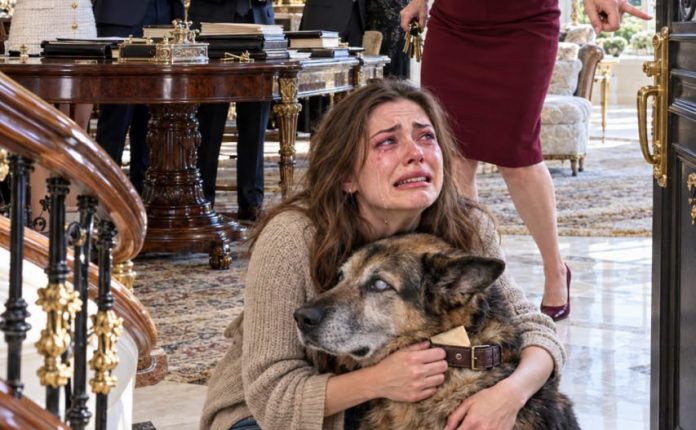
Scout refused to lie on the unfamiliar floor.
I spread Grandpa's flannel blanket beside the bed.
He circled it twice.
Then he lowered himself carefully.
His joints clicked.
I sat beside him until he relaxed.
Outside, trucks moved along the highway.
Their tires hissed against wet pavement.
Every unfamiliar sound made Scout raise his head.
I stroked his shoulder.
“It's all right.”
I wished somebody could say the same to me.
At midnight, I unfolded Grandpa's note again.
Forty-six.
Seventeen.
Nine.
I wrote the numbers on the motel stationery.
Then I began guessing.
Forty-six years in business.
Seventeen years since something happened?
Nine days since his funeral?
None of it made sense.
I examined the drawing.
A horseshoe with one missing nail.
That part felt familiar.
When Grandpa was younger, he'd stamped the symbol onto the saddles he made.
He once explained that he had broken the original metal stamp.
One nail-shaped mark never printed correctly.
Customers began recognizing it.
Eventually, he adopted the flaw as his trademark.
“People remember what's different,” he told me.
I looked at the drawing.
Maybe the numbers weren't about money.
Maybe they belonged to his workshop.
At seven the next morning, I fed Scout.
He ate only a few bites.
I crushed his veterinarian-approved medication into the food as instructed.
Then I packed his blanket.
Margaret's office occupied the second floor of an old brick building downtown.
There was an elevator.
I was grateful.
Scout could no longer manage long staircases.
Margaret met us at the door.
She wore a charcoal jacket.
Her gray hair was pinned neatly.
When she saw Scout, her expression softened.
“Hello, old friend.”
Scout lifted his head.
He recognized her voice.
Margaret knelt carefully.
She rubbed his ears.
“Jonah trusted you with quite a responsibility.”
I looked at her.
“Please tell me what happened.”
She guided us into her office.
A bowl of water waited beside a chair.
Scout drank.
Then he settled at my feet.
Margaret opened a folder.
“Your grandfather revised his will several months ago.”
“I know.”
“What you heard yesterday was a valid will. But it did not describe everything Jonah owned or controlled.”
I frowned.
“Grant inherited the house.”
“Yes.”
“And Cynthia and Trevor received the bank accounts.”
“Yes.”
“And I received Scout.”
“Correct.”
“Then what else is there?”
Margaret folded her hands.
“Your grandfather also established a trust years before his death.”
I stared at her.
“What kind of trust?”
“One originally created to protect the workshop business and certain family assets.”
“Why didn't you mention it yesterday?”
“Because its terms require a separate process. And because your grandfather left specific instructions concerning how beneficiaries would be informed.”
I leaned forward.
“Are you saying there is another inheritance?”
“There may be a substantial interest available to you.”
“May?”
Margaret opened another document.
“Jonah didn't want you making decisions based on promises.”
I couldn't speak.
“He knew you'd devoted years to his care,” she continued.
“He also knew Grant and Cynthia had developed expectations about the estate.”
“Expectations?”
Margaret looked uncomfortable.
“They had been discussing his property long before he died.”
I remembered several arguments.
Grant wanted Grandpa to sign documents.
Cynthia wanted access to accounts.
Grandpa sometimes became upset after their visits.
He rarely explained why.
Margaret continued.
“Jonah was particularly concerned about pressure to liquidate the workshop.”
“Grant wants to demolish it.”
“I know.”
“How?”
“Because he told me.”
I looked toward Scout.
He slept against my chair.
“Why did Grandpa leave the house to Grant?”
Margaret took a breath.
“That's the part we need to discuss carefully.”
She handed me a photocopy.
It was a deed.
The property description looked familiar.
But attached to it was a legal notice.
The farmhouse sat on one parcel.
The workshop stood on another.
I read the address twice.
“Wait.”
Margaret nodded.
“Most people assume the workshop and farmhouse are one property.”
“They're not?”
“Not entirely.”
Grandpa had divided the land many years earlier.
The residence occupied the main parcel.
The workshop and a narrow access lane were held separately.
That second parcel belonged to a company.
Bennett Heritage Leatherworks.
I knew the name.
Grandpa used it on invoices.
But I'd never understood its structure.
“Who owns the company?” I asked.
“A trust holds its controlling interest.”
I felt my heart beat faster.
“Which trust?”
Margaret slid another document across the desk.
The Bennett Legacy Trust.
Established seventeen years earlier.
I looked at the numbers in my pocket.
Forty-six.
Seventeen.
Nine.
“Seventeen,” I whispered.
Margaret glanced up.
“What?”
“It's in Grandpa's note.”
I showed her.
She studied the paper.
Her eyes moved toward the horseshoe.
Then she gave a small, sad smile.
“He really did think of everything.”
“What does nine mean?”
“I'm not certain yet.”
“And forty-six?”
“That was how many years he worked in the trade when he first discussed retiring. It may refer to a workshop record.”
I shook my head.
“I'm confused.”
“Understandably.”
Margaret took out another file.
“Jonah created the trust after Daniel died.”
My father.
The mention of his name caught me off guard.
“Why?”
“He wanted to protect part of the business for Daniel's child.”
“For me?”
“Yes.”
I stared at her.
“But he never told me.”
“He wanted you to make your own life first.”
I gave a humorless laugh.
“Didn't work out that way.”
Margaret's expression softened.
“No. It didn't.”
She explained that Grandpa had originally planned for the business to continue operating.
But after his health deteriorated, he feared Grant would sell its equipment and land.
Several attempts had been made to persuade Grandpa to transfer control.
Grandpa refused.
Then his concerns deepened.
“Why?” I asked.
Margaret hesitated.
“Because records suggested someone was attempting to use his declining health to obtain authority he hadn't granted.”
I remembered a winter afternoon.
Grant had arrived with a folder.
He'd asked Grandpa to sign a paper.
Grandpa refused.
Grant became angry.
I interrupted.
I'd asked him to leave.
For two days afterward, Grandpa barely spoke.
“Was Grant trying to get the workshop?” I asked.
Margaret nodded slowly.
“That's one possibility.”
“Do you have proof?”
“We have evidence that needs proper review.”
“What kind?”
“Documents. Account records. Correspondence.”
I felt sick.
“Why didn't Grandpa go to the police?”
“Some matters were civil disputes. Others were unresolved. He also wanted to avoid a confrontation while he was ill.”
Margaret reached across the desk.
“There's something you need to understand, Mara.”
I waited.
“Your grandfather's final arrangements were not designed merely to reward one person and punish another.”
“Then what were they designed to do?”
“To protect what he believed mattered.”
I looked at Scout.
He was dreaming.
His paws twitched gently.
Margaret continued.
“And to give certain people an opportunity to show how they would treat what they believed was no longer valuable.”
That sentence stayed with me.
I thought about Cynthia kicking Scout.
Grant ordering me out.
Trevor taking Grandpa's pocketknife.
“Was that the test?”
Margaret didn't answer immediately.
“Part of it.”
I placed Grandpa's note on the desk.
“So what happens now?”
“We need to locate a particular set of business records.”
“Where?”
“In the workshop.”
I remembered the warning.
“Yesterday you told me not to go there.”
“Alone, at night, while Grant was controlling access. I still wouldn't recommend that.”
“Then how do we get inside?”
Margaret opened a drawer.
She removed an old brass key.
“Jonah made arrangements for lawful access through the trust.”
I stared at it.
The head was shaped like a small horseshoe.
One nail was missing.
I recognized it immediately.
Grandpa kept a similar key on his workshop ring.
“Why is that special?”
“Because he identified the secure cabinet with the same mark.”
My throat tightened.
Grandpa had spent his life creating things with his hands.
Even his final instructions were shaped like something from his workshop.
Margaret set the key beside the note.
“We should arrange an inventory with the independent trustee and notify Grant appropriately.”
“Will that take long?”
“The trustee can attend this afternoon.”
I looked down at Scout.
“I want to be there.”
Margaret nodded.
“Your grandfather specifically requested that.”
We returned to Willow Creek Road after lunch.
An independent trustee, Samuel Reed, met us outside.
Samuel was a retired accountant.
I'd seen him at Grandpa's funeral.
He carried a clipboard.
Grant's truck was parked beside the garage.
When he saw us, he came outside immediately.
“What are you doing here?”
Margaret remained calm.
“We've come to inspect trust property.”
Grant looked at Samuel.
“Trust property?”
“Yes,” Samuel replied.
“The workshop parcel and its records.”
Grant's expression changed.
“That building is part of my father's estate.”
“Not the residence bequest,” Margaret explained.
Grant's jaw tightened.
“You never mentioned this yesterday.”
“I advised you that separate business matters remained.”
He looked toward me.
“Did you put them up to this?”
I almost laughed.
“Yesterday you said I had nothing.”
“Don't start.”
Samuel stepped forward.
“We're not here to argue.”
Grant pointed toward the workshop.
“Fine. Look around. It's full of junk.”
Scout growled softly.
He stood beside me.
His ears angled toward Grant's voice.
I rubbed his shoulder.
“Easy.”
We walked along the narrow gravel path.
The workshop stood behind the maple trees.
Its cedar siding had turned silver.
A weather vane creaked above the roof.
The carved horseshoe remained over the entrance.
One nail missing.
Grandpa had painted the door dark green.
I remembered helping him.
I was twelve.
He'd let me paint the bottom half.
I'd made an awful mess.
He never corrected my uneven strokes.
Inside, the air smelled of leather and cedar.
Dust floated through the afternoon light.
Tools hung above the workbench.
Patterns filled labeled drawers.
Finished saddles stood on wooden racks.
It felt as though Grandpa had stepped outside for lunch.
I touched the edge of his stool.
His worn leather apron hung nearby.
I had to turn away.
Margaret noticed.
“We can take a moment.”
I shook my head.
“I want to finish.”
Samuel began documenting the room.
Margaret checked the rear storage area.
I examined the workbench.
The horseshoe symbol appeared on a cabinet near the window.
Below it were three brass number wheels.
A combination lock.
Forty-six.
Seventeen.
Nine.
My hands went cold.
I entered the numbers.
The lock clicked.
Inside sat several bound ledgers.
A small metal cash box.
An envelope addressed to Margaret.
And a narrow wooden case.
I called the others.
Margaret looked at the opened cabinet.
For a moment, she said nothing.
Then she touched the edge of the workbench.
“Oh, Jonah.”
Samuel photographed everything.
He checked the ledgers.
Then he opened the envelope.
Margaret read the enclosed letter.
Her expression became grave.
“What is it?” I asked.
She looked toward the door.
“We need Grant to remain outside until we document this.”
“Why?”
Samuel lifted one of the ledgers.
Several pages contained copies of transactions.
Money had moved from business accounts into accounts linked to Grant.
Other records showed expenses entered under false descriptions.
There were invoices for machinery that had never arrived.
Payments to a company I didn't recognize.
Grant's handwriting appeared on several authorizations.
I stared at the dates.
Some transactions occurred while Grandpa was recovering from his second stroke.
He'd barely been able to hold a pen.
“How could he have approved these?”
Margaret's voice was quiet.
“That's exactly the question.”
Samuel turned another page.
There were transfers involving Cynthia too.
Smaller amounts.
Repeated regularly.
I recognized one payment.
It matched an amount Cynthia claimed she'd spent helping Grandpa.
But she hadn't paid that expense.
I had.
The receipt was in my own records.
My chest tightened.
“Why would they do this?”
Neither answered.
We documented everything.
Samuel arranged to secure the originals.
Margaret contacted a forensic accountant.
Grant waited outside.
When we emerged, his face was hard.
“What did you find?”
Margaret looked at him.
“Financial records requiring investigation.”
His eyes narrowed.
“What kind of investigation?”
“We'll communicate formally.”
He glanced at the metal case Samuel carried.
“That's my father's property.”
Samuel answered.
“It belongs to the trust.”
Grant stepped closer.
“And who's the beneficiary?”
Margaret didn't reply.
I looked at her.
For the first time, I saw real fear in Grant's expression.
Not grief.
Not anger.
Fear.
That night, Margaret called me.
She'd examined Grandpa's letter.
It contained instructions about the trust.
And one final request.
Jonah wanted his family informed together.
But he also wanted me to understand what I was choosing.
“Mara,” Margaret said, “the trust gives you a significant role.”
“How significant?”
“You are the designated successor controlling beneficiary, subject to the trust's terms.”
I sat very still.
“What about Grant?”
“He has no beneficial interest in the workshop trust.”
“And Cynthia?”
“Neither does she.”
I stared at the motel wall.
“Grandpa left them the house and accounts.”
“Yes.”
“But protected the workshop separately.”
“Exactly.”
“Why?”
Margaret paused.
“Because that's where he believed his life's work could survive.”
I looked at Scout sleeping nearby.
“And why did he leave me the dog?”
Margaret's answer was almost a whisper.
“Because Jonah needed to know who would protect something that could no longer offer them anything.”
I closed my eyes.
I thought about Cynthia laughing.
Trevor grinning.
Grant opening the door.
The afternoon rain.
Scout stumbling when Cynthia kicked him.
Then I remembered Grandpa's note.
This was a test.
Now I understood what he'd been watching.
But I still didn't know what the consequences would be.
Margaret continued.
“Your uncle has received notice to preserve relevant records. The trust's accountants are reviewing the transfers.”
“Will he lose the house?”
“Not automatically. Separate ownership and any future legal remedies must be handled properly.”
“And the money?”
“That depends on what the investigation establishes.”
I swallowed.
“Margaret?”
“Yes?”
“Was Grandpa angry with them?”
A long silence followed.
“Very.”
I waited.
“But he was also disappointed.”
That hurt more.
“He wanted them to become better people,” she said.
“He didn't want revenge to become the last thing his family remembered.”
I looked toward the window.
The rain had stopped.
The parking lot shone under the motel lights.
“What am I supposed to do?”
Margaret answered carefully.
“Decide what kind of future you want to build with what he protected.”
I rested my hand on Scout's back.
His breathing was slow.
Steady.
Warm.
Outside, the highway hummed.
And for the first time since the funeral, I realized Grandpa hadn't left me without a home.
He'd left me with a responsibility.
One I wasn't certain I knew how to carry.
END PART 2