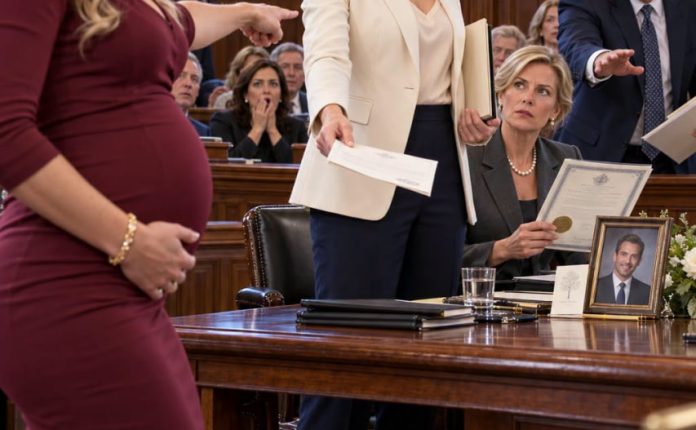
The woman accusing my husband of abandoning her was wearing white.
Not bridal white. Something softer, almost ceremonial.
Her sleeveless maternity dress seemed painfully out of place against the dark wood of the Boston courtroom.
October had brought freezing rain overnight.
Everyone else had arrived in heavy coats.
Delaney Price stood beside her attorney, one hand covering her barely rounded stomach.
Her mother, Marlene, adjusted a tissue in her daughter's hand.
Then Delaney saw me.
She lowered her eyes.
It was a small movement, but deliberate.
I had watched her practice similar expressions at work whenever a supervisor questioned an overdue assignment.
That morning, however, she wasn't explaining a missing purchase order.
She was demanding five million dollars.
From me.
Because she claimed to be pregnant with my husband's child.
My husband had been dead for five years.
"Where is Thomas Warren?"
Marlene Price rose from the gallery before the judge had finished speaking.
"Where is the man who ruined my daughter?"
Judge Evelyn Mercer looked over her glasses.
"Mrs. Price, you will sit down."
Marlene pointed at me.
"His wife knows where he is. She's protecting him because they've got money."
"Another interruption," the judge said, "and you will be removed."
Marlene sat.
Delaney began crying.
I studied the seam of her dress.
Someone had carefully pressed it that morning.
The detail bothered me more than it should have.
For a moment, I remembered pressing Thomas's shirts before his business trips.
Five years of widowhood had not taught me how to stop making such comparisons.
Naomi Keene, my attorney, leaned closer.
"Claire, keep looking at me."
I turned toward her.
"Don't respond to the mother. Let the record develop."
I nodded.
Naomi was fifty-two, composed, and wonderfully uninterested in theatrical arguments.
She had represented my family's trusts for eight years.
When I called her about the complaint, she had read the allegations twice.
Then she asked one question.
"Does this woman know Thomas is dead?"
"I don't know."
That answer had disturbed us both.
Now I was sitting inside a courtroom trying to understand how my dead husband could have supposedly fathered an unborn child.
And why my coworker believed she was entitled to his estate.
My name is Claire Warren.
I was thirty-nine that October.
At Marston Design Collaborative, I worked as a senior contracts manager.
My responsibilities involved commercial development agreements, construction schedules, insurance provisions, and the endless disputes that arise when expensive projects encounter ordinary human carelessness.
I liked the work.
I liked finding a sentence buried in a contract that could prevent six months of litigation.
I liked the way an agreement became clearer when everyone stopped pretending they wanted the same thing.
Money was never my reason for staying.
My father had left me several properties and a diversified investment portfolio.
Thomas had built his own business before we married.
After his death, I became trustee of certain remaining family assets, although not everything I owned belonged to his estate.
My financial circumstances were comfortable.
My life was considerably less so.
And I preferred that nobody at work knew exactly how either one looked.
Delaney joined Marston three years earlier.
She was twenty-four then, newly promoted from a temporary administrative position.
She was quick with names, excellent at remembering birthdays, and remarkably skilled at appearing helpful without accepting much responsibility.
At first, I liked her.
She brought coffee when I worked late.
She remembered the anniversary of Thomas's death after I mentioned it once.
She sometimes left little chocolate bars beside my keyboard.
The gestures felt thoughtful.
I overlooked the small inconsistencies.
She borrowed twenty dollars without returning it.
She repeatedly forgot her wallet.
When she admired a silver bracelet I wore, I gave it to her.
The bracelet had been a birthday present from an aunt.
I rarely wore it.
Delaney hugged me in the break room.
"Claire, you're honestly the sweetest person here."
I laughed.
"Don't tell anyone. They'll give me extra work."
For a while, that was what our friendship sounded like.
Light conversations over paper coffee cups.
Requests for advice.
Questions about office politics.
Occasional lunches.
Nothing remarkable.
Then she saw the Aston Martin.
It happened on a Thursday afternoon in early summer.
I had driven Thomas's dark green car to work because my usual vehicle needed servicing.
The Aston Martin had spent most of the previous winter inside the garage.
I sometimes thought of selling it.
But every time I considered arranging an appraisal, I pictured Thomas leaning across the passenger seat to kiss me at a traffic light.
So I kept it.
Delaney appeared beside the parking entrance as I climbed out.
"Claire?"
I smiled.
"Morning."
She walked around the hood.
"That is a beautiful car."
"It was Thomas's."
"Your husband?"
"Yes."
She bent slightly to examine the emblem.
"Does he have a collection?"
"No."
"What does he do?"
I paused.
I had no idea why the present tense suddenly felt so difficult.
"He worked in investments and property development."
Delaney straightened.
"That explains a lot."
"What does?"
She smiled.
"Oh, nothing. You just never talk about money."
I locked the car.
"There's not much to discuss."
But afterward, money seemed to be the only subject she wanted to discuss.
She asked whether I owned my house.
Whether Thomas had inherited wealth.
Whether we had children.
Whether my family maintained trusts.
I answered some questions and redirected others.
My father had always said that financial privacy spared people from relationships built around imaginary bank balances.
I had considered that advice old-fashioned when I was younger.
At thirty-nine, I understood it.
What I didn't understand was how thoroughly Delaney had begun studying me.
Two months later, she asked about Eastbank Residences.
We were reviewing a commercial lease amendment.
She spotted the address on an old delivery reference.
"Isn't that an expensive building?"
"It's a residential property."
"Do you live there?"
"Not anymore."
She looked interested.
"Still own the apartment?"
"My family trust does."
I moved the folder away.
"Did you update the contractor schedule?"
She returned to her computer.
I forgot the exchange.
I should not have.
The legal complaint arrived on a Tuesday.
I was reviewing a supplier agreement when Graham Bell from human resources knocked on my office door.
"Claire, do you have a moment?"
His expression was strained.
He carried a sealed envelope.
"Someone delivered this for you."
Inside was a demand letter.
The letter named Thomas Edward Warren.
It alleged sexual assault, intimidation, financial abandonment, and an ongoing campaign of concealment.
The claimant was Delaney Price.
The requested settlement was five million dollars.
I read the first page.
Then the second.
Then I went back to the beginning.
Graham stood in the doorway.
"Is everything all right?"
I looked at him.
"Who else has seen this?"
He hesitated.
"Delaney has spoken with human resources."
"About what?"
"Something involving your husband."
I folded the letter.
"Thomas died five years ago."
Graham's expression changed.
Not much.
But enough.
"You never mentioned that."
"I didn't know it was necessary."
He opened his mouth.
Then closed it.
I asked him to leave.
After he shut the door, I sat very still.
My first feeling was not anger.
It was something closer to bewilderment.
Thomas had died at Massachusetts General Hospital on October 14, 2021.
A physician had explained the final complications of his illness.
I had signed the necessary forms.
I had chosen the cemetery.
I had stood beside his grave while rain soaked the shoulders of my black coat.
There were records.
Photographs.
Witnesses.
A death certificate.
There was no uncertainty about what had happened.
Yet Delaney was claiming that he had approached her four months earlier.
My hands began shaking.
I called Naomi.
She asked me to send the complaint.
Twenty minutes later, she called back.
"Claire, this isn't merely an accusation against Thomas."
"I know."
"They're attempting to involve you as trustee. They've also identified property that may not belong to his estate."
"Can they take it?"
"Not because somebody requests it."
I closed my eyes.
"Then why are they doing this?"
"That's what we need to establish."
She was silent for a moment.
"Do you know whether Delaney has ever visited Eastbank?"
"No."
"Does anybody else have access?"
"The property management company has administrative access. I haven't used the apartment regularly since Thomas died."
"Have the locks been changed?"
I couldn't remember.
That frightened me.
The emergency hearing was scheduled after Delaney's attorney requested restrictions on transfers from certain trusts.
Naomi prepared the necessary records.
She wanted to submit Thomas's death certificate immediately.
I agreed that we should, but asked her to let Delaney describe the supposed encounters first.
"Why?"
"Because she keeps saying she met him."
"She may simply be lying."
"Maybe."
I looked at the photograph of Thomas beside my desk.
"But if somebody is pretending to be him, I want to know how much they know."
Naomi considered that.
Then she said, "We will not let curiosity interfere with protecting you."
I promised.
I meant it.
At the hearing, Delaney described delivering an urgent folder to Eastbank four months earlier.
She claimed she had been told that I needed the documents at home.
Near the entrance, she encountered a well-dressed man.
He introduced himself as Thomas.
He supposedly explained that I was delayed.
Then he invited her to wait in his car.
Delaney said he locked the doors and sexually assaulted her.
Her voice faltered.
Her attorney gave her time.
I did not interrupt.
I was certain the man was not Thomas.
I was not certain what had happened to Delaney.
Those were different questions.
She claimed the man subsequently threatened her with compromising photographs.
She said he arranged additional meetings at hotels.
When she discovered her pregnancy, he stopped answering.
She approached me, according to her testimony, but I refused to help.
That last claim surprised me.
Delaney had never told me she believed Thomas had assaulted her.
She had once asked whether my husband traveled frequently.
Another time, she asked whether he used a second telephone.
I had dismissed those questions as intrusive.
Apparently, she intended to present them as attempts to seek assistance.
Naomi made careful notes.
Judge Mercer requested the evidence identifying the alleged perpetrator.
Delaney's attorney presented hotel receipts.
Then text messages.
Then surveillance footage from Eastbank.
The recording showed the entrance.
Delaney approached a broad-shouldered man near the elevators.
He wore a gray overcoat.
They spoke.
He turned toward the garage.
She followed.
The recording ended.
Judge Mercer watched it twice.
"Is there footage from the garage?"
"Unfortunately not," Delaney's attorney answered.
"Why?"
"My client understands that the recordings were deleted."
"On what basis?"
Delaney leaned forward.
"Thomas told me he could access the security system."
I looked again at the paused image.
At the coat.
At the dark patches on its elbows.
I knew those patches.
Thomas had bought the coat in London.
He loved the cut but wore through the elbows while traveling.
A tailor repaired it with darker material.
I had donated it after his death.
I remembered the cardboard box.
The donation center.
The woman who helped me carry everything inside.
I remembered sitting in my parked car afterward because I could not bring myself to drive home.
Someone had apparently found a coat resembling his.
Or perhaps someone had found the actual coat.
Naomi noticed me staring.
"What is it?"
"His coat."
"Whose?"
"Thomas's."
Her fountain pen stopped moving.
"Are you sure?"
"I recognize the repairs."
She studied the image.
Then wrote something on her pad.
"Don't react."
Delaney continued.
She claimed the man had photographs from our wedding.
She said he knew my travel schedule.
He allegedly understood the structure of Thomas's investments.
He had mentioned Eastbank's upstairs rooms.
Each detail tightened the cold knot beneath my ribs.
The apartment was not simply an investment property.
It had been our first home together.
Thomas had proposed to me there.
We had painted the bedroom ourselves.
After his diagnosis, we kept the apartment even though we moved into a house better suited to his treatment.
I visited occasionally after his death.
Then less often.
Eventually, I stopped.
I could not bear the sight of his coffee mug beside the kitchen sink.
I had never imagined someone else entering those rooms.
Naomi began questioning Delaney.
"You met this man four months ago?"
"Yes."
"He said his name was Thomas Warren?"
"Yes."
"He identified himself as Mrs. Warren's husband?"
"Yes."
"You believe he fathered your child?"
Delaney lifted her chin.
"I'm certain."
"Did you see a government-issued identification document?"
"He showed me pictures."
"That isn't what I asked."
Delaney glanced at her attorney.
"His phone had wedding photographs."
"Did you verify his identity through any other source?"
"He knew Claire."
"Did you ever see him and Claire together?"
"No."
"Did you ever speak to Mrs. Warren about his identity?"
"She wouldn't listen."
Naomi paused.
"What exactly did you ask her?"
Delaney hesitated.
"I asked whether he traveled."
"Did you tell her a man claiming to be her husband had assaulted you?"
"No."
"Did you tell her you were pregnant?"
"Not immediately."
"Then she could not have refused to address an allegation you never made to her, correct?"
Delaney began crying again.
Her attorney objected to the characterization.
Judge Mercer reminded Naomi of the limited purpose of the hearing.
Naomi accepted the instruction.
Then she opened her folder.
Before she could speak, I touched her sleeve.
"May I ask her something?"
Naomi leaned closer.
"What?"
"Whether she's certain."
Naomi studied my expression.
Then asked permission for a brief direct clarification.
The judge allowed it through counsel.
I kept my voice low.
"Delaney, you're saying the father of your child is my husband?"
She turned toward me.
"Yes."
"You're absolutely certain?"
Her expression hardened.
"I know who I was with, Claire."
I nodded.
For a moment, I could not speak.
I thought about Thomas sitting on our kitchen floor, assembling a cabinet badly because he refused to read the instructions.
I thought about his laugh.
The last birthday cake we shared.
The sound of hospital machinery beside his bed.
Then I looked at Judge Mercer.
"Your Honor, my attorney has my husband's death certificate."
Naomi stood.
She handed the authenticated record to the clerk.
The judge examined it.
Her eyes moved slowly down the page.
"Thomas Edward Warren."
She read the date aloud.
"October fourteenth, twenty twenty-one."
A chair creaked behind me.
Naomi submitted the probate records.
The final estate documents.
Supporting identification.
"My client's husband died five years ago," she said.
"He could not have fathered this pregnancy."
Nobody moved.
Delaney stared at the papers.
Marlene stopped dabbing her eyes.
Graham Bell, seated behind them, slowly raised his head.
I noticed his face because he looked more startled than anyone else.
Not outraged.
Not sympathetic.
Simply startled.
As though something had happened before he expected it.
Judge Mercer turned toward Delaney.
"Did you know Mr. Warren was deceased?"
"No."
"Did the man you met ever acknowledge that fact?"
Delaney shook her head.
"He told me Claire was pretending they weren't together."
Marlene stood halfway.
"My daughter has been deceived!"
Judge Mercer ordered her to sit.
Naomi requested preservation of the original surveillance files, access logs, and message records.
She also challenged the attempt to freeze assets based on an identification that had now been contradicted by official records.
The judge declined to impose the requested immediate restrictions.
She continued the matter for further proceedings and directed attention toward authenticating the remaining evidence.
No one declared Delaney innocent.
No one declared her guilty.
But her claim that Thomas was alive had collapsed.
The courtroom began emptying.
Rebecca approached me.
"Claire, I didn't know."
I looked at her.
"You could have asked."
She lowered her eyes.
I had no energy for an apology.
Near the doorway, Delaney called my name.
"Claire."
I stopped.
Naomi remained beside me.
Delaney approached with Marlene close behind.
Her face was pale.
"I didn't know he was dead."
"Then somebody lied to you."
She nodded.
"He knew things."
"What things?"
"Your apartment. Your pictures. The rooms."
I felt the air change.
"Which rooms?"
"He took me upstairs once."
Naomi straightened.
"Inside Eastbank?"
Delaney nodded.
"He had keys."
My mouth went dry.
"Where did he take you?"
"Upstairs. Through the hallway. There's a bedroom with blue curtains."
Those curtains had belonged to Thomas.
He chose them because he said the color reminded him of the sea.
I had never replaced them.
Delaney rubbed her hands together.
"He said you never went there anymore."
I turned toward Naomi.
"We need to inspect the apartment."
But Delaney caught my sleeve.
"There's something else."
I looked back.
She seemed frightened now.
Not offended.
Not theatrically wounded.
Frightened.
"He told me to delete some photographs if you ever found out about the apartment."
"What photographs?"
Her mother reached for her arm.
"Delaney, stop talking."
Delaney ignored her.
"Pictures of him opening a safe."
I stared at her.
Thomas had owned a safe.
It was concealed behind a narrow panel in his study.
Only a handful of people knew it existed.
And I had not opened it since his death.
"Where are those pictures?" Naomi asked.
Delaney swallowed.
"On an old phone."
Marlene's grip tightened.
"Enough."
Delaney pulled away.
"He said the safe belonged to him."
I could barely hear the conversations around us.
Because I suddenly remembered something else.
Two weeks before the lawsuit, Graham had asked whether I planned to move the Eastbank apartment into a different trust.
He claimed the question related to an employee relocation inquiry.
At the time, I thought nothing of it.
Now I wondered why a human resources manager had been discussing property held outside the company.
Naomi touched my shoulder.
"Claire."
I looked at her.
"Don't go to Eastbank alone."
I promised I wouldn't.
Then Delaney said something that made the promise feel immediately necessary.
"He wasn't alone when he opened the safe."
Marlene closed her eyes.
"Delaney."
But Delaney continued.
"There was another man in the room."
"Did you see his face?"
She shook her head.
"Only his reflection in the window."
"Did he speak?"
Delaney looked toward the elevators.
Then back at me.
"Yes."
"What did he say?"
Her lips trembled.
"He said somebody at Marston had already checked that you wouldn't be coming home."
I turned toward the courtroom doors.
Graham Bell was gone.
END PART 1