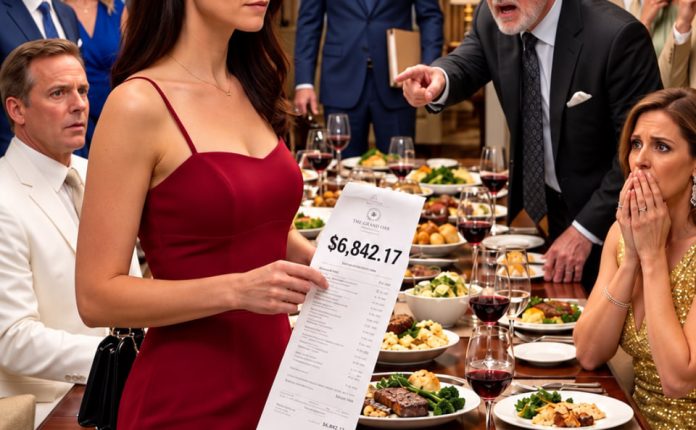
Grandma didn't shout.
That was what I remember most clearly about the moment our Thanksgiving dinner fell apart.
My mother had just admitted that the money intended for my first home had been used to purchase a house for my younger sister. Dad had explained that my single status somehow made my need for housing less legitimate.
Mallory was sitting across from me, wearing an expensive cream sweater, beside a husband who suddenly looked as bewildered as I felt.
And Grandma was dialing her attorney.
“Henry? Evelyn Warren. I'm sorry to disturb your holiday.”
There was a pause.
“No, I'm well. But I've discovered something concerning the gift we arranged for Claire three years ago.”
Mom stood up.
“Evelyn, really. This is a family matter.”
Grandma raised a finger without looking at her.
“I need the documentation we signed. The letter explaining the purpose of the gift, the check records, everything.”
Henry said something.
Grandma listened, then turned toward me.
“Claire, did you authorize your parents to use the money for Mallory?”
“No.”
“Did you agree to give Mallory any portion of it?”
“No.”
“Have they paid you back?”
I shook my head.
“Not anything.”
Grandma relayed my answers.
I had never heard her sound so businesslike.
She had spent most of my childhood making birthday cakes and repairing torn stuffed animals. I knew she had managed my grandfather's financial affairs after his death, but I had rarely seen that part of her.
Now she sat perfectly straight, asking precise questions while my parents shifted uncomfortably.
“We'll meet tomorrow,” she told Henry. “Yes, I'll bring Claire.”
She ended the call.
Dad immediately leaned forward.
“There was no reason to involve an attorney.”
Grandma placed the phone beside her plate.
“Then perhaps you can explain why my granddaughter has no house and no money.”
Mom folded her arms.
“We used the funds to help Mallory establish a stable home. Claire had an apartment and a good job.”
“So did you ask Claire first?”
Mom's face tightened.
“We knew what was best.”
“That wasn't my question.”
Dad reached for his water glass.
“Linda managed the account. I wasn't involved in every decision.”
Grandma turned toward him.
“Were you aware where the money came from?”
He looked down.
“Of course.”
“Then you were involved enough.”
Mallory made a little sound of protest.
“Can everyone please stop acting as though we stole something?”
I looked at her.
“What would you call it?”
Her eyes flashed.
“Mom and Dad told me the money was available.”
“It wasn't theirs to give.”
“They said Grandma wanted to help the family.”
Grandma's chair scraped against the floor.
“I wanted to help Claire.”
Mallory glanced away.
I had imagined confronting my sister many times over the years, usually over some smaller slight. She had borrowed my clothes when we were teenagers, forgotten to repay modest loans in our twenties, and expected me to cancel plans when she needed childcare.
Those incidents suddenly looked different.
But I didn't know whether she had understood the source of the house payment from the beginning.
“Mallory,” I asked, “when did you find out it was my money?”
She didn't answer.
“Please.”
“Don't interrogate me in front of the children.”
Sophie was sitting at the far end of the table, drawing circles on a paper napkin. Oliver had fallen asleep against Derek's shoulder.
Derek stood.
“I'm taking them into the den.”
He gently lifted Oliver and guided Sophie away.
When he returned, he stayed standing near the doorway.
“What money?” he asked.
Mallory began smoothing her napkin.
“Derek, not now.”
“Our down payment came from your sister?”
Mom interrupted.
“It came through a family account.”
Derek stared at her.
“That's not what I asked.”
I felt a strange, painful sympathy for him.
He had been in the family for six years. He knew Mom could be controlling, but he generally avoided arguments and focused on the children.
He was looking at his wife as though he had never seen her properly before.
Grandma turned to me.
“Can you access the account?”
I opened the banking application on my phone.
I had not checked it in months. Each time I considered looking, I remembered Mom's insistence that the money was invested elsewhere.
Now I signed in and stared at the balance.
$216.43.
I refreshed the screen.
The number remained.
I placed the phone on the table.
Grandma studied it.
“That's all?”
I nodded.
Dad muttered something under his breath.
Mom leaned toward me.
“Claire, we were going to explain.”
“When?”
“Once everything settled.”
“It's been three years.”
She looked annoyed rather than ashamed.
“We were trying to keep everyone happy.”
“Everyone except me.”
“Don't twist my words.”
Grandma took my hand.
“Claire, look at me.”
I did.
“You aren't responsible for making this easier for them.”
It was the first time someone in that room had said anything that made me feel steady.
Dad turned toward Mom.
“Linda, you told me she'd stopped checking that account.”
The words came out quietly, almost accidentally.
Mom looked furious.
“Paul.”
He pressed his lips together.
I stared at both of them.
They hadn't merely hoped I wouldn't notice.
They had discussed the possibility.
They had planned around my ignorance.
Derek pushed his chair back.
“I need to know what happened before I make another mortgage payment.”
Mallory stood.
“Please, Derek.”
“Did you know?”
She started crying.
“I thought Mom was handling it.”
“That isn't an answer.”
He walked into the hallway.
Mallory followed him.
I heard their voices through the doorway, strained and low.
Then Mallory said something that made me sit upright.
“Please don't tell him about the other account.”
Grandma heard it too.
She looked toward the hallway.
“What other account?”
Mom suddenly announced that the dinner was over.
She began collecting plates with frantic efficiency, although we were in Grandma's house.
“Everyone needs to go home and calm down.”
Grandma took the serving plate out of her hands.
“You can leave when you're ready, Linda. But don't pretend that cleaning up will erase what you've done.”
Dad went to get his coat.
Mom followed him, but not before turning back toward me.
“Your grandmother has always favored you,” she said. “You know that, don't you?”
I wanted to ask whether she could hear herself.
Instead, I said, “You took my money.”
Her expression hardened.
“You've always counted every little thing.”
The cruelty was so familiar that it barely surprised me.
What surprised me was that I no longer felt obligated to answer it.
My parents left.
Mallory and Derek remained in the hallway for another ten minutes before Derek gathered the children.
He stopped beside me on the way out.
“I didn't know it belonged to you,” he said.
I wanted to believe him.
“Then ask your wife what she knew.”
He nodded once.
Mallory didn't look at me.
After they left, Grandma and I sat at the table surrounded by cold food.
The candles had burned down. The cranberry sauce had formed a skin. Somewhere in the den, the television was still playing a children's cartoon.
Grandma picked up my phone.
“May I look at the transactions?”
I showed her what I could.
There were several older transfers, but the application displayed abbreviated descriptions.
A large withdrawal had occurred about five months after I opened the account.
Another had followed several weeks later.
Both were far larger than anything I would have authorized.
Grandma wrote down the dates.
Then she said, “I'm sorry.”
I shook my head.
“You didn't do this.”
“I should have told Henry to help you set up an individual account.”
“I should have done it myself.”
She studied me.
“We can spend the next twenty years listing what we should have done. I'd rather find out what actually happened.”
I laughed once, though I was close to crying.
“That sounds like you.”
She reached across the table.
“I'm still the woman who wants to sit on your porch, Claire.”
For the first time that day, I cried.
Not loudly.
I simply couldn't keep my face composed any longer.
Grandma moved her chair beside mine and held me until the worst of it passed.
The next morning, we met Henry in his office at nine.
He had practiced law for almost forty years and worked in a converted brick house with tall windows and worn wooden floors.
His assistant brought coffee.
Henry placed a folder on the conference table.
Inside was a copy of Grandma's gift letter, dated three years earlier.
It identified me as the recipient, stated the amount, and explained that Grandma was providing the money to assist with the purchase of my first residence.
There was also a copy of the cashier's check.
My name appeared on the payee line.
Henry read the letter carefully.
“This establishes what Evelyn intended,” he explained. “It doesn't automatically tell us what happened after Claire deposited the money.”
I felt a small chill.
“Because it was a joint account?”
“Yes.”
He folded his glasses.
“Joint ownership can give each account holder considerable authority to withdraw funds. Whether someone breached an agreement, made false representations, or owes repayment is a separate question. We need documents before making conclusions.”
Grandma nodded.
“Then let's get them.”
Henry asked me to describe how my parents had persuaded me to open the account.
I repeated Mom's explanation about earning interest, keeping the funds accessible, and helping me manage closing arrangements.
He wrote everything down.
“Did your parents ever say the money belonged to them?”
“No. They repeatedly called it my money.”
“Any messages?”
I opened my phone.
There were several.
One from Mom read, “Don't worry about your house funds. Dad and I are keeping everything safe until you choose a property.”
Another said, “We are only holding it for you. Stop stressing yourself.”
Henry asked me to preserve the messages.
He advised me not to delete anything, even conversations that seemed unrelated.
Then he explained how to request statements and account records directly from the bank.
Since I was an account owner, I could obtain information about activity on the account.
He also suggested that I establish a new personal account at a separate institution for my current income and savings.
“Don't let a dispute over the old account create new problems,” he said.
Grandma looked satisfied.
“That's what I wanted to hear.”
By lunchtime, I had requested the records.
At four that afternoon, Mom called.
I let it ring.
She called again.
Then came a text.
“You have embarrassed this entire family over money Grandma gave you for free.”
I read it three times.
For free.
As though receiving a gift made me less entitled to keep it.
A second message arrived.
“Mallory has children. You need to understand that not everyone has your freedom.”
I showed Grandma.
Her jaw tightened.
“Save those.”
That evening, Derek called.
He sounded exhausted.
“Claire, I'm trying to understand what's going on.”
I sat on my couch with a blanket over my knees.
“I'm still trying myself.”
He paused.
“Mallory says your parents transferred money into an account they opened for our house purchase.”
“An account in whose names?”
“Linda and Mallory, apparently.”
I remembered the remark from Thanksgiving.
The other account.
“Did you know about it?”
“No.”
He exhaled.
“I thought our down payment was a family gift. Linda told me she and Paul had saved for years to help us.”
“Did Mallory tell you the same thing?”
“Yes.”
I closed my eyes.
“How much was the down payment?”
“About $118,000.”
There was a long silence.
“That house cost four hundred and something thousand, didn't it?”
“Four hundred thirty-eight thousand.”
I remembered Mallory showing me listings in that price range.
At the time, I had assumed she was dreaming.
Derek continued.
“The lender's paperwork described the down payment as a gift from Linda and Paul.”
“That wasn't their money.”
“I know that now.”
His voice broke slightly on the last word.
He told me he had spent hours examining documents and asking Mallory questions.
She admitted that her mother had transferred money into an account they could use toward the purchase.
But she insisted she had believed Mom had every right to do so.
“There's something else,” Derek said.
I sat straighter.
“What?”
“The down payment wasn't the only money your parents gave her.”
My throat tightened.
“How much more?”
“I don't know yet. She won't show me everything.”
He promised to send copies of the purchase documents he had access to.
After we hung up, I sat without moving.
For three years, my parents had insisted that I wait because the timing wasn't right.
But they had made sure Mallory didn't have to wait.
They had allowed me to walk through other people's houses while she chose paint colors for one purchased with my money.
I imagined the craftsman I'd lost, the maple trees, and the room where Grandma might have sat.
Then I remembered something else.
Mallory had bought her house the spring after my parents talked me out of making an offer.
The timing had never been accidental.
Two days later, the bank provided the first batch of statements.
I opened the documents at my kitchen table.
The initial deposit appeared clearly.
$120,000.
Several months afterward, there was a transfer for $100,000.
The description identified an account I didn't recognize.
A second transfer for $18,500 followed.
The remaining money had gradually been reduced by fees and smaller transactions.
I printed the statements and spread them across the table.
For the first time, the missing money was no longer an argument about who needed help.
It was a series of dated transactions.
And those dates told their own story.
The $100,000 transfer occurred eleven days before the offer on Mallory's house was accepted.
The $18,500 transfer took place shortly before closing.
I had been working overtime during those weeks because my hospital was understaffed.
I remembered calling Mom about a bungalow I wanted to tour.
She had told me it was a terrible time to buy.
Now I knew why.
When I gave Henry the documents, he read them silently.
Then he asked, “Claire, are you certain you never authorized these transfers?”
“Completely.”
He nodded.
“Then we need to identify the destination account and determine what agreements, if any, your parents claim justified this.”
Grandma leaned forward.
“What happens if they refuse?”
Henry looked at both of us.
“Then we consider formal demands and whatever legal remedies the facts support.”
He carefully avoided promising an outcome.
I appreciated that.
For the first time, someone was treating the situation seriously enough not to offer easy reassurance.
As we prepared to leave, Henry's assistant entered with an envelope delivered by courier.
It was from Derek.
Inside were copies of the closing disclosure, the gift letter used for the mortgage, and the settlement paperwork for Mallory's house.
Henry began reading.
His expression changed.
“Interesting,” he said.
He laid one document in front of me.
It showed Linda and Paul as the people providing the down payment.
The amount was $118,500.
The date matched the combined transfers from my account.
At the bottom was a signed declaration that the funds were a gift and repayment was not expected.
I stared at my parents' names.
Henry tapped the paper.
“This doesn't establish how the money was acquired,” he said. “But it shows what they represented when the house was purchased.”
Grandma looked toward the window.
Then she asked a question I hadn't considered.
“Henry, what would happen if the lender discovered that the source of these funds had been misrepresented?”
He didn't answer immediately.
“That would depend on the facts and applicable lending requirements. We should not assume fraud simply from what we have here.”
I nodded.
But I understood the significance.
The money had passed through two sets of documents.
Grandma's gift to me.
And my parents' purported gift to Mallory and Derek.
Somewhere between them, the truth had been replaced.
And I intended to find out exactly who had helped replace it.
END PART 2