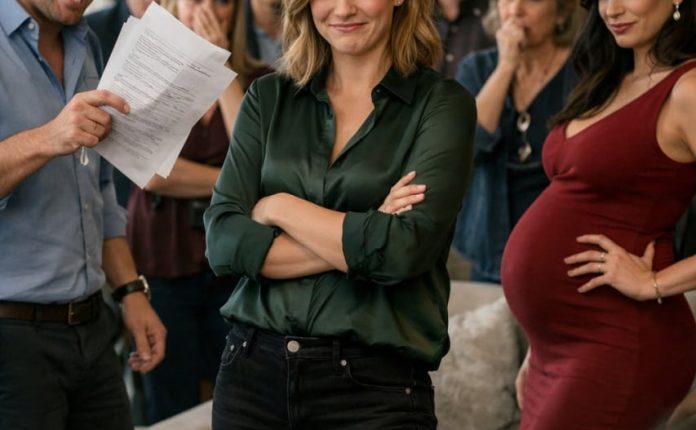
"Then don't tell her anything."
I picked up my coat.
"That isn't the same as telling the truth."
"She's going to leave me."
"I don't know what she'll do."
"Then why take the chance?"
I turned back.
"Because she deserves the chance to decide."
His face crumpled for a moment.
"Mara, please."
I wanted to comfort him.
That instinct was so familiar it almost overcame everything else.
When he was little, he had come to me with scraped knees, bad report cards, and broken toys.
I had helped him fix what I could.
But I could not fix this by pretending it hadn't happened.
"I love you," I told him.
He looked up.
"I do. But I can't make this disappear."
He lowered his head.
I left him standing in the kitchen.
Outside, the cold air smelled of wet leaves and chimney smoke.
I had reached my car when my phone rang.
It was Mr. Baird.
I answered.
"Ms. Whitcomb, I'm sorry to call so late. I wanted to let you know I've reviewed the available notes."
I leaned against my car.
He continued.
"The employee your brother spoke with recorded a brief interaction after the viewing. Your brother stated that he had a family keepsake and requested an envelope."
I closed my eyes.
"Did the employee know what it was?"
"The note says a necklace."
I looked toward the house.
Through the kitchen window, I could see Reid still standing beside the table.
Mr. Baird's voice was careful.
"Our employee did not understand that the necklace had been designated to remain with your mother. He should have checked the arrangement instructions before assisting."
"Did Reid say he had permission?"
"According to the note, yes."
I thanked him.
Then I sat in my car, listening to the engine idle.
Reid had admitted taking the necklace.
The funeral home's record supported the timing.
And my brother had knowingly claimed permission that contradicted the final instructions we had both heard.
I was no longer deciding whether to confront him.
I was deciding how to tell Elodie, and how to bring our mother's necklace home without allowing another lie to take its place.
Elodie called me Tuesday morning while I was standing beside a milling machine at work.
I saw her name on my phone and let it ring.
Then I walked to the break room and called her back.
"Hi, Mara. I hope I'm not interrupting anything."
"You're fine."
Her voice sounded uncertain.
"I wanted to ask you something about Thanksgiving."
I sat on the edge of a plastic chair.
"All right."
"Did I do something to upset you?"
I looked at the vending machine across the room.
"No, Elodie."
"Are you sure?"
"Yes."
She was quiet for a moment.
"Reid said you were having a difficult holiday because of your mom."
I closed my eyes.
It was another explanation built around my grief.
A convenient one.
Something that made my behavior understandable without requiring him to explain his own.
"I did miss Mom," I said. "But you didn't upset me."
"I'm glad."
She hesitated.
"Reid's been acting strange since Thursday."
"How?"
"He keeps asking whether we've spoken."
I didn't answer.
"He also asked me not to wear the necklace you complimented."
My fingers tightened around the phone.
"What did he say?"
"That it might be too delicate for everyday use."
"Have you taken it off?"
"Yes. It's in my jewelry box."
I felt a small measure of relief.
At least the necklace wasn't being worn while we sorted out what had happened.
"Elodie, I need to talk to you about it."
Her tone changed.
"What's wrong?"
I glanced at the clock.
My break was almost over.
"This isn't something I want to explain while you're at work or I'm at work. Could we meet somewhere quiet?"
"Is Reid involved?"
"Yes."
She took a breath.
"Then I think I need to know."
We agreed to meet Wednesday evening at my house.
After the call, I stood beside the vending machine for several seconds.
I knew Reid would be furious.
But Elodie had already begun noticing his behavior.
Keeping silent would not protect her.
It would leave her trying to understand a problem everyone else knew about.
That afternoon, I sent Reid a message.
I'm meeting Elodie tomorrow. You can tell her yourself before then, but she needs the truth.
He called within minutes.
I stepped outside the plant to answer.
"You promised you'd give me time," he said.
"I promised I'd listen."
"There's no reason to drag her into this."
"She's wearing Mom's necklace."
"She isn't wearing it now."
I frowned.
"How do you know?"
"Because I asked her to put it away."
"Reid."
"What?"
"You're still trying to manage what she knows."
He was silent.
Then he said, "I'm bringing you the photographs tonight."
"Good."
"And I want to talk before you see her."
"We already talked."
"Not about everything."
Something in his voice made me stop walking.
"What else is there?"
He didn't answer immediately.
"Mara, I didn't know how bad things had gotten when Mom was sick."
I looked toward the parking lot.
"What things?"
"Between us."
I waited.
"I knew you were angry," he said. "I just didn't know how much."
That was not what I had expected him to say.
I leaned against the cold brick wall.
"We can talk about that. But it doesn't change what happened."
"I know."
"Do you?"
A truck passed on the access road.
Finally, he said, "I'll bring the pictures after work."
He hung up.
That evening, Reid arrived at my house carrying a small brown envelope.
He looked tired.
There were dark circles beneath his eyes.
I let him in.
He stood in the kitchen without taking off his coat.
"Here."
He held out the envelope.
I opened it carefully.
Inside were two tiny photographs.
Dad at twenty-three.
Reid and me on the back steps.
The pictures were slightly bent at the corners, but otherwise intact.
I touched the edge of Dad's photograph.
It was so small I could almost cover his face with my thumbnail.
"Where were they?"
"In the desk upstairs at Mom's. I put them in the drawer after the funeral."
"Why didn't you remember that yesterday?"
"I was panicking."
I studied him.
"Did you look for them before coming here?"
"Yes."
"Was anything else in the envelope?"
"No."
I placed the photographs on the table.
For months, they had been sitting in a drawer while Elodie wore the locket that was supposed to hold them.
That detail felt almost as painful as the missing necklace itself.
"Did you ever open them after you took them out?"
He looked puzzled.
"What do you mean?"
"Did you look at them?"
He shook his head.
"Not really."
I stared.
"You took Mom's necklace because you needed something to remember her by, but you removed the pictures and didn't look at them?"
He winced.
"I know how it sounds."
"Then help me understand."
He took off his coat and sat down.
For several minutes, he seemed unable to decide where to begin.
Finally, he said, "I was jealous of you."
I sat opposite him.
He continued.
"Not because Mom loved you more. I know she didn't. But you knew what to do."
I almost laughed.
Not because it was funny.
Because I remembered how frightened I had been.
I had called nurses to ask questions I thought I should already know.
I had sat in the car outside the pharmacy crying because they were out of a prescription.
I had searched the internet at midnight for ways to make hospital sheets more comfortable.
I had not known what to do.
I had simply kept doing the next thing.
"Reid, I was making it up as I went along."
He nodded.
"Maybe. But you were there."
He rubbed his hands together.
"When I came to visit, I never knew what to say. Mom was so thin. She'd look at me like she was trying to make me feel better, and I couldn't stand it."
"She wanted to see you."
"I know that now."
"She wanted to see you then."
He lowered his head.
I wished I could take the sharpness out of that truth.
But I couldn't.
He needed to hear it.
"After she died," he continued, "everybody talked about how much you had done. At the funeral, people kept thanking you. They kept telling me how lucky Mom was to have you."
I remembered those conversations.
Most people had meant well.
They knew I had been the primary caregiver.
They wanted to acknowledge it.
I had not considered how those words sounded to Reid.
"I felt like I hadn't done anything," he said.
"So you took the necklace?"
He nodded.
"I wanted something that was mine. Something nobody could say you had earned more than me."
I looked at him for a long time.
There was a kind of honesty in what he had said.
It did not make the act less wrong.
But it was the first explanation that matched his behavior.
"You could have told me you felt that way."
"I didn't want you to think I was selfish."
I gave him a tired look.
He glanced at the photographs.
"Yeah. I know."
For a while, we sat without speaking.
Then I asked, "What happened in August?"
He breathed out slowly.
"Elodie's birthday."
"Why give her the locket?"
He rubbed his thumb over a small scratch on the table.
"I'd been dating her for a few months. Things were going well. She was talking about how thoughtful her last boyfriend had been."
I said nothing.
"I wanted to give her something meaningful. I was looking at jewelry online, and everything I liked was expensive."
"So you opened the box where you'd kept Mom's necklace."
He nodded.
"I told myself Mom would've liked Elodie."
"She never met her."
"I know."
"And even if she had liked her, that didn't mean she'd want to give her the necklace."
He looked down.
"I know that too."
"Did you ever plan to tell Elodie where it came from?"
"No."
"Why?"
"Because I knew how she'd react."
I leaned back.
That was the most revealing sentence of all.
He had known.
Somewhere beneath the explanations about grief and feeling excluded, he had understood that an honest account would make the gift impossible.
He had chosen not to give an honest account.
"Did you have it cleaned?"
He looked surprised.
"Yes."
"Where?"
"A jeweler near the dealership."
"Did they repair anything?"
"No. Just polished it."
"Did they say anything about the silver link?"
"The woman asked if I wanted it fixed. I told her to leave it."
I felt a sharp ache.
"Why?"
He looked at me.
"Because Mom liked it."
For the first time that evening, tears filled his eyes.
I didn't know what to do with that.
He had remembered one of the most personal details about our mother's necklace.
He had preserved it.
Then he had given the necklace away.
His grief had not erased his love.
And his love had not prevented him from betraying her wishes.
Both things were true.
I looked down at Dad's photograph.
"Reid, you can't use loving Mom as the reason for everything you did."
He wiped his eyes.
"I know."
"You have to take responsibility for the choices you made after she died."
He nodded.
"I want to."
"Then tell Elodie."
He was quiet.
"Tell her yourself," I said. "Before she comes here tomorrow."
He looked up.
"Will you be there?"
"Yes."
"Will you let me explain?"
"I'll let you tell the truth."
He pressed his lips together.
"Okay."
I was not sure whether to believe him.
But I wanted to give him the opportunity.
After he left, I placed the photographs in a small envelope of my own.
Then I took out the visitation picture.
I enlarged it on my phone.
Mom's face looked peaceful.
The necklace rested against the blue fabric.
Her wedding ring was visible near the edge of the photograph.
I studied the image for a long time.
Then I noticed something that had nothing to do with the jewelry.
Reid's hand was visible at the side of the casket.
He had been standing near Mom when I took the picture.
I remembered the exact moment.
He had reached toward her as though he wanted to touch her shoulder, then stopped.
I had assumed he was overwhelmed.
Perhaps he was already thinking about taking the necklace.
Perhaps the idea came later.
There was no way to know.
I put down the phone.
I did not want to spend the rest of my life treating every memory of my brother as evidence against him.
Wednesday morning, Mr. Baird called.
He had completed an initial review.
The employee who spoke with Reid remembered the exchange.
His name was Nathan.
He had been helping clear flowers from the viewing room near closing time.
Nathan remembered Reid approaching with a small object in his hand.
Reid had asked for an envelope.
When Nathan asked whether he needed assistance returning anything to the casket, Reid said the item was a family keepsake his mother wanted him to have.
Nathan provided an envelope.
He did not examine the object closely.
He also did not check the written instructions.
"I should explain something," Mr. Baird said. "This does not mean the employee had authority to approve a change to the arrangements."
"I understand."
"The jewelry was listed to remain with your mother. A change should have been discussed with the authorized family representative and documented."
"Which would have been me."
"Yes."
I stared out the window.
Mr. Baird continued.
"We are reviewing our procedures. I also want to apologize that this wasn't caught before the casket was closed."
I appreciated the apology.
But I needed more than an apology.
"Can the necklace be returned to Mom?"
There was a pause.
"Potentially. But not through an informal arrangement."
"What would have to happen?"
He explained that returning jewelry to a closed and buried casket would require coordination with the cemetery and compliance with applicable authorization and permit requirements.
There could be legal, practical, and financial complications.
He would not promise that the process could be completed until the requirements were confirmed.
I wrote down everything he said.
Then I asked whether he could provide a written summary of his review.
He agreed, subject to the privacy and records obligations that applied to the funeral home.
I thanked him.
After hanging up, I called Daniel Mercer at Cedar Bluff.
He explained that any reopening would need proper approval and professional supervision.
He also said something that helped me breathe a little easier.
"There is no indication that the grave itself was disturbed. Whatever happened with the jewelry, the burial site has remained secure."
For nearly a week, I had been frightened by images of someone opening Mom's grave.
Now I understood that my fear had begun with the wrong possibility.
The violation had occurred in the funeral home.
Before the burial.
By someone she loved.
I spent the rest of Wednesday trying to concentrate at work.
Every measurement took longer than usual.
I checked numbers twice.
At four thirty, my supervisor asked whether I needed to leave early.
I told him I had a family matter.
He nodded and said to go.
When I reached home, Elodie's car was already in the driveway.
She stood beside it with a small handbag over one shoulder.
She had not brought the necklace.
"Hi," she said.
"Come in."
She followed me into the kitchen.
I offered coffee.
She asked for water.
I filled a glass and set it in front of her.
She looked around.
"You have a lovely house."
"Thank you."
She sat down.
Then she looked directly at me.
"Mara, what's going on?"
Before I could answer, headlights crossed the front window.
Reid had arrived.
I heard his car door close.
A moment later, he knocked.
When I opened the door, he looked past me toward Elodie.
She stood.
"Reid?"
He stepped inside.
There was a long silence.
Then Elodie asked a question that made all our careful plans unnecessary.
"Is this about the necklace?"
Reid stopped.
She looked from him to me.
"I saw the way Mara looked at it on Thanksgiving. And you've been asking me not to wear it ever since."
She folded her arms.
"Where did you actually get it?"
Reid's face went pale.
I waited.
He had promised to tell her.
This was his chance.
He swallowed.
"It belonged to Mom."
Elodie looked confused.
"Your mother?"
"Yes."
She frowned.
"Then why did you say it came from a resale shop?"
He looked at me.
I said nothing.
Elodie took a step back.
"Reid."
He rubbed his face.
"She was supposed to be buried wearing it."
The room went silent.
Elodie stared at him.
"What?"
He closed his eyes.
"I took it after the visitation."
Her glass remained untouched on the table.
For several seconds, she seemed unable to speak.
Then she reached into her handbag.
She took out a small velvet jewelry pouch.
"I brought it because I thought maybe Mara wanted to look at the clasp."
She placed the pouch on the table.
Her hands were shaking.
She opened it.
Inside lay my mother's necklace.
The silver link caught the light.
Elodie looked at Reid.
"You gave me something you took from your mother's casket?"
He nodded.
She stepped away from him.
"No."
Her voice was very quiet.
"No, Reid. You don't get to make me part of that."
She looked at me.
"I'm so sorry."
I shook my head.
"You didn't know."
She glanced at the necklace.
"I wore it in front of your family."
"You didn't know," I repeated.
Her eyes filled with tears.
Reid moved toward her.
"Elodie, please. I can explain."
She stepped back.
"You already did."
He stopped.
I watched him struggle to find the words that usually came so easily.
There were none.
Elodie picked up her handbag.
"I need to go."
Reid followed her toward the door.
"Can we talk?"
"Not tonight."
"Please."
She turned around.
"You let me believe that necklace was a gift you bought because you cared about me. You knew where it came from. You knew your sister was sitting across from me at Thanksgiving."
She looked toward the kitchen table.
"And you let me wear it."
Reid lowered his head.
Elodie opened the door.
"I need some time to decide what that means."
Then she left.
I stood beside the table.
The necklace lay between us.
Reid looked toward the driveway until her taillights disappeared.
Then he turned to me.
"You got what you wanted."
I felt a sudden, exhausted anger.
"No."
He stared.
"What I wanted was to serve Thanksgiving dinner without discovering that our mother's burial wishes had been violated."
He looked away.
"What I wanted was for you to keep the promise you made beside her bed."
I picked up the velvet pouch.
"And what I want now is to make sure we finally do right by her."
For three days after Elodie left my house, Reid didn't call.
I didn't call him either.
The necklace remained on my kitchen table inside the velvet pouch.
Every morning, I moved it before breakfast.
Every evening, I returned it to the same place.
I didn't want to put it away.
Putting it in a drawer felt too much like accepting that it belonged there.
On Saturday, Aunt Bethany came over.
She had called twice during the week, asking whether I'd learned anything.
I had told her only that I was still sorting things out.
Now I was ready to explain.
She listened while I described the funeral home's records, Reid's confession, and Elodie's reaction.
When I finished, she looked at the pouch.
"May I?"
I nodded.
She opened it carefully.
The locket rested in her palm.
She rubbed the engraved face with her thumb.
"I remember when Sylvie first showed me this."
I sat opposite her.
"She was so proud of it. Your father had taken extra shifts to pay for it."
Bethany smiled faintly.
"She wore it to my kitchen one afternoon and kept finding excuses to tuck her hair behind her ears so I'd notice."
I smiled despite myself.
"That sounds like Mom."
Bethany examined the chain.
"And there's your little repair."
I nodded.
"She was proud of that too."
My aunt closed her hand around the necklace.
"Your brother did a dreadful thing."
I looked down.
"But I don't think he did it because he didn't love her."
"I know."
"That's what makes it so difficult."
She handed the pouch back.
I had expected her to become furious.
Instead, she looked tired.
"I wish he'd told somebody how he was feeling before he made such a terrible decision."
I thought about what Reid had said at Mom's house.
That he'd felt useless.
That he thought I had received all the credit for caring for her.
That he'd wanted something nobody could say I deserved more.
I understood his feelings better now.
I still couldn't understand why he had decided that taking the necklace was an acceptable answer.
Bethany studied me.
"Are you going to tell the rest of the family?"
"I don't know."
"You don't have to make a public spectacle of him."
"I don't want to."
"Good."
"But I'm not going to pretend it was a harmless mistake."
She nodded.
"Then don't."
We drank our coffee.
After a while, I asked whether she would be willing to attend a meeting with Reid and Elodie.
"Why Elodie?"
"Because she was affected too. And because I don't want Reid telling three different versions of what happened."
Bethany considered it.
"I'll come."
The next morning, Elodie called.
Her voice sounded steadier than it had on Wednesday.
"I wanted to make sure you still have the necklace."
"I do."
"Good."
She hesitated.
"Reid's been calling."
"Have you answered?"
"Once."
I waited.
"He keeps saying he made a mistake because he was grieving."
I rubbed my forehead.
"That's part of it."
"I understand grief can make people do strange things."
Her voice tightened.
"But he had nine months to tell the truth."
"Yes."
"He gave me that necklace in August. He watched me put our pictures inside. He took me to dinner wearing it. He told me it was old, but he never said anything about his mother."
I looked at the pouch.
"I know."
"I keep thinking about Thanksgiving."
"Elodie—"
"You were trying to be kind to me while I was sitting there wearing something that belonged with your mom."
"You didn't know."
"I know you keep saying that."
She paused.
"But I wish I had looked at you more carefully. You must have been hurting."
I closed my eyes.
Her concern almost undid me.
"You were a guest in my home. You had no reason to suspect anything."
She sighed.
"I've told Reid I need some distance."
"I'm sorry."
"Don't be. I need to understand whether this was one terrible decision or part of how he handles difficult things."
That was a question I had been asking myself.
Reid had lied before.
Small lies.
Convenient lies.
Explanations that protected him from embarrassment.
I had treated them as minor faults because he was usually kind, generous, and quick to help when something was immediately in front of him.
But this wasn't a forgotten errand or a late appointment.
This involved our mother, her final request, and a promise he had knowingly broken.
I told Elodie about the meeting I wanted to arrange.
She agreed to attend.
Then I called Reid.
He answered on the fourth ring.
"Hello?"
"Reid, we need to talk."
"We've talked."
"Not with everyone who needs to be involved."
He was silent.
"Bethany and Elodie are willing to come to Mom's house on Sunday afternoon."
His voice hardened.
"You're putting me on trial."
"No."
"Then why do we need an audience?"
"Because you've been asking people to keep different parts of this quiet. I want us to stop doing that."
He breathed heavily into the phone.
"Elodie's coming?"
"Yes."
"Did she say that?"
"She did."
There was a long pause.
Then he asked, "Are you going to tell everybody I'm a thief?"
"I'm going to tell the truth. You can decide how you want to participate."
He said nothing.
"Reid, I don't want to humiliate you. But Mom's wishes weren't a private rule you could change. Elodie deserves an honest explanation. Bethany is family, and she's been helping me."
"Fine."
"Sunday at two."
"Fine."
He hung up.
I sat with the phone in my hand.
For years, I had wondered what might happen if I stopped smoothing over my brother's mistakes.
Now I was finding out.
Sunday afternoon was gray and windy.
I arrived at Mom's house early.
I turned up the heat, wiped down the kitchen table, and set out four mugs.
I left the necklace in its velvet pouch beside the arrangement papers.
The photographs of Dad and us were in a separate envelope.
I had not opened either since Wednesday.
Bethany arrived first.
She brought a tin of cookies.
"You don't need these," she said, "but I couldn't bear to arrive empty-handed."
I smiled.
She took off her coat and looked around.
"I still expect Sylvie to come around that corner and tell us we're sitting in the wrong chairs."
That made me laugh.
Mom had always insisted that nobody had assigned seats.
Then she complained when we sat somewhere different.
Elodie arrived a few minutes later.
She wore a dark blue coat and carried nothing.
She looked nervous but determined.
Reid was last.
He came in with his hands in his pockets and stopped when he saw everyone seated at the table.
For a moment, I thought he might leave.
Instead, he pulled out a chair.
"All right," he said. "Let's get this over with."
Bethany looked at him.
"That's a poor way to begin."
He flushed.
"I'm sorry."
I placed the funeral arrangement form in the middle of the table.
"This says Mom's locket and wedding band were to remain with her."
Nobody spoke.
"Reid took the necklace during the visitation. He later gave it to Elodie and told her he'd bought it at a resale shop."
Reid stared at the table.
Bethany looked at him.
"Is that accurate?"
He nodded.
"Please answer out loud."
"Yes."
Elodie folded her hands.
"Did your mother ever actually tell you to take it?"
Reid rubbed his face.
"No."
I felt the words settle over the room.
He continued.
"She said years ago that she wanted us to have things to remember her by. I used that to convince myself I wasn't doing anything wrong."
Bethany's expression tightened.
"But she specifically asked to be buried with that necklace."
"I know."
"And you promised her."
His voice broke.
"I know."
For the first time since Thanksgiving, he wasn't arguing.
He wasn't looking for a technical explanation.
He wasn't asking anyone to consider how frightened or excluded he had felt before acknowledging what he'd done.
He was simply answering.
Elodie looked at him.
"Why did you give it to me?"
He swallowed.
"I wanted to give you something beautiful."
"Why that necklace?"
He looked down.
"Because I had it."
She waited.
"And because I couldn't afford the jewelry I was looking at," he admitted.
I had suspected as much.
Still, hearing him say it made me feel sick.
He continued.
"I didn't plan any of it. I just kept telling myself I would put the necklace back someday. Then I gave it to you, and I couldn't figure out how to undo it without telling everybody what I'd done."
Elodie shook her head.
"You didn't have to buy me expensive jewelry."
"I know."
"You could have given me flowers. Or written me a letter."
He nodded.
"I know."
"What hurts isn't that you couldn't afford something."
She wiped her cheek.
"It's that you thought giving me a stolen family keepsake was better than being honest about what you could afford."
He flinched at the word stolen.
But he did not argue.
Bethany sat quietly beside me.
I was grateful for that.
There was no benefit in turning the meeting into a competition over who had been hurt most.
The facts were painful enough.
I slid the envelope of photographs toward Reid.
"Do you remember these?"
He looked inside.
His face changed.
For a long moment, he studied the picture of us on the back steps.
"I forgot how little I was," he said.
"You were three."
He touched the photograph.
"That was the summer Dad built the swing."
"Yes."
"I fell off it."
"You jumped."
He almost smiled.
"You told Mom I'd fallen."
"Because you asked me to."
The memory hung between us.
Then I looked at him.
"I spent a lot of our childhood covering for you."
He lowered his eyes.
"I know."
"And I kept doing it after we grew up."
He said nothing.
"I don't want to do that anymore."
He nodded slowly.
"I don't want you to either."
Bethany leaned forward.
"Reid, what are you going to do to put this right?"
He looked at the necklace.
"I'll give it back."
"That's already happened," I said.
He nodded.
"Then I'll pay whatever it costs to have it returned to Mom."
I studied him.
"That may be complicated."
"I know."
"There may be permits. The cemetery has to approve the process. The funeral home has to be involved."
"Then I'll deal with it."
I looked at him.
"Not just by writing a check."
He nodded.
"Whatever needs doing."
Bethany asked about the funeral home's review.
I explained that Mr. Baird had acknowledged a failure to verify the jewelry instructions before closure.
The funeral home was reviewing its procedures.
I also explained that the cemetery had confirmed there was no evidence of grave disturbance.
Bethany seemed relieved.
"At least Sylvie's resting place hasn't been disturbed."
"Yes."
For a moment, nobody spoke.
Then Elodie asked something I hadn't considered.
"Does Mara have to go through the process of returning it? Could Reid handle the arrangements himself?"
I looked at her.
She continued.
"She's already handled so much. Maybe part of making this right is not leaving the work to her again."
Reid looked at me.
The room grew very quiet.
It was a simple observation.
But it touched the part of our family history I had never found a way to explain.
For years, whenever something needed arranging, people called me.
The hospital records.
The insurance forms.
The funeral.
The property taxes.
The broken furnace.
The paperwork after Mom died.
Reid offered help often, but I usually ended up managing the details.
Sometimes that was because he forgot.
Sometimes it was because I didn't trust him to finish.
We had built a pattern together.
Now Elodie had asked whether he could do the work without relying on me.
Reid straightened.
"I'll call the cemetery tomorrow."
I said nothing.
"And the funeral home."
He looked at me.
"I'll find out what's required and put everything in writing."
"Good."
He nodded.
"Good."
There was another silence.
Then Bethany asked Elodie whether she wanted to say anything else.
Elodie looked toward Reid.
"I don't know what happens with us."
His expression changed.
"I understand."
"I care about you," she said. "But I don't know whether I can trust you."
He nodded.
"I know."
"I'm not deciding today."
"Okay."
She looked down at her hands.
"And I don't want you trying to persuade me. I want you to show me that you can tell the truth when it costs you something."
Reid wiped his face.
"Okay."
That was all.
No dramatic reconciliation.
No promise that everything would be fine.
Elodie stood, thanked Bethany and me, and left quietly.
Reid remained seated.
After a while, Bethany went into the living room to give us privacy.
He looked at the necklace.
"Mara?"
"Yes?"
"I'm sorry."
I studied his face.
He had apologized before.
Usually quickly.
Usually while trying to end an uncomfortable conversation.
This time, he kept speaking.
"I'm sorry I took it. I'm sorry I lied to you. I'm sorry I made Elodie part of it. And I'm sorry I left you to handle so much when Mom was sick."
My throat tightened.
"I needed you then."
He nodded.
"I know."
"Sometimes I needed you just to show up."
He looked at me.
"I know."
I had imagined this conversation many times during Mom's final months.
In those imaginary conversations, I told Reid exactly how much he'd hurt me.
He understood immediately.
Then everything became easier.
Real life was different.
The words came slowly.
I kept forgetting what I wanted to say.
And Reid could not undo the evenings he'd missed.
"I don't want to spend the rest of our lives being angry about what happened," I told him.
He looked hopeful.
"But I can't pretend it didn't happen."
His expression grew serious again.
"I know."
"We're going to have to do things differently."
He nodded.
For the first time, I believed he was listening.
After Bethany returned, we discussed the practical steps.
Reid would contact the cemetery and funeral home.
He would request written information about the authorization process and costs.
He would keep me informed because I was also Mom's child and a co-owner of the family burial arrangements.
He would not make decisions without consulting me.
And he would not ask me to handle the difficult phone calls on his behalf.
As we prepared to leave, Reid picked up the envelope of photographs.
He studied them one more time.
"Can I get copies of these?" he asked.
I hesitated.
Then I nodded.
"Of course."
He placed them back on the table.
"I'll take copies. The originals should stay with the locket."
I looked at him.
That was the first thing he'd said all afternoon that sounded like a decision made for Mom rather than for himself.
Outside, the wind had grown stronger.
Bethany left first.
Reid stood beside his car while I locked the house.
"Do you think Elodie will ever forgive me?" he asked.
I turned toward him.
"I don't know."
He nodded.
"Do you think you will?"
I looked at the dark windows of our mother's house.
"I hope so."
His eyes filled again.
I continued.
"But forgiveness isn't the same as trust. Trust is going to take longer."
He lowered his head.
Then he opened his car door.
"I'll call the cemetery in the morning."
I watched him drive away.
For the first time since Thanksgiving, the necklace was no longer the only thing I was thinking about.
I was wondering whether my brother could become someone I didn't have to protect from the consequences of his own choices.
The answer would not come from another apology.
It would come from what he did next.
Reid called the cemetery at nine fifteen Monday morning.
I know the exact time because he sent me a message afterward.
I spoke with Daniel Mercer. He says there are procedures we have to follow. I'm calling the funeral home next.
I read it twice.
Then I put my phone down and went back to work.
I wanted to ask what Daniel had said.
I wanted to make sure Reid understood everything.
I wanted to call the cemetery myself and confirm the details.
Instead, I let him do what he had promised.
That was harder than I expected.
For years, I had dealt with problems by taking responsibility for them.
When Reid forgot to pay his share of a bill, I reminded him.
When a contractor needed information about Mom's house, I answered.
When a form required a signature, I made sure it was completed.
I told myself I was being practical.
Sometimes I was.
But I had also made it easy for my brother to remain less responsible than he should have been.
Now, for the first time in a long while, I was trying not to take over.
At lunchtime, another message arrived.
Mr. Baird is reviewing the requirements with the cemetery. He'll send us both an update. I'm going to Mom's house after work to check on the pipes.
I looked at the message.
The pipes.
It was such an ordinary responsibility.
But it mattered.
I had planned to check them myself that weekend.
Instead, I wrote:
Thank you. Please make sure the basement window is closed.
He answered:
Already on my list.
I smiled faintly.
Then I returned to work.
Over the next two weeks, Reid kept his word.
He spoke with the cemetery superintendent, the funeral director, and the people responsible for reviewing the necessary authorization documents.
He requested written information rather than relying on verbal assurances.
He copied me on correspondence.
When a form required my participation, he explained why and gave me time to review it.
He did not ask me to finish the paperwork for him.
The process was more complicated than either of us had imagined.
Returning a personal object to a buried casket was not something the cemetery could authorize through a casual phone call.
There were legal requirements, professional responsibilities, and concerns about protecting the burial site.
Mr. Baird explained that any approved procedure would have to be supervised by qualified personnel.
The cemetery would not allow family members to approach or handle the casket.
I was grateful for that.
I wanted Mom's wishes respected.
I did not want to stand beside an open grave and see anything that would replace my memories of her funeral.
Reid understood.
When he called to discuss the arrangements, his voice was quiet.
"You don't have to be there if you don't want to."
I considered that.
"Neither do you."
"I know."
He paused.
"But I think I should."
"Why?"
"Because I was there when I took it."
I closed my eyes.
For once, he was not looking for a way around the uncomfortable part.
"All right," I said.