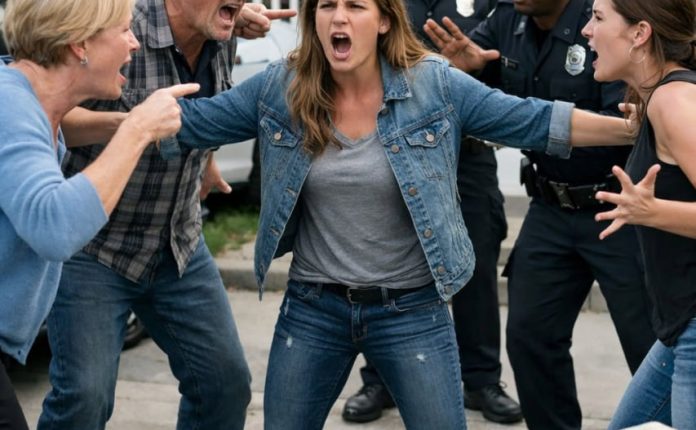
I asked Officer Mercer to repeat himself.
“Your sister's name is on what paperwork?”
“There appears to be an authorization allowing your parents to occupy the property.”
“That's impossible.”
“Are you saying you didn't give permission?”
“I'm saying I specifically refused.”
He paused.
“Then it's important that we speak in person.”
I asked again whether my father was injured.
The officer explained that he had become lightheaded during an argument near the moving truck. The paramedics had examined him, and although he was conscious and speaking, they recommended further medical assessment.
I could hear another voice behind the officer.
Someone asked about a replacement lock.
My stomach tightened.
“Officer, has someone broken into my house?”
“We're investigating how entry was obtained. Please bring identification and any documentation establishing ownership.”
I ended the call.
Ethan was standing in the kitchen doorway, already dressed for work.
“What happened?”
“Mom and Dad are at Briar Lake.”
His expression changed.
“Inside the cottage?”
“I think so. The police are there.”
“Why?”
“Something about moving paperwork and the locks.”
He put down his coffee.
“I'll drive.”
We left fifteen minutes later.
Normally, the drive to Briar Lake took a little more than forty minutes.
I had always enjoyed that journey.
The main road ran through farmland before narrowing between stands of pine and oak. In spring, wildflowers grew beside the drainage ditches. During autumn, the trees turned copper and red.
That morning, everything looked gray.
Rain had fallen overnight. The pavement was damp, and low mist hung above the fields.
Ethan kept both hands on the steering wheel.
I called my mother.
No answer.
I called my father.
Nothing.
Then I called Vanessa.
She answered after several rings.
“Claire?”
“Where are Mom and Dad?”
Silence.
“Vanessa.”
“They're supposed to be at the lake.”
I looked at Ethan.
“How do you know that?”
“Because they're moving.”
“I told them they couldn't stay there.”
She sighed.
“Can we not do this first thing in the morning?”
“The police are at my house.”
There was a sharp intake of breath.
“What?”
“The police called me. They've found Mom and Dad at Briar Lake.”
“That's ridiculous.”
“Did you arrange for them to move in?”
“I helped them find a moving company.”
“Did you tell them I gave permission?”
Another silence.
“Claire, you're making this sound much worse than it is.”
“Did you?”
“They needed somewhere to go.”
“That isn't an answer.”
She lowered her voice.
“I thought you'd change your mind once they were settled.”
I felt something inside me go still.
“You knew I'd refused.”
“You were being unreasonable.”
“So you arranged it anyway?”
“Mom's health isn't good. Dad's stressed. Somebody needed to make a decision.”
“About my property?”
She snapped.
“You don't need to keep reminding everyone what you own.”
I looked through the windshield.
The mist was clearing from the road.
“Vanessa, did you put my name on any documents?”
She didn't answer immediately.
Then she said, “I have to go.”
The call ended.
Ethan glanced toward me.
“What did she say?”
“She arranged the move.”
“Did she admit signing anything?”
“No.”
He shook his head.
“Call Rebecca.”
I found our attorney's number.
Ms. Holt's assistant answered and took a message. I explained that police were at our vacation property and that a document appeared to have been issued in my name without my approval.
Ten minutes later, Rebecca returned the call.
Her first question was practical.
“Has anyone been arrested?”
“Not that I know.”
“Has the officer asked you to make a statement?”
“Not yet.”
“Then don't speculate about who created the paperwork. Tell the officers what you know personally. Keep copies of everything, and don't destroy any messages.”
I glanced at Ethan.
“What about my parents?”
“Are they safe?”
“The officer says my father is conscious.”
“Good. Establish the facts first. We can discuss the property and any legal implications afterward.”
Her calm voice helped.
But I was still frightened.
Because this was no longer a disagreement about money.
Someone had apparently used my name to enter my house.
And my parents were standing in the middle of it.
When we turned onto Willow Point Road, I saw the police vehicle first.
It was parked near the entrance to our gravel driveway.
A white moving truck stood beside it.
My father's sedan was parked partly on the shoulder, its rear wheel dangerously close to the drainage ditch.
Two men in blue work shirts stood beside the truck, talking quietly.
An ambulance was parked farther down the driveway.
Ethan stopped behind the police vehicle.
For several seconds, I couldn't make myself open the door.
The cottage stood between tall pine trees, exactly where it always had.
White siding.
Dark green shutters.
A small screened porch with the rocking chairs Ethan had repaired the previous summer.
But something looked wrong.
The front door was open.
And on the porch sat two cardboard boxes labeled DIANE KITCHEN.
My mother was sitting beside them.
She had wrapped one of our guest bedroom blankets around her shoulders.
When she saw me, she stood too quickly, then caught herself against the porch railing.
“Claire.”
I stepped out of the car.
“Mom, what are you doing here?”
She looked toward the officer approaching us.
“Please don't make a scene.”
That was her first concern.
Even with a police vehicle in the driveway, she was worried about appearances.
Officer Mercer introduced himself.
He was a broad shouldered man in his forties with a quiet voice and tired eyes.
“Mrs. Bennett?”
“Yes.”
“Thank you for coming. Before we discuss anything, is that your husband?”
He nodded toward Ethan.
“Yes.”
“Would you both come over here?”
We followed him to the side of the driveway.
My father stood near the ambulance with a paramedic.
He looked pale.
When our eyes met, he turned away.
Officer Mercer opened his notebook.
“We received a call from a neighbor shortly after six thirty this morning. The caller reported an unfamiliar truck and two men removing the front door lock.”
“That neighbor was probably Mr. Bell,” I said.
“Correct.”
I glanced toward the neighboring house.
Mr. Bell stood near his porch, holding a coffee mug.
He raised one hand when he saw me.
I returned the gesture.
The officer continued.
“Your caretaker told us nobody had permission to enter. He became concerned when he saw the hardware being changed.”
“Because I told him not to let anyone in.”
“That matches his statement.”
I looked toward the cottage.
“Did someone force the door?”
“The existing lock was removed. We haven't yet established exactly what access was used before that.”
“Who ordered the replacement?”
“The moving crew says they were instructed to install it as part of the move.”
“By whom?”
Officer Mercer turned a page.
“That's part of what we need to clarify.”
I could hear the men beside the truck shifting their feet.
One looked embarrassed.
The other seemed impatient.
My mother called from the porch.
“Claire, we didn't know any of this would happen.”
I looked at her.
“What did you think would happen?”
She began to cry.
I wanted to comfort her.
That instinct was so old it nearly overpowered everything else.
Instead, I asked Officer Mercer to continue.
He explained that when the officers arrived, my parents had already entered the cottage.
The movers were unloading boxes.
My father told the police that his daughter had agreed to let him and his wife stay there.
Mr. Bell disputed that claim.
During the argument, my father became dizzy and sat down on the porch steps.
An ambulance was called.
The movers stopped unloading.
The officers requested identification and asked to see whatever paperwork authorized the move.
That was when the document appeared.
Officer Mercer took a transparent sleeve from his folder.
Inside was a two page printed authorization.
The first page carried my name and the Willow Point Road address.
It stated that Richard and Diane Bennett had permission to occupy the cottage temporarily while their primary residence was being renovated.
There was no fixed departure date.
The document also authorized changing the existing locks and allowing a moving company to bring household belongings onto the property.
At the bottom appeared a typed version of my full name.
Below it was a cursive signature.
I stared.
It resembled the way I signed birthday cards.
But it wasn't my signature.
“That isn't mine.”
Officer Mercer watched me carefully.
“Are you certain?”
“Yes.”
“Have you ever authorized your sister or parents to sign documents on your behalf?”
“No.”
“Have you given anyone power of attorney over the property?”
“Absolutely not.”
He pointed toward the second page.
“This appears to have been sent to the moving company electronically.”
The sender information was printed near the top.
Vanessa's name.
Her mobile number.
And an email address associated with Grant.
I recognized the address immediately.
It was the same one Grant used when he sent invitations to their engagement party.
I felt Ethan move beside me.
He leaned closer to examine the page.
“When was this emailed?” he asked.
Officer Mercer indicated the date.
Three days earlier.
I remembered what had happened that evening.
Vanessa had sent a message asking whether I had found Mom and Dad somewhere to stay.
I'd answered that she needed to work with them on alternative accommodation.
She had replied with a single word.
“Fine.”
Now I understood what she had meant.
She wasn't accepting my decision.
She was ending the discussion because she had already made another plan.
Officer Mercer asked, “Would you be willing to provide a formal statement saying you didn't authorize this?”
I looked at my parents.
My mother was wiping her eyes with a tissue.
My father sat on the ambulance step.
For a moment, I saw them as they had been years earlier.
My father teaching me to ride a bicycle.
My mother holding a wet towel against my forehead when I was sick.
The people who had loved me before I understood what mortgages or property deeds were.
I didn't want them involved in a police investigation.
But I hadn't brought the police there.
And pretending the document was valid would make me responsible for a decision I had specifically refused.
“Yes,” I said.
“I'll give a statement.”
My mother's sobbing became louder.
I walked toward her.
“Mom, I need you to answer something.”
She pressed the tissue against her mouth.
“What?”
“Did you know I hadn't agreed to this?”
She shook her head.
“Vanessa said you'd come around.”
“That's different from permission.”
“She told us everything had been arranged.”
I looked at my father.
He was watching.
“Dad?”
He spoke slowly.
“Vanessa said she had talked to you.”
“Did she tell you I'd said yes?”
He looked down.
“She said you wouldn't object once we were here.”
That was not the answer I needed.
“Dad, did you believe I had agreed?”
He rubbed his hands together.
“I wanted to.”
I stood there for a moment.
Those three words were more revealing than any accusation.
He hadn't been deceived by a convincing explanation.
He had accepted an explanation because it allowed him to do what he wanted.
My mother looked toward the open doorway.
“We didn't think you'd actually call the police.”
“I didn't.”
“Then why are they here?”
“Because someone saw people changing the locks on my house.”
She stared at me.
For the first time, she seemed to understand how the situation looked from outside the family.
I asked whether she had seen the authorization before that morning.
She said Vanessa had shown it to them on her phone.
“Did you recognize the signature?” I asked.
“Not really.”
“Did you ask me about it?”
“No.”
“Why?”
Her answer came softly.
“Because I was afraid you'd say no again.”
I didn't know what to do with that.
Officer Mercer approached and asked whether I wanted the moving company to remove the belongings already unloaded.
“Yes.”
My mother gasped.
“Claire, where are we supposed to go?”
I looked toward her car.
“Back to Hawthorne Drive.”
“Vanessa has contractors coming.”
“Then you'll need to discuss that with her.”
My father rose from the ambulance step.
“This is unbelievable.”
Ethan moved closer but remained silent.
I turned toward my father.
“What is unbelievable?”
He gestured at the police vehicle.
“This. Making your parents look like criminals.”
“I didn't forge a document, Dad.”
He recoiled.
“Don't use that word.”
“Then tell me what happened.”
He looked toward the cottage.
“Your sister was trying to help.”
“She used my name without permission.”
“We don't know that.”
“The movers have paperwork she sent.”
My father rubbed his forehead.
He looked older than he had at the wedding.
I wanted to stop arguing.
But I also needed him to understand that the argument was no longer something he could settle by telling me to be the bigger person.
Officer Mercer told us the police would document the disputed authorization, the lock damage, and the statements from everyone present.
He explained that whether further criminal investigation or charges followed would depend on the evidence and the applicable law.
He didn't make promises.
He didn't accuse my parents of crimes on the spot.
He simply asked them to cooperate.
My father agreed.
My mother nodded through tears.
The movers began carrying boxes back to the truck.
I went inside with Ethan.
The living room smelled of damp cardboard and furniture polish.
Several of our framed photographs had been taken down from the shelves.
The quilt my grandmother made lay folded on a chair.
My mother's china was stacked near the fireplace.
The small wooden table Ethan had built for our anniversary had been moved against the wall.
I touched its scratched surface.
This place had been ours.
Not because we were wealthy.
Not because we wanted more than other people had.
Because we'd worked for it, saved for it, and spent years making it our own.
Now strangers had walked into it carrying boxes because someone in my family had decided my refusal wasn't final.
Ethan looked around.
“We should photograph everything before we move anything.”
I nodded.
We took pictures of the door, the removed lock, the displaced furniture, and the boxes.
The officers had already documented the relevant evidence.
Still, Rebecca had advised me to keep my own records.
In the hallway, I noticed a white plastic grocery bag hanging from the guest bedroom doorknob.
Inside were toiletries and a bottle of my mother's prescription medication.
It brought me up short.
They hadn't come for one night.
They had packed to live here.
I set the bag carefully on the bed.
From the doorway, Ethan watched me.
“Are you all right?”
“No.”
He nodded.
“Do you want to sit down?”
“Not yet.”
I looked at the guest room.
My mother had brought her favorite pillow.
My father's slippers were beside the dresser.
Their toothbrushes were already in the bathroom.
They had been here less than an hour, and the house was beginning to look as though I was the visitor.
I walked outside.
Mr. Bell was standing beside the fence.
He looked uncomfortable.
“Sorry to call the police,” he said.
“You did exactly what I asked.”
“I tried ringing your phone first.”
I checked my screen.
There were two missed calls from him at 6:38 and 6:41.
I'd been in the shower.
“I didn't hear it.”
“Didn't seem right to let those fellows take the lock off.”
“Thank you.”
He shifted his weight.
“Your parents said they were moving in. I told them I thought there'd been a misunderstanding.”
I smiled faintly.
“You were right.”
He looked toward the moving truck.
“Your father told me the house was becoming a family place.”
That phrase stayed with me.
A family place.
Not my property.
Not Ethan's and mine.
Something everyone could claim whenever it suited them.
“Did he say anything else?”
Mr. Bell hesitated.
“He said you'd understand after a few days.”
I thanked him.
Then I returned to Officer Mercer to give my statement.
He asked when I had last spoken with my parents about the cottage.
I told him about the Saturday visit.
I described their request, my refusal, and the conversation about Vanessa's proposed move.
He asked whether I had communicated my refusal in writing.
I showed him the message exchange with Vanessa.
He photographed the relevant messages.
When I reached the one where she said I'd been unreasonable, he looked up.
“Did she ever acknowledge that you'd refused permission?”
“She did when I called her this morning.”
“Do you have that conversation recorded?”
“No.”
“Then tell me exactly what you remember, without trying to fill in anything you're uncertain about.”
I did.
I also provided the name of our attorney and copies of our property tax statement and insurance documents.
The officer didn't need all of them immediately, but he noted that I had them.
Before he finished, he asked whether I had any reason to believe Vanessa possessed a copy of my signature.
I thought about it.
There were birthday cards, Christmas cards, and family documents.
Then I remembered something.
Three months earlier, Vanessa had asked me to email a copy of a signed letter confirming our parents' address for a benefits application.
I had sent it without hesitation.
It was an ordinary letter.
My mother had needed proof that she still lived at Hawthorne Drive.
The letter included my full name, signature, and contact information.
I told Officer Mercer.
He wrote it down.
“Do you still have the email?”
“Yes.”
“Please preserve it.”
The thought made me feel sick.
Had Vanessa copied my signature from a document I'd sent to help our mother?
I didn't know.
But the possibility was no longer abstract.
When the movers finished reloading the truck, the supervisor approached me.
His name was Luis Ortega.
He looked embarrassed and exhausted.
“Ma'am, I'm sorry. We were told the property owner approved the move.”
“I understand.”
He held up his phone.
“The booking was prepaid. We had the authorization in our job packet.”
“Who paid?”
He glanced toward the officer.
“I can provide that information to the police.”
Officer Mercer nodded.
“Please do.”
Luis looked back at me.
“We wouldn't have touched the lock if we'd known.”
I believed him.
He had no reason to know the family history.
He'd simply arrived at a job site with paperwork that appeared legitimate.
That was what disturbed me most.
A document with my name had been enough to bring people to my property and begin changing it.
The locks were only the visible damage.
I wondered what else might have been arranged without my knowledge.
By late morning, the moving truck was gone.
The ambulance had left after my father declined transportation and agreed to seek medical evaluation.
My parents stood beside their car.
My mother looked exhausted.
My father seemed determined not to meet my eyes.
I approached them.
“Please have Dad checked today.”
My mother nodded.
“Will you come with us?”
“I need to secure the cottage and finish speaking with the police.”
She looked wounded.
“You're choosing paperwork over your father.”
“No, Mom. I'm making sure the house is safe. Ethan can take Dad to urgent care if you need help.”
She looked toward Ethan.
He nodded.
“I can.”
My father spoke sharply.
“I can drive myself.”
Nobody argued.
I glanced at the boxes piled in the back seat.
“Are you going home?”
My mother hesitated.
“We don't know if Vanessa will let us.”
I stared at her.
“It's still your home, isn't it?”
My father said nothing.
That silence was different.
I felt a new concern moving beneath the anger.
“What do you mean, you don't know?”
My mother looked at my father.
He turned away.
“Richard,” she said.
He rubbed the back of his neck.
“Vanessa and Grant have started changing things.”
“What things?”
“The guest rooms. The kitchen. Some of our furniture.”
I looked toward their car.
“Where are you sleeping?”
My father answered reluctantly.
“In the back bedroom.”
“Your old bedroom?”
“No. That belongs to Vanessa and Grant now.”
I felt a hollow ache.
I had imagined my parents deciding to downsize.
Perhaps renting an apartment near their doctors.
Instead, they had apparently become guests in the house I'd helped them keep.
My mother opened her mouth.
Then closed it.
I waited.
Finally, she said, “Vanessa told us we couldn't stay once the contractors started.”
“When do they start?”
“Monday.”
It was Wednesday.
I took a slow breath.
“Where did she expect you to go if I refused the lake house?”
My father looked toward the trees.
My mother whispered, “She said you wouldn't refuse us forever.”
For a moment, none of us spoke.
Then my father said, “We should go.”
He helped my mother into the car.
I watched them drive away.
The police vehicle remained in the driveway.
Officer Mercer was finishing his notes.
Ethan stood beside me.
“What are you thinking?” he asked.
“That Vanessa didn't just arrange the move.”
“What do you mean?”
“She gave away their room before they had somewhere else to live.”
He looked toward the road.
“And assumed we'd take them.”
“Yes.”
I wasn't ready to call it deliberate cruelty.
Vanessa had always been impulsive.
She often made plans based on the assumption that other people would solve the practical problems afterward.
But this was more serious than forgetting a reservation or overspending on a holiday.
She had created a situation in which our parents were being displaced from their home.
And when I refused to absorb the consequences, someone had used my name to make my consent appear unnecessary.
We drove into town after the officers left.
A locksmith installed a new deadbolt and inspected the doors and windows.
Ethan arranged for the alarm system to be checked.
I spent the afternoon restoring the cottage.
Each small task irritated me more than the last.
Putting the photographs back.
Moving the table.
Checking drawers.
Washing the guest room bedding.
At three o'clock, my phone rang.
Grant.
I almost ignored it.
Then I answered.
“Claire, I heard there was trouble at the lake.”
“That's one way to describe it.”
He sighed.
“Vanessa says the police misunderstood.”
“The police arrived because people were changing my locks without permission.”
“She says your parents had authorization.”
“They didn't.”
He went quiet.
Then he asked, “Did you really say no?”
“Twice. In person and by message.”
He exhaled.
“She told me you agreed to let them stay temporarily.”
“She told everyone that except me.”
I heard a door close on his end.
When he spoke again, his voice was lower.
“Listen, I need to ask you something.”
“All right.”
“Did you ever sign a paper allowing Vanessa to make decisions about your lake house?”
“No.”
“Not even for emergencies?”
“No.”
He was silent for several seconds.
Then he said, “I need to check something.”
“What?”
“An email she sent from my account.”
My grip tightened on the phone.
“The email to the moving company?”
“Yes.”
“Why was it sent from your account?”
“I don't know.”
“Grant.”
“I left my laptop at home while I was traveling for work. Vanessa sometimes uses it to print things.”
“Are you saying you didn't authorize the document?”
“I'm saying I didn't send it.”
I closed my eyes.
“Have you seen it?”
“Not until today.”
He sounded genuinely shaken.
“I thought she was arranging storage for her parents.”
I could hear someone calling his name in the background.
He lowered his voice.
“Claire, can you email me a copy of the document?”
I hesitated.
“Talk to Officer Mercer. And speak with your own attorney if you need to.”
He didn't argue.
“That might be a good idea.”
Before ending the call, I asked one more question.
“Grant, why did Vanessa insist your parents-in-law leave Hawthorne Drive so quickly?”
He paused.
“We need to begin the renovations.”
“Why can't they stay while you work?”
“The contractors are using the bedrooms.”
“All of them?”
He didn't answer.
Then he said, “There's more going on with the house than you realize.”
The line went quiet.
“Grant?”
“I need to talk to Vanessa first.”
He ended the call.
I stood in the cottage kitchen, staring at my phone.
Ethan came in from the porch.
“What happened?”
I repeated the conversation.
He listened carefully.
“Do you think Grant knows something about the house transfer?”
“I think he knows something he doesn't want to say.”
Ethan leaned against the counter.
“Then don't chase him. Let Rebecca handle the documents.”
We left the cottage before sunset.
On the drive home, I called our attorney again.
Rebecca listened without interrupting.
When I finished, she said, “I want you to obtain the recorded deed, if there is one, and verify the current ownership information through the county.”
“Can we do that?”
“Yes. Recorded property documents are generally available through the county's land records system, although procedures vary.”
“Why?”
“Because your parents may not understand what they signed, and neither may your sister.”
I thought of my mother sitting on the porch beneath a blanket.
“Could they actually have given away their home without knowing where they'd live?”
“It's possible,” Rebecca said. “But we need documents before reaching conclusions.”
She asked whether my parents had independent legal advice.
I didn't know.
Whether Vanessa had provided the attorney.
I didn't know.
Whether the property had been refinanced or secured by any additional loans.
Again, I didn't know.
For five years, I had known exactly when the mortgage payment was due.
But I knew surprisingly little about the decisions being made around it.
That realization embarrassed me.
I had been so focused on preserving the house that I had stopped asking how my parents were managing everything else.
Rebecca reassured me that I hadn't been responsible for supervising my parents' finances.
“They're adults,” she said. “You helped them. That doesn't make you their financial guardian.”
I understood.
But understanding didn't remove the worry.
That evening, Ethan made soup.
I barely ate.
At eight thirty, my mother called.
Her voice was quiet.
“Your father is fine.”
“Did he see a doctor?”
“Yes. They checked him. They said he should rest and follow up with his regular physician.”
“I'm glad.”
She hesitated.
“We're back at the house.”
“Good.”
“Vanessa is angry.”
I said nothing.
“She says you've humiliated her.”
“Mom, I gave the police an accurate statement.”
“She thinks you could have handled things privately.”
“We tried handling things privately when I said no.”
My mother sighed.
For a moment, I thought she would end the call.
Instead, she said, “Grant and Vanessa are arguing.”
“About the moving authorization?”
“About that. And about the house.”
I sat up.
“What about the house?”
She was quiet.
Then she said, “Your sister says we promised to leave.”
“Did you?”
“We told her we'd find somewhere.”
“Before you knew I'd agree to the lake house?”
“Yes.”
I closed my eyes.
“Mom, why?”
“Because she said the arrangement would only work if we moved out.”
“What arrangement?”
My mother's breathing changed.
“Your father should explain.”
“Then put him on.”
“He doesn't want to talk tonight.”
I waited.
“Mom, did you and Dad understand what you signed when you gave Vanessa the house?”
“Of course we did.”
“Then why do you sound frightened?”
She started crying.
Not loudly.
Not the dramatic tears I'd seen at the wedding.
These were quiet, exhausted sobs.
“I thought we'd all be happy,” she whispered.
I wanted to tell her everything would be fine.
But I couldn't make that promise.
After we hung up, I sat beside Ethan on the sofa.
He turned down the television.
“What's wrong?”
“Mom said there was an arrangement.”
“What kind?”
“She wouldn't explain.”
Ethan was quiet.
Then he asked, “Do you want to help them?”
“Yes.”
“Do you want them living in our lake house?”
“No.”
He nodded.
“Those can both be true.”
I looked at him.
He continued.
“You can help them understand the documents. You can help them find a safe place to live. But you don't have to hand over your home.”
I leaned against his shoulder.
For the first time all day, I let myself cry.
The next morning, Rebecca called with preliminary information from the county records.
The deed had been recorded shortly before the wedding.
My parents had transferred their ownership interest in Hawthorne Drive to Vanessa.
The document wasn't imaginary.
It wasn't a promise of some future gift.
As far as the recorded deed showed, Vanessa had received the property.
The existing mortgage, however, had not disappeared.
My parents were still the named borrowers.
Rebecca explained that title to the property and liability for the loan were different things.
Vanessa might own the house subject to the lender's rights, while my parents remained responsible for the mortgage they had signed.
Depending on the loan terms, transferring ownership could also raise issues with the lender.
I sat down at the kitchen table.
“So Mom and Dad gave away the house, but they still owe the bank?”
“Based on the records we've seen, yes. We need to review the loan documents and any agreements made at closing.”
I stared at the wall.
My parents had given Vanessa the asset.
But they might still be carrying the debt.
And until the wedding, I had been the one making those payments.
Rebecca continued.
“There's another concern.”
“What?”
“The recorded deed doesn't show that Vanessa paid your parents for the property.”
“It was a gift.”
“That's consistent with the document. But your parents should understand that they no longer hold title to the house.”
I thought of my father standing in his own driveway, looking uncertain about whether Vanessa would allow him inside.
My stomach turned.
“Can they reverse it?”
“Not simply because they regret the decision. We need to understand the circumstances, what representations were made, and whether any legal grounds exist to challenge the transfer. I can't promise an outcome.”
I appreciated that she didn't pretend there was an easy solution.
Before we ended the call, she suggested that my parents obtain independent legal counsel.
She also advised me not to make payments or sign any financial agreements to rescue the situation until the full facts were known.
I agreed.
Then I called my father.
He answered on the fourth ring.
“Claire.”
“Dad, I need to ask you about the house.”
He sighed.
“Not again.”
“Yes, again.”
“I'm tired.”
“I know. But you need to understand something. The deed has been recorded. Vanessa owns the house.”
“Of course she does.”
“And you still owe the mortgage.”
He went silent.
“Dad?”
“We knew we'd have to keep paying it for a while.”
“Without my payments?”
He didn't answer.
“Did Vanessa agree to reimburse you?”
“She's going to take care of things.”
“How?”
He sounded irritated.
“Grant has contacts. They're looking into refinancing.”
“Have they applied?”
“I don't know.”
“Did anyone explain that the lender might have concerns about transferring a mortgaged house?”
He was quiet.
Then he said, “Vanessa told us her lawyer had taken care of it.”
I looked at Ethan across the kitchen.
“Whose lawyer?”
“Someone Grant recommended.”
“Did you speak with that lawyer privately?”
“No.”
“Did you read the documents before signing?”
My father became defensive.
“I'm not an idiot, Claire.”
“I didn't say you were.”
“You're treating us like children.”
“I'm trying to understand why you're responsible for a mortgage on a house you no longer own.”
He said nothing.
I softened my voice.
“Dad, you need independent advice.”
“We can't afford another lawyer.”
“I can help you find someone. But I won't pay the mortgage or take on any more property obligations.”
He made a frustrated sound.
“There you go again.”
“Dad, those are two different things.”
“Everything comes back to money with you.”
I swallowed.
“No. Everything keeps coming back to money because nobody wants to discuss it until there's a crisis.”
He hung up.
That afternoon, Grant called again.
This time, he sounded angry.
Not at me.
At the situation.
“I found the email,” he said.
I sat down.
“What email?”
“The one sent to the moving company. It came from my account while I was at a conference in Denver.”
“Did Vanessa send it?”
“She admitted she used my laptop.”
I closed my eyes.
“And the signature?”
“She says she copied it from an old letter because she thought it would avoid delays.”
For several seconds, I couldn't speak.
Grant continued.
“She insists she wasn't trying to hurt anybody.”
“That's not the question.”
“I know.”
“Did she understand I hadn't agreed?”
He hesitated.
“Yes.”
I looked toward the window.
The sun was shining on our backyard.
It seemed absurd that the world could look so ordinary while my family was coming apart.
“Then she knowingly used my name.”
“That's what it sounds like.”
“What did she tell you?”
“That you'd eventually accept the arrangement.”
I rubbed my forehead.
“Grant, I'm going to cooperate with the police.”
He was quiet.
“I understand.”
Then he said, “There's something else you should know.”
I waited.
“When Vanessa and I discussed the wedding gift, I thought we were receiving the house outright.”
“You said that at dinner.”
“Yes. But after the wedding, I learned your parents still owed a significant amount on the mortgage.”
“That's correct.”
“Vanessa said it wouldn't matter because you were going to keep paying.”
I closed my eyes.
“Did she say I had agreed?”
“She said it was already how the family handled things.”
I didn't answer.
Grant continued.
“I told her we couldn't build a financial plan around money somebody hadn't promised us.”
“Good.”
“She said you wouldn't stop paying because you were too attached to the house.”
A bitter laugh escaped me.
“She was wrong.”
“Yes.”
He hesitated.
“Vanessa has been talking about refinancing the property and using some of the equity for renovations.”
I felt cold.
“Has she done that?”
“Not that I know. I told her we needed professional advice before borrowing against anything.”
“Why didn't you tell me earlier?”
He exhaled.
“Because I didn't understand how much of this was being kept from you. And because I wanted to believe my wife.”
His answer was painfully human.
I couldn't hate him for wanting to trust her.
But I also couldn't ignore the consequences of that trust.
“Grant, does Vanessa understand that your parents-in-law still owe the bank?”
“She does now.”
“And what is she planning to do?”
He went quiet.
“She says your parents should continue paying until we can refinance.”
I looked at my phone.
“From what income?”
“I asked her the same thing.”
Neither of us spoke for several seconds.
Then Grant said, “I don't think Vanessa ever made a realistic plan for what would happen after they gave us the house.”
I thought of the wedding tent.
The cream colored folder.
My mother's delighted smile.
The guests praising my parents for their generosity.
They had staged the gift as though the difficult work were already complete.
But all they had really done was move responsibility from one person to another.
And when I stopped accepting it, the arrangement began to collapse.
I thanked Grant for calling.
Then I asked him to preserve the email and cooperate with Officer Mercer.
He agreed.
After the call, I sat quietly for a long time.
Ethan came home just after six.
He found me at the kitchen table with my laptop open.
“Are you still working?”
“No.”
I turned the screen toward him.
It showed the mortgage payment history.
Sixty months.
A line of regular withdrawals stretching across five years.
He sat beside me.
“What are you thinking?”
“That I made this so easy for them.”
He frowned.
“You helped your parents.”
“I made it possible for them to avoid facing reality.”
“That wasn't your intention.”
“I know.”
I scrolled through the payments.
“Every time they had to make a difficult decision, I covered the bill. They learned there would always be somewhere to turn.”
Ethan rested his hand on the table.
“That doesn't make you responsible for their choices.”
“Maybe not. But I can't keep repeating the same mistake.”
He nodded.
“What do you want to do?”
I thought about my mother.
My father.
Vanessa.
The house we'd grown up in.
The cottage by the lake.
The police report.
The false authorization.
Then I closed the laptop.
“I want the truth in one room,” I said.
“And after that?”
“I want everyone to take responsibility for what they've actually done.”
Rebecca helped arrange a meeting at her office.
My parents agreed reluctantly.
Grant agreed immediately.
Vanessa refused at first.
Then Grant told her he would attend whether she came or not.
She changed her mind.
The meeting was scheduled for Monday afternoon.
But on Sunday evening, my father called.
His voice was unsteady.
“Claire, I need to tell you something before tomorrow.”
I sat down.
“What is it?”
“You remember the night I first asked you to help with the mortgage?”
“Of course.”
“I kept something from you.”
I felt my stomach tighten.
“What?”
He took a long breath.
“Your mother doesn't know about it either.”
I gripped the phone.
“Dad, what are you talking about?”
“I kept records. Every payment you made.”
I looked toward my computer.
“So did I.”
“Not just the payments,” he said.
“I wrote down what I intended to do for you when we were able.”
I waited.
Then he said, “I promised myself your sister would never benefit from your sacrifice without you being treated fairly.”
I closed my eyes.
“Dad.”
“Claire, I need you to hear me.”
His voice broke.
“Because when we gave Vanessa the house, I knew exactly what I was doing.”
END PART 2