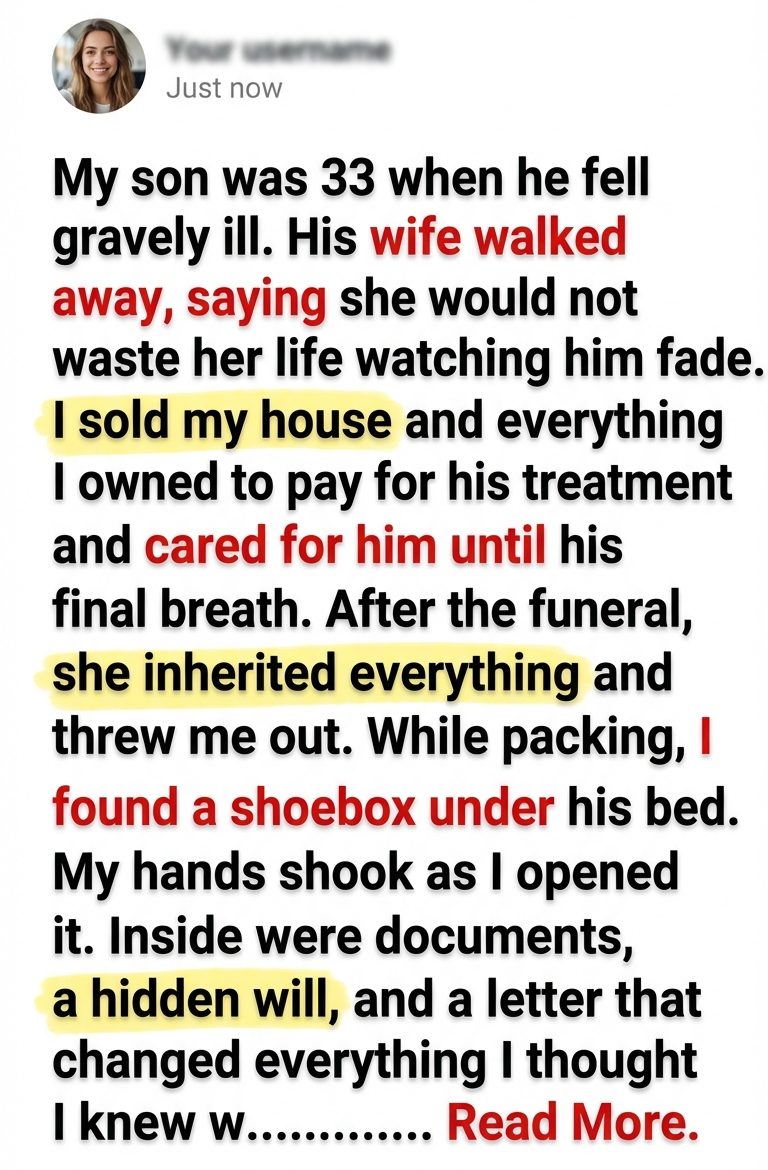
My son was 33 when he fell gravely ill. His wife walked away, saying she would not waste her life watching him fade. I sold my house and everything I owned to pay for his treatment and cared for him until his final breath. After the funeral, she inherited everything and threw me out. While packing, I found a shoebox under his bed. My hands shook as I opened it. Inside were documents, a hidden will, and a letter that changed everything I thought I knew.
The first time the doctors said the word terminal, I felt the room tilt.
It was one of those sterile hospital rooms where everything was too white, too bright, too cold. Machines hummed softly. Nurses moved with practiced calm. Outside the window, people carried on with their ordinary lives, crossing streets, drinking coffee, talking on phones, while mine split cleanly into two parts: before that moment, and after.
My son, Daniel, sat propped against the pillows, only thirty-three years old, his face thinner than it should have been, his hands folded as if he were the one comforting me. He gave me a small smile and said, “Mom, don’t look like that. We’ll fight.”
And I nodded, because that is what mothers do.
We fight, even when we are already afraid we are losing.
Daniel had always been the kind of person who made a room feel warmer just by being in it. As a boy, he used to drag home injured birds, broken bicycles, stray dogs, and anything else he believed deserved a second chance. As a man, he became no different. Gentle. Steady. The sort of person who remembered birthdays, fixed neighbors’ fences, and stayed late at work to help the newest employee learn the ropes.
He had married young.
Her name was Vanessa, and at first, I truly believed she loved him. She was beautiful in the polished, expensive way that made people turn their heads. Daniel adored her. He used to talk about her as if he had somehow won a prize he never expected to receive. I ignored the little things at first—the way she rolled her eyes when he spoke too long, the way she checked restaurant prices before asking how he was feeling, the way every inconvenience seemed to wound her more deeply than his pain ever could.
Then he got sick, and masks fell quickly.
At the beginning, Vanessa still came to appointments. She sat beside him in waiting rooms wearing sleek coats and expensive perfume, scrolling through her phone while doctors explained scans and treatment plans. But as the weeks became months, and the months became darker, her patience thinned like cheap fabric. Hope was exciting to her. Caretaking was not.
The day she left, there was no dramatic buildup.
No tears. No pleading. No attempt to soften the blow.
Daniel had just come home from another exhausting treatment cycle. He could barely walk from the car to the bedroom. I had made soup and was fluffing the pillows behind his back when Vanessa appeared in the doorway holding a suitcase. She looked immaculate, like she was headed to the airport for a weekend getaway instead of abandoning her dying husband.
She crossed her arms and said, in a flat, almost bored voice, “I can’t do this anymore.”
Daniel looked up at her, confused. “Do what?”
“This.” She gestured vaguely at the room, at the medicine bottles, the blankets, the oxygen machine. “I’m not going to waste my life watching you fade.”
I remember the silence after that sentence more than the sentence itself.
It was the silence of something sacred breaking.
Daniel stared at her as though he had misheard. I stood so quickly my chair scraped across the floor. My whole body shook with a kind of rage I had never known before, but my son—my kind, exhausted son—just closed his eyes for a moment as if he were the one ashamed.
Vanessa set her house key on the dresser.
“I deserve a future too,” she said.
Then she walked out.
The front door clicked shut behind her, and that was that.
She did not come back.
After she left, I moved in completely.
At first I told myself it would be temporary, just until Daniel got stronger, just until the new treatment worked, just until the next specialist offered another possibility. But illness does not bargain with mothers, and time does not pause because we are not ready.
I sold my house within two months.
It was the little blue place I had lived in for twenty-six years, the one with the rose bushes Daniel planted for me when he was fourteen. I sold my furniture, my jewelry, the china cabinet my own mother left me, even the old upright piano that had sat in my living room since before Daniel was born. Piece by piece, I turned my life into cash and fed it into hospital bills, medications, specialists, private nurses for the nights when I physically could not stay awake another second.
Friends told me not to bankrupt myself.
They said things like, “You have to think of your future too.”
But my son was my future.
What was a house compared to more time with him? What was furniture compared to another round of treatment, another week, another morning when I could bring him tea and hear him say, “Thanks, Mom”?
So I sold everything.
And when that was not enough, I sold more.
The months that followed blurred into a hard, sacred rhythm. Pills sorted into plastic containers. Thermometers. Insurance calls. Emergency room visits at 3 a.m. Bowls of broth that went untouched. Laundry that smelled of bleach and antiseptic. Long nights spent in a chair beside his bed, listening to his breathing change with the dark.
There are kinds of exhaustion that sleep cannot fix.
But even then, there were moments of grace.
Some afternoons, when the pain medication was working and the sunlight came softly through the curtains, Daniel would talk to me the way he used to when he was little. About books he loved. About fishing with his grandfather. About songs he wanted played at impossible future barbecues we both pretended he would one day host.
Once, in the middle of a quiet evening, he reached for my hand and said, “I’m sorry, Mom.”
I frowned. “For what?”
“For all of this.”
I bent over him and kissed his forehead. “Never apologize for needing me.”
He looked at me with wet, tired eyes. “You always show up.”
That sentence still lives in my bones.
Vanessa, meanwhile, stayed gone.
Not completely invisible—just strategically absent.
Every now and then she would send a text asking vague questions about paperwork or insurance. Once she asked whether Daniel had remembered the password to one of his accounts. Another time she wanted to know whether the title to his car was still in the safe. She never asked if he was afraid. Never asked if he was in pain. Never once asked if he wanted to hear her voice.
Toward the end, Daniel stopped mentioning her altogether.
It was as if he had finally accepted that some people leave long before their shoes touch the door.
Winter arrived early that year.
The trees outside his bedroom window turned brittle and bare. The days grew shorter. His body grew weaker. There came a point when the doctors stopped talking about recovery and began speaking in softer terms: comfort, dignity, peace. I hated those words. They sounded too polished, too neat, for what was really happening.
What was really happening was that my child was slipping away one breath at a time, and I could do nothing except hold on while he drifted beyond my reach.
He died just before dawn on a Tuesday.
Rain tapped softly against the window. The lamp beside his bed cast a gold circle over the blanket. I had been awake all night, counting breaths, smoothing his hair, whispering things mothers whisper when words are all they have left. At some point, his fingers tightened around mine. His eyes opened just enough to find me.
“Mom,” he whispered.
“I’m here.”
He gave the faintest nod.
Then, with my hand in his, he was gone.
The funeral was three days later.
I do not remember most of it clearly. Only fragments. The smell of lilies. The weight of black fabric on my shoulders. The sound of people saying he was in a better place, as if that should comfort a mother who still wanted him here. Vanessa appeared in dark sunglasses and an elegant black dress that looked too new, too carefully chosen. She cried in public, accepted condolences like a widow in a movie, and held herself with that same polished composure she had worn when she left him.
I watched her from across the room and felt something cold settle inside me.
Not grief. Not exactly.
Recognition.
After the funeral, I returned to the house numb with exhaustion. I had barely removed my shoes when Vanessa arrived. She did not ask if I needed tea. Did not ask whether I had eaten. She walked into the living room with a folder tucked under her arm and the sharp expression of someone handling a business matter.
“We need to discuss living arrangements,” she said.
I stared at her. “Living arrangements?”
“The house is mine now. Legally.” She tapped the folder. “As his spouse, everything passes to me.”
Everything.
Such a small word for such cruelty.
I looked around at the rooms where I had bathed my son, fed him, turned him in bed, and whispered him through nightmares. The rooms where I had spent the last of my savings to keep him safe and cared for. She stood there, not seeing any of that, only property lines and account balances.
“I need a little time,” I said quietly.
Her mouth tightened. “I think you’ve had enough time.”
There are humiliations so deep they leave no immediate wound because the pain arrives later. That was one of them. I packed my clothes, my toiletries, and the few things I had brought with me after selling my own home. I folded cardigans with shaking hands. Wrapped framed photographs in towels. Moved like a ghost through the house where my son had died.
Then, in his bedroom, I knelt to look beneath the bed for a missing shoe.
That was when I saw the shoebox.
It was pushed far back into the shadows, plain brown cardboard with no label on top. I almost ignored it. I almost left it there, thinking it was just another forgotten pair of slippers or old paperwork. But something about its careful placement stopped me. Daniel had never been careless. Even sick, he kept small things organized.
My hands trembled as I pulled it toward me.
Inside were documents, a hidden will, and a letter that changed everything I thought I knew.
For a moment, I simply stared.
The will was dated eight months earlier, signed and witnessed properly. My eyes raced over the lines once, twice, three times because I could not believe what I was reading. Daniel had created a new will after Vanessa left. In it, he revoked all previous versions. The house, his savings, his personal effects, the insurance payout that remained—everything was left not to Vanessa, but to a family trust under my control, with specific instructions for how the assets were to be used.
Beneath it was the letter.
Mom, it began, if you are reading this, then it means things happened the way I feared they might.
By the time I reached the second paragraph, I was crying too hard to breathe properly.
He wrote that Vanessa had changed after his diagnosis in ways he could no longer ignore. He had overheard her on the phone discussing “what she’d be left with” if things went badly. He had seen her more concerned with policies and account access than treatment plans. He wrote that he had tried, at first, to believe fear was making her selfish, but the day she walked out, he understood the truth.
Then came the sentence that split me open:
You were the only one who stayed because you loved me, not because you were waiting to inherit me.
I covered my mouth and sobbed into my palm.
The rest of the letter explained everything. Daniel had quietly met with an attorney while he was still strong enough. He had arranged the trust to protect what little remained and to reimburse me, as much as possible, for the money I had spent on his care. He also left instructions that a portion be donated to a patient assistance fund at the hospital, because, even dying, my son had been thinking of strangers.
At the bottom of the letter, he wrote one final line:
You gave me dignity when everything else was being taken from me. Please let this give some back to you.
The next morning, I called the attorney whose card was tucked inside the box.
By the end of the week, Vanessa’s confidence had cracked.
There were meetings. Raised voices. Legal threats that dissolved the moment the hidden will was authenticated. She had assumed being the wife was enough. She had assumed appearances would carry her. She had assumed no one had seen her clearly. But my son had. Quietly, painfully, completely.
When the attorney informed her that the previous inheritance path had been revoked months before Daniel’s death, the outrage on her face was almost theatrical. She called it manipulation. She called it unfair. She even tried to suggest I had somehow coerced him in his final months.
But the letter, the witnesses, and the dates told a different story.
The truth told the story.
In the end, she lost the house. She lost access to the accounts she had already started mentally spending. She lost the version of herself she had planned to present to the world: the elegant widow tragically rewarded for her suffering. There had been no suffering for her. Only calculation.
As for me, I kept the house long enough to breathe again.
I did not become wealthy. There was no secret fortune, no miraculous reversal that erased grief. Real life is not so neat. But there was enough—enough to rent a small place of my own, enough to stop fearing every grocery bill, enough to know that the years I had poured into Daniel’s final chapter had not ended with me discarded like old furniture.
More importantly, I had his words.
Sometimes that is the greater inheritance.
I keep the letter in my bedside drawer now, wrapped in a white cloth. On difficult nights, I take it out and read it slowly. I trace the shape of his handwriting. I stop at the places where the ink pressed harder into the page, where I can almost feel the effort it took him to say what mattered before time ran out.
People speak often about what the dying leave behind.
They usually mean money. Property. Jewelry. Titles. Tangible things that can be counted, fought over, transferred in envelopes and signatures.
But that is not all the dead leave us.
My son left me proof that he knew me. Proof that my sacrifices were not invisible. Proof that love, even at the edge of death, still sees clearly. Vanessa believed she would inherit his life because she had married into it. But she never understood the one thing that mattered most.
Love is not claimed by title.
Love is revealed by who remains when everything becomes unbearably hard.
And I remained.
I remained through the vomiting, the weakness, the morphine haze, the fear, the silence, the final breath. I remained when the house smelled like sickness and sorrow. I remained when hope was thin and exhaustion was endless. I remained because he was my son.
In the end, he knew that.
And because he knew it, he made sure I would know it too.
That shoebox did more than change a legal outcome. It changed the story I had been telling myself. I thought I had failed to protect him from betrayal. I thought I had nothing left but grief and a suitcase. Instead, hidden beneath his bed, my son had left me one last act of love, one last shield against the woman who had mistaken his dying for her opportunity.
She walked away when he needed her most.
But he did not let her walk away with the truth.