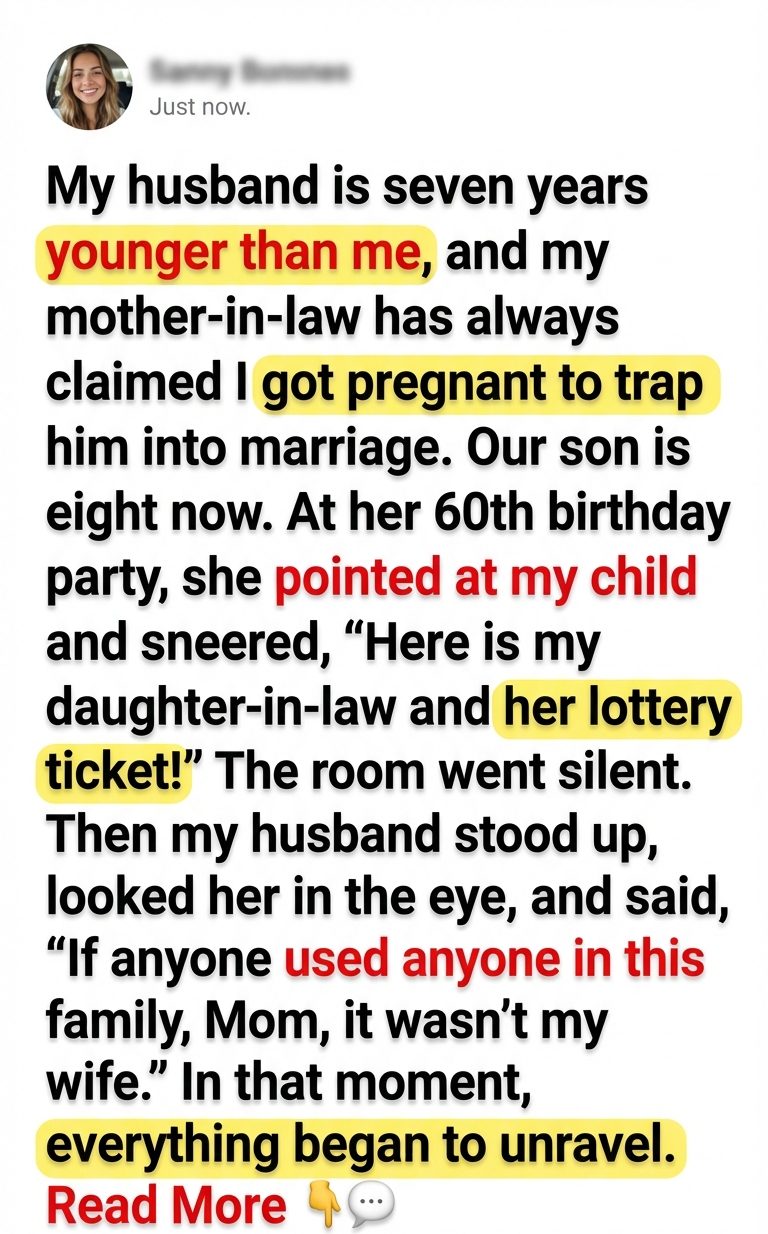
My husband is seven years younger than me, and my mother-in-law has always claimed I got pregnant to trap him into marriage. Our son is eight now. At her 60th birthday party, she pointed at my child and sneered, “Here is my daughter-in-law and her lottery ticket!” The room went silent. Then my husband stood up, looked her in the eye, and said, “If anyone used anyone in this family, Mom, it wasn’t my wife.” In that moment, everything began to unravel.
From the day I met my mother-in-law, she looked at me as though I were a problem she intended to solve.
I was thirty-one, confident, established, and already long past the stage of apologizing for my life choices. Her son, Daniel, was twenty-four, brilliant, warm, and somehow steadier than men I had dated who were a decade older. We met at a charity fundraiser through mutual friends, spent most of the night talking near a tray of miniature desserts nobody touched, and by the end of the evening I knew two things with absolute certainty: he was younger than me, and I did not care.
His mother, however, cared enough for all of us.
At first, she disguised it as concern.
She would tilt her head and say things like, “You’re just in very different stages of life,” or, “Daniel has always been so impressionable,” in the tone people use when they want to sound thoughtful while planting poison. When Daniel and I got serious, she grew bolder. She made little jokes about cradle robbing. She called me “the experienced one” in front of relatives with a smile too sharp to be kind. She never said anything openly vicious while Daniel was still close enough to hear, but she never needed to. Women like her built entire reputations on saying cruel things beautifully.
Then I got pregnant.
It was not planned, though not unwelcome. We had been together for almost two years, living in the same apartment, talking openly about marriage and a future and where we wanted to settle down. When I showed Daniel the positive test, he stared at it for a second, then laughed once in disbelief before lifting me clean off the kitchen floor. We sat on the couch afterward with takeout growing cold between us, talking about names and fear and money and how terrifying it was that happiness could arrive in such a fragile form.
His mother’s reaction was very different.
She didn’t congratulate us.
She didn’t ask if I was feeling all right.
She looked at the sonogram photo like it was forged evidence and said, “Well. I suppose this speeds up your plans.”
I remember the silence after that.
Daniel frowned. “What does that mean?”
But she only smiled and reached for her wineglass. “Nothing, darling. Just that some women know how to secure things quickly.”
That was the first time she said it in front of him.
Not the last.
Over the years, her theory became family folklore. Not accepted exactly, but repeated often enough that it hung in the air at holidays and barbecues and birthday dinners. According to her, I had set my sights on her sweet, younger son, gotten pregnant on purpose, and maneuvered him into marriage before he was ready. The fact that Daniel adored our son, built a thriving career, and loved me with visible, unembarrassed devotion did nothing to soften her. If anything, it seemed to irritate her more. Happiness, when it contradicted her version of events, only made her cling harder to the lie.
Our son, Noah, turned eight that spring.
He had Daniel’s dark eyes, my stubborn mouth, and a laugh that could fill a room before his body even entered it. He was the kind of child strangers smiled at in grocery store lines. The kind who remembered janitors’ names at school and cried over dead ladybugs on sidewalks. I spent a lot of time protecting him from his grandmother’s tone, if not always her words. She was never openly cruel to him, but there was a kind of chill in the way she treated him, as though he were evidence of some old grievance rather than a little boy made of love and cereal crumbs and missing front teeth.
Daniel saw it too.
That was the thing people often missed about my husband because of his age when we met. They assumed youth meant blindness. That he was naïve, dazzled, or easily led. But Daniel noticed everything. He just believed for a long time that patience would fix what confrontation might break. He kept giving his mother opportunities to be better. More understanding. More generous. Less obsessed with proving herself right.
She wasted every single one.
When her sixtieth birthday approached, she announced she wanted “one proper family celebration” at a country club outside town. The kind of place with cream tablecloths, chandeliers, and servers who moved like they were gliding. She spent weeks planning it and even longer making sure everyone knew how much work she had put into it. My sisters-in-law coordinated floral centerpieces. Her brother made a speech in advance over the phone to “set the tone.” There were printed menus, assigned seating, and enough passive-aggressive emails to qualify the whole thing as a military operation.
I did not want to go.
Daniel knew that. We sat on the edge of our bed the night before the party while Noah slept down the hall, and I told him plainly, “Your mother is looking for a stage.”
He sighed and rubbed his jaw the way he did when he was tired before he admitted something difficult. “I know.”
“And stages are dangerous when someone has been rehearsing resentment for eight years.”
He looked at me then, really looked, and some quiet decision seemed to settle behind his eyes. “If she does anything tomorrow,” he said, “I’m ending it.”
I wanted to believe him.
But history makes promises feel flimsy. There had been scenes before—comments at Christmas, veiled insults at Easter, one unforgettable anniversary dinner where she referred to me as “the family surprise package.” Each time Daniel addressed it, she cried, denied, or reframed it as a joke that my “sensitivity” had distorted. There is a certain kind of manipulative parent who survives on the belief that no one will ever challenge them publicly. In private they can always rewrite. In public, they count on politeness to protect them.
The party began beautifully.
Of course it did.
The country club lawns were trimmed to perfection. White hydrangeas filled the entry hall. Guests arrived in linen and silk and summer-weight suits, carrying gift bags and expensive bottles of wine. A trio played jazz near the terrace doors. The cake alone looked like a sculpture. My mother-in-law wore a fitted navy dress with pearl earrings and the expression of a woman fully enjoying being the center of a universe she believed she had earned.
I kept Noah close.
He looked painfully handsome in a little blazer, serious at first and then increasingly restless as adults drifted into long conversations about property values, cruises, and cholesterol. Daniel moved easily through the room, greeting cousins, hugging aunts, carrying plates for older relatives. He was charming when he wanted to be, but I knew him well enough to see the tension underneath it. His smile never fully reached his eyes whenever his mother was nearby.
Dinner was served just after seven.
We were seated at a long table beneath a chandelier that threw soft golden light over everything, making even unpleasant people look gentler than they were. Speeches began between courses. Her sister spoke first, reminiscing about childhood summers. A friend from church talked about my mother-in-law’s generosity. Someone joked about sixty being the new forty. Laughter rose and fell on cue. Wineglasses clinked. My mother-in-law basked in it all with the smug serenity of someone who had spent her whole life curating admiration.
By dessert, she was glowing.
That was usually the danger zone—when praise, attention, and alcohol braided together into the version of her that needed an audience for her cruelty. I saw her glance down the table at us more than once, eyes narrowing faintly whenever Daniel touched my shoulder or leaned toward Noah to whisper something that made him grin.
Then came the toast.
She stood slowly, one hand lifting her champagne flute, the other pressed theatrically to her chest while the room softened into expectant silence. She began conventionally enough, thanking everyone for coming, for making her feel so loved, for “reminding me what family is all about.” Her voice carried easily, trained by years of knowing exactly how to command attention. She made a few jokes. People laughed. She thanked her daughters. She thanked old friends. Then her gaze settled on our end of the table.
I felt it before she spoke.
“Of course,” she said lightly, “family is always full of surprises.”
A few polite smiles appeared.
She turned her body slightly and pointed, actually pointed, at Noah.
“And here,” she said, with that brittle little laugh she used when she was about to slice someone open, “is my daughter-in-law and her lottery ticket!”
The room went silent.
Not politely quiet. Not the hush of people waiting for the joke to land. True silence. Heavy, shocked, immediate. Even Noah seemed to feel it. He looked up from his dessert, confused, spoon still in his hand.
My chest tightened so hard it hurt.
For one terrible second, all I could think was not in front of him. Whatever humiliation she wanted to inflict on me, however badly she needed her old story to breathe, she had dragged my child into it. My beautiful, bright, eight-year-old son, reduced to a prop in his grandmother’s bitterness.
I started to rise.
But Daniel was faster.
He stood so abruptly his chair scraped hard across the floor. The sound cracked through the room like a starter pistol. Every head turned toward him. He looked at his mother with a face I had never seen before—not angry exactly, though anger was there, incandescent beneath the surface. It was something colder than anger. Final.
He put one hand on the back of Noah’s chair, steadying him without taking his eyes off his mother.
Then he said, very clearly, “If anyone used anyone in this family, Mom, it wasn’t my wife.”
You could feel the room lean.
My mother-in-law blinked, caught off balance not by opposition alone but by public opposition. “Daniel,” she said with a strained laugh, “don’t be ridiculous. It was a joke.”
“No,” he said. “It wasn’t.”
Her smile faltered.
He took a breath, and in that brief pause I sensed it—years of restraint giving way all at once. Not impulsively. Not messily. Like a dam finally admitting the obvious fact that it had been split open a long time ago.
“You’ve spent eight years telling anyone who would listen that my wife trapped me with pregnancy,” he said. “Eight years insulting the woman I love because you couldn’t stand that I made a choice you didn’t control.”
Several relatives lowered their eyes. A cousin near the far end of the table stared fixedly at her plate. My mother-in-law’s sister looked as though she wanted to vanish into the centerpiece.
His mother recovered enough to stiffen. “I think this is neither the time nor the place.”
Daniel gave a short, humorless laugh. “That didn’t stop you.”
She opened her mouth, but he kept going.
“You want to talk about using people?” he said. “Let’s talk about how Dad funded your lifestyle for years while you drained joint accounts and called it budgeting. Let’s talk about how you pressured him into staying in a marriage he was miserable in because appearances mattered more to you than truth. Let’s talk about how every time one of us did something you didn’t like, you rewrote it until you were the victim and everyone else was manipulative.”
A soft sound escaped someone at the table. Shock, probably. Or recognition.
My mother-in-law’s face was turning a dangerous color. “That is enough.”
“No,” Daniel said again. “It’s not. Because you’ve spent nearly a decade making my wife pay for your resentment. And since you brought my son into it, we’re done pretending.”
I sat frozen.
Part of me wanted to stop him, to protect him from what came after, because families like his did not respond to exposure with enlightenment. They responded with blame, fracture, denial. But a larger part of me—quieter, older, exhausted—understood that this moment had been coming from the first day she realized I would not disappear.
My mother-in-law set down her glass with a sharp click. “You have no idea what your father and I went through.”
“I know enough,” Daniel replied. “I know he told me, near the end, how often you used guilt to get your way. I know how many times he apologized for not protecting us from your mouth. And I know you’ve confused cruelty with honesty for as long as I can remember.”
There it was.
The first true crack.
Because until that moment, I had not known my father-in-law had ever said such things aloud to Daniel. He had died two years earlier after a brief illness, and though he was a gentler soul than his wife had ever deserved, he had rarely confronted her openly. I used to think that was weakness. In that instant, I realized it may also have been fatigue.
My mother-in-law looked stricken for exactly one second before indignation rushed back in to save her.
“Oh, now your dead father gets dragged into this?” she snapped. “How convenient.”
Daniel’s jaw tightened. “You dragged an eight-year-old into it.”
No one moved.
No one ate.
No one came to her rescue.
That, I think, startled her most of all. Not his defiance, but the absence of immediate reinforcement. Her whole life had depended on people smoothing over her edges so they would not be cut. But once one person refuses to do it loudly enough, others often discover their courage in the echo.
It was my sister-in-law, Claire, who spoke next.
Very softly, but clearly.
“Mom,” she said, “you need to stop.”
My head turned.
Claire had spent most of her life orbiting their mother carefully, speaking in appeasing tones, managing moods before they fully formed. Hearing that sentence from her felt like watching a locked window swing open in winter.
Their mother stared. “Excuse me?”
Claire swallowed. “You’ve said awful things about her for years. About both of them. We’ve all heard it.”
My mother-in-law looked from one child to the other as if betrayal were the only language she understood fluently. “So this is what we’re doing? Attacking me at my own birthday?”
“No,” Daniel said. “You did that to yourself.”
The unraveling, once started, came quickly.
An aunt murmured that maybe everyone should calm down, but even she did not defend the comment. Claire admitted she had stopped bringing friends around because she never knew when her mother would humiliate someone for sport. My brother-in-law, who usually hid inside jokes and business trips whenever family tension flared, finally said, “You always push until someone breaks, and then you act shocked.”
I watched my mother-in-law’s face as control left it piece by piece.
It was almost frightening how naked she looked without the protective coating of admiration and intimidation. Smaller somehow. More frantic. She tried the old methods in sequence: denial, outrage, tears, self-pity. First it was “You’re misunderstanding me.” Then “After all I’ve done for this family.” Then “I can’t believe you’d treat me this way on my birthday.” But the machinery had jammed. The script no longer worked because too many people had finally acknowledged they had memorized it.
And through it all, Noah sat very still.
That was what finally moved me.
I stood, bent beside him, and touched his hair. “Hey,” I whispered, “why don’t we go get some air?”
He nodded, solemn in the way children become when they sense adult pain without understanding its architecture. Daniel looked at me immediately, the fury in him softening at the edges the moment his eyes found our son.
“I’m coming,” he said.
We left the ballroom together.
Outside, the terrace was cool and quiet, washed in summer evening shadows and the faint scent of cut grass. Inside, through the glass, I could still see figures moving in agitation around the table. But out there, under the dim garden lights, it was just the three of us.
Noah looked up at Daniel. “Did Grandma mean me?”
The question nearly undid me.
Daniel crouched to eye level. “No, buddy,” he said gently. “Grandma said something mean because she was being unfair. None of this is your fault. Not even a little bit.”
Noah considered that with the grave attention only children can bring to broken adult moments. “Was she being mean to Mom?”
“Yes,” Daniel said.
Noah slipped his small hand into mine. “Then I don’t like her party.”
I laughed, and the laugh broke into tears halfway through. Daniel stood and pulled us both in, his arm around my shoulders, Noah pressed against my side. For a long moment, none of us spoke. I could feel Daniel’s heart pounding through his shirt.
“I’m sorry,” he whispered into my hair. “I should have stopped this years ago.”
Maybe he should have.
But regret is not always useless. Sometimes it arrives as action, belated and imperfect but real. Sometimes the person who failed to protect you finally understands what protection requires. That night, on a stone terrace outside a ballroom full of stunned relatives and melting birthday cake, my husband stopped being a son who hoped his mother might change and became, fully, the man I had always believed he was.
We did not go back inside.
Daniel texted his siblings that we were leaving and that he would talk to them later. The drive home was quiet except for Noah chattering sleepily in the back seat about whether we could order pizza because the party dessert had “suddenly not felt right.” Children have a genius for wandering back toward normalcy. It saved me that night. By the time we got home, got him changed, and tucked him into bed, my own shaking had finally begun to subside.
Then Daniel and I sat at the kitchen table in the dark.
No candles. No speeches. Just the hum of the refrigerator and the kind of silence that follows a storm once you realize the house is still standing.
“She’s going to call everyone,” I said.
“I know.”
“She’s going to cry. Rewrite it. Tell people you ambushed her.”
“I know.”
I looked at him across the table. “And?”
He met my gaze steadily. “And I’m done participating in the lie.”
There it was again—that finality.
We talked for hours that night. About boundaries. About what contact with his mother would look like now. About Noah, and what we would and would not allow him to be exposed to. About all the smaller moments over the years that had led here, each one easier to excuse than confront until together they became impossible to live with. Daniel admitted how deeply his father’s late confessions had affected him, how ashamed he felt that he had kept hoping for improvement instead of drawing a line sooner.
I told him something I had never said out loud.
“That woman never really hated me for being older,” I said. “She hated me because I was the first person you chose without asking her who you should be.”
He sat back as if the sentence had struck him physically.
Then he nodded. “You’re right.”
In the weeks that followed, the family fallout was exactly as messy as expected.
Some relatives avoided us, preferring neutrality over honesty. Others quietly reached out to say they had seen it for years and were sorry they had said nothing. My mother-in-law left voicemails ranging from furious to tearful to bizarrely magnanimous, as though granting us a chance to apologize to her. Daniel did not answer. Claire visited twice without telling their mother. My brother-in-law took longer, but eventually came around too.
And my mother-in-law?
She learned, perhaps for the first time in her life, that public cruelty sometimes costs more than the thrill it purchases.
We did not cut her off in a theatrical blaze. Real families are rarely that neat. But we did set terms. No contact with Noah unless there was genuine accountability. No undermining me. No revisionist nonsense about traps, tickets, or stolen sons. Daniel wrote it all in one clear email and sent it without embellishment. Whether she changes is no longer the question shaping our home. That is the freedom I did not know we were missing until we had it.
Sometimes I still think about that moment at the table.
Her finger pointing. Noah’s spoon suspended in his hand. The cold silence that followed. And then Daniel standing—not hesitating, not laughing it off, not smoothing it over—and saying the one thing that cracked the whole performance open: If anyone used anyone in this family, Mom, it wasn’t my wife.
He was right.
I had spent years being cast as the manipulator because it was easier for his mother to believe in schemes than in love. Easier to call my son a lottery ticket than to admit her son had grown into a man she could not control. Easier to insult me than to confront the truth of her own history—how often she had confused possession with motherhood, dominance with devotion.
That night did not just expose her.
It freed us from her version of our story.
And once the truth was spoken in a room full of witnesses, once the silence stopped protecting the wrong person, there was no weaving it back together.
Everything unraveled.
But for the first time in years, what remained was real.