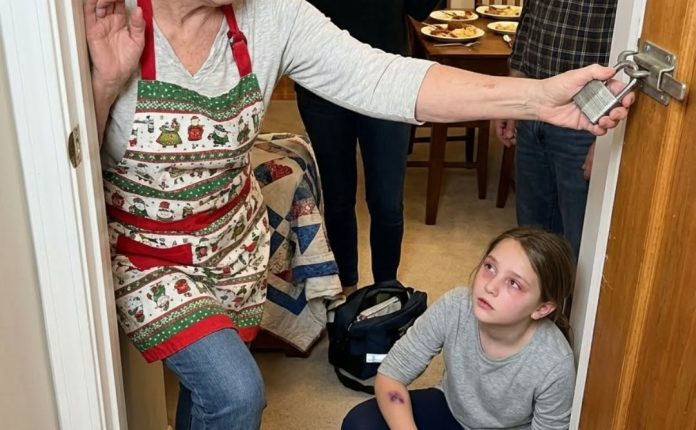
Michael repeated that there had been a mix-up over childcare.
Denise nodded.
Then Carter spoke.
“Dad told me not to answer anybody.”
Michael closed his eyes.
The social worker asked Carter whether this had happened before.
He looked at me before answering.
“Not like tonight.”
That phrase stayed with me.
Not like tonight.
I realized there were things happening in my son’s house that I had never been allowed to see.
The next morning, while Lily slept, I called Renee.
I did not accuse her. I simply told her what had happened and asked why she had told Michael she would not cover for him again.
There was a long silence.
Then she started crying.
Three months earlier, Michael and Denise had left the children alone one evening while they went to a party. Carter had walked outside looking for them after Lily woke up frightened. A neighbor found him near the street and called the police.
Renee had arrived before officers could fully sort out what happened.
Michael convinced her to say she had been supervising the children and had stepped away briefly.
She lied for him.
She told herself she was protecting the family.
Instead, she protected Michael from the consequence that might have stopped him from doing it again.
The school later raised concerns because Carter had been falling asleep in class and became anxious whenever anyone talked about emergency contacts. Family services had started asking questions.
Michael had hidden almost all of it from me.
Renee said she refused to lie a second time. She had even told Denise that if they left the children alone again, she would report it herself.
That was why Michael needed everyone to believe Lily was at Renee’s house.
He was not simply trying to enjoy a birthday weekend.
He was hiding a pattern.
There was one more thing Renee had kept.
A voicemail.
Michael had called her earlier that evening when she did not answer the first time. His message was short.
He asked her to tell me Lily was staying with her if I called.
Renee had never agreed.
She still had the recording.
I told her not to delete it.
For the next few days, my life narrowed to two children and a hospital room.
Lily improved enough to go home with me. Carter came too under a temporary safety arrangement while the adults sorted out what would happen next.
On our first morning together, I found him sitting at my kitchen table with a pencil and a piece of paper.
He was writing down the time Lily took her medicine.
I asked why.
He shrugged.
“So nobody can say it happened different.”
That nearly broke me.
A week later, his teacher called. She explained something I had not known about Carter. A few months earlier, after an emergency-preparedness lesson, he had started keeping little timelines whenever something frightened him. Writing down times made him feel less confused.
That was why the paper from the night I found them was so careful.
It was not evidence because a ten-year-old had planned to expose his father.
It was evidence because a frightened boy had learned that adults sometimes changed their stories.
Michael called me repeatedly during those days.
Sometimes he was angry. Sometimes apologetic. Sometimes he spoke as if the entire disaster had happened to him.
He said I was destroying his family.
I told him the family had been in danger before I ever unlocked his front door.
Denise was harder to read.
When she spoke to me alone, she admitted she had wanted to stay with Lily. She said Michael convinced her they would only be gone a few hours and that the children would sleep.
I asked why she left Carter too.
She stared at the floor.
“Michael said Carter would call us if Lily got worse.”
“He’s ten.”
She started crying.
I felt sorry for her.
But feeling sorry for someone is not the same as pretending they had no choice.
She had made one.
So had Michael.
The first review meeting went badly.