My own parents beat my sleeping six-year-old and smashed her face for my niece’s birthday photos. They clinked glasses and laughed, “Finally she’ll look as worthless as she is.” I didn’t argue — I called 911 while their perfect front lawn filled with sirens.
The dispatcher told me to keep the line open and speak quietly, so I stood just outside the guest-room doorway with my phone pressed against my ear and forced myself not to make a sound that would warn them.
From where I was standing, I could see my mother dragging my daughter upright against the pillows while my father held his phone sideways, adjusting the frame beneath the birthday balloons as though he were still trying to capture some perfect family moment.
Image
They were still taking pictures.
That was the part my mind kept refusing to accept.
My daughter had fallen asleep in her sweatshirt and leggings after the drive, worn out before the party was even finished, and when I had last seen her she had been curled comfortably on the guest-room bed with her hair across one cheek.
Now that same hair covered only part of the swelling.
Not enough.
The side of her face looked wrong immediately, the kind of wrong a parent recognizes before the brain has even found language for it, and I could see how slowly she was trying to wake while my mother kept one hand under her chin.
Beside the bed stood my niece in a paper birthday crown.
She should have been thinking about cake, gifts, wrapping paper, and whatever six-year-olds remember about a birthday party after the adults stop paying attention.
Instead, she was squeezing her hands together so tightly that the cardboard gift bag at her feet trembled every time she shifted her weight.
I had only stepped outside to get the last present from the car.
Less than five minutes.
I kept replaying that number because it seemed impossible that something so ugly could fit inside such a small amount of time.
Five minutes was walking down the driveway, opening the car, finding the package, and coming back through the house.
Five minutes was nothing.
Yet it was enough for my parents to turn a child’s birthday picture into something I would never be able to forget.
My mother pinched my daughter’s chin and turned her face toward my father’s phone.
“Hold still,” she snapped.
My daughter was barely awake.
Her eyelids fluttered, and her body sagged toward the pillows as though she still did not understand why she was being pulled upright.
My father laughed and tapped the screen several times.
The camera flash lit the room for an instant and caught two half-full glasses sitting on the dresser.
The sight of those glasses hit me almost as hard as the swelling on my daughter’s cheek because they made the whole thing feel casual to them.
They had hurt her, positioned her for photographs, and kept drinking.
I wanted to cross the room immediately.
I wanted to rip the phone from my father’s hand, push my mother away, and demand to know what kind of grandparents could do something like that to a sleeping six-year-old.
But the dispatcher was still speaking quietly in my ear.
I gave the address.
I described the swelling.
Then I repeated exactly what I had heard my parents say.
I did not soften it because they were my parents.
I did not call it a misunderstanding.
I did not tell myself that maybe I had entered the room at the wrong moment and somehow missed an explanation that would make any of this normal.
And I did not warn them that help was coming.
That mattered to me more with every second.
If I confronted them too early, they would have time to delete the photographs, close the camera app, move the glasses, straighten the room, and agree on a version of events before anyone else walked through the door.
I had grown up around them.
I knew how quickly they could turn something cruel into something respectable once outsiders were watching.
So I stayed on the line.
My mother continued fussing with my daughter’s face as though the problem was the angle of the photograph rather than the child in front of her.
My father checked his screen, frowned at one image, and adjusted his grip.
My niece kept looking from my daughter to the doorway.
For one second, our eyes met.
I put a finger to my lips.
She did not speak.
She only tightened her hands again.
Then the first siren reached the end of the street.
My father’s head snapped toward the window.
It was the first time since I had come back inside that he looked genuinely interrupted.
My mother released my daughter’s chin.
“What did you do?”
There was no confusion in her voice.
That told me more than any excuse she could have offered later.
She did not ask what had happened outside.
She did not ask whether somebody was hurt.
She looked directly at me and asked what I had done.
I crossed the room.
The blue blanket beneath my daughter had been bunched near her legs, so I pulled it around her, gathered her carefully against me, and lifted her from the bed.
She made a small sound when her swollen cheek touched my shoulder.
Every muscle in my body tightened at once.
There are moments when anger feels almost physical, as if it has weight and temperature, and I understood in that instant how easily I could lose control if I let myself look at my parents instead of my child.
But my daughter needed my hands steady.
The dispatcher was still listening.
So I held her securely and moved away from the bed.
Red and blue light began sliding across the pale walls.
Outside, emergency vehicles crowded the curb beside my parents’ trimmed front lawn, the mailbox, and their spotless family SUV.
That ordinary suburban scene made everything inside the house feel even more unreal.
The yard looked cared for.
The driveway looked clean.
The birthday decorations were still up.
From the street, nothing about that house would have warned anyone what had been happening in the guest room.
Party guests started backing away from the porch as responders moved through the open front door.
The atmosphere changed instantly.
A room my parents had controlled seconds earlier no longer belonged to their version of events.
My father reacted first.
He said my daughter had fallen from the bed.
He said it quickly, as though the explanation had been waiting for an audience.
My mother followed with a different defense.
She said I was emotional.
She said I had misunderstood a family joke.
The two explanations did not even fit together.
If my daughter had simply fallen, there was no reason for a joke about finally making her look worthless.
If it was all a joke, there was no reason for my father to immediately invent a fall.
Still, both of them kept talking.
They talked over me, over each other, and eventually over the people who were trying to examine my daughter.
My father kept insisting that accidents happened.
My mother kept insisting that I had always been too sensitive where my daughter was concerned.
They seemed convinced that if they produced enough words, one version might eventually become believable.
But there was something my father had forgotten in the rush to explain himself.
His phone was still glowing in his hand.
The camera app was open.
An officer noticed it before my father could lock the screen.
What appeared there was not one carefully chosen birthday picture.
It was a burst of photographs.
The sequence mattered.
In the first image, my daughter was asleep.
That alone damaged my father’s claim that she had simply fallen and then somehow ended up being photographed upright beside the birthday decorations.
In the next image, my mother’s fingers were visible under my daughter’s chin.
She was physically positioning her face toward the camera.
Then came the last image.
My niece had turned away from the camera while my father reached toward my daughter’s face.
No one needed me to interpret what the photographs showed.
The progression was sitting there on the screen in the order it had happened.
The officer took the phone before my father could close the app or lock it.
That was when my parents’ stories began changing again.
My father said my mother had been the one handling my daughter.
My mother said my father had taken things too far.
Then each of them insisted that neither had intended to hurt her.
The shift was almost immediate.
A few minutes earlier they had been presenting a united front.
Now they were separating themselves from each other’s actions, each trying to preserve a smaller piece of innocence.
I sat with my daughter still wrapped in the blue blanket while a responder knelt beside us and asked her simple questions.
The questions were gentle and short.
My daughter answered some of them with tiny movements and others with quiet words.
The responder checked the swelling along her cheek while I kept one arm around her shoulders.
I was trying not to crowd her.
I was also trying not to let her see what was happening on my face whenever my parents spoke.
My niece was still near the bed.
The paper crown remained on her head, tilted slightly now, and I remember looking at it and thinking how completely the adults in that room had stolen the meaning from what should have been her birthday.
Then she reached up and removed it herself.
She held it for a second before setting it on the floor.
That small action changed the room more than any shouting could have.
She looked at the officer and said, “Grandma said I had to stand beside her so everyone could see which granddaughter was worth celebrating.”
My mother immediately told her to stop talking.
My niece flinched.
It was quick, but everyone close enough to see her noticed.
She did not pick the crown back up.
And she did not take back what she had said.
My mother’s face hardened.
She tried to redirect the conversation toward me again, saying I had caused chaos at a family birthday and was frightening both children by making everything bigger than it needed to be.
That argument might have worked in another setting.
It might even have worked on me years earlier, before I had learned how often she used embarrassment to make someone doubt what they had clearly seen.
But there was no way to shrink what had happened now.
My daughter had a swollen cheek.
My niece had described the purpose of the staged photograph.
My father’s phone contained a sequence showing my sleeping child being repositioned for the camera.
And both of my parents had already offered explanations that contradicted each other.
I stopped trying to answer every sentence they threw at me.
My attention stayed on my daughter.
She had become very quiet again, the kind of quiet that frightened me more than crying would have.
She kept one hand curled into the edge of the blue blanket.
Every so often her fingers tightened around the fabric.
I rubbed her back slowly and told her I was right there.
I did not ask her to tell me what happened.
Not yet.
There were already adults asking necessary questions, and I did not want my fear to become one more thing she had to manage.
My parents, however, seemed desperate to fill every silence.
My father complained that his phone had been taken before he could explain the pictures.
My mother said my niece was confused because she had been overstimulated by the party.
Then my father said he had only been trying to calm everyone down.
Each new sentence created another problem for the sentence before it.
I kept thinking about the moment I had walked back inside.
The balloons above the bed.
My father holding the phone sideways.
My mother’s fingers under my daughter’s chin.
The two glasses on the dresser.
My niece’s hands shaking beside the gift bag.
None of those details had looked accidental.
They had looked arranged.
That realization was bad enough.
Then I started remembering the exact words my parents had laughed over their drinks.
“Finally she’ll look as worthless as she is.”
I had heard cruelty from them before.
I knew how they compared people, how they could turn affection into a competition and then act offended when someone refused to participate.
But I had never imagined they would bring that ugliness down onto my six-year-old while she was asleep.
I looked at my niece and understood something else.
She was not standing beside that bed because she had wanted a funny birthday picture.
She had been placed there too.
She had been made part of the comparison.
Whatever my parents thought they were giving her by declaring her the granddaughter “worth celebrating,” they had burdened her with watching another child be degraded for her benefit.
The birthday crown on the floor said more about how she felt than anything else could have.
I thought that was the worst thing we were going to hear that night.
I thought the photographs and my niece’s statement had already explained the shape of what had happened.
My parents had wanted a cruel comparison.
They had wanted a picture that made one granddaughter look favored and the other humiliated.
It was monstrous, but it was at least understandable as their choice.
Then my daughter shifted against me.
Her eyes opened more fully for the first time since I had lifted her from the bed.
She looked tired and confused.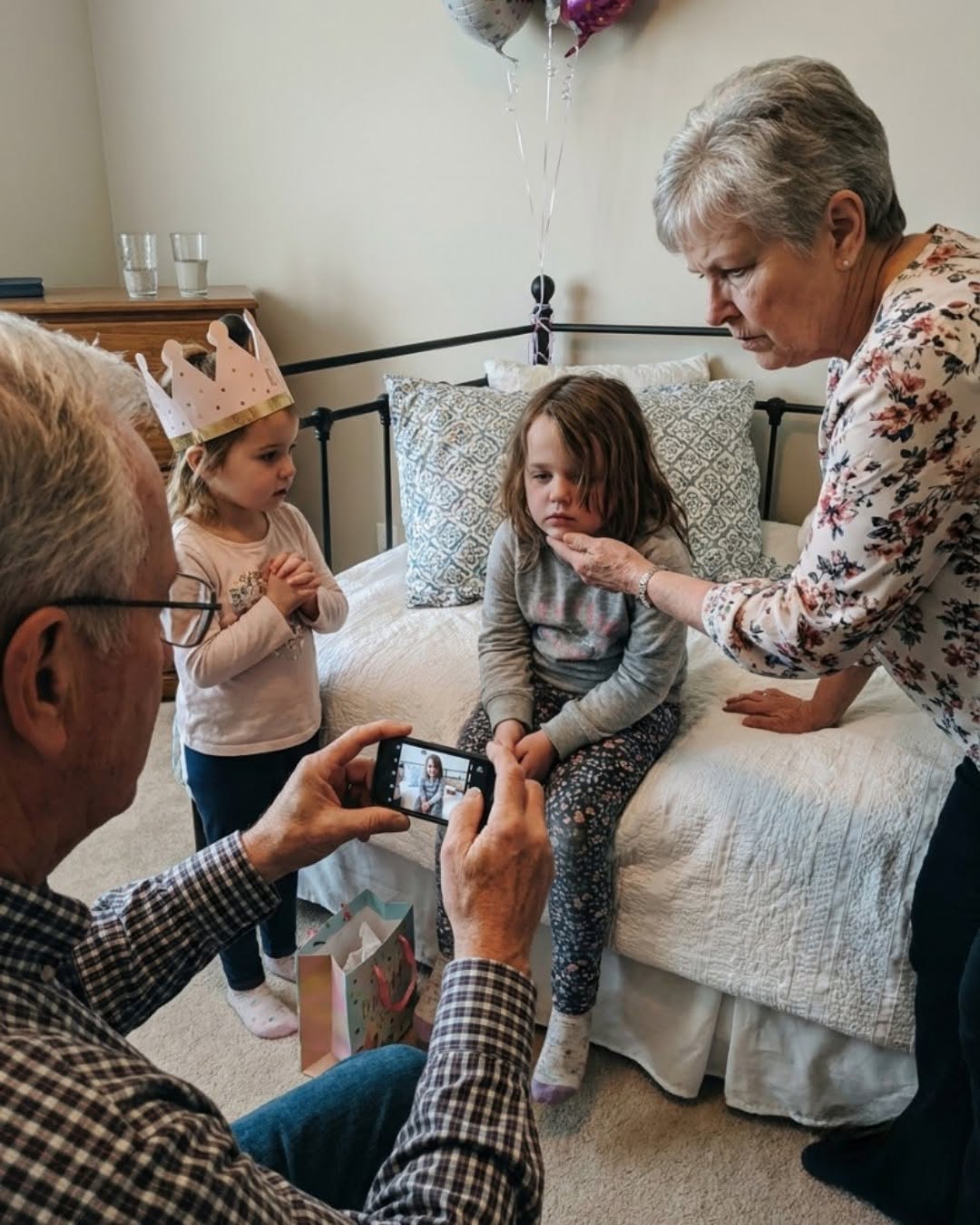 One hand stayed wrapped in the blue blanket while the other moved carefully toward her face before stopping short of the swollen area.
I told her not to touch it and asked whether she needed anything.
She did not answer that question.
Instead, she looked at me with an expression I could not immediately read.
It was not anger.
That would have been easier.
It looked more like fear mixed with uncertainty, as though she was waiting to learn whether I was going to be upset with her for something she did not understand.
Then she whispered, “Mom, Grandma showed me your message.”
For a moment, I thought I had misheard her.
I asked what message she meant.
My mother’s voice stopped behind us.
My daughter tightened her fingers around the edge of the blanket.
She swallowed and continued in the same small voice.
“She said you told them to fix my face for the pictures.”
Everything I thought I understood about that room shifted.
Until then, the question had been why my parents would hurt my daughter and turn it into a birthday photo.
Now there was another question underneath it.
What had my mother shown my six-year-old — and why had she wanted my daughter to believe that I had asked for this?
One hand stayed wrapped in the blue blanket while the other moved carefully toward her face before stopping short of the swollen area.
I told her not to touch it and asked whether she needed anything.
She did not answer that question.
Instead, she looked at me with an expression I could not immediately read.
It was not anger.
That would have been easier.
It looked more like fear mixed with uncertainty, as though she was waiting to learn whether I was going to be upset with her for something she did not understand.
Then she whispered, “Mom, Grandma showed me your message.”
For a moment, I thought I had misheard her.
I asked what message she meant.
My mother’s voice stopped behind us.
My daughter tightened her fingers around the edge of the blanket.
She swallowed and continued in the same small voice.
“She said you told them to fix my face for the pictures.”
Everything I thought I understood about that room shifted.
Until then, the question had been why my parents would hurt my daughter and turn it into a birthday photo.
Now there was another question underneath it.
What had my mother shown my six-year-old — and why had she wanted my daughter to believe that I had asked for this?