The first thing I remember clearly is my granddaughter trying to breathe at the bottom of my basement stairwell while Christmas dinner sat untouched upstairs.
She was crouched against the lowest step, bruised, bandaged, and pulling for air as if every breath had to be dragged into her chest by force.
Beside her lay the portable oxygen tank she depended on.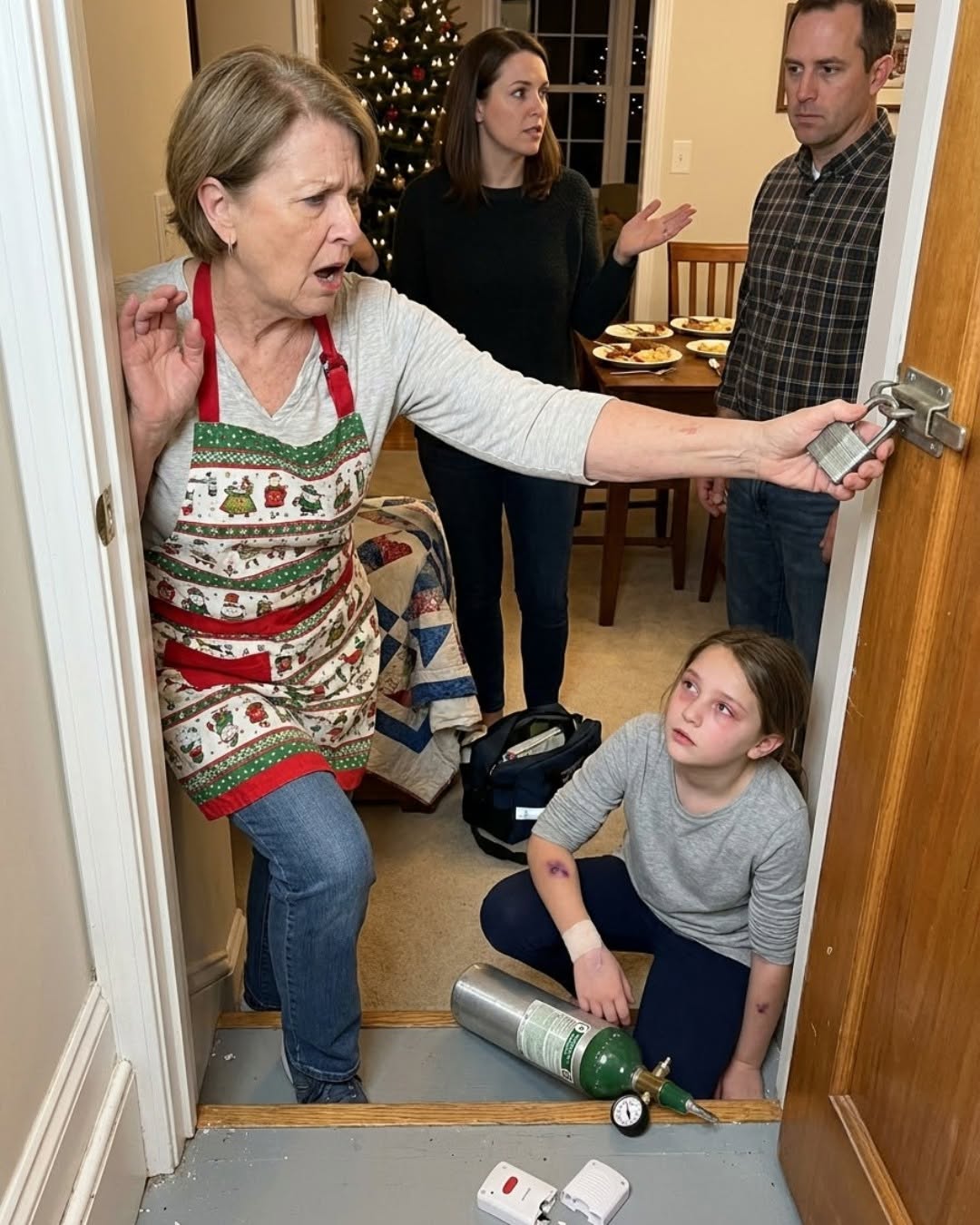
Its gauge was pinned at zero.
In one hand, she was still clutching what remained of her emergency buzzer, the small device snapped cleanly in half.
Only minutes earlier, I had been standing in my dining room believing my daughter when she dismissed the sounds beneath us as another tantrum.
My daughter’s boyfriend had been at the Christmas table with us, and neither of them had acted as though anything serious was happening downstairs.
The ham was on the table, the mashed potatoes were cooling, and the tree lights were blinking across a room that was supposed to feel safe.
Instead, my sick granddaughter had been locked behind a padlocked basement stairwell door with an oxygen tank that had been drained empty.
I did not stop to argue once I found her.
I lifted her carefully, carried her upstairs, and reached for the small emergency cylinder kept in her medical bag.
My hands shook while I connected it, but I made myself focus on the fittings, the tubing, and the sound of oxygen finally moving where it was supposed to go.
I wrapped her in a quilt on the living room couch and stayed close until the panic in her breathing began to ease.
Then I looked at my daughter and her boyfriend.
Whatever explanation they thought they were going to give me could wait outside.
I grabbed their bags, carried them to the yard, threw them onto the lawn, and locked both adults outside before dessert had even been served.
My daughter immediately started pounding both palms against the patio door.
Her boyfriend paced behind her, raising his voice and insisting that I had misunderstood what happened.
I could see their mouths moving through the glass, but I was no longer interested in explanations that came before my granddaughter’s safety.
The Christmas ham remained in the center of the dining table while melted butter hardened across the mashed potatoes.
Two plates sat untouched beneath the blinking tree lights, and the whole room had the strange appearance of a celebration interrupted in the middle of a sentence.
My granddaughter stayed curled beneath the quilt, breathing through the oxygen I had connected for her.
I kept looking at her face, trying to make sense of how close I had been to missing what was happening inside my own house. Then I went back downstairs. The stairwell looked different now that I knew what it had been used for. The padlock was still hanging from the latch. One edge of the metal had been scratched clean. I realized my granddaughter had been striking it with the broken emergency buzzer, trying to make enough noise for someone upstairs to hear her. That detail stayed with me because it meant the sounds my daughter had called a tantrum had not been random crying or angry kicking. They had been an attempt to get help. The portable oxygen tank was still lying on its side near the bottom step. I checked the valve. It was fully open. The gauge still read zero. Then I noticed the backup tank. It had been wedged behind the basement door, where it would not have been immediately visible from the stairs. I pulled it out and checked it. The tank was full. For one moment, that should have been reassuring. It was not. The regulator was missing. Without it, the full tank might as well have been locked behind another door. I carried the backup tank upstairs and set it beside the couch where my granddaughter could see it. Her eyes went to the tank first. Then they shifted toward the patio door and the lawn beyond it. My daughter’s purse was lying outside with the rest of the bags. My granddaughter looked at it for several seconds before speaking. “Mom took the silver part,” she whispered. Then she added, “Before he brought me downstairs.” Those words rearranged the entire evening in my mind. Earlier, while I had been finishing Christmas dinner, my daughter had complained about the oxygen equipment in the dining room. She said it made the room look like a hospital. At the time, the comment had irritated me, but I had not treated it as anything more than that. When she offered to move the backup tank somewhere safer, I had actually thanked her. I had believed she was helping. Now that same tank was sitting beside my granddaughter with no regulator attached to it. Outside, my daughter was pointing toward her boyfriend as if the whole thing had happened without her knowledge. I picked up the useless backup tank and held it where she could see it through the glass. “Where is the regulator?” I asked. Her boyfriend answered first. He shouted that my granddaughter had panicked and emptied the first tank because she had been breathing too fast. My daughter began nodding beside him. She was crying hard enough that strands of hair had stuck to her cheeks, but her words did not match what I had found downstairs. “She does this whenever attention shifts away from her,” she called through the door. Then she said, “He was trying to calm her down.” I looked back at the couch. My granddaughter’s hand tightened around the quilt. That small movement told me more than the shouting outside. I sat down beside her and kept my voice level. I asked what had happened after her mother removed the regulator. She told me her mother had instructed her to sit in the basement stairwell until she could come back to dinner without using the oxygen. The sentence was so difficult to absorb that I asked nothing for several seconds. My granddaughter continued anyway. When she tried to climb back upstairs, her mother’s boyfriend pushed the stairwell door closed. Then he fastened the padlock. My granddaughter still had the emergency buzzer at that point. She pushed it through the railing and tried to use it to make noise, hoping somebody at the dinner table would realize she needed help. Her mother’s boyfriend grabbed the buzzer from her. Then he snapped it against the banister. My daughter had been there. She had watched it happen. “She told him not to break it,” my granddaughter said quietly. Then she looked down at the quilt around her and finished the sentence. “But she didn’t unlock the door.” Outside, my daughter struck the patio glass again. Her voice came through clearly enough this time. “I thought he was only going to scare her!” she shouted. That was the moment the story my daughter had been trying to tell collapsed under her own words. Until then, she had acted as though her boyfriend had made some terrible mistake while trying to handle an unreasonable child. Her admission meant something else entirely. She had known my granddaughter was being frightened deliberately. She had known the stairwell was being used to punish her. She had known the oxygen equipment had been taken away. Her objection was not that the plan existed. Her objection was that her boyfriend had gone farther than she expected. I told her medical help was coming. I also told both of them that they were not entering my house again that night. Her boyfriend immediately grabbed one of the bags from the lawn and started walking toward their car. His urgency to leave made a sharp contrast with my daughter, who stayed planted at the patio door. She kept insisting that my granddaughter belonged with her. “You can’t turn her against her own mother,” she said. I did not answer for my granddaughter. I turned toward the couch instead. “Do you want to go home with her?” I asked. The answer came without hesitation. “No.” My daughter heard it through the glass. For me, that should have been the worst thing I learned that night. It was not. My granddaughter slowly lifted the edge of her bandaged sleeve. Around her wrist were bruises that did not match the fresh marks from the basement stairwell. They were older. Some were already fading. I stared at them and felt the timeline widening beyond Christmas dinner. Everything until that point could still have been described, however horribly, as one night in which two adults made a cruel and dangerous decision. The older bruises took away even that explanation. My granddaughter began speaking again. “At home, he turns off my oxygen when he says I’m being dramatic,” she whispered. I stayed beside her and listened. “Mom gives him the regulator so I can’t turn it back on.” The missing silver regulator was no longer just the object that had made the backup tank useless in my basement. It was part of a pattern my granddaughter already recognized. She knew what it meant when her mother removed it. She knew what happened when the boyfriend decided she was being dramatic. She knew that the oxygen she depended on could be turned into something another adult controlled. Suddenly, details from the evening that had seemed merely rude or strange became harder to dismiss. My daughter complaining that the equipment made the dining room look like a hospital was no longer just an insensitive remark. Her volunteering to move the backup tank was no longer an ordinary household favor. The regulator missing from the full cylinder was no longer something that could be explained by confusion. The first tank being left with its valve fully open mattered. The backup tank being hidden behind the basement door mattered. The broken buzzer mattered. The scratches on the lock mattered. The older bruises around my granddaughter’s wrist mattered. Most of all, my daughter’s own words mattered. She had said she thought her boyfriend was only going to scare the girl. That meant she had accepted fear as part of the punishment. The argument outside continued, but I stopped listening to most of it. My attention stayed on the child beneath the quilt and the oxygen cylinder beside her. The living room was warm from the house and still decorated for Christmas, but nothing about the scene felt ordinary anymore. The tree lights continued blinking as though the evening had not changed. The dinner remained where I had left it. The plates had not moved. The food kept cooling. Those ordinary details made what my granddaughter was telling me harder, not easier, to understand. This had happened while we were all supposed to be together. It had happened only a short distance below the room where we were eating. And the person who should have protected her had been part of the reason she could not get back upstairs. I kept thinking about the emergency buzzer in her hand when I found her. It had been designed to call for help. When that failed, she had used the broken pieces to strike the metal latch hard enough to scrape it. She had kept trying even after the device itself had been destroyed. Meanwhile, upstairs, her mother had given us an explanation convenient enough to stop anyone from checking immediately. Another tantrum. That phrase had almost worked. It had turned a medical emergency into supposed bad behavior. It had turned desperate noise into something adults were expected to ignore. And because it came from the child’s own mother, it had carried just enough authority for the room to hesitate. I hated realizing that I had hesitated too. But there was no useful purpose in spending that moment punishing myself instead of listening to my granddaughter. So I stayed beside her and let her tell me what she was ready to tell me. She did not give a dramatic speech. She did not need to. A missing regulator, an empty tank, a locked door, a broken buzzer, and bruises from more than one day were already saying enough. Outside, my daughter continued insisting that I did not understand. The problem was that I finally did understand more than she wanted me to. Her boyfriend had not simply lost his temper during Christmas dinner. My daughter had not simply failed to stop him quickly enough. The method itself was familiar to my granddaughter. The regulator had been taken before. Her oxygen had been switched off before. She had already learned that being accused of dramatics could mean losing control of the equipment she needed to breathe. That was why she had known exactly where to look when I brought the full backup cylinder upstairs. She did not ask why the regulator was missing. She told me who had taken it. There was a terrible difference between those two reactions. One belonged to a child encountering something shocking for the first time. The other belonged to a child recognizing a routine. I looked toward the glass door again. My daughter was still there, separated from us by only a few feet and a locked door. Earlier that evening, I had believed the biggest problem in my dining room was her annoyance over visible medical equipment. Now the oxygen tank beside the couch had become the clearest object in the house. It showed exactly who had been allowed to control my granddaughter’s safety. My daughter had not helped her boyfriend make one terrible decision on Christmas. She had been handing him control for weeks.