His tone changed immediately. He told my husband to stop discussing the argument and arrange emergency medical care now. My husband grabbed his phone to make the call while the relative beside me helped add another clean towel around the baby.
My mother-in-law tried to take control again.
“I can drive them. There’s no reason to bring an ambulance here.”
My husband looked up from the phone.
“You’re not driving her anywhere.”
It was the first consequence she seemed to understand.
She stared at him as though he had insulted her rather than stopped her from controlling the situation. “Excuse me?”
“You heard me.”
Then the doctor spoke through the phone still in my hand.
“There is something else you need to know.”
My husband stopped dialing long enough to listen.
The doctor explained that my mother-in-law had called him earlier. She had not merely implied that I was receiving care. She had specifically told him I had already been taken to the hospital and that I was being evaluated.
I felt my husband’s hand close around my shoulder.
My mother-in-law said, “That is not what I meant.”
The doctor replied, “It is what you said.”
She tried to interrupt, but he continued. He had asked which hospital. She had told him she wasn’t sure because my husband had supposedly taken me so quickly.
My husband went completely still.
“I was upstairs,” he said.
Nobody needed to explain the contradiction.
His mother had told the doctor that he had taken me somewhere when she knew perfectly well he was still inside the house.
“I assumed you were going to take her,” she said.
“You used my name.”
“I was trying to prevent a whole scene over stomach pain.”
I looked down at the newborn in my arms.
The scene she claimed she had been preventing was already lying against my chest.
My husband finished the emergency call. After that, the argument briefly became secondary because I was exhausted, shaking, bleeding, and terrified something might be wrong with the baby.
One relative stayed beside me. The other went to unlock the front door and clear the way.
She made one mistake while rushing around. She came back with my mother-in-law’s coat and asked whether we should wrap the baby in it for warmth.
“No,” the doctor said immediately through the phone. “Keep using clean towels.”
The relative dropped the coat onto a chair and apologized to me. It was a small mistake made while she was trying to help, and the difference between that and what my mother-in-law had done was impossible to miss. One person had made a rushed decision and corrected it the moment she was told. The other had been corrected repeatedly and was still arguing.
My mother-in-law moved toward the bathroom again.
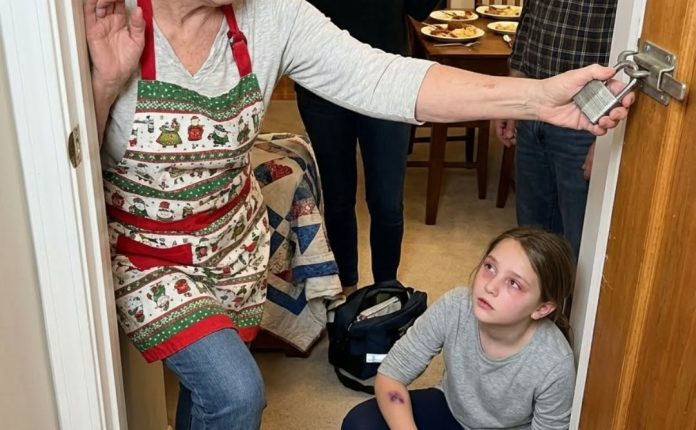
My husband blocked the doorway.
“Stay back.”
“I am her family.”
“So am I.”
Her expression shifted at that. Until then, she had acted as though being his mother gave her the final vote in every room he entered.
He did not move.
By the time emergency medical workers arrived, I had lost track of how many minutes had passed. I remember their voices, the sudden concentration of people around me, and my husband repeatedly answering questions while refusing to let his mother answer for me.
When someone asked how my lip had been injured, my mother-in-law said from the hall, “She bumped into something when she got upset.”
My husband turned toward me instead.
I touched the split in my lip.
“She shoved me.”
The room changed again.
One of the relatives whispered, “I saw her push you toward the bathroom, but I thought she was moving you out of the hallway.”
My mother-in-law snapped, “I did not shove her hard enough to hurt her.”
The words landed harder than any denial could have.
My husband stared at her.
“You just admitted you pushed her.”
“I guided her.”
“You just said you didn’t shove her hard enough to hurt her.”
“She was hysterical.”
I almost laughed, but I had no strength for it.
I had spent the night being told that every sign of danger was evidence that I was dramatic. Pain meant indigestion. Asking for help meant panic. Being pushed meant being guided. Giving birth on a bathroom floor apparently still wasn’t enough to make her reconsider the story she had decided everyone should believe.
One of the medical workers picked up the gauze from beside my knee and sealed it with the rest of my belongings rather than leaving it behind. The doctor’s earlier instruction suddenly made sense to my husband.
He looked at his mother, then at the gauze.
She noticed.
“Oh, please,” she said. “Now you’re collecting evidence against me?”
My husband answered without raising his voice.
“I’m keeping what belongs to my wife.”
That sentence stayed with me.
At the hospital, the baby and I were separated only long enough for the examinations we both needed. My husband stayed close enough that I could see him whenever I turned my head.
His mother came too, despite being told not to ride with us. She arrived later with one of the relatives and tried to walk straight into the room.
My husband stepped outside before she could.
I could hear pieces of their conversation through the partly closed door.
“You cannot keep me from my grandchild.”
“She just gave birth.”
“I know that.”
“On a bathroom floor.”
Silence followed.
Then his mother said, “And the baby is fine.”
My husband’s reply came more slowly.
“You still don’t understand what you did.”
She lowered her voice, but I could hear enough. She said she had raised children herself. She said women sometimes mistook digestive pain for contractions. She said I had been emotional for weeks. She said she had believed she was preventing everyone from overreacting.
My husband asked one question.
“Then why did you lie to the doctor?”
She did not answer immediately.
That question became the center of everything.
She could argue about whether she recognized labor. She could argue about whether she thought I was exaggerating. She could change the word shove to guide and insist the relatives had misunderstood her.
But she could not explain why she had told a physician that I was already receiving medical care when I was still inside her house asking to be taken there.
Eventually she said, “Because he would have told everyone to rush her in, and I knew that would make her panic more.”
I closed my eyes.
There it was.
Not a misunderstanding.
Not an assumption.
She had lied because she knew the doctor would disagree with her.
My husband must have understood the same thing, because his next words were quiet enough that I nearly missed them.
“So you made sure he couldn’t tell us what to do.”
His mother began talking quickly. She said she had been trying to protect me from stress. She said the entire family had already been anxious. She said she had expected my discomfort to pass.
But every new explanation made the same fact clearer: she had not simply been wrong. She had removed other people’s ability to make a different decision.
She had told the relatives there was no emergency.
She had told the doctor the emergency was already being handled.
And she had put me behind a bathroom door while those two lies protected each other.
My husband came back into my room alone.
For a while he stood near the foot of the bed without saying anything. I was holding our baby again, bundled properly now, and I watched him struggle with something I had seen him avoid for years.
His mother was used to being believed first.
He was used to letting that happen.
Finally he pulled a chair beside me.
“I should have answered you sooner.”
I looked at him.
He did not add an excuse.
That mattered.
He told me he remembered hearing me call his name once from downstairs. His mother had come into the bedroom a few minutes earlier and said I was embarrassed because I had an upset stomach and wanted privacy. He had believed her.
My stomach tightened at the admission.