“You heard me?”
“Once.”
“And you didn’t come?”
His eyes dropped.
“No.”
That hurt differently from anything his mother had done.
For a moment I wanted him to defend himself, because anger would have been easier if he gave me something obvious to fight. Instead he said, “I should have checked on you. I trusted her version instead of checking with my wife.”
I turned my face toward the baby.
“I needed you.”
“I know.”
“No. You know now.”
He took that without arguing.
That was the point where the night stopped being only about his mother.
Keeping her away from me would not fix what had happened if my husband returned to the same habit the next time she contradicted me. I did not need him to become louder than she was. I needed him to stop treating her certainty as proof.
So I made the decision while sitting in that hospital bed.
“We are not going back there.”
He looked at me.
Our bags, clothes, and most of the baby supplies we had brought for the visit were still at his mother’s house.
I continued, “I don’t care where we stay tonight after they discharge us. I am not taking this baby back into that house.”
He nodded once.
“Okay.”
“And she does not come into this room.”
“Okay.”
“And you don’t tell me in two days that she has calmed down and we should forget it.”
His mouth tightened.
“I won’t.”
I studied him before answering.
“I’m going to remember whether you mean that.”
He did not ask me to trust him immediately.
Instead he stood up, went into the hallway, and told his mother she would not be coming into my room or holding the baby that day.
I heard her reaction almost at once.
She accused me of turning him against her.
He corrected that too.
“This is my decision.”
She demanded to know how long he intended to punish her.
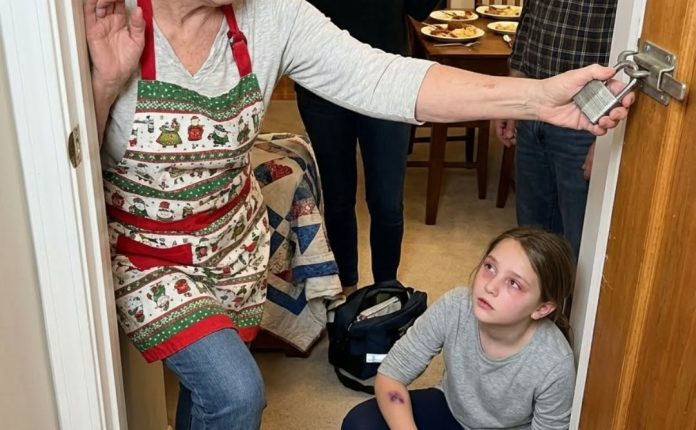
He said, “This isn’t punishment. She asked for medical help. You stopped her from getting it, lied to the family, lied to the doctor, and pushed her into a bathroom. Until you can say those things without changing the words, there is nothing to discuss.”
His mother left the hospital furious.
One relative went with her. The other remained long enough to apologize to me.
She admitted she should have checked for herself after hearing me ask for help. She had let my mother-in-law’s confidence override what she had heard with her own ears.
“I thought she knew better because she sounded so sure,” she said.
I understood exactly what she meant.
That had been my mother-in-law’s real power in the family. She did not need everyone to agree with her. She only needed to sound more certain than anyone else long enough for people to surrender their judgment.
This time, the consequences were too visible to smooth over.
The doctor later spoke with my husband directly about the earlier phone call. He repeated what had been said and made it clear that, had he known I was still at the house and asking for help, his advice would have been immediate evaluation.
My husband asked him the question that had been hanging over us.
“Did my mother sound confused?”
The doctor said no.
He said she had sounded definite.
That answer ended the last version of the story in which this could be dismissed as crossed wires.
When we were finally preparing to leave the hospital, my husband went back to the house with one relative to collect our things. I was nervous about it because I knew his mother would see the trip as another opportunity to change his mind.
She tried.
He told me afterward that she followed him from room to room while he packed. First she said I was humiliating her. Then she said I was using the baby to control him. Then she insisted the doctor had frightened everyone unnecessarily.
He kept packing.
At one point she told him, “You know me. You know I would never put your wife or child in danger.”
My husband stopped.
He said, “I know what you did because I was there for the part afterward.”
Then he zipped the bag and left.
There was no dramatic reconciliation waiting for us the next morning.
There was no perfect apology.
For several days, his mother sent messages through relatives insisting that she was willing to forgive the way she had been treated at the hospital.
My husband did not respond to those messages.
When she finally contacted him directly, she asked what she had to do to see the baby.
He gave her one condition before any conversation about visits could begin: she had to acknowledge what had happened without replacing it with softer words.
No indigestion.
No guiding me to a quieter room.