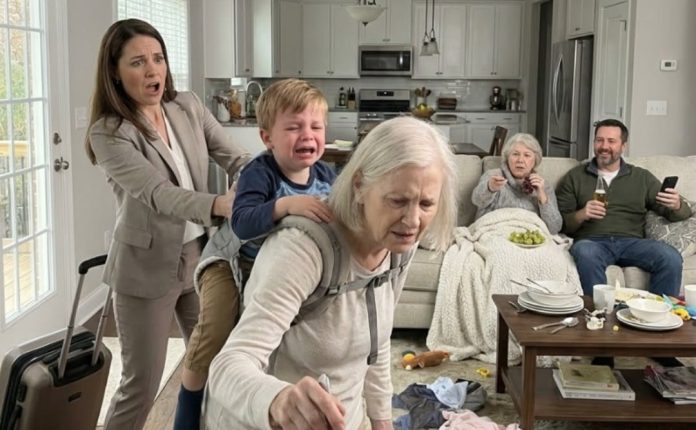
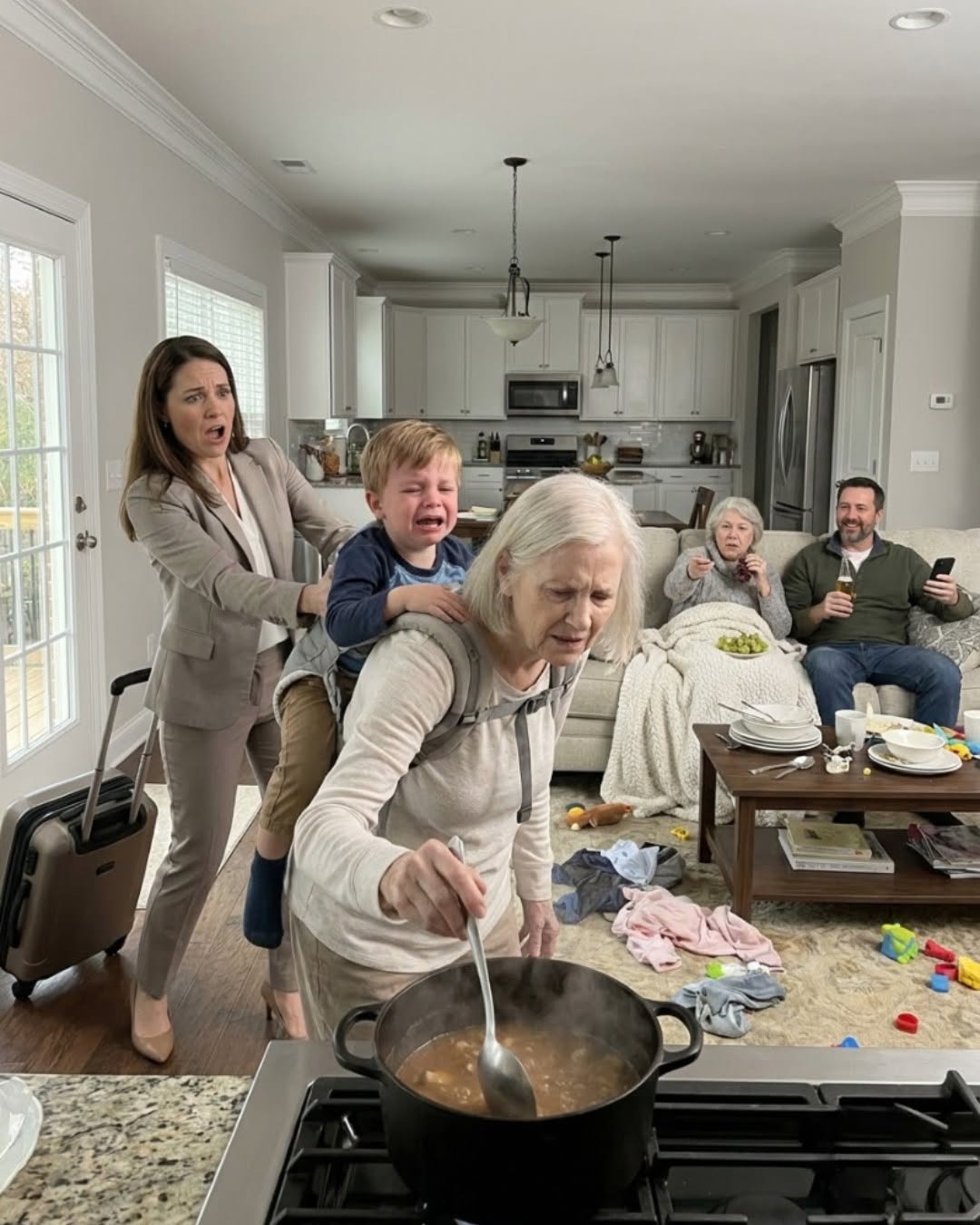
I came home three hours early and found my sick mother cooking dinner with my son strapped to her back while my husband drank beer on the couch — so I quietly shut off every utility in the house and drove her straight to the mansion no one knew I secretly owned.
I didn’t scream.
I didn’t throw a single accusation.
I just stood there in my own kitchen and watched the truth reveal itself.
My flight from New York had landed three hours ahead of schedule, which felt like a gift after the week I’d had.
I had just closed the biggest business deal of my career, the kind of deal that had taken years of late nights, missed weekends, and swallowing my nerves in rooms where nobody cared how tired I was.
But none of that mattered while I was getting off the plane.
All I could think about was Noah.
My four-year-old son had been counting the days until I came home, and I pictured the way he would run toward me before I even made it through the front door.
And I was thinking about my mother, Rose.
She had come down from her small hometown in the Blue Ridge Mountains to stay with us while I traveled, even though I had repeatedly told her she didn’t need to do anything except rest and enjoy time with her grandson.
Rose lived with severe rheumatoid arthritis.
There were mornings when opening a jar hurt her hands.
There were days when simply crossing a room took more effort than she wanted anyone to notice.
She was preparing to begin another round of medication, and I had worried about leaving her even for a few days.
Mark told me I was worrying for nothing.
My husband looked me straight in the eye before I left and promised he would take care of her.
I gave him one request.
“Take care of Mom.”
He had smiled like the request was almost insulting.
“Of course,” he said. “She won’t have to lift a finger.”
I believed him.
That was the part I kept thinking about later. Not that he lied. That I had made it so easy for him to lie because I wanted to believe the man I married would understand that caring for my mother was not a favor to me. It was basic decency. I didn’t call from the airport because I wanted the homecoming to be a surprise. I imagined walking in with my suitcase, hearing Noah’s feet pounding across the floor, and seeing Mom curled up somewhere comfortable with a blanket over her knees. Instead, the first thing I noticed when I opened the front door was the cold. The air conditioner was blasting hard enough to make the entryway feel almost refrigerated. Then I saw Eleanor. My mother-in-law was sitting comfortably in the living room under a blanket, watching television and eating grapes. Mark was stretched out on the couch nearby with a beer in one hand and his phone in the other. Neither of them noticed me immediately. That gave me several seconds to take in the rest of the house. Dishes covered the table. Laundry had been left wherever it landed. Noah’s toys were scattered across the floor. The place didn’t look like a home where two adults had been caring for a child and a sick guest. It looked like everyone had simply stopped expecting themselves to do anything. Then I heard crying from the kitchen. Noah. I dropped the handle of my suitcase and hurried toward the sound. The sight waiting for me stopped me in the doorway. My mother was standing over the stove with my son strapped to her back. One hand was stirring a heavy pot. The other was gripping the counter so tightly her knuckles looked strained because she was struggling to remain upright. Her face was pale. Sweat had soaked into her clothes. Her shoulders trembled with the effort of balancing Noah’s weight while managing dinner. For a second, my brain refused to fit the picture together. This was the woman who sometimes needed extra time to stand from a chair. This was the woman I had specifically asked Mark to protect from unnecessary strain. And she was carrying my four-year-old while cooking for three perfectly capable adults. “Mom, what are you doing?” I asked. Rose looked toward me, startled. Then her expression changed immediately into the one she had used my entire life whenever she was hurting but didn’t want me to worry. She lowered her eyes. “It’s okay, sweetheart,” she said. “Eleanor wanted dinner. I’m almost finished.” I stared at her. Before I could answer, Eleanor called from the living room. “Tell her not to overcook the meat this time. You country people ruin everything.” A beat later, Mark laughed. “And don’t forget my gray pants. I need them tomorrow.” The words came so casually that they told me more than shouting ever could have. This wasn’t one bad afternoon. They were comfortable. Comfortable ordering my mother around. Comfortable mocking her. Comfortable watching her struggle while they rested. And apparently comfortable enough to believe I would never see it. For years, I had stayed quiet about smaller things. I told myself every marriage involved compromise. I told myself Eleanor was difficult because she was protective of her son. I told myself Mark sometimes made careless comments because he didn’t understand how they sounded. Meanwhile, I paid the mortgage. I paid for vacations. I bought the cars. When Eleanor needed dental work, I paid for that too. I didn’t keep score because I believed a family shouldn’t have to. But somehow the generosity had never earned respect. If anything, it had made them feel entitled to more. They treated the things I provided as ordinary and treated me like I was still the person who should feel lucky to have been accepted by them. I could tolerate what they thought of me longer than I should have. What I couldn’t tolerate was looking at my mother and realizing they had extended the same contempt to her. Rose was the woman who had once sold part of her farmland to help me afford college. She had never described that sacrifice as a sacrifice. She had simply told me to study hard and build something with the opportunity. Years later, when my career began taking off and I tried to repay her, she resisted almost everything. She wanted enough to be comfortable. Nothing more. And now she was standing in my kitchen, sick and shaking, being treated like unpaid help by people whose comfort I had financed. Something inside me settled. Not exploded. Settled. I stepped forward and carefully lifted Noah from my mother’s back. He wrapped himself around me immediately, still upset, his face warm against my shoulder. Then I took a clean towel and wiped the sweat from Rose’s forehead. She looked embarrassed. That hurt almost as much as everything else. She should not have been embarrassed. The people sitting comfortably in the next room should have been. I turned off the burner. Then I went to pick up a suitcase. “We’re leaving,” I said. Rose looked at me as though she wanted to ask whether I was sure. I didn’t give her the chance to talk me out of it. The three of us had almost reached the front of the house when Eleanor finally understood what was happening. She stood up. “Your mother isn’t finished.” I looked at her. Not at the dinner. Not at the laundry. At her. She genuinely believed that was the problem. Mark got off the couch and moved toward the door. Then he stepped directly in front of it. “Apologize to my mother,” he said. “Then go finish dinner.” Noah tightened his arms around me. Rose stood beside me with her shoulders slightly bent, exhausted from everything they had asked her to do. I could have argued. There were years of things I could have said. I could have listed every payment, every insult, every moment I had ignored because keeping the peace seemed easier than forcing the truth into the open. But the truth was already standing in front of me. I didn’t need to explain it to Mark. He knew exactly what he had done. So I reached for my phone. Mark must have assumed I was calling someone because his expression changed into irritation. I wasn’t calling anyone. I opened the home management system connected to the services and controls I had been paying for. Then, quietly, I began removing their access to the comfort they had mistaken for something they were entitled to. The television went dark. Eleanor turned toward the screen. The lights shut off. Then the air conditioner stopped. The sudden absence of its constant hum made the room feel strangely exposed. A second later, Mark’s phone began lighting up with cancellation alerts. He looked down once. Then again. “What did you do?” he shouted. I finally gave him the answer he had earned. “I returned you to the lifestyle you can actually afford.” I wasn’t proud because I had found the perfect comeback. There was nothing satisfying about watching a marriage reduce itself to that sentence. But for the first time in years, I wasn’t going to make myself smaller to keep two other adults comfortable. Mark kept talking as I opened the door. I didn’t argue back. I walked outside with Noah and Rose. The evening air felt warmer after the aggressively cold house, and Mom drew a slow breath as we moved away from the doorway. Then I headed across the street. That was when Mark’s anger changed into confusion. Across from our house stood the massive stone mansion he had admired for years. He had commented on it more than once. He wondered who owned it. He wondered what kind of person could afford a house like that and barely seem to use it. He had no idea the answer had been sleeping next to him. I had purchased the mansion three years earlier. I had paid for it in full. And I had kept it to myself. Not because I was trying to play some elaborate game with my husband. I had built my career slowly, carefully, and privately, and over time I learned that every visible sign of my success seemed to become another thing Mark or Eleanor assumed they deserved access to. The house was different. It was something I wanted untouched by that expectation. So I never told them. I walked toward the gate with Rose beside me and Noah still clinging to my shoulder. Behind us, I heard Mark following. I placed my thumb against the gate scanner. The gate opened. Mark stopped. For once, he had no prepared response. He simply stared as the entrance moved aside for me. “How do you have access to that house?” he demanded. I turned around. “Because I bought it three years ago,” I said. “It’s fully paid for. And it’s mine.” His face changed as he looked from me to the mansion and then back toward the house he had been standing in moments earlier like everything inside it belonged automatically to him. The difference between us had never been that I was powerless. The difference was that I had spent years choosing not to use power as a weapon inside my own family. He had mistaken restraint for dependence. He had mistaken generosity for obligation. And worst of all, he had mistaken my mother’s kindness for weakness. Rose touched my arm lightly. That small gesture brought my attention back to what actually mattered. She was exhausted. Noah needed calm. Whatever happened between Mark and me after that could wait. The immediate decision had already been made. My mother was not going back into that kitchen. My son was not going back into that room while his father treated cruelty like normal family behavior. And I was not going back to pretending that keeping a household together was more important than protecting the people inside it. I guided Rose through the gate. For years, she had been the person who stepped in whenever I needed somewhere safe to land. She had done it when money was tight. She had done it when college seemed impossible. She had done it again by traveling to help with Noah even while her own body was fighting her. This time, I could give something back without asking her permission first. Behind us, Mark was still trying to understand the mansion. He thought the house was the secret. It wasn’t. The real secret was how much of my life I had built without needing his approval, how many things I had kept separate because some quiet part of me already understood that love and access were not the same thing. I had spent years giving him access anyway. To my money. To my labor. To my patience. To the benefit of every doubt. That evening, for the first time, I stopped confusing access with love. I didn’t need to humiliate him in front of anyone. I didn’t need Eleanor to admit what she had done. I had already seen enough. The pot on the stove had told me enough. My mother’s shaking hand had told me enough. Noah crying on her back had told me enough. And Mark standing in the doorway ordering me to apologize had finished the rest. The gate continued opening until there was enough room for all three of us to pass through. I shifted Noah higher on my hip and slowed my steps so Rose wouldn’t have to hurry. She looked toward the house ahead of us, then at me. For once, she wasn’t carrying anything. No heavy pot. No laundry. No four-year-old on an aching back. Just herself. That was all I had ever asked Mark to protect. He hadn’t. So I would. The shock on his face lasted only a moment before something else replaced it. Calculation. Because after years of believing he understood exactly what I owned, exactly what I earned, and exactly how much I would tolerate, Mark finally realized I had secrets too. And the mansion was only the beginning.