When I pulled into my driveway at 3:18 on Thursday afternoon, I expected the house to be quiet.
My work trip in Denver had ended a day early after a client canceled our final meeting, and I had not told anyone I was coming home.
I wanted to surprise my five-year-old daughter, Lily, with the stuffed fox I had bought at the airport.
Instead, two police cruisers were parked in front of my house.
For a second, I just sat behind the wheel with both hands gripping the steering wheel, trying to understand why officers would be at my address in the middle of an ordinary Thursday afternoon.
Then I saw the front door standing wide open.
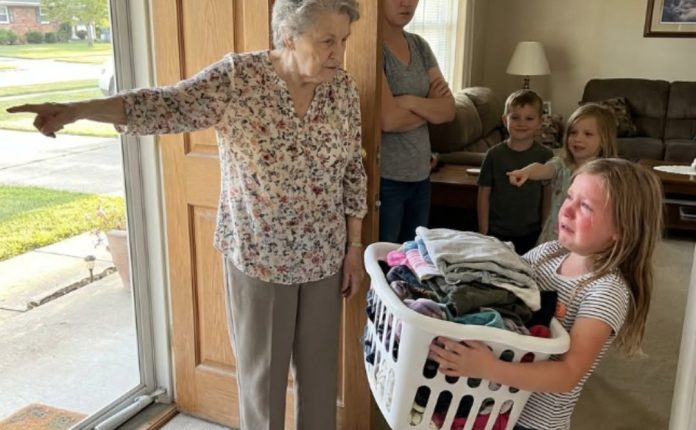
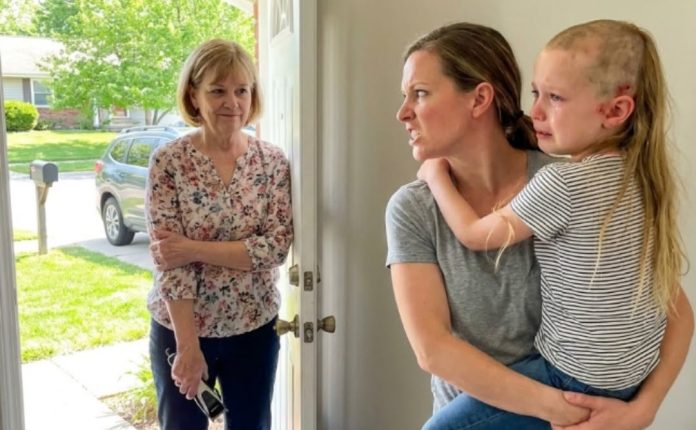
My mother, Evelyn Harper, was on the porch with her arms crossed.
My older sister, Melissa, hovered behind her with a phone in her hand and that familiar, satisfied look she wore whenever she believed she had finally proved me wrong.
Then I heard Lily crying.
It was not the irritated cry of a child who had been told she could not have dessert or stay up late.
It was small, broken, terrified sobbing.
I was out of the car before I had fully shut the door.
I ran past my mother and sister and into the house.
Lily was sitting on the living room rug in her pink dinosaur pajamas, clutching her blanket so tightly that her knuckles had turned white.
Two uniformed officers stood near the couch.
One of them was crouched several feet away from her, speaking in the careful, quiet voice adults use around frightened children.
It was not helping.
Lily had her face buried against her knees.
Then she heard me.
“Mommy!”
She launched herself across the room and into my arms so hard that I nearly fell backward.
Her entire body was shaking.
I dropped to my knees and held her while she wrapped both arms around my neck.
“Please don’t let them take me,” she whispered.
I pulled back just enough to see her face.
“Take you where?”
Her breathing hitched.
“Grandma said they were taking me away because I was bad.”
Every adult in that room heard her.
I looked at my mother.
Evelyn’s mouth tightened.
“Don’t be dramatic, Natalie,” she said. “She needed discipline.”
That sentence landed harder than if she had shouted.
I had left my daughter with my own mother because I believed Lily would be safe with family while I worked.
Now Lily was trembling in my arms because that same person had apparently convinced her that police officers had come to remove her from her home.
“Discipline?” I asked.
Melissa stepped forward before my mother answered.
“She locked herself in your bedroom and refused to listen,” she said. “Mom thought she might hurt herself.”
The older officer turned toward me.
“Ma’am, I’m Officer Daniels,” he said. “We received a report of an out-of-control child creating a dangerous situation in the home.”
I looked down at Lily again.
That was when I noticed the left side of her face.
Her cheek was red.
It was not bruised, and I was not going to pretend it was something worse than what I could see, but the redness was obvious enough that I noticed it immediately.
“What happened to your face?” I asked.
Lily pressed herself against my chest and started crying harder.
My mother sighed as if Lily were the one making the situation difficult.
“She threw a fit because I wouldn’t let her eat cupcakes before lunch.”
Melissa nodded quickly.
“She screamed and slammed doors. We had no choice.”
No choice.
I could feel anger climbing into my throat, but yelling would not help Lily.
It would not create a record of what had happened.
It would not tell me what my mother and sister had said when they called the police.
So I carried Lily to the couch, sat down with her on my lap, and pulled her blanket around both of us.
Then I started asking questions.
I asked Officer Daniels for the report number.
I asked for the time of the call.
I asked him to confirm that the recording associated with the call would be preserved.
I asked him to document Lily’s statement that her grandmother had told her the police were taking her away because she was bad.
I also asked him to note the redness on Lily’s cheek.
My mother gave one short laugh.
“You’re overreacting.”
I looked at her.
“No,” I said. “I’m acting.”
My mother stopped smiling.
I did not accuse her of anything I could not prove.
I did not make a speech.
I simply told Evelyn and Melissa to leave my house.
Melissa immediately protested.
“We were doing you a favor.”
My mother’s expression hardened.
“And who exactly is going to watch Lily the next time your job sends you away?”
That question told me she still thought this was a debate about my choices as a mother.
It was not.
“I’ll figure that out,” I said. “But it won’t be either of you.”
They walked out angry.
As they passed my airport bag, the stuffed fox I had bought for Lily slipped onto the floor.
Lily climbed down from my lap, picked it up, and pressed its orange face against her red cheek.
She refused to let it go.
That night, she slept with the fox tucked beneath her chin.
Or at least she tried to sleep.
She woke twice asking whether the police were coming back.
Each time, I sat beside her until her breathing slowed.
The next night, it happened again.
The fear had followed the officers out of our house and stayed behind in Lily’s bedroom.
Over the next six days, I stopped treating what happened as a family disagreement.
I changed the locks.
I removed Evelyn and Melissa from Lily’s authorized pickup list.
I canceled every form that gave either of them permission to make decisions for her.
I kept the police report number beside my coffee maker where I would see it every morning.
And I requested that the call be preserved.
My mother tried to frame my response as punishment.
Melissa insisted the whole thing had gotten out of hand because everyone had been upset.
I did not argue with either of them.
The one fact I could not ignore was that my five-year-old had believed police officers were about to take her away because she had been bad.
Whatever explanation my mother and sister wanted to give me, I needed to know how two police cruisers had ended up in my driveway in the first place.
A week after I came home, Evelyn and Melissa agreed to meet me and Officer Daniels in a plain interview room.
They arrived together.
That did not surprise me.
My mother had always been strongest when Melissa was beside her agreeing with everything she said.
They both began with the same explanation.
It had been a misunderstanding.
Lily had been difficult.
They had been worried.
Nobody had meant to scare her.
The police had supposedly been called because they were concerned about safety, not because they wanted anything bad to happen.
Officer Daniels did not argue with them.
He placed a speaker on the table.
Then he played the call.
Melissa’s voice came first.
She described Lily as violent and uncontrollable.
Hearing those words while sitting across from my sister felt different from hearing a summary of them from an officer.
Lily was five.
The child I had held shaking on my couch was being described as if she were some dangerous person the adults in the house could not manage.
Then another voice came through faintly in the background.
My mother’s.
“Tell them Natalie left her without proper supervision.”
I looked at Evelyn.
She did not look at me.
The dispatcher asked Melissa whether Lily was in immediate danger.
There was a pause.
Melissa hesitated.
Then she said, “I need this documented. We may have to prove her mother is unfit.”
The entire meaning of that Thursday afternoon changed in one sentence.
Until that moment, Evelyn and Melissa had maintained that the call had been about an out-of-control child.
Now the recording showed that my parenting had been part of the conversation while the call was still happening.
This had not simply been a panicked attempt to get help with Lily.
They wanted something documented about me.
I stayed seated.
My mother did not.
Evelyn jumped out of her chair and started screaming that Melissa had misunderstood what she meant.
Melissa snapped back almost immediately.
She said she had only repeated what Evelyn told her to say.
My mother accused her of twisting everything.
Melissa accused my mother of leaving her exposed.
For the first time since I had walked into my house and seen Lily on the rug, I was not the person they were trying to overpower with their version of events.
They were turning on each other.
Melissa pointed at our mother.
Her face was red now, and her voice rose over Evelyn’s protests.
Then she shouted the sentence that changed everything for me.
“You said the police report was the only way we could get Lily away from Natalie!”
The room seemed suddenly smaller.
I had spent the previous week trying to answer one question: why would my mother and sister call the police over a five-year-old having a meltdown?
Now I had an answer that was much harder to dismiss.
The police call had not only been about Lily’s behavior.
According to Melissa’s own words, it had been part of an effort to create a record they believed could be used against me.
I did not celebrate when Melissa said it.
Nothing about that moment felt like a victory.
My daughter had still spent nights waking in fear.
She had still believed strangers in uniform might remove her from her home because her grandmother told her she was bad.
The stuffed fox still had to be tucked under her chin before she could settle down.
And the people responsible were still my mother and my sister.
What changed in that interview room was not the past week.
What changed was my willingness to keep treating them as people who automatically deserved access to my child because they were family.
I had already changed the locks and removed their permissions before hearing the recording.
After hearing it, those decisions no longer felt temporary.
They felt necessary.
I did not need to know whether Evelyn blamed Melissa or Melissa blamed Evelyn.
I had heard enough to understand that neither one of them had protected Lily from the fear they created.
They had brought authorities into my home and then tried to explain it as discipline.
They had described my five-year-old as violent and uncontrollable.
They had discussed documenting me as an unfit mother.
And when their own words were played back, they did not begin by asking what the experience had done to Lily.
They began by fighting over whose idea it had been.
That mattered to me more than either of them realized.
For years, disagreements in my family had followed a predictable pattern.
My mother would make a decision, Melissa would reinforce it, and I would eventually be told that resisting them meant I was being difficult, emotional, or ungrateful.
This time, I had a five-year-old depending on me to make a different choice.
I could absorb criticism about my job.
I could listen to my mother question how I handled childcare.
I could tolerate my sister believing she knew my life better than I did.
What I could not do was hand Lily back to people who had used her fear as part of a larger argument about me.
So I stopped trying to repair the room.
I stopped trying to make Evelyn and Melissa agree on a version that would allow all of us to pretend this had been one terrible misunderstanding.
The recording had already shown what they had said.
Their argument showed what each of them was willing to do once responsibility became uncomfortable.
My job was not to referee their fight.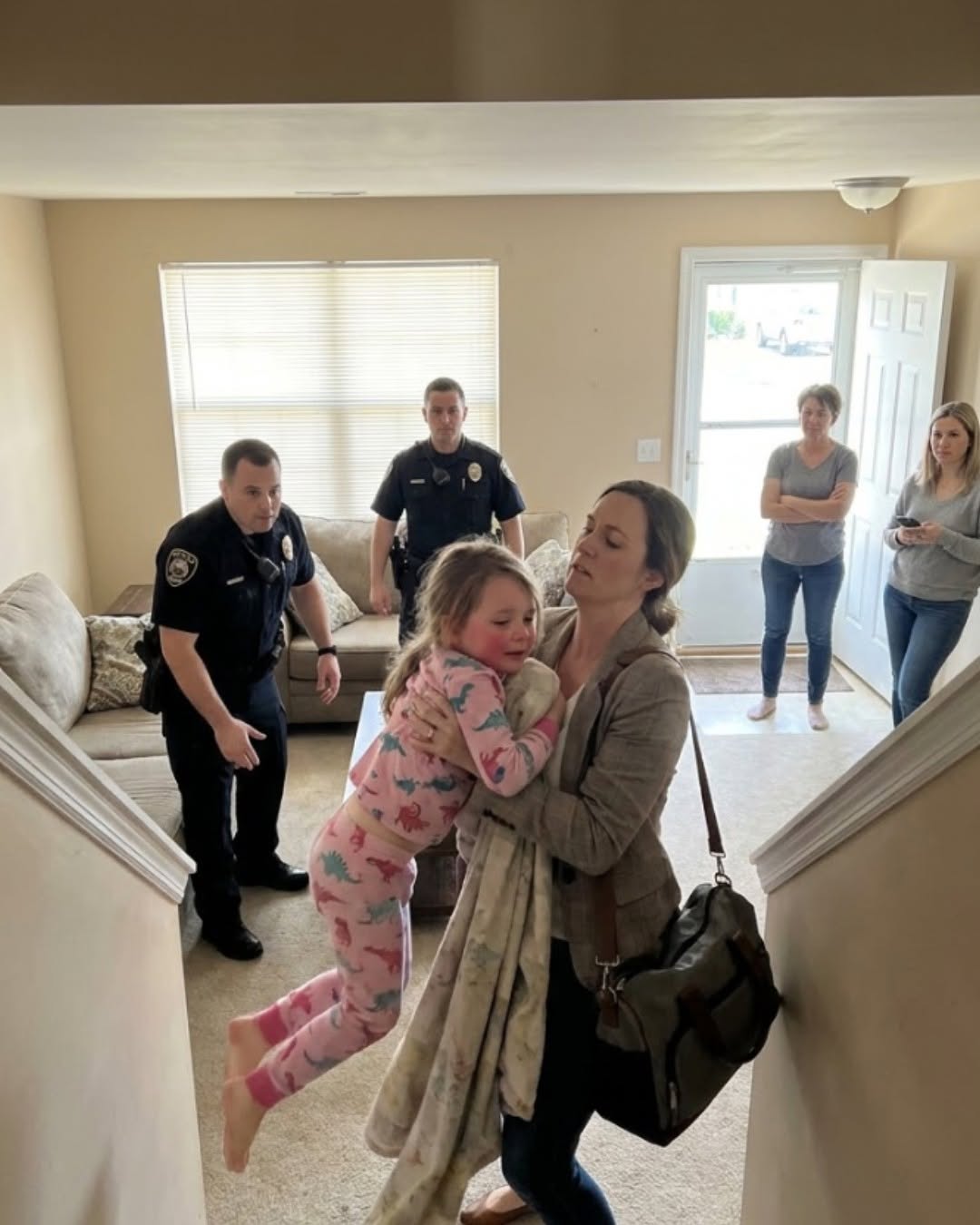 My job was to take Lily home and make sure she felt safe there again.
That evening, when I walked through my newly changed front door, Lily was waiting for me with the stuffed fox under one arm.
She asked where I had been.
I told her I had been talking to people about what happened the day I came home.
She looked at me carefully.
“Are the police coming back?”
“No,” I said. “You’re home with me.”
She thought about that, then held the fox out to me because one of its ears had folded backward.
I straightened it for her.
That tiny request affected me more than the shouting in the interview room had.
A week earlier, the fox had fallen from my airport bag in the middle of the worst homecoming I could have imagined.
Lily had grabbed it while my mother and sister were leaving and pressed it against her face because she needed something soft to hold.
Now she was handing it to me for an ordinary problem that could actually be fixed.
I smoothed the ear, gave it back, and watched her tuck it beneath her arm before heading toward the living room.
The locks were different.
The pickup list was different.
The permissions were different.
And my relationship with my mother and sister was different too.
I did not know how long Lily would remember the sight of two officers standing in our living room.
I did know that I would remember what she whispered into my shoulder when I came through the door.
Please don’t let them take me.
That was the sentence I carried with me after the accusations, after the recording, and after Evelyn and Melissa began screaming at each other.
Because in the end, the most important thing I did was not winning an argument with my family.
It was believing my daughter’s fear, documenting what happened, removing access that no longer felt safe, and refusing to let family loyalty matter more than the child who was counting on me.
That night, Lily climbed into bed with the stuffed fox tucked beneath her chin.
Before I turned off the light, she reached up and touched its now-straight ear.
Then she closed her eyes.
For the first time since I had come home early, she did not ask whether the police were coming back.
My job was to take Lily home and make sure she felt safe there again.
That evening, when I walked through my newly changed front door, Lily was waiting for me with the stuffed fox under one arm.
She asked where I had been.
I told her I had been talking to people about what happened the day I came home.
She looked at me carefully.
“Are the police coming back?”
“No,” I said. “You’re home with me.”
She thought about that, then held the fox out to me because one of its ears had folded backward.
I straightened it for her.
That tiny request affected me more than the shouting in the interview room had.
A week earlier, the fox had fallen from my airport bag in the middle of the worst homecoming I could have imagined.
Lily had grabbed it while my mother and sister were leaving and pressed it against her face because she needed something soft to hold.
Now she was handing it to me for an ordinary problem that could actually be fixed.
I smoothed the ear, gave it back, and watched her tuck it beneath her arm before heading toward the living room.
The locks were different.
The pickup list was different.
The permissions were different.
And my relationship with my mother and sister was different too.
I did not know how long Lily would remember the sight of two officers standing in our living room.
I did know that I would remember what she whispered into my shoulder when I came through the door.
Please don’t let them take me.
That was the sentence I carried with me after the accusations, after the recording, and after Evelyn and Melissa began screaming at each other.
Because in the end, the most important thing I did was not winning an argument with my family.
It was believing my daughter’s fear, documenting what happened, removing access that no longer felt safe, and refusing to let family loyalty matter more than the child who was counting on me.
That night, Lily climbed into bed with the stuffed fox tucked beneath her chin.
Before I turned off the light, she reached up and touched its now-straight ear.
Then she closed her eyes.
For the first time since I had come home early, she did not ask whether the police were coming back.