“If this was discipline,” the judge asked, “what lesson was Meadow supposed to learn?”
Dustin opened his mouth.
Nothing came out.
Judith leaned toward him and whispered something, but the judge raised one hand.
“I asked her father.”
Dustin shifted in his chair.
He glanced at his attorney, then at Judith, as though the correct answer might be hidden between them.
“She had become disrespectful,” he finally said.
The judge looked down at the medical report.
“How?”
“She argued about brushing her hair.”
Meadow’s fingers tightened around the purple elephant.
The judge noticed.
“She argued about brushing her hair, so your mother removed all of it?”
Dustin swallowed.
“It wasn’t meant to hurt her.”
“Did you authorize it?”
His attorney touched his sleeve, but the question was already waiting.
Dustin looked at the floor.
“I told Mom to handle the situation.”
“That was not my question.”
The silence lasted several seconds.
Then Dustin said, “Yes.”
Judith exhaled beside him, almost proudly.
The judge turned toward her.
“Did Meadow consent to having her head shaved?”
Judith’s attorney objected because she was not a party to the custody case.
The judge acknowledged the objection and returned her attention to Dustin.
“What did you believe your mother intended to do?”
Dustin’s voice became defensive.
“She said Meadow needed a serious consequence.”
“Did you ask what consequence?”
“No.”
“Did you call afterward to check on your child?”
“No.”
“Did you take her to a physician?”
“No.”
“Did you ask whether she was injured?”
Dustin’s face reddened.
“I was trying to keep my marriage together.”
The judge closed the folder.
“Your daughter’s scalp was cut, she stopped speaking, and you sat beside the adult responsible.”
Nobody moved.
Even Judith stopped whispering.
The judge granted me temporary primary custody while the child-welfare investigation and full custody evaluation proceeded.
Dustin received supervised visitation at a family center.
Judith was prohibited from contacting Meadow or attending those visits.
The order also prevented either of them from approaching Meadow’s school, doctor, counselor, or my temporary residence.
It was not a permanent ruling.
The judge made that clear.
But for the first time since Tuesday, I knew Judith could not simply appear and demand access.
When we left the courtroom, Dustin followed us into the hallway.
“You didn’t have to destroy our family,” he said.
Meadow heard him.
She stopped walking.
I turned around slowly.
“Your mother held clippers against our crying child while you approved it.”
“She didn’t know Meadow would react like this.”
“She is eight years old.”
Dustin looked toward Meadow.
For one moment, I thought he might finally kneel, apologize, or ask whether she was hurting.
Instead, he pointed at her hat.
“You see? You’re teaching her to be ashamed.”
Meadow’s face disappeared against my side.
Francine stepped between us.
“The temporary order requires distance,” she said. “Take another step and courthouse security will document it.”
Dustin remained where he was.
Judith stood behind him with her purse pressed against her ribs.
“You will regret making me the enemy,” she called.
I looked directly at her.
“You made an eight-year-old child your enemy first.”
Then I took Meadow home.
That evening, she sat in the bathtub wearing her pink hat.
She refused to remove it even after the fabric became damp around the edges.
I sat on the closed toilet lid.
“You can keep it on,” I said.
Her eyes stayed on the water.
“Grandma said you would be angry because I made her do it.”
My stomach tightened.
“You did not make her do anything.”
“I kicked her.”
“While she was holding you down?”
Meadow nodded.
“She said good girls sit still.”
I closed my eyes for one second.
Then I asked permission before touching her hand.
“You were protecting yourself.”
“Daddy said kicking adults makes me bad.”
“Daddy was wrong.”
The words tasted like grief.
I had spent eleven years protecting Dustin’s image inside our marriage.
Now every excuse I had made for him stood between my daughter and the truth.
The next morning, Meadow met Dr. Helen Ruiz, a child therapist experienced in trauma and family violence.
Dr. Ruiz did not ask Meadow to describe everything immediately.
She offered paper, clay, dolls, and a box of soft hats.
Meadow selected a blue hat with silver stars.
Then she placed one doll behind a wooden door and another beneath a plastic table.
“What is happening?” Dr. Ruiz asked.
“The little one is hiding her hair.”
“Is someone looking for her?”
“The grandmother.”
“What does the grandmother want?”
“To make her ugly so nobody looks at her.”
I sat outside the room and heard only fragments.
Each one cut deeper than the clippers had.
After the session, Dr. Ruiz explained that Meadow showed clear signs of acute trauma.
Her silence, shaking, sleep problems, appetite changes, repetitive drawings, and fear of removal were consistent with what she had experienced.
“She may recover well,” Dr. Ruiz said. “But recovery requires safety, predictability, and control over her own body.”
I wrote down every word.
Then I asked the question frightening me most.
“Should she see Dustin?”
“That decision belongs to the court,” Dr. Ruiz said carefully.
“Therapeutically, any contact should proceed at Meadow’s pace and under professional supervision.”
At home, I began changing small things.
Nobody entered Meadow’s room without knocking.
Nobody touched her hat without permission.
She chose where to sit, when to discuss Tuesday, and whether photographs could be taken.
Control returned through choices ordinary children should never have lost.
On Monday, the child-welfare investigator interviewed Dustin.
He claimed Judith had only intended to trim Meadow’s hair.
He said the clippers slipped, making an even shave necessary.
That story lasted less than one day.
Francine found a message Dustin had sent Judith Tuesday morning.
Meadow had borrowed my tablet for homework, and Dustin’s messages were still synchronized through our family account.
Judith had written:
“She refused the hairstyle I selected for school pictures. This vanity needs to end.”
Dustin replied:
“Then cut it all off. Maybe embarrassment will teach her respect.”
Seven minutes later, Judith sent a photograph of the clippers resting beside Meadow’s yellow hair ribbons.
Dustin responded with a thumbs-up symbol.
There was no accidental trim.
No slipped blade.
No misunderstanding.
There was planning, permission, and the deliberate use of humiliation as punishment.
I forwarded the complete message thread to my attorney, the investigator, and Meadow’s court-appointed representative.
Dustin called within an hour.
“You accessed private messages.”
“They were synchronized to our family tablet.”
“You’re twisting what I said.”
“I preserved exactly what you said.”
“I was angry.”
“So was Judith.”
“You know Mom speaks dramatically.”
“She shaved our daughter bald.”
He lowered his voice.
“If you use those messages, I could lose unsupervised custody.”
I almost laughed.
Even then, his concern was what he might lose.
Not what Meadow already had.
“You authorized an adult to humiliate and injure your child,” I said.
“Consequences are not something I am doing to you.”
He began crying.
For years, his tears had ended arguments.
They had made me soften my words, carry his responsibility, and apologize for making him feel guilty.
This time, I ended the call.
Two days later, Meadow’s teacher sent me a folder of classroom work.
Most pages were ordinary spelling tests and math exercises.
One page was not.
The Friday before the shaving, Meadow had completed an assignment titled, “An Adult I Trust.”
She drew me standing beside her under a large green umbrella.
At the bottom, she wrote:
“My mom listens when I say stop.”
Her teacher had placed a gold star beside the sentence.
On the back, Meadow had added another drawing in pencil.
It showed Judith holding scissors.
The teacher had asked about it.
Meadow said Grandma wanted to “fix” her before school photographs.
The teacher documented the conversation and emailed Dustin because he was listed as the second parent contact.
Dustin replied:
“My mother is old-fashioned. Please don’t encourage Meadow’s dramatics.”
He never told me.
The email proved he had received a warning before Tuesday.
He had not misunderstood Judith’s intentions.
He had dismissed Meadow’s fear and concealed it from me.
When the investigator showed him the email, Dustin changed his account again.
He admitted knowing Judith had threatened Meadow’s hair before.
He insisted he never believed she would actually do it.
Then he blamed me for not recognizing the conflict sooner.
That was Dustin’s pattern.
Every truth became someone else’s failure after it reached him.
Judith refused a voluntary interview.
Through her attorney, she described the incident as a private family matter involving cultural beliefs about discipline.
But the blocked doorway created a separate concern.
I had not imagined it.
Meadow had described Judith standing between us and the exit.
The red marks near Meadow’s ear supported the doctor’s conclusion that she moved while the clippers were against her skin.
Judith had controlled the punishment.
Then she tried to control whether we could leave.
The investigator referred the evidence to local authorities for review.
No one promised immediate charges or a dramatic arrest.
The custody court did not need to wait for a criminal outcome to protect Meadow.
Three weeks after the first hearing, Dustin attended his initial supervised visit.
Meadow refused to enter the visitation room.
She stood in the hallway wearing her blue star hat and clutched the purple elephant beneath one arm.
The visitation supervisor crouched several feet away.
“You do not have to hug anyone,” she said.
“Can he take my hat?”
“No.”
“Can Grandma come?”
“No.”
“Can I leave if I’m scared?”
“Yes.”
Meadow looked at me.
I told her the same thing.
She entered.
Through the observation window, I watched Dustin remain seated as the supervisor instructed.
He had brought a large gift bag.
Inside were dolls, art supplies, candy, and a long blond wig.
When Meadow saw the wig, she froze.
Dustin smiled nervously.
“I thought this would help you feel normal again.”
Meadow dropped the purple elephant.
Then she ran toward the door.
The supervisor ended the visit immediately.
Dustin followed, protesting that the gift had been thoughtful.
“She loved long hair,” he said.
Dr. Ruiz later explained what should have been obvious.
The wig told Meadow that her appearance needed correcting before her father could accept her again.
It also centered his discomfort rather than her recovery.
The visitation center documented the incident.
Future visits required approval from Meadow’s therapist and completion of a parenting intervention program.
Dustin blamed me.
Judith blamed the supervisor.
Neither asked why Meadow had run.
The final custody evaluation took four months.
During that time, Meadow’s hair began returning as soft, uneven fuzz.
Some mornings, she examined it in the bathroom mirror.
Other mornings, she covered every inch beneath a hat.
I never asked her to choose courage for my comfort.
One Saturday, she entered the kitchen without anything covering her head.
I was mixing pancake batter.
I saw her reflection in the microwave door and kept stirring.
She climbed onto a stool.
“Did you notice?” she asked.
“Yes.”
“You didn’t stare.”
“I was waiting to learn what you wanted.”
She touched the new growth near her ear.
“I want strawberry pancakes.”
So I made them.
She ate three.
That afternoon, she asked me to photograph the top of her head.
Not for court.
Not for a doctor.
She wanted to see the tiny curls forming near the back.
“They’re different,” she said.
“They’re yours.”
“Can I keep them short?”
“Of course.”
“Forever?”
“For as long as you choose.”
Choice transformed the mirror from an enemy into an ordinary object again.
Meanwhile, Dustin completed six parenting classes but refused individual therapy.
His course reports showed attendance, not insight.
During supervised sessions, he repeatedly asked Meadow when she would “stop punishing” him.
He told her families forgive mistakes.
He never called the shaving abuse.
He called it an overreaction, an unfortunate haircut, or his mother’s poor judgment.
Each phrase removed him from the decision.
At the custody trial, the judge reviewed the synchronized messages, medical findings, teacher’s email, therapy reports, and visitation records.
Dustin’s attorney argued that one terrible decision should not permanently define a father.
My attorney agreed with part of that statement.
Then she explained that Dustin had been given months to take responsibility.
He had used every opportunity to minimize, blame, pressure, and protect Judith instead.
Judith testified that Meadow had requested a shorter haircut.
The judge asked whether an eight-year-old requesting a trim would need to be held still.
Judith said Meadow became hysterical because I had taught her to fear discipline.
Then my attorney showed her the photograph of the clippers beside the yellow ribbons.
Judith admitted sending it before the shaving began.
“Why photograph the clippers?” my attorney asked.
“To show my son I had the situation under control.”
“What situation?”
“Meadow’s defiance.”
“An eight-year-old refusing your preferred hairstyle?”
Judith’s mouth tightened.
“She needed to understand authority.”
That answer ended any possibility that the court would treat the event as an accidental haircut.
The judge issued her ruling two weeks later.
I received primary physical custody and sole authority over Meadow’s medical care, therapy, education, and appearance-related decisions.
Dustin’s contact remained professionally supervised.
Expansion would depend on Meadow’s emotional safety, his compliance with therapy, and demonstrated accountability.
Judith received no visitation.
She was prohibited from contacting Meadow directly or appearing at locations connected to her school, treatment, or supervised visits.
The judge emphasized that the order could be reviewed if circumstances genuinely changed.
Then she addressed Dustin.
“Your mother used your daughter’s body to enforce obedience,” she said.
“You supplied permission, ignored a warning, and defended the aggressor after seeing the injury.”
Dustin stared at the table.
The judge continued.
“Hair may grow back. A child’s trust does not return on the same schedule.”
Judith began whispering angrily to her attorney.
Dustin did not touch her shoulder this time.
He sat alone.
Outside the courthouse, he approached me only after asking the supervising officer for permission.
“I’m going to lose Mom too,” he said.
I looked at him.
“What does that mean?”
“She says I betrayed her by admitting the messages were real.”
Even now, he described honesty as betrayal.
“Meadow lost both of you the moment neither of you protected her,” I said.
“You still have an opportunity to become safe enough for her.”
“Will you help me?”
“No.”
The answer surprised him.
“I will not obstruct your progress,” I added. “But I will not complete it for you.”
He nodded, though I could not tell whether he understood.
Six months after the shaving, Meadow attended school picture day.
She wore a green dress and small silver earrings.
Her hair had grown into short curls that lifted at the crown.
Before leaving home, she stood in front of the mirror.
“Grandma said mirrors made me vain,” she said.
“Mirrors only show you what is there.”
“What do you see?”
I stood behind her without touching.
“My daughter.”
She smiled.
“What else?”
“A brave girl who should never have needed to be this brave.”
Meadow selected no hat that morning.
But she placed the blue star hat inside her backpack.
Recovery did not mean proving she no longer needed comfort.
It meant knowing comfort was available when she chose it.
At school, her teacher asked whether Meadow wanted to remove the hat from her backpack before the photograph.
Meadow shook her head.
“It belongs in the picture too,” she said.
The photographer placed it beside her on the stool.
When the photographs arrived, Meadow’s smile was small but real.
The blue hat rested near one hand.
Her purple elephant remained hidden inside her backpack because she had decided she no longer needed him for the camera.
I purchased three copies.
One for our home.
One for Dr. Ruiz.
One for the folder containing every document that had protected her.
Dustin asked for a copy during a supervised visit.
Meadow thought about it.
Then she said yes, but only after he completed individual therapy.
For the first time, he did not argue.
He enrolled the following week.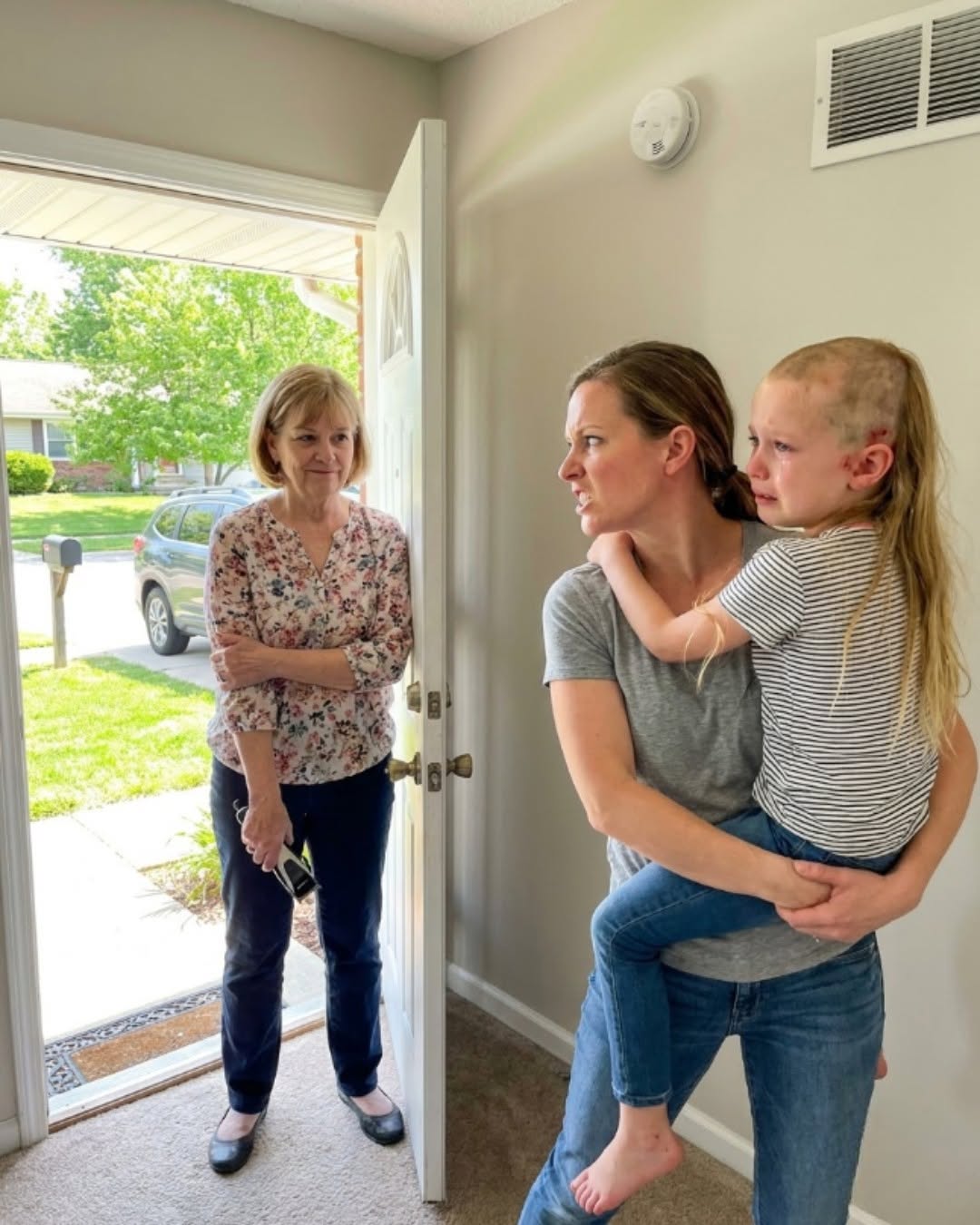 Progress came slowly.
Some visits ended early.
Some apologies still contained excuses.
But eventually, Dustin said the sentence Meadow had waited almost a year to hear.
“I gave Grandma permission, and what happened was wrong.”
Meadow looked at the supervisor.
Then she looked at her father.
“You were supposed to say no.”
“I know.”
“You were supposed to come get me.”
“I know.”
“You chose Grandma.”
Dustin began crying.
This time, he did not ask Meadow to comfort him.
“Yes,” he said. “I did, and I failed you.”
Meadow did not forgive him that day.
Nobody asked her to.
She picked up her elephant and requested to leave.
The supervisor opened the door.
I was waiting outside.
On the first anniversary of the incident, Meadow asked for a haircut.
Not because anyone demanded it.
Not because school pictures were approaching.
Not because short hair represented humility.
She chose it.
We visited a quiet salon recommended by Dr. Ruiz.
The stylist explained every tool before using it.
She asked permission before touching Meadow’s hair and stopped whenever Meadow raised one finger.
Meadow chose a short bob with soft layers around her face.
The golden curls fell onto a clean white cape.
This time, she watched them fall without shaking.
When the stylist finished, Meadow studied herself from every angle.
Then she smiled at me through the mirror.
“It grows back,” she said.
The words tightened my chest.
Judith had used them to dismiss pain.
Meadow had reclaimed them as proof of survival.
“Yes,” I said. “But nobody gets to take it again.”
On the way home, sunlight moved across her new haircut through the car window.
Meadow lowered the visor mirror and examined herself.
She did not look vain.
She looked free.
That evening, she placed the pink winter hat, the blue star hat, and one yellow ribbon inside a small memory box.
The purple elephant remained on her pillow.
Some things were ready to be stored.
Others were still needed.
I no longer measured healing by whether Meadow could enter a room uncovered.
I measured it by whether she knew the door would remain open when she wanted to leave.
I measured it by her laughter returning during breakfast.
By the pictures she drew with enormous trees instead of enormous arms.
By the way she finally stopped asking whether discipline meant someone could change her body without permission.
Judith had been right about only one thing.
Hair grows back.
But she was wrong about everything that mattered.
Trust requires protection.
Forgiveness requires accountability.
And discipline never gives an adult ownership of a child’s body.
Meadow’s hair returned because that was what bodies naturally do.
Her voice returned because people finally listened.
Her smile returned because nobody demanded it.
And her safety returned because when the moment came to choose between my marriage and my daughter, I kept the only promise that mattered.
I chose Meadow.
Progress came slowly.
Some visits ended early.
Some apologies still contained excuses.
But eventually, Dustin said the sentence Meadow had waited almost a year to hear.
“I gave Grandma permission, and what happened was wrong.”
Meadow looked at the supervisor.
Then she looked at her father.
“You were supposed to say no.”
“I know.”
“You were supposed to come get me.”
“I know.”
“You chose Grandma.”
Dustin began crying.
This time, he did not ask Meadow to comfort him.
“Yes,” he said. “I did, and I failed you.”
Meadow did not forgive him that day.
Nobody asked her to.
She picked up her elephant and requested to leave.
The supervisor opened the door.
I was waiting outside.
On the first anniversary of the incident, Meadow asked for a haircut.
Not because anyone demanded it.
Not because school pictures were approaching.
Not because short hair represented humility.
She chose it.
We visited a quiet salon recommended by Dr. Ruiz.
The stylist explained every tool before using it.
She asked permission before touching Meadow’s hair and stopped whenever Meadow raised one finger.
Meadow chose a short bob with soft layers around her face.
The golden curls fell onto a clean white cape.
This time, she watched them fall without shaking.
When the stylist finished, Meadow studied herself from every angle.
Then she smiled at me through the mirror.
“It grows back,” she said.
The words tightened my chest.
Judith had used them to dismiss pain.
Meadow had reclaimed them as proof of survival.
“Yes,” I said. “But nobody gets to take it again.”
On the way home, sunlight moved across her new haircut through the car window.
Meadow lowered the visor mirror and examined herself.
She did not look vain.
She looked free.
That evening, she placed the pink winter hat, the blue star hat, and one yellow ribbon inside a small memory box.
The purple elephant remained on her pillow.
Some things were ready to be stored.
Others were still needed.
I no longer measured healing by whether Meadow could enter a room uncovered.
I measured it by whether she knew the door would remain open when she wanted to leave.
I measured it by her laughter returning during breakfast.
By the pictures she drew with enormous trees instead of enormous arms.
By the way she finally stopped asking whether discipline meant someone could change her body without permission.
Judith had been right about only one thing.
Hair grows back.
But she was wrong about everything that mattered.
Trust requires protection.
Forgiveness requires accountability.
And discipline never gives an adult ownership of a child’s body.
Meadow’s hair returned because that was what bodies naturally do.
Her voice returned because people finally listened.
Her smile returned because nobody demanded it.
And her safety returned because when the moment came to choose between my marriage and my daughter, I kept the only promise that mattered.
I chose Meadow.