
Rebecca’s message stayed on my screen while Emma slept beside me under a thin hospital blanket.
“Leave Mom out of this,” she had written. “Hiding the pouch was my idea.”
For several seconds, I read the words without answering.
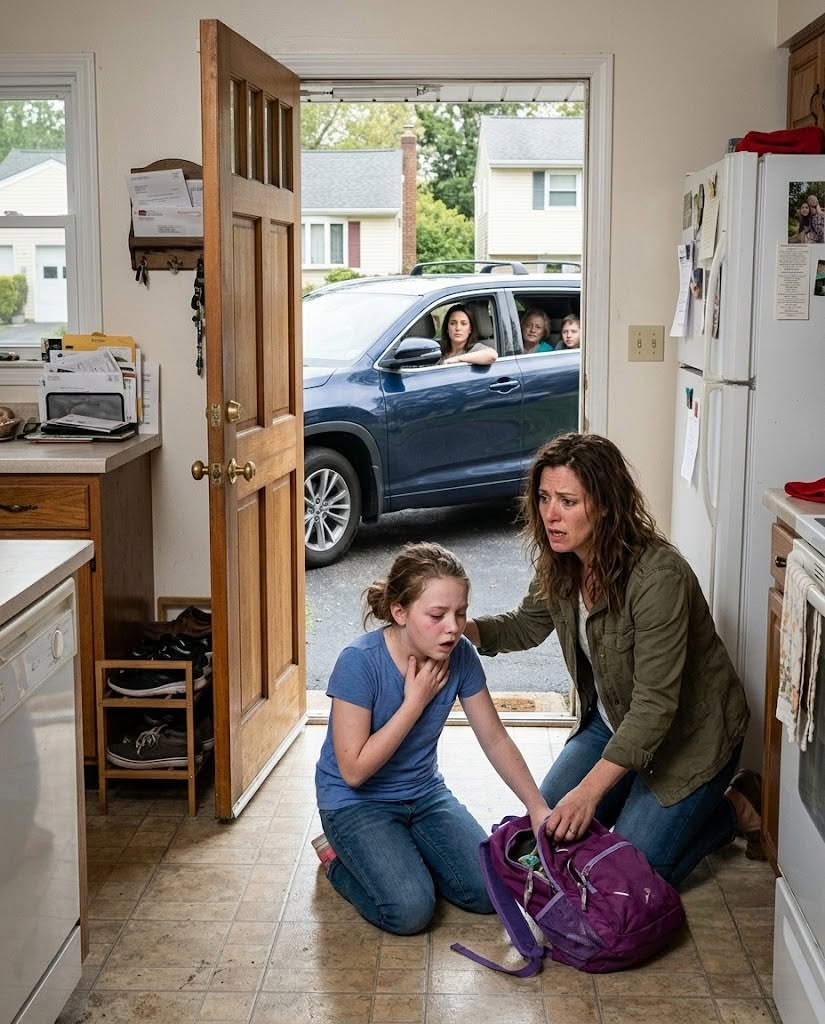
I had spent the last few hours telling myself that my mother and sister had made a terrible decision under pressure.
That explanation was already hard enough to accept.
People panic.
People underestimate symptoms.
People tell themselves a child is exaggerating because the alternative means admitting that something frightening is happening in front of them.
But Rebecca’s message changed the shape of what had happened.
The emergency pouch had not been misplaced.
It had not fallen out of Emma’s backpack.
No one had forgotten where it was.
Someone had taken the medication my 10-year-old daughter had been trained to use during a severe allergic reaction and placed it somewhere she could not reach.
Then, while Emma struggled to breathe, they had loaded the other children into an SUV for a luxury day trip.
I looked at Emma’s hand resting on the blanket.
Earlier, in that kitchen, those fingers had been pressed against her throat.
Now they were curled loosely near the hospital wristband around her arm.
My phone buzzed again.
Rebecca.
“This has gotten way out of control,” she wrote. “I already told you I did it. Mom didn’t know what I was doing until afterward.”
A second message followed almost immediately.
“She thought Emma was being dramatic. We both did.”
That explanation might have mattered if I had not heard my mother on the phone at 11:07. I could still hear her voice clearly. “An ambulance will turn this into a whole production. We already paid for the day package, and the other kids shouldn’t lose their trip because Emma is upset.” There was nothing confused about that sentence. There was no panic in it. There was irritation. Emma’s reaction had become an inconvenience standing between them and a day they had already paid for. I saved screenshots of the family conversation and put my phone face down. I was not interested in winning an argument while my daughter was still being monitored. A nurse came in to check Emma again, speaking softly so she would not wake more than necessary. The room had settled into that strange hospital rhythm where every few minutes someone adjusted something, wrote something down, or asked a quiet question that suddenly carried enormous weight. When Emma woke again, she looked at me first. “Are they mad at me?” she asked. That question hurt more than anything Rebecca had written. I moved my chair closer. “No,” I said. “You didn’t do anything wrong.” Emma looked toward the foot of the bed. “They said everybody was tired of missing stuff because of me.” I kept my voice steady. “Who said that?” She rubbed one thumb over the blanket. “Aunt Rebecca said the cousins were excited and Grandma said I always got scared when people had plans.” She swallowed. “Then Aunt Rebecca took the red pouch out.” I did not interrupt. Emma explained it in the simple, careful way children sometimes describe something terrible because they do not yet realize which detail will matter most to the adults listening. She had started itching after eating that morning. She told them her throat felt strange. Rebecca said she was probably nervous because everyone was getting ready to leave. Emma went for her backpack. That was when Rebecca removed the red pouch. My mother saw her holding it. Emma said Rebecca asked where they should put it so she would “stop reaching for it every time she got worked up.” My mother pointed toward the top of the refrigerator. Rebecca put it there. That distinction mattered. Rebecca may have physically moved the pouch, but my mother had not been an innocent bystander who discovered it later. Emma had watched both of them make the decision together. Then they kept getting ready to leave. I asked Emma what happened after I called. Her eyes filled with tears, but she did not cry. “Grandma said you were going to ruin everything because you always make it serious.” The words landed heavily because they sounded exactly like my mother. For years, she had used different versions of the same sentence whenever I drew a boundary she did not like. I was making things difficult. I was taking something too seriously. I was embarrassing the family. I was turning a small problem into a big one. That morning, Emma had heard the same argument while her airway was tightening. The doctor later confirmed what I already understood from the urgency of her treatment: this had been a severe reaction, and delaying emergency care longer could have ended very differently. I did not need a more dramatic warning than that. By late afternoon, Emma’s condition had improved enough that I could think about what came next instead of only what might happen in the next ten minutes. That was when the practical pieces started moving. My mother lived in the apartment above my garage because, two years earlier, she had said rising expenses were making it impossible for her to stay in her previous place. I had not charged her rent. I covered the utilities connected to the apartment, too. Rebecca had been in a difficult stretch of her own. Her vehicle had stopped being reliable, and she needed transportation for work and for her kids. I let her use my spare SUV. When after-school costs became difficult, I paid those as well. None of it had been presented as a permanent arrangement. But over time, temporary help had quietly turned into something they treated as ordinary family infrastructure. My garage apartment was simply where Mom lived. My spare SUV was simply what Rebecca drove. My money was simply what covered the gap whenever another expense appeared. Until that afternoon, I had never attached those things to obedience or gratitude. I did not help them because I expected them to agree with every decision I made. But there was one condition I had apparently assumed without ever speaking aloud. If I trusted them with my child, they had to protect her. That condition had been shattered. My first message to the family group had already ended the open-ended support. My mother would receive proper written notice concerning the apartment. Rebecca would return my vehicle and spare key. I would make sure the children were not suddenly without groceries or transportation during the immediate transition, because they had not caused any of this. But the indefinite financial support was over. And neither woman would ever be alone with Emma again. Within minutes, other relatives began joining the conversation. Some had only seen the consequences, not the morning that caused them. One relative told me I was making major financial decisions while emotional. Another asked whether I could wait a week before taking back the SUV because Rebecca needed it for work. Someone else said my mother had nowhere else ready to go. Those concerns were real. They were also not reasons to pretend nothing had happened. So I answered once. I explained that no child would lose food because of my decision. I explained that I was not putting my mother outside that night. I explained that the housing change would be handled through proper written notice rather than an impulsive lockout. And I explained that Rebecca had until that evening to return a vehicle that belonged to me. Then I added the one fact nobody had been given yet. Emma’s emergency medication had been deliberately removed from her backpack and placed on top of the refrigerator before the family left her struggling to breathe. The conversation changed immediately. Several relatives stopped arguing about whether I was overreacting. One asked Rebecca directly if the statement was true. Rebecca replied that she had already admitted moving the pouch but insisted she had only been trying to stop Emma from “working herself up.” My mother finally wrote something. “I never would have left if I thought she was actually dying.” I stared at that sentence for a long time. It contained the defense they both kept returning to. They had decided how sick Emma was allowed to be. Every fact that contradicted their decision had been treated as evidence that Emma was dramatic instead of evidence that they were wrong. The rash did not change their minds. The wheezing did not change their minds. Emma saying her throat felt wrong did not change their minds. My order to call 911 did not change their minds. Even the arrival of my car did not make them stop the SUV. They looked at me and drove away. That was not one mistaken judgment made in a split second. It was a chain of choices. Emma woke again while I was reading the messages. This time she asked whether Grandma was coming to see her. I told her no. She nodded, but the expression on her face told me she was trying to decide whether that was good news or bad news. Children can love people who frighten them. They can miss people who failed them. Nothing about that contradiction makes the failure smaller. “Do I have to go back there?” she asked. “No.” That answer came easily. Some decisions are complicated because every option carries a cost. That one did not. My phone rang a few minutes later. Rebecca. I declined the call. She called again. Then she sent a message saying she was on her way to return the SUV and wanted to talk in person. I told her to leave the vehicle at my house and put the key in the agreed place. I would not be meeting her while Emma was in the hospital. She responded that I owed her a conversation before making choices that affected her children. I understood why she wanted that conversation. She wanted the argument to move away from the kitchen floor and toward everything she could lose. The SUV. The childcare help. The money. The family relationships. But those were consequences of the decision, not substitutes for discussing the decision itself. I asked one question instead. “When you heard Emma wheezing, why didn’t you call 911?” Rebecca did not answer for almost twenty minutes. When she finally did, her response was shorter than I expected. “Because I thought she was doing it again.” Again. That word explained more than any apology could have. This had not started at 11:07 that morning. Somewhere along the way, my family had created a story about Emma. She was anxious. She was dramatic. Her allergies ruined plans. Her fear made everyone change schedules. Once they accepted that story, every warning sign was forced to fit inside it. Her reaching for medication became attention-seeking. Her asking for help became manipulation. My concern became overreaction. The family outing became the thing that needed protecting. I felt a different kind of anger then. Not the hot anger that makes you want to send ten messages at once. This was colder. It clarified things. I had spent years making life easier for two adults who, when my daughter made their day harder, had treated her safety like an obstacle. Helping them had never been the problem. Leaving Emma dependent on their judgment again would be. That evening, a relative texted to confirm that Rebecca had returned the SUV. The spare key was with it. My mother sent a separate message asking whether she could stay in the apartment if she promised never to babysit Emma again. I did not negotiate by text. The apartment issue would proceed properly, just as I had said. The boundary around Emma was separate and permanent. No unsupervised contact. No emergency responsibility. No situation where either woman could decide that Emma’s symptoms were inconvenient enough to ignore. The next morning, Emma was tired but more like herself. She complained about the hospital food. She asked for her own sweatshirt. She wanted to know whether she had missed something important at school. Those ordinary complaints were the best things I had heard in twenty-four hours. Before we left, I checked her belongings carefully. Backpack. Phone. Discharge papers. Emergency medication. Then I stopped at the red pouch. It was back where it belonged. Not above a refrigerator. Not hidden because an adult had decided she might misuse it. Inside her backpack, in the place Emma had been taught to reach. I handed the backpack to her instead of carrying it myself. She opened the front pocket and checked for the pouch. It was a small movement, but I watched her shoulders relax when she saw it. “Can I keep it with me all the time now?” she asked. “Yes,” I said. She looked at me to make sure I meant it. “All the time?” “All the time.” The days after that were messy in the way real family consequences usually are. There was no single dramatic moment when everyone suddenly understood everything. Some relatives apologized for defending Rebecca and my mother before knowing the details. Others remained focused on how difficult the changes would be for them financially. Rebecca alternated between apologizing and explaining. My mother insisted that she loved Emma and had simply believed the situation was less serious than it was. I did not argue with either statement. Love does not erase a dangerous choice. Intent does not restore trust automatically. What mattered to me was not forcing them to say the perfect words. It was making sure Emma never had to depend on those words for her safety again. I reorganized the practical parts of our lives accordingly. Emergency instructions were reviewed. Anyone responsible for Emma would know exactly where her medication was and exactly what to do if symptoms appeared. There would be no debate about whether calling for help was embarrassing, expensive, inconvenient, or disruptive to someone else’s plans. Emma would not have to persuade an adult that she deserved care. That was the part I kept returning to. A 10-year-old should not need to win an argument while struggling to breathe. Weeks later, Emma and I were getting ready to leave the house when she paused beside the kitchen counter. Her backpack was open. For a second, I thought she had forgotten something for school. Instead, she reached inside, touched the red emergency pouch, and zipped the bag closed again. Then she swung the backpack over one shoulder and headed toward the door. She did not ask permission to carry it. She did not ask whether having it might inconvenience anyone. She simply checked that the thing meant to protect her was where it belonged. And this time, nobody moved it out of her reach.