At 3:18 a.m., I stood in the hallway outside our bathroom and listened to my fifteen-year-old daughter cry into the sink.
The bathroom light buzzed above us with that thin electrical hum you only notice when the rest of the house is silent.
Bleach mixed with fever sweat, sour vomit, and the cheap hand soap I bought in bulk because Michael checked every receipt that came through our kitchen.
The tile was cold beneath my bare feet, but Emily looked fever-hot, folded over the porcelain bowl with one arm wrapped around her stomach so tightly her fingertips had turned white.
Her father stood in the doorway and looked at her pain as though it were one more bill he had not agreed to pay.
“If you drag her to the ER over one of her little performances, don’t expect me to pay a dime.”
Michael did not raise his voice.
He rarely needed to.
He had spent years learning how to make a quiet sentence feel like a locked door.
Emily had been vomiting for almost three days.
At first, I told myself it was a stomach bug from school, the kind that moves through hallways and cafeterias every winter and leaves half the class home with crackers and ginger ale.
Then the fever came.
Then she stopped asking for water.
Then she stopped complaining.
That was the change that scared me most.
Emily had always been a talker when she was little, the child who narrated every bruise, every lost pencil, every unfair group project, and every tiny victory on the ride home from school.
Somewhere over the years, that voice had gotten smaller inside our house.
She learned to listen for Michael’s footsteps before she answered a question.
She learned to check his face before asking for money.
She learned that pain was easier for him to tolerate when it stayed quiet.
A child does not learn to disappear in a single day.
Someone teaches her, one correction at a time, where she is allowed to stand.
That night, Emily moved through the hallway bent at the waist, one hand sliding along the wall because standing straight made the color drain from her face.
Every few steps, she paused and breathed through her mouth.
When Michael crossed the bedroom floor, her eyes snapped toward the sound.
“She’s exaggerating,” he said, rubbing his face. “She always does this when she has a test.”
There was no test.
I knew there was no test because I had signed the school calendar hanging beside the refrigerator two days earlier.
Still, for one dangerous second, I almost let his certainty replace what I could see with my own eyes.
That was one of Michael’s greatest skills.
He could say something with enough irritation that the rest of us began searching for ways to make it true.
For fifteen years, I had given him the things people politely call trust.
My paycheck went into the account he managed.
My passwords were written in a notebook he kept in his desk.
My schedule lived on the shared calendar he checked more closely than his own.
Even my grocery receipts went beneath the ceramic bowl by the door so he could circle anything he considered unnecessary.
I had told myself it was organization.
Then I called it stress.
Then I called it marriage.
The truth was simpler and harder to admit: I had been shrinking my life around his reactions.
Emily had watched me do it.
When she spit something pink into the sink, my entire body went cold.
“We are going to the emergency room,” I said.
Michael reached past me, took the thermometer from my hand, and stared at the number as though the fever itself had challenged his authority.
“Don’t be ridiculous, Sarah. You make her weak by babying her.”
For one ugly second, I imagined throwing the thermometer into the mirror.
I imagined the crack spreading through the glass while every sentence I had swallowed for fifteen years came out at once.
I imagined telling him exactly what I thought of a man who could watch his daughter shake and still worry first about money, control, and whether the neighbors might think his house was not perfect.
I did not throw it.
Rage can feel powerful, but sometimes the first useful act of defiance is quieter.
I looked at Emily instead.
Her eyes were lowered.
Her shoulders were trembling.
She was waiting to see which one of us I would believe.
Before dawn, she collapsed beside the shower.
I found her on the floor with the curtain half open and water tapping into the tub behind her.
Her gray hoodie was twisted under one shoulder, and her cracked phone was pressed against her chest like it was the one thing she had managed to save.
Her lips were dry.
Her eyelashes barely lifted when I touched her cheek.
“Mom,” she whispered. “Don’t tell Dad.”
The words landed harder than the sight of her on the floor.
My daughter was not afraid of the hospital.
She was afraid of what would happen if he knew she had asked for help.
At 4:06 a.m., I pulled the emergency cash I had hidden between two stacks of clean towels.
It was not much.
A few twenties, two tens, and some folded bills I had saved from grocery money whenever the total came in lower than Michael expected.
I grabbed Emily’s hoodie, found her sneakers, and helped her through the back door without turning on a single light.
The neighborhood was dark and still.
A porch light glowed two houses down, and somewhere beyond the fence a sprinkler clicked through its slow rotation as though this were an ordinary morning.
In the rideshare, Emily rested her head against my shoulder.
My hands shook so badly in my lap that the driver kept checking us in the rearview mirror.
Each time he looked, Emily curled tighter around her stomach.
“If he finds out,” she whispered, “he’s going to get worse.”
“It doesn’t matter anymore,” I told her.
The sentence came out steadier than I felt.
I needed those words to become true before we reached the hospital.
At the county hospital intake desk, a clerk entered our arrival time while a nurse wrapped an orange triage band around Emily’s wrist.
The intake form reduced the last three days to three clean phrases.
Abdominal pain.
Fever.
Persistent vomiting.
There was no box for the way she watched every doorway.
There was no line for the fact that I had hidden cash in towels because asking my husband for money could become an interrogation.
There was no clinical phrase for a child who whispered, “Don’t tell Dad,” while lying on a bathroom floor.
The nurse looked up from the screen.
“How long has she been like this?”
“Almost three days.”
Her expression changed.
It was small, but I saw it.
She glanced from Emily to me, then back to Emily.
“Three days with the vomiting and fever?”
I nodded.
Michael’s voice was still in my head, calling it drama.
The nurse did not call it drama.
She stood, pushed the keyboard away, and signaled toward the triage doors.
Sometimes the emergency begins long before a person reaches the emergency room.
Sometimes it begins in a house where everyone has been trained to doubt the person in pain.
The doctor pressed gently on the lower part of Emily’s abdomen.
She screamed.
The sound was so sudden and raw that the entire ER seemed to stop.
A woman froze with a paper coffee cup halfway to her mouth.
An orderly stopped with one hand on a metal bed rail.
The receptionist’s fingers hovered above the keyboard.
A man in a work jacket stared at the vending machine because looking anywhere else felt like an intrusion.
The monitor kept beeping.
A cart wheel kept turning for one second after the nurse stopped pushing it.
Nobody moved.
“I need blood work and an ultrasound now,” the doctor said.
His voice was calm, but everything around him accelerated.
A nurse reached for supplies.
Another pulled the curtain wider.
The doctor asked Emily where the pain had started, whether it had moved, whether she could remember the last time she had eaten, and whether anyone had given her medication.
Emily answered in fragments.
Then a man’s voice echoed from somewhere down the corridor.
Her whole body flinched.
The doctor noticed.
He noticed the way her fingers locked around my sleeve.
He noticed the way her eyes went immediately to the entrance.
He noticed that she seemed more afraid of footsteps than needles.
“I need to speak with her alone,” he told me.
For a moment, I felt the old reflex rise inside me.
The reflex to stay.
The reflex to explain.
The reflex to make sure Emily did not say something that would make Michael angry.
Then I understood what that reflex really was.
It was not protection.
It was training.
I stepped outside the curtain.
My phone began vibrating before I reached the row of plastic chairs.
Michael.
Fifteen missed calls.
Then a message appeared.
Where are you?
Another followed almost immediately.
If you took her to the hospital, you’re going to regret it.
I read it twice.
For years, messages like that had filled me with guilt before fear had a chance to arrive.
I would begin explaining myself in my head.
I would search for the right tone, the right apology, the right version of events that might keep the evening calm.
That morning, something changed.
I did not feel guilty.
I felt cold.
The timestamps sat there in plain view.
4:21 a.m.
4:22 a.m.
Two lines of text, simple enough to fit on a phone screen, and suddenly the control I had spent years minimizing looked exactly like what it was.
Twenty minutes later, the doctor returned.
He closed the curtain behind him and pulled the plastic chair closer.
“Mrs. Bennett, your daughter needs urgent surgery.”
My knees nearly gave out.
“What does she have?”
“An advanced infection. Likely complicated appendicitis. If you had waited much longer, it could have been fatal.”
The words much longer stayed in the air.
Three days.
Three days of vomiting.
Three days of fever.
Three days of Michael telling us she was performing.
I gripped the edge of the chair until the hard plastic pressed into my palm.
The doctor continued carefully.
He explained that the surgical team was being contacted and that they needed to move quickly.
I heard the words, but my mind kept returning to the bathroom, the thermometer in Michael’s hand, and Emily whispering that she did not want him told.
Then the doctor lowered his voice.
“There is something else.”
He glanced toward the bed.
“The infection explains the abdominal crisis. It does not explain all of the findings.”
I looked at him.
“What findings?”
“There are signs of blows. Some recent.”
For a second, the room seemed to tilt.
I stared at the chart near his hand.
The paperwork recorded symptoms.
The timestamps recorded delay.
The medical findings recorded something I had not been willing to imagine.
“Blows?” I repeated.
The doctor did not dramatize it.
He did not accuse.
He simply held my gaze long enough to make clear that this was not a misunderstanding he intended to ignore.
Before I could ask another question, a familiar voice rose at reception.
“I’m her father. I want to see my daughter now.”
Michael.
Even before I saw him, my body reacted.
My shoulders tightened.
My hand closed around the phone.
For years, that voice had been enough to rearrange a room.
The doctor stepped into the corridor before Michael reached the exam area.
Michael was still wearing the dark work jacket he kept by the front door.
His hair was uncombed, and his face carried the controlled irritation he used whenever he expected strangers to side with him.
“My wife took our daughter without telling me,” he said. “I need to know what is going on.”
The doctor placed himself between Michael and the hallway.
“Your daughter is receiving emergency treatment.”
“I’m her father.”
“I understand.”
“Then move.”
The doctor’s posture did not change.
Behind him, the receptionist stopped typing.
The orderly stayed near the bed rail.
The woman with the paper coffee cup lowered it slowly.
Michael looked past the doctor and found me.
“Sarah.”
He said my name like a warning.
My phone was still in my hand, the threatening message visible on the screen.
The doctor turned slightly toward me.
“I need to know something,” he said. “Is Emily safe if he comes in?”
The question should have been easy.
It was one word.
Yes or no.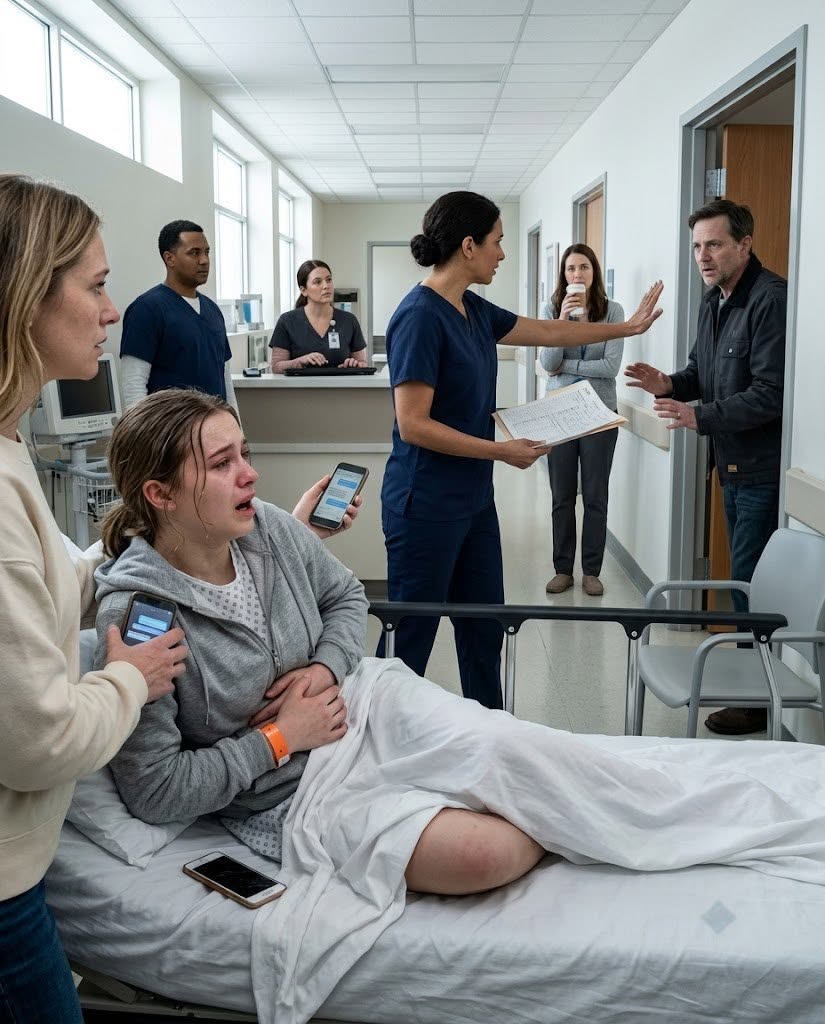 But fifteen years of habit can crowd into the space before a single answer.
I looked at Michael.
I remembered the receipts.
The passwords.
The way Emily watched the bedroom door.
The way she had hidden her pain until she collapsed.
The way she had whispered, “Don’t tell Dad,” as if his anger were more dangerous than what was happening inside her body.
Before I could speak, Emily screamed from behind the curtain.
“Don’t let him in!”
The corridor froze for the second time that morning.
Michael’s expression flickered.
The doctor looked toward the exam room.
Emily’s voice came again, cracked by fear and pain.
“He knows why it hurts!”
The confidence drained from Michael’s face like water.
He lifted both hands.
“She doesn’t know what she’s saying. She’s sick.”
The doctor turned back to him slowly.
“The infection does not explain everything we found.”
Michael’s jaw tightened.
I stepped forward and held up my phone.
The messages were still there.
Where are you?
If you took her to the hospital, you’re going to regret it.
For once, I did not explain them away.
I did not lower my eyes.
I did not tell myself he had been tired, worried, stressed, or afraid of the bill.
I let the words mean what they meant.
The doctor looked at the screen, then at me.
“Is she safe with him?”
This time, the answer came before fear could stop it.
“No.”
The word was quiet.
It was also the truest thing I had said in years.
Michael stared at me as though I had broken a rule he believed would hold forever.
“Sarah, think about what you’re doing.”
I was thinking about it.
I was thinking about my daughter in a hospital bed with an orange band around her wrist.
I was thinking about the surgery team being called because we had nearly waited too long.
I was thinking about the marks the doctor had found and the terror in Emily’s voice when she heard her father’s footsteps.
“I am,” I said.
The doctor kept himself between Michael and the hallway.
Behind the curtain, Emily still had one hand wrapped around my sleeve.
I went back to her.
She looked at the doorway first, then at me.
“He can’t come in,” I told her.
Her grip loosened by a fraction.
It was not a happy ending.
She still needed urgent surgery.
There were questions I was only beginning to understand and truths my daughter had carried alone because the adults around her had taught her silence was safer.
But that morning, inside a bright county hospital corridor, the pattern finally broke.
The chart showed the symptoms.
The timestamps showed the delay.
The messages showed the threat.
And when the doctor asked whether my daughter was safe, I stopped protecting the man who had made her afraid to ask for help.
I chose her.
For the first time in years, Michael was the one standing outside the door.
But fifteen years of habit can crowd into the space before a single answer.
I looked at Michael.
I remembered the receipts.
The passwords.
The way Emily watched the bedroom door.
The way she had hidden her pain until she collapsed.
The way she had whispered, “Don’t tell Dad,” as if his anger were more dangerous than what was happening inside her body.
Before I could speak, Emily screamed from behind the curtain.
“Don’t let him in!”
The corridor froze for the second time that morning.
Michael’s expression flickered.
The doctor looked toward the exam room.
Emily’s voice came again, cracked by fear and pain.
“He knows why it hurts!”
The confidence drained from Michael’s face like water.
He lifted both hands.
“She doesn’t know what she’s saying. She’s sick.”
The doctor turned back to him slowly.
“The infection does not explain everything we found.”
Michael’s jaw tightened.
I stepped forward and held up my phone.
The messages were still there.
Where are you?
If you took her to the hospital, you’re going to regret it.
For once, I did not explain them away.
I did not lower my eyes.
I did not tell myself he had been tired, worried, stressed, or afraid of the bill.
I let the words mean what they meant.
The doctor looked at the screen, then at me.
“Is she safe with him?”
This time, the answer came before fear could stop it.
“No.”
The word was quiet.
It was also the truest thing I had said in years.
Michael stared at me as though I had broken a rule he believed would hold forever.
“Sarah, think about what you’re doing.”
I was thinking about it.
I was thinking about my daughter in a hospital bed with an orange band around her wrist.
I was thinking about the surgery team being called because we had nearly waited too long.
I was thinking about the marks the doctor had found and the terror in Emily’s voice when she heard her father’s footsteps.
“I am,” I said.
The doctor kept himself between Michael and the hallway.
Behind the curtain, Emily still had one hand wrapped around my sleeve.
I went back to her.
She looked at the doorway first, then at me.
“He can’t come in,” I told her.
Her grip loosened by a fraction.
It was not a happy ending.
She still needed urgent surgery.
There were questions I was only beginning to understand and truths my daughter had carried alone because the adults around her had taught her silence was safer.
But that morning, inside a bright county hospital corridor, the pattern finally broke.
The chart showed the symptoms.
The timestamps showed the delay.
The messages showed the threat.
And when the doctor asked whether my daughter was safe, I stopped protecting the man who had made her afraid to ask for help.
I chose her.
For the first time in years, Michael was the one standing outside the door.