The line did not move like a pulse.
It cinched.
Chloe dragged in a shallow breath, and the skin beneath her chin tightened around that charcoal-black seam as though an invisible hand had pulled it from both ends.
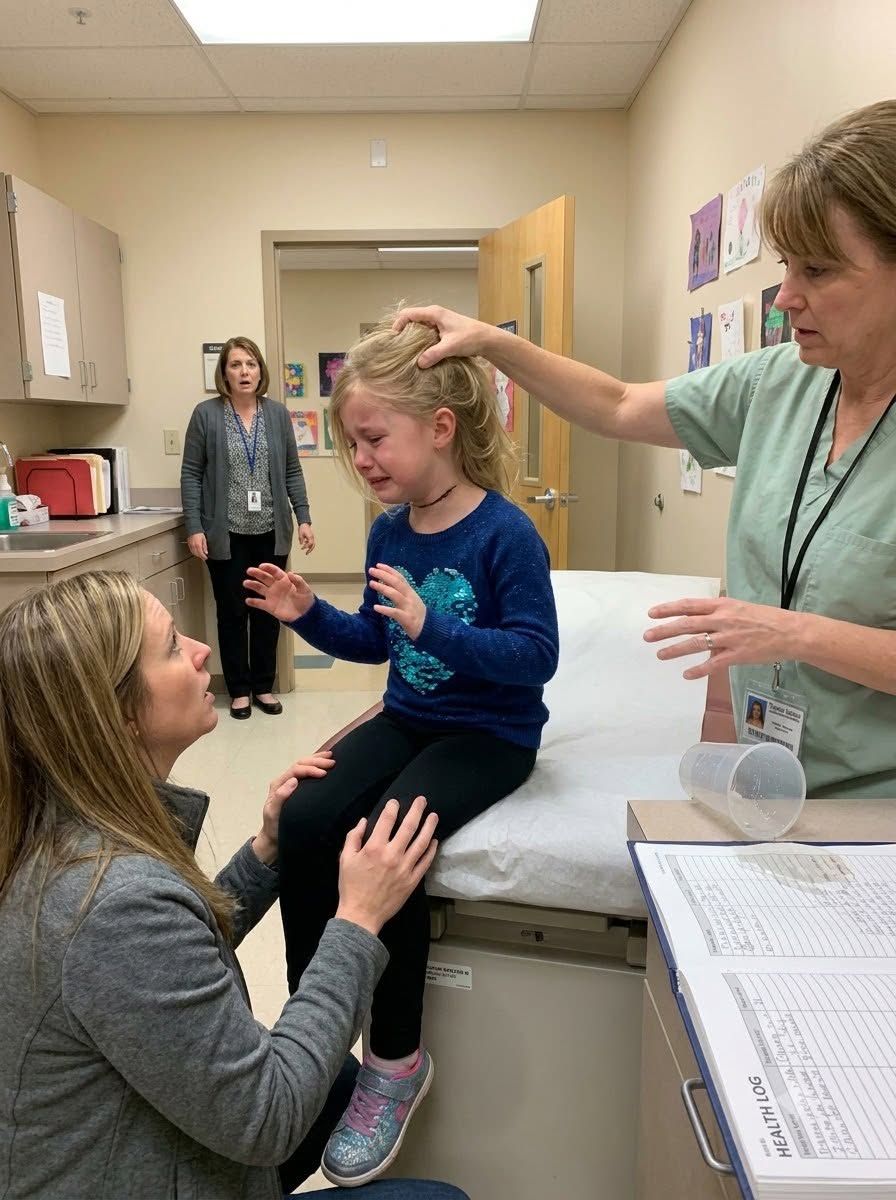
Mrs. Henderson stepped backward so quickly that her hip struck the metal cabinet behind her.
The secretary in the doorway covered her mouth.
I reached for Chloe, but the nurse caught my wrist before my fingers touched her neck.
“Don’t pull on it,” she said, and all the annoyance had vanished from her voice. “Whatever that is, it’s under pressure.”
Chloe’s eyes lifted toward mine for the first time since I had entered the room.
“Mommy,” she whispered, “I can’t get it off.”
The words hit harder than any scream could have.
Mrs. Henderson told the secretary to call 911, clear the hallway, and bring the emergency bag, then she lowered herself in front of Chloe and began speaking with the calm, careful tone she should have used forty minutes earlier.
“Chloe, I’m not going to touch your neck yet,” she said. “I only need you to breathe slowly and keep looking at your mom.”
Chloe nodded without lifting her chin.
Her fingers remained pressed against the sides of her neck, but now I could see what the nurse had missed.
A tiny black knot was hidden beneath the fold of skin just behind Chloe’s left jaw, almost completely buried by swelling and strands of blonde hair.
It was not a vein, a rash, or a line beneath her skin.
It was a cord.
A thin black cord had tightened so deeply around my daughter’s neck that the skin had swollen over its edges, making it look as though someone had drawn a crooked charcoal seam directly into her body.
Mrs. Henderson saw the knot at the same moment I did.
“Oh, sweetheart,” she breathed. “How long has this been there?”
Chloe’s lower lip trembled.
“Since Sunday.”
Sunday.
It was Tuesday afternoon.
For two nights, I had tucked blankets around her, kissed the top of her head, and turned off the hallway light without seeing the cord hidden beneath her hair.
For two mornings, I had watched her choose soft food and assumed she was being picky.
For two school lunches, adults had looked inside her mouth while the real danger remained wrapped around the outside of her throat.
The paramedics arrived within minutes, though every second felt stretched thin enough to break.
One of them knelt beside Chloe while the other asked Mrs. Henderson for the timeline, and I watched the nurse hand over the wet health record with shaking fingers.
Monday, 11:58 AM.
Tuesday, 12:15 PM.
Repeated pain with swallowing. t Food refusal. No visible throat irritation. The paramedic read the entries, then looked at the dark cord and asked the question no one in that room wanted to answer. “Was the outside of her neck examined on Monday?” Mrs. Henderson swallowed. “No.” He did not lecture her. He did not have to. Chloe’s breathing had begun to whistle faintly through her nose, and that sound ended every conversation that did not involve getting her help. They stabilized the cord so it would not tighten further, placed a small oxygen mask near her face, and carried her out through a side hallway while teachers kept curious children inside their classrooms. I walked beside the stretcher with one hand wrapped around Chloe’s fingers. She squeezed me every time the wheels crossed a doorway seam. At the emergency department, a team moved quickly without turning Chloe into a spectacle. They checked her breathing, monitored the swelling around her neck, and gave her medicine to keep the inflammation from worsening while a specialist examined the cord. The doctor explained that the black waxed string had an adjustable sliding knot, the kind used on inexpensive handmade necklaces. Each time the cord was tugged, twisted, or slept on, the knot could ratchet tighter without loosening again. Swelling had hidden most of it by the time Chloe reached school on Monday. By Tuesday, swallowing had become painful because the pressure and inflammation were affecting the soft tissue around her throat. The line had seemed to move because the cord shifted against the swollen skin whenever she breathed. The doctor did not promise that everything was fine. She said the pressure had lasted too long, and Chloe needed the cord removed carefully while they watched her airway. A nurse brought me a consent form, and my hand shook so badly that my signature looked like it belonged to someone else. Chloe watched me from the bed, her blue sequin sweater folded in a clear belongings bag near the wall. “Am I in trouble?” she asked. I stared at her. “For what?” “The necklace.” “No, baby.” “But jewelry isn’t allowed at school.” The fear in her face changed shape before my eyes. She was not afraid only because her neck hurt. She had been protecting a secret because she believed the rule mattered more than the danger. I leaned close enough that she could see my whole face without moving her head. “You are not in trouble,” I said. “Not for the necklace, not for crying, and not for asking to come home.” Her eyes filled. “I didn’t ask to come home.” “What do you mean?” “I asked them to make it stop hurting.” The sentence sat between us while machines hummed softly around the bed. I had spent the drive to school asking why this happened only there. The nurse had assumed Chloe wanted to leave early. The secretary had said they could not calm her down. But Chloe had never been trying to escape school. She had been trying to get help without revealing the necklace. The specialist removed the cord after the swelling was controlled enough to do it safely. When she came back, she placed the cut pieces in a small specimen cup because the doctor wanted to see exactly how the knot had tightened. The string was thinner than a shoelace and darker than thread. One end had three tiny blue beads. The other held a flattened silver-colored star. I recognized it immediately. Chloe had shown me that star on Friday afternoon while I was standing at the kitchen counter, answering a work email and trying to calculate whether my checking account could survive the electric bill, groceries, and the minimum payment on my credit card. A girl in her class had made matching friendship necklaces. I remembered saying it was pretty. I remembered telling Chloe to put it somewhere safe. I did not remember seeing her fasten it around her neck. When Chloe woke after the procedure, the cord was gone, a soft protective dressing rested beneath her chin, and the angry swelling had begun to ease. She still spoke in a whisper, but she could take a small sip of water without crying. I wanted that sip to erase the last two days. It did not. Mrs. Henderson called my phone three times that afternoon. I let each call go to voicemail while I sat beside Chloe’s bed and watched the oxygen number on the monitor. The first message was formal. The second was an apology. In the third, her voice broke when she said she had reviewed Monday’s health entry and realized Chloe had kept touching the sides of her neck during the examination. She had written it down as anxiety. That detail changed my anger into something heavier. The signs had not been invisible. They had been translated into behavior adults thought they understood. Late that evening, a hospital social worker asked Chloe whether anyone had put the cord around her neck or pulled it tight. The question made Chloe look at me before she answered. “No.” “Did another child tell you to wear it?” “My friend gave it to me.” “Did your friend tell you not to remove it?” Chloe hesitated. “She said we had to keep them on until Friday.” The social worker remained gentle. “What happens Friday?” “She’s leaving.” The girl’s family was moving away at the end of the week, and the necklaces were supposed to be a promise that the girls would stay best friends after she left. On Sunday night, Chloe had worn hers to bed because she was afraid taking it off would break the promise. The sliding knot had caught in her hair while she slept. When she pulled the necklace free Monday morning, the knot tightened. She tried to loosen it in the bathroom but could not get her fingers beneath the cord. Then the skin began to swell around it. “Why didn’t you show me?” I asked, keeping my voice quiet even though shame was burning through my chest. Chloe looked down at the hospital blanket. “I tried.” “When?” “Sunday night.” I searched my memory and found only scattered pieces: laundry tumbling in the dryer, my laptop open beside a pile of unopened mail, Chloe standing in the kitchen doorway with her pajama sleeves pulled over her hands. Then I remembered what she had asked. “Mommy, do you have to keep a promise if it starts to hurt?” I had been reading an email from my supervisor about a missed deadline. Without turning around, I had said, “A promise is a promise, honey. Give me five minutes.” t Five minutes became twenty. Then bedtime. Then Monday morning. Chloe had not misunderstood the words. She had understood them exactly as a seven-year-old would. She believed pain was the price of being loyal. I pressed my knuckles against my mouth because I did not want my guilt to become another thing she had to manage. “I gave you a bad answer,” I said. “I was distracted, and I didn’t listen to what you were really asking.” She studied my face. “Are you mad at me?” “No.” “Are you mad at my friend?” “No. I’m scared because you were hurting, and I’m sorry I made you think you had to keep hurting to keep someone’s promise.” She reached for my hand beneath the blanket. “What if she doesn’t want to be my friend now?” “Then we’ll be sad about that together,” I said. “But no friendship gets to ask for your breathing, your voice, or your body as proof.” The next morning, the girl’s mother called after the school contacted families about the necklaces. She sounded terrified and kept apologizing, but the truth was simpler than the disaster everyone had imagined. Her daughter had made two necklaces from a craft kit at home. She had not known the sliding knots could tighten dangerously, and she had taken her own necklace off Sunday because it felt uncomfortable. On Monday morning, she noticed Chloe holding her neck and asked whether the necklace was stuck. Chloe told her not to say anything because both girls believed they would be punished for breaking the school’s no-jewelry rule. The other child stayed quiet until Tuesday afternoon, when a teacher entered the classroom and removed the matching necklace from her backpack. That was the second time an ordinary rule had become larger than a child’s sense of safety. The children were not hiding cruelty. They were hiding what they thought was disobedience. Mrs. Henderson came to the hospital before Chloe was discharged. She wore the same pale green scrubs, but her identification badge was crooked now, and a coffee stain marked one sleeve. She did not bring flowers, balloons, or a speech designed to make me forgive her. She brought a copy of the health log. The water that spilled in her office had blurred part of Tuesday’s entry, but the times were still readable. Monday, 11:58 AM. Tuesday, 12:15 PM. At the bottom, beneath the neat blue handwriting, she had added a new note in darker ink. External neck examined after parent request. Constricting cord observed. Emergency response initiated. “I should have looked on Monday,” she said. “Yes.” “I thought I was seeing a pattern of avoidance.” “You were seeing a pattern of pain.” Her face tightened, but she did not defend herself. “Yes.” I expected that agreement to satisfy something in me. It did not. There was no sentence she could offer that would return Monday afternoon, Monday night, or Tuesday morning to my daughter. Still, what she did next mattered. Mrs. Henderson told me she had already asked the principal to review how repeated complaints were documented, how children who could not fully explain symptoms were questioned, and how staff responded when a parent raised a concern that did not match the first examination. She was not asking me to keep the incident quiet. She was asking permission to include her mistake in the review. I looked at Chloe, who was turning the corner of her hospital blanket between her fingers. “What do you want?” I asked her. Chloe looked at Mrs. Henderson. “I want you to believe kids even when they don’t say it right.” Mrs. Henderson’s eyes filled, but she did not look away. “I will,” she said. “And I’ll teach the other adults to slow down too.” Chloe considered that answer, then nodded once. It was not forgiveness. It was a condition. The school review did not end with anyone being dramatically marched out of the building. Mrs. Henderson remained off student duty while the incident was evaluated, and the school arranged additional oversight before she returned. The health office changed its intake form so repeated pain complaints required staff to record the child’s exact words, inspect both the reported area and nearby external areas when appropriate, and contact a parent again if symptoms returned without explanation. The principal also sent families a plain notice about corded jewelry and adjustable necklaces without naming Chloe. None of those steps erased what happened. They did make it harder for the same kind of mistake to hide behind tidy handwriting. Chloe came home after one night of observation with instructions for rest, soft food, and follow-up care. The first evening, she slept in my bed while I sat beside her answering only the work messages that could not wait. My supervisor had reassigned the meeting I abandoned and warned me that my attendance record was becoming a problem. Three overdue bills waited on the kitchen counter. The laundry was still unfolded. Ordinary pressure had not disappeared because my daughter had been frightened. What changed was the order in which I answered it. When Chloe called my name, I closed the laptop before I asked what she needed. Sometimes she wanted water. Sometimes she wanted me to check beneath her chin even though the cord was gone. Once, she only wanted to know whether her friend could visit before moving day. The visit happened Thursday afternoon at our kitchen table. The other girl arrived carrying a paper bag with the remaining beads from the craft kit. Her mother stayed nearby, visibly nervous, but the girls did not need adults to build a dramatic explanation for them. “I took mine off,” the girl admitted. “I wanted to,” Chloe said. “I thought you’d be mad.” “I thought you’d stop being my friend.” They looked at each other across two cups of applesauce. Then the girl pushed the paper bag toward Chloe. “We can make something that doesn’t go on our necks.” They threaded the blue beads onto two short key rings while I watched from the counter. The flattened silver star went onto Chloe’s ring. The matching moon went onto her friend’s. No vows. No rules about how long they had to keep them. When the girl’s family moved, the friendship did not remain perfect. t The children missed video calls, argued over a game, and sometimes went days without messaging. They also mailed each other drawings and laughed so loudly during one call that I had to remind Chloe it was past bedtime. The friendship survived because it was allowed to bend. My relationship with Chloe needed the same kind of repair. For weeks, she asked whether I was busy before telling me anything important. Every time she did, I felt the cost of all the moments when my tired face or half-answered words had taught her to measure her needs against my stress. I could not fix that with one apology. I began giving her a different answer. “I may be working, but I’m listening.” Then I proved it by turning my chair, putting down the phone, and waiting through the long pauses children use while deciding whether an adult is safe enough for the whole truth. Mrs. Henderson returned to the school health office later that semester under new supervision. The first time Chloe developed a stomachache after lunch, she hesitated outside the office door. Her teacher offered to walk with her, but Chloe said she wanted to go by herself. Mrs. Henderson listened, checked what Chloe said hurt, and called me before deciding what the complaint meant. It turned out to be nothing more serious than eating too quickly before recess. That ordinary outcome mattered more than any dramatic apology. A child had reported pain, and an adult had treated the report as information instead of strategy. By spring, the narrow mark beneath Chloe’s chin had faded from dark charcoal to pale pink and then to a line I could see only when the light caught it. The doctor said healing would take time, and so did trust. On the final Tuesday of the school year, I packed Chloe’s lunch before waking her. I placed a turkey sandwich in the main compartment, added a sleeve of crackers, and reached automatically for an applesauce cup. For months, applesauce had reminded me of everything I failed to notice. That morning, Chloe wandered into the kitchen, looked inside the lunchbox, and took the cup back out. “I want apple slices today,” she said. “Are you sure?” She nodded, chewing one of the crackers I had left on the counter. They no longer hurt going down. I sliced an apple while Chloe clipped the little silver-star key ring to the zipper of her backpack. The star rested there loosely, carrying no knot, no pressure, and no promise she had to suffer to keep.