The third blow tore the deadbolt from the frame.
The door swung inward so violently that a framed photograph fell from the hallway wall and shattered.
Carol dropped the sledgehammer.
She crossed the broken glass without looking down and reached for Leo.
His eyes opened briefly, but he did not lift his head from my shoulder.
“He’s burning up,” she said.
“I know.”
Carol pulled a phone from her sweatshirt pocket.
“I called 911 before I started driving here. They should be less than two minutes away.”
My knees finally gave way.
Carol caught Leo while I slid against the wall.
The folder fell from the porch rail and burst open across the floor.
Typed pages scattered among the broken wood.
One page was titled DAY ONE: DISORIENTATION.
Another read DAY TWO: RESOURCE PRESSURE.
The final section was labeled DAY THREE: COMPLIANCE.
An ambulance arrived before I could read anything else.
Paramedics carried Leo outside, placed an oxygen sensor on his finger, and began checking his temperature and blood sugar.
A police officer wrapped a blanket around my shoulders.
I kept telling him about the locks, the missing food, the disabled phone, and the water.
My sentences came out in the wrong order.
Carol knelt beside the manila folder, gathering every page with both hands.
“Don’t lose that,” I told the officer.
“We won’t.”
A paramedic lifted Leo onto a stretcher.
I climbed into the ambulance beside him.
Carol tried to follow, but the officer stopped her.
“You need to remain here,” he said.
She looked at me.
For the first time since I had met her, Carol’s face held no criticism.
Only shame.
“I’ll tell them everything,” she said.
At the hospital, doctors treated Leo for dehydration and a viral infection worsened by heat and inadequate fluids.
His fever had reached 103.8 degrees.
The pediatrician said another night inside that house could have produced far more dangerous complications.
I held Leo’s hand while cool fluids entered through a tiny intravenous line.
He slept beneath a white blanket with his blue cup beside him.
A nurse had found one in the pediatric supply room.
It had a rocket ship.
When Leo woke, he whispered, “Daddy forgot the present.”
I turned away before he could see my face.
Michael had not forgotten anything.
According to the folder, every hour had been planned.
At 4:20 that afternoon, Detective Mara Ellis entered the hospital room carrying an evidence bag.
Inside was Michael’s THREE-DAY RESET file.
Carol followed with another officer.
She remained near the door.
“Mrs. Bennett,” Detective Ellis said, “your mother-in-law has provided a statement.”
I looked at Carol.
She gripped the cuff of her sweatshirt.
“Michael called me Sunday,” she began. “He said you were becoming unstable and needed an intervention.”
“What kind of intervention locks a toddler inside a house?”
“He said Leo would stay with me.”
My stomach turned.
Carol continued before I could answer.
“Michael asked me to remove food while you were shopping Monday. He gave me the garage code.”
She admitted emptying the refrigerator and pantry.
Michael told her he would bring Leo to her house before leaving for Miami.
He claimed I would remain alone for several hours without distractions, then agree to enter a wellness program.
“You cleaned the rice container,” I said.
Carol’s eyes filled.
“Yes.”
“Why?”
“Michael said you hid your anxiety medication inside it.”
“I have never taken anxiety medication.”
“I know that now.”
I wanted to scream at her.
Instead, I looked toward Leo.
Anger could wait until he was safe enough for me to spend it.
Carol said Michael gave her the folder Wednesday night.
She was supposed to arrive Saturday morning after his return.
Her role was to witness what he called my “breakthrough.”
“What did that mean?” I asked.
Carol looked at Detective Ellis.
The detective answered.
“According to the final pages, Michael expected you to sign several documents before he released you.”
She opened the evidence bag and displayed photocopies.
One document granted Michael temporary sole custody of Leo.
Another transferred my interest in our house to a company I did not recognize.
A third authorized a private mental-health evaluation selected and paid for by Michael.
The signature lines were marked with yellow tabs.
My hands began shaking.
“He wanted me dehydrated and frightened before asking me to sign?”
“That appears to have been the intended pressure,” Detective Ellis said.
Carol covered her mouth.
She had not read the entire folder when Michael first delivered it.
He told her the papers were treatment consent forms.
That morning, she opened the file to find the address of the supposed wellness center.
Instead, she found the custody transfer.
Then she reached the page titled CONTROLLED DEPRIVATION SCHEDULE.
It listed the thermostat setting.
The phone cancellation.
The padlocks.
The water shutoff.
Even the location of Leo’s fever medicine appeared beside one instruction:
REMOVE TO PREVENT UNSUPERVISED DOSING.
Carol drove to Michael’s office first, thinking she could force him to stop.
His assistant said he was not in Miami.
He had taken personal leave.
The company had no major account meeting scheduled.
Michael had lied about the trip.
“Where is he?” I asked.
Detective Ellis turned another page.
A receipt inside the folder showed a short-term rental eleven miles from our house.
Michael had booked it for four nights.
He was not across the country.
He was nearby.
Waiting.
The smart thermostat records showed he had monitored the house remotely.
At 8:00 Thursday night, he raised the temperature another four degrees.
At 6:15 Friday morning, he remotely closed the water valve connected to our home system.
He knew Leo was inside.
The folder even contained a handwritten note beside Leo’s name.
“Mild fever likely increases Emily’s urgency. Do not interrupt unless symptoms become visibly severe.”
I stopped breathing.
“How could he see us?”
The detective exchanged a glance with Carol.
Then she showed me a photograph of our living room smoke detector.
Michael had installed a camera inside it.
He called it part of the security upgrade.
The device transmitted video to his private account.
He had watched me ration water.
He had watched Leo crying on the rug.
He had watched me strike the iron bars and cut into the laundry-room wall.
He had never called for help.
Detective Ellis told me officers were executing a search warrant at the rental property.
They had also preserved smart-home logs before Michael could delete them.
No arrest had been announced yet.
The evidence required review, and prosecutors would determine the charges.
But officers were looking for him.
Carol moved toward my bed.
I raised one hand.
“Don’t.”
She stopped.
“I thought I was helping my son save his marriage,” she whispered.
“You emptied food from a house where your grandson lived.”
“He promised Leo would be with me.”
“You never checked.”
“No.”
“You trusted Michael because blaming me was easier.”
Carol’s tears fell silently.
“Yes.”
That answer did not earn forgiveness.
But it was the first honest thing she had given me.
Detective Ellis asked whether Michael had pressured me about money or property before.
Until then, I had believed our finances were ordinary.
Michael paid the mortgage through our joint account.
I handled groceries and Leo’s preschool expenses.
He discouraged me from opening mail because his company provided “complex tax benefits.”
Three months earlier, he began insisting we refinance the house.
I refused because the home had been purchased partly with money my grandmother left me.
The deed listed both our names.
Michael called my refusal distrustful.
Two weeks later, he scheduled a therapist for me without permission.
I attended one session.
The therapist asked why Michael believed I was experiencing paranoia.
I laughed because the idea seemed absurd.
Now nothing about it felt absurd.
Detective Ellis wrote everything down.
An officer entered the room at 5:07 p.m.
Michael had been found inside the rental property.
He was watching the hidden camera feed when police arrived.
On the table beside him were the original transfer documents, a bottle of champagne, and a wrapped toy truck for Leo.
The present.
He truly had bought one.
That detail disturbed me more than if he had forgotten.
Michael expected to return after terrorizing us and hand our child a toy.
He believed affection could erase captivity.
The officer said Michael had not been formally charged yet.
He was being questioned while investigators examined the devices and documents recovered from the rental.
My immediate priority was protection.
A hospital advocate helped me contact an emergency family-law attorney.
By evening, we had requested temporary custody orders and protection for both Leo and me.
I also revoked Michael’s access to Leo’s medical information wherever possible.
The police arranged for an officer to remain near our hospital floor.
Leo slept through most of it.
Children can survive the collapse of an entire world while holding one plastic truck borrowed from a nurse.
The next morning, his fever began falling.
He drank diluted juice and asked for toast.
When the tray arrived, he broke the toast into two pieces.
One piece he ate.
The other he pushed toward me.
“For later,” he said.
My three-year-old had learned to save food after forty-eight hours.
I went into the bathroom and cried where he could not see me.
Carol remained at the hospital all night, but I did not allow her inside Leo’s room.
She sat beneath the vending machines with her hands folded around a paper cup.
At sunrise, she gave Detective Ellis access to her phone, bank records, and every message Michael had sent.
The messages confirmed her role.
They also showed Michael had manipulated her.
He told Carol I had become addicted to prescription medication.
He claimed I neglected Leo whenever he traveled.
He sent cropped photographs showing unfolded laundry, dirty breakfast dishes, and Leo crying during ordinary toddler tantrums.
Carol had accepted each image as evidence.
She never called me.
She never asked what happened before or after the photograph.
Michael built his case from moments every parent experiences, then removed the surrounding life.
One message from Carol read:
“If removing conveniences teaches her gratitude, I’ll help.”
Michael replied:
“Three days will reset her completely.”
That was where the file’s name came from.
Not therapy.
Not safety.
Obedience.
Later that morning, my attorney, Dana Brooks, arrived with temporary orders signed by a judge.
I received temporary sole physical custody of Leo.
Michael was prohibited from contacting us or approaching the hospital, my sister’s home, Leo’s preschool, or our damaged house.
Any future contact would depend on criminal and family-court proceedings.
Carol was not included in the protection order because she had assisted the rescue and cooperated immediately.
That did not mean she had access to Leo.
Dana made that clear.
“You decide who sees your child, subject to court orders,” she said.
I told Carol she could receive updates through Dana.
She nodded.
“I understand.”
For once, she did not argue about what a grandmother deserved.
Michael called the hospital from an unknown number that afternoon.
A nurse intercepted the call.
He claimed there had been a marital misunderstanding and demanded information about Leo.
The nurse provided nothing.
Then Michael left a voicemail on Dana’s office line.
His voice sounded calm.
“Emily became hysterical during a structured separation exercise.”
He said the doors were locked because I had previously threatened to run away with Leo.
He said emergency supplies had been hidden beneath the kitchen sink.
Police searched that cabinet.
It contained cleaning products and an empty plastic container.
No food.
No water.
No medicine.
Michael also claimed the water shutoff had been accidental.
The smart-system log showed he entered his password, confirmed the command, and dismissed a warning about occupied premises.
Every excuse created another record.
Two days later, prosecutors approved charges connected to unlawful confinement, child endangerment, domestic violence, and attempted coercion.
The exact charges could still change as the case developed.
Michael appeared before a judge and was ordered to have no contact with us.
His passport was surrendered.
His employer placed him on administrative leave after police seized a company laptop from the rental.
The laptop contained drafts of the property-transfer documents.
It also contained something unexpected.
Michael had been communicating with a woman named Vanessa Cole, a regional sales director from his company.
Their messages were not merely romantic.
They discussed the house.
Michael had promised Vanessa they would move into it after I entered long-term treatment.
She believed I had already agreed to give him custody and leave the state.
One message from Vanessa asked:
“What if she refuses to sign?”
Michael answered:
“She won’t refuse after the reset.”
Vanessa immediately contacted an attorney when investigators questioned her.
She denied knowing we would be locked inside.
Her later messages supported that claim.
When Michael described shutting off the water, she wrote:
“You said Leo wouldn’t be there. Stop this now.”
Michael did not answer.
Vanessa called Carol the following morning.
That call explained why Carol opened the folder earlier than planned.
Vanessa told her Leo might still be inside the house.
Carol first called Michael.
He said Vanessa was jealous and lying.
Carol called my phone.
It went directly to a disabled-number message.
Then she opened the folder.
She reached our driveway forty-three minutes later.
The truth had not transformed Carol into a hero.
It had forced her to choose whether she would remain Michael’s accomplice.
She chose the sledgehammer.
That choice saved Leo.
It did not erase the empty pantry.
Both facts remained true.
After four days, Leo was discharged.
I did not return to the house.
My sister Rebecca brought us to her apartment, where she had stocked the kitchen with too much food.
Leo opened every cabinet.
He counted juice boxes, crackers, cereal, and soup cans.
Then he carried three granola bars into the bedroom and placed them beneath his pillow.
I found them that night.
I did not take them away.
Dr. Nina Patel, a child therapist, advised us to keep food and water visibly available.
She gave Leo a small backpack containing snacks, a water bottle, and a card with trusted adults’ photographs.
He wore the backpack inside Rebecca’s apartment for nearly two weeks.
At bath time, he placed it beside the tub.
During naps, he kept one strap around his wrist.
Trauma does not understand that the refrigerator is full again.
It remembers the moment the apple was gone.
I began therapy too.
For years, Michael had controlled small things.
Passwords.
Bank statements.
Car maintenance.
Who visited.
How long I stayed at my mother’s house.
He never called it control.
He called it efficiency.
When I questioned him, he kissed my forehead and asked why I always expected the worst.
Eventually, I stopped questioning.
The locked door was not the beginning.
It was only the first part impossible to rename.
Dana helped me file for divorce and permanent custody arrangements.
A forensic accountant examined our finances.
Michael had opened a line of credit against the house using a signature that resembled mine.
The money funded the rental property, legal document preparation, and payments to a private consultant.
That consultant had previously designed aggressive corporate “performance resets.”
Michael adapted workplace deprivation tactics into a plan for his family.
The consultant claimed he never knew a child would be involved.
Investigators preserved their communications.
Again, there was no instant ending.
Criminal cases move through hearings, motions, evidence reviews, and negotiations.
Family court follows its own process.
I learned to stop measuring justice by speed.
Safety came first.
Then documentation.
Then accountability.
At the temporary custody hearing, Michael entered wearing the navy suit I had bought for our tenth anniversary.
He looked rested.
I hated him for looking rested.
His attorney described him as a devoted father who had exercised catastrophic judgment during a marital intervention.
Then the judge reviewed the smart-home log.
She saw every temperature change.
Every camera access.
Every dismissed warning.
She studied the note predicting that Leo’s fever would increase my urgency.
Then she looked at Michael.
“You monitored your sick child for hours,” she said.
Michael leaned toward his microphone.
“I believed Emily still had sufficient water.”
The judge opened the photograph of the refrigerator.
“Where?”
He had no answer.
She continued temporary sole custody and suspended his direct visitation pending a full evaluation.
Any eventual contact would begin professionally supervised and only after therapists determined it would not harm Leo.
Michael’s mother testified next.
Carol did not minimize her involvement.
She admitted removing food.
She admitted believing Michael’s lies without contacting me.
She admitted placing loyalty to her son above concern for her grandson.
Then Dana asked why she broke down the door.
Carol looked toward me.
“Because I finally read what my son wrote instead of believing what I wanted him to mean.”
Her voice shook.
“And because Leo was going to pay for my cowardice.”
After court, Carol handed Dana an envelope.
Inside was the deed to her small rental property.
She offered to let Leo and me live there without charge during the proceedings.
I refused the gift.
Then I reconsidered the practical need.
Through attorneys, we created a six-month lease at a fair reduced rate.
The agreement contained no promise of access to Leo.
Carol accepted every condition.
For three months, she saw him only in photographs I approved.
She attended counseling and a family-accountability program voluntarily.
She never sent gifts directly.
She never asked me to tell Leo that Grandma was good.
Her first letter to me contained four pages.
There were no excuses.
The sentence I remembered was simple:
“I confused defending my son with loving him, and that confusion nearly killed yours.”
I did not forgive her immediately.
Forgiveness given under pressure is another locked door.
Six months later, Leo asked why Grandma Carol no longer visited.
I told him she had helped Daddy make a dangerous choice.
Then I told him she had also broken the door and brought help.
“Is she bad?” he asked.
“People are more complicated than one word.”
“Is Daddy bad?”
I sat beside him on the carpet.
“Daddy made choices that were dangerous and wrong.”
“Does he get a present?”
“No.”
Leo thought about this.
“Do we have water?”
“Yes.”
“Show me.”
We walked through the apartment together.
I opened the kitchen faucet.
Then the bathroom faucet.
Then the shower.
Water moved through every pipe.
Leo laughed and placed both hands beneath the stream.
That became our evening ritual for weeks.
Check the pantry.
Check the refrigerator.
Turn on one faucet.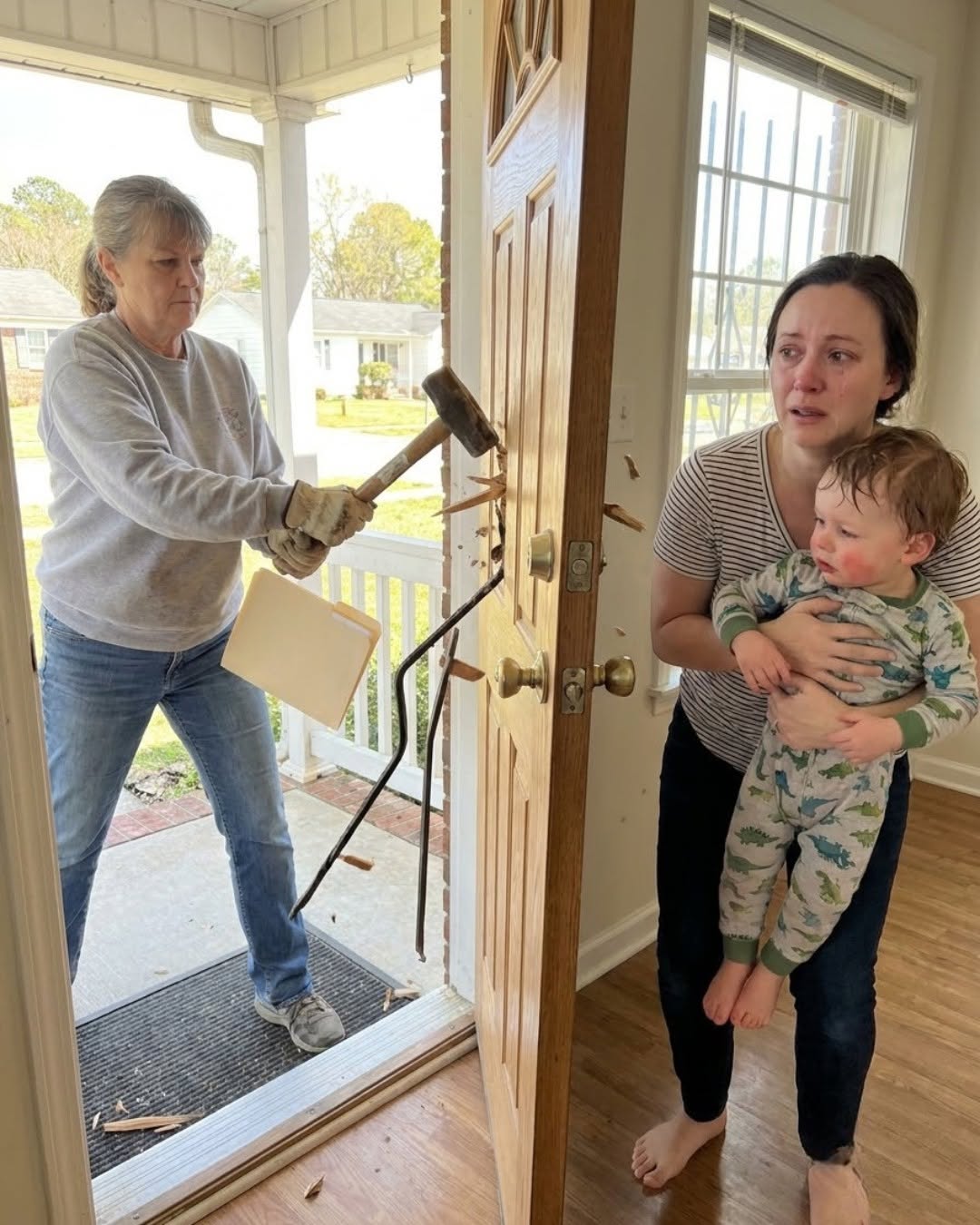 Look at the front door.
The deadbolt locked from the inside.
Every window opened.
Safety became something he could verify.
Nearly one year after the rescue, Michael accepted a negotiated resolution to several charges.
He received incarceration followed by supervised release, mandatory intervention programs, and continued no-contact restrictions.
The forged financial documents remained part of separate proceedings.
Our divorce became final two months later.
I received primary custody, control of the house, and authority over Leo’s medical and therapeutic care.
Michael had no automatic access.
Any future request would require professional review, evidence of sustained treatment, and a court determination centered on Leo’s safety.
I sold the house.
People asked whether leaving felt like letting Michael win.
They misunderstood.
A house is not victory when a child remembers being thirsty inside it.
Before the sale, I returned once with Dana and a locksmith.
The broken front door had been replaced.
The iron bars still covered every window.
I stood in the empty living room where Leo had slept on the rug.
Then I opened the folder investigators had returned after copying it.
MICHAEL — THREE-DAY RESET.
The pages still smelled faintly of dust and Carol’s garage.
I removed my preschool flyer from the evidence sleeve.
My handwriting covered the back.
Times.
Doors.
Water.
Leo’s fever.
The record I created before knowing anyone would read it.
I placed that page inside a new folder labeled:
EMILY AND LEO — THE DAY WE GOT OUT.
I kept it.
Not because I wanted to live inside the worst forty-eight hours of my life.
Because Michael had written a plan expecting my fear to erase my resistance.
My notes proved the opposite.
Carol eventually met Leo again inside his therapist’s office.
She sat across the room and waited for him to approach.
He carried his snack backpack, though it was almost too small for him now.
“Did you break the door?” he asked.
“Yes.”
“Did you take the crackers?”
Carol’s face collapsed.
“Yes.”
“Why?”
“Because I believed something that wasn’t true, and I didn’t check whether you were safe.”
Leo looked at me.
I nodded, letting him know he could leave.
He remained.
“Don’t take them again,” he said.
“I never will.”
That was not forgiveness.
It was a boundary spoken by a four-year-old who finally trusted that adults would obey it.
Carol followed that boundary.
Over time, supervised meetings became short park visits with me present.
She brought no lectures.
No criticism.
Only water, snacks, and the patience to let Leo decide whether to hold her hand.
One summer afternoon, he offered her half his apple.
Carol began crying.
Leo frowned.
“It’s just an apple.”
For him, perhaps it finally was.
For us, it was proof that hunger no longer controlled the meaning of food.
I remarried nobody.
I did not need a dramatic new love to prove my life continued.
I returned to work, opened my own bank account, and learned every password attached to my name.
Leo began preschool again.
His teacher kept a water bottle within reach and allowed his snack backpack to hang beside his chair.
By autumn, he stopped checking it every hour.
One morning, he left it in the car.
We had already reached the classroom when I noticed.
“Do you want me to bring it?” I asked.
Leo looked toward the snack shelf inside.
“No. They have food here.”
Five ordinary words.
They felt larger than any courtroom ruling.
Michael believed three days without freedom, food, water, or communication would teach me dependence.
Instead, those days taught me exactly how little of my life had ever been safely mine.
He believed locked doors would make me compliant.
They showed me every exit I needed to build.
He believed Leo’s fear would pressure me into surrendering custody.
It became the reason I stopped surrendering anything.
Carol’s sledgehammer broke more than the front door.
It broke the version of our family built around Michael’s calm voice, his passwords, his explanations, and everyone’s willingness to believe him.
The truth beneath that version was ugly.
Carol had helped him.
Vanessa had almost ignored him.
I had trusted him.
Then each of us reached a moment when trust was no longer an excuse.
Some acted sooner than others.
Some carried more blame.
But only one person wrote a schedule predicting that a child’s fever would improve his bargaining position.
I no longer wonder whether Michael loved us.
Love without safety is not enough.
Love that demands captivity is not love.
And a present waiting outside a locked door does not make the person holding the key a father.
The last thing Michael said before locking us inside was that Leo and I would not starve in three days.
He was right about one thing.
We survived.
But survival was never the lesson he intended.
Leo learned that doors should open from the inside.
Carol learned that loyalty without questions can become complicity.
And I learned that when someone calls control protection, the difference is simple.
Protection leaves you a way out.
Look at the front door.
The deadbolt locked from the inside.
Every window opened.
Safety became something he could verify.
Nearly one year after the rescue, Michael accepted a negotiated resolution to several charges.
He received incarceration followed by supervised release, mandatory intervention programs, and continued no-contact restrictions.
The forged financial documents remained part of separate proceedings.
Our divorce became final two months later.
I received primary custody, control of the house, and authority over Leo’s medical and therapeutic care.
Michael had no automatic access.
Any future request would require professional review, evidence of sustained treatment, and a court determination centered on Leo’s safety.
I sold the house.
People asked whether leaving felt like letting Michael win.
They misunderstood.
A house is not victory when a child remembers being thirsty inside it.
Before the sale, I returned once with Dana and a locksmith.
The broken front door had been replaced.
The iron bars still covered every window.
I stood in the empty living room where Leo had slept on the rug.
Then I opened the folder investigators had returned after copying it.
MICHAEL — THREE-DAY RESET.
The pages still smelled faintly of dust and Carol’s garage.
I removed my preschool flyer from the evidence sleeve.
My handwriting covered the back.
Times.
Doors.
Water.
Leo’s fever.
The record I created before knowing anyone would read it.
I placed that page inside a new folder labeled:
EMILY AND LEO — THE DAY WE GOT OUT.
I kept it.
Not because I wanted to live inside the worst forty-eight hours of my life.
Because Michael had written a plan expecting my fear to erase my resistance.
My notes proved the opposite.
Carol eventually met Leo again inside his therapist’s office.
She sat across the room and waited for him to approach.
He carried his snack backpack, though it was almost too small for him now.
“Did you break the door?” he asked.
“Yes.”
“Did you take the crackers?”
Carol’s face collapsed.
“Yes.”
“Why?”
“Because I believed something that wasn’t true, and I didn’t check whether you were safe.”
Leo looked at me.
I nodded, letting him know he could leave.
He remained.
“Don’t take them again,” he said.
“I never will.”
That was not forgiveness.
It was a boundary spoken by a four-year-old who finally trusted that adults would obey it.
Carol followed that boundary.
Over time, supervised meetings became short park visits with me present.
She brought no lectures.
No criticism.
Only water, snacks, and the patience to let Leo decide whether to hold her hand.
One summer afternoon, he offered her half his apple.
Carol began crying.
Leo frowned.
“It’s just an apple.”
For him, perhaps it finally was.
For us, it was proof that hunger no longer controlled the meaning of food.
I remarried nobody.
I did not need a dramatic new love to prove my life continued.
I returned to work, opened my own bank account, and learned every password attached to my name.
Leo began preschool again.
His teacher kept a water bottle within reach and allowed his snack backpack to hang beside his chair.
By autumn, he stopped checking it every hour.
One morning, he left it in the car.
We had already reached the classroom when I noticed.
“Do you want me to bring it?” I asked.
Leo looked toward the snack shelf inside.
“No. They have food here.”
Five ordinary words.
They felt larger than any courtroom ruling.
Michael believed three days without freedom, food, water, or communication would teach me dependence.
Instead, those days taught me exactly how little of my life had ever been safely mine.
He believed locked doors would make me compliant.
They showed me every exit I needed to build.
He believed Leo’s fear would pressure me into surrendering custody.
It became the reason I stopped surrendering anything.
Carol’s sledgehammer broke more than the front door.
It broke the version of our family built around Michael’s calm voice, his passwords, his explanations, and everyone’s willingness to believe him.
The truth beneath that version was ugly.
Carol had helped him.
Vanessa had almost ignored him.
I had trusted him.
Then each of us reached a moment when trust was no longer an excuse.
Some acted sooner than others.
Some carried more blame.
But only one person wrote a schedule predicting that a child’s fever would improve his bargaining position.
I no longer wonder whether Michael loved us.
Love without safety is not enough.
Love that demands captivity is not love.
And a present waiting outside a locked door does not make the person holding the key a father.
The last thing Michael said before locking us inside was that Leo and I would not starve in three days.
He was right about one thing.
We survived.
But survival was never the lesson he intended.
Leo learned that doors should open from the inside.
Carol learned that loyalty without questions can become complicity.
And I learned that when someone calls control protection, the difference is simple.
Protection leaves you a way out.