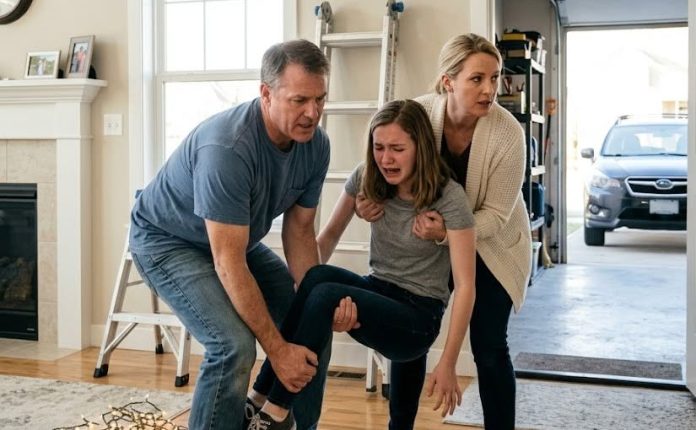
At 10:17 on a Tuesday morning, seven-year-old Lily Carter raised her hand during reading class at Jefferson Elementary School in Ohio.
She did not wave it high or call across the room.
She lifted it carefully, the way children do when they know they are supposed to wait their turn even when something feels wrong.
“Mrs. Grayson,” Lily whispered, “I can’t breathe right.”
At the front of the classroom, Mrs. Grayson kept writing vocabulary words on the board.
Around Lily, the ordinary school morning continued for another few seconds—open books, pencils moving across paper, backpacks tucked beside desks, children waiting for the next instruction.
Then the teacher answered without turning the moment into an emergency.
“You were talking perfectly well a minute ago.”
Lily knew that did not mean she was fine.
Her breathing had already begun to change.
Each inhale carried a thin whistle that had not been there before, and she was working harder for every breath.
Her shoulders rose higher each time she tried to pull air into her lungs, while the muscles around her ribs tightened beneath her yellow school shirt.
She tried again.
“My inhaler,” Lily said. “It’s in my backpack.”
That got the attention of several students nearby.
Heads turned toward her desk as the sound of her breathing became harder to ignore.
This was not the first time Lily’s asthma had been discussed with the school.
Her mother had already submitted a doctor-signed emergency action plan explaining that Lily had asthma and that she was permitted to carry and use her rescue inhaler whenever symptoms appeared.
The blue inhaler was not something Lily had secretly brought to class.
It was there because adults responsible for her care had already planned for exactly this kind of moment.
Lily reached into her backpack.
Her fingers found the inhaler, and she pulled it out.
For a child who was already struggling to breathe, it was the one familiar object she knew was supposed to help her.
But before she could use it, Mrs. Grayson crossed the classroom.
The teacher reached down and took the inhaler directly from Lily’s hand.
“You don’t need this,” she said. “You need to calm down.”
Lily stared at the inhaler now held by someone else.
Her breathing did not slow.
It became more difficult.
“My chest hurts,” she gasped.
Mrs. Grayson answered with something that referred not to Lily’s condition in that moment, but to what the teacher believed had happened before.
“You used that excuse during recess last week.”
Whatever Mrs. Grayson believed about the previous week, Lily’s body was giving unmistakable signals now.
She reached toward the inhaler again.
Mrs. Grayson lifted it above her head, putting it beyond the seven-year-old’s reach.
“Sit down and take slow breaths.”
Lily tried to obey.
She sat with the same teacher who had just taken away the medication she had been told she could use during an asthma episode telling her to control her breathing instead.
She tried to inhale slowly.
She could not.
Her airway continued tightening, and every breath became smaller than the one before it.
What had started as a whistle was becoming a struggle that the other children could now see.
Lily bent forward over her desk and pressed both hands against it.
The position did not fix what was happening.
Her shoulders remained tense as she fought for air.
The color around her lips began to fade.
The room that had been focused on vocabulary was now watching Lily.
One student finally stood up.
His name was Ethan Morales.
“She looks really sick,” Ethan said.
It was a simple observation from a child looking across a classroom at another child whose condition was visibly worsening.
Mrs. Grayson did not send him for help.
“Sit down, Ethan,” she ordered.
Ethan was expected to return to his seat.
Lily was expected to keep trying to breathe slowly.
And the inhaler remained out of Lily’s control.
Lily tried to speak again.
This time, nothing came out.
The child who had managed to tell her teacher that she could not breathe, ask for her inhaler, and say that her chest hurt could no longer get words out.
Then her knees buckled.
Lily collapsed onto the classroom floor.
The entire atmosphere in the room changed in an instant.
There was no longer any question that something serious was happening in front of the class.
The students who had been watching from their desks now saw Lily on the floor, unable to communicate as she had only moments earlier.
Ethan moved before anyone could turn the moment back into another instruction.
He ran.
He ignored the shouting behind him, rushed out of the classroom, and sprinted into the hallway.
He kept going until he reached the nurse’s office.
Then he slammed both hands against the door.
“Lily can’t breathe!”
School nurse Rebecca Owens reacted immediately.
She grabbed her emergency bag and rushed toward the classroom with Ethan’s warning still defining the situation: a child could not breathe.
When Rebecca reached the room, Lily was still on the floor.
The nurse did not tell Lily to calm down.
She did not wait to see whether the episode would pass on its own.
She recognized that Lily needed emergency help.
“Call 911 now.”
The instruction was immediate.
Rebecca took the inhaler and used it with a spacer while checking Lily’s condition.
The same blue inhaler Lily had reached for at the beginning of the episode was finally being used as part of the emergency response.
By then, however, the situation had gone far beyond the moment when Lily had first raised her hand and quietly said something was wrong.
The class had watched the progression in real time.
They had heard Lily ask for help.
They had watched her retrieve the inhaler from her backpack.
They had seen their teacher take it away.
They had heard Lily say her chest hurt.
They had seen her reach for the medication again.
They had watched the inhaler lifted out of her reach.
They had watched her struggle at her desk until she could no longer speak.
And finally they had watched her fall.
For Ethan, seeing all of that had been enough to make him disobey the command to sit down when Lily’s condition became unmistakably dangerous.
His decision brought the school nurse into the room.
The nurse’s decision brought emergency services.
Five minutes later, paramedics arrived at the school.
Their arrival changed the hallway as well as the classroom.
Students who had been moved or gathered outside could see that the event was no longer being treated as a child needing to calm herself down.
Lily was being taken for emergency medical care.
The paramedics carried her past frightened students waiting in the hallway.
For those children, the image of their classmate leaving with paramedics came only minutes after she had been sitting among them during reading class.
The speed of the change made the sequence difficult to dismiss.
At 10:17, Lily had raised her hand.
She had said she could not breathe correctly.
She had asked for the medication she carried for precisely that problem.
She had been told she did not need it.
Then she had deteriorated until she collapsed.
Five minutes after the nurse called for emergency help, paramedics were there.
The crisis was now moving beyond the classroom.
At 10:29, Principal Mark Holloway was in his office when the phone rang.
Only twelve minutes had passed since Lily first raised her hand during reading class.
In those twelve minutes, an ordinary elementary school morning had turned into a medical emergency involving a seven-year-old student, a rescue inhaler, the school nurse, a 911 call, and paramedics carrying a child from the building.
Principal Holloway answered the phone.
The woman on the other end introduced herself immediately.
“This is Dr. Rachel Carter,” she said. “I’m Lily’s mother. The hospital just contacted me.”
Those words placed another piece of the morning into the principal’s hands.
Lily’s mother was no longer hearing about a minor classroom issue or a child who had become upset at school.
She had been contacted by the hospital.
Principal Holloway closed the office door.
Whatever had happened in that classroom was no longer confined to Mrs. Grayson, Lily, Ethan, and the students who witnessed it.
A parent now knew her daughter had required emergency care, and she wanted to understand why.
For Rachel, there was already one fact that made the situation impossible to treat as an unpredictable asthma episode with no warning.
Lily had warned the teacher.
Her daughter had not suddenly collapsed without first recognizing symptoms.
She had said she could not breathe correctly.
She had asked for the rescue inhaler that she carried because of her diagnosed asthma.
There was also the emergency action plan Rachel had already provided.
It was doctor-signed.
It specifically explained that Lily was permitted to carry and use her rescue inhaler when symptoms appeared.
That meant the blue inhaler in Lily’s backpack had a purpose known before Tuesday morning.
Its presence was part of a plan designed around a predictable medical risk.
Lily had followed that plan as far as a seven-year-old could.
She recognized something was wrong.
She told an adult.
She identified the medication she needed.
She retrieved it herself.
The breakdown came after that.
Mrs. Grayson had taken the inhaler from Lily’s hand.
She had told Lily, “You don’t need this.”
When Lily said her chest hurt, the teacher referred to the previous week and called it an excuse.
When Lily reached for the inhaler, the teacher held it above her head.
When Ethan said Lily looked really sick, he was told to sit down.
Only after Lily could no longer speak, after her knees gave way, and after she collapsed did Ethan run for someone else.
Rebecca Owens then responded as a medical emergency required.
She rushed to Lily.
She called for 911.
She used the inhaler with a spacer.
Paramedics arrived within minutes.
None of those later actions erased what had happened before Lily reached the floor.
The hospital call to Rachel had turned the classroom sequence into a question the principal could not answer by focusing only on the ambulance response.
The central issue had begun earlier.
It began when a seven-year-old recognized the warning signs in her own body and asked to use the medication intended for those symptoms.
Rachel did not need a dramatic speech to make that issue clear.
She needed an answer about one action.
Inside the closed office, Principal Holloway listened as Lily’s mother moved directly to the decision that had changed the course of the morning.
She knew her daughter had asthma.
She knew the school had the doctor-signed emergency action plan.
She knew Lily was allowed to carry and use her rescue inhaler whenever symptoms appeared.
And now she knew her daughter had ended up needing emergency medical care after attempting to use that inhaler in class.
The timeline left a narrow but devastating question.
Why had the medication been taken away?
For the students who witnessed the episode, the answer mattered because they had seen the physical consequences unfold in front of them.
For Ethan, it mattered because he had been ordered to sit down after saying Lily looked sick, only to watch her collapse moments later.
For Rebecca, the urgency was visible the moment she reached the classroom and called for emergency help.
For Rachel, the question carried the weight of everything she had done before that morning to make sure adults at school knew how Lily’s asthma was supposed to be handled.
The emergency plan had existed before the crisis.
The inhaler had been with Lily before the crisis.
Lily had recognized the symptoms before she collapsed.
She had asked for the inhaler before she lost the ability to speak.
Yet the medication was taken out of her hand.
The difference between those moments was measured in only minutes.
At the start, Lily was still able to raise her hand and whisper for help.
Then she was wheezing.
Then her chest hurt.
Then she was pressing both hands into her desk, fighting to breathe.
Then the color around her lips changed.
Then she could not speak.
Then she fell.
By the time adults treated the situation as an emergency, one child had already decided the classroom response was not enough and had run into the hallway to find someone else.
The fact that Ethan was seven-year-old Lily’s classmate—not the adult responsible for making medical decisions—made his reaction stand out even more sharply.
He did not have Lily’s emergency action plan in front of him.
He did not need to interpret medical paperwork.
He simply looked at her and understood that she was in serious trouble.
“She looks really sick,” he had said.
When that warning did not change the response, he eventually ran for help himself.
Now Rachel was asking the school’s principal to account for what happened before Ethan reached the nurse.
Principal Holloway had closed his door, but there was no closing off the sequence of events that had already happened throughout the building.
A classroom of children had witnessed it.
A student had run through the hallway asking for help.
The nurse had responded.
Emergency services had been called.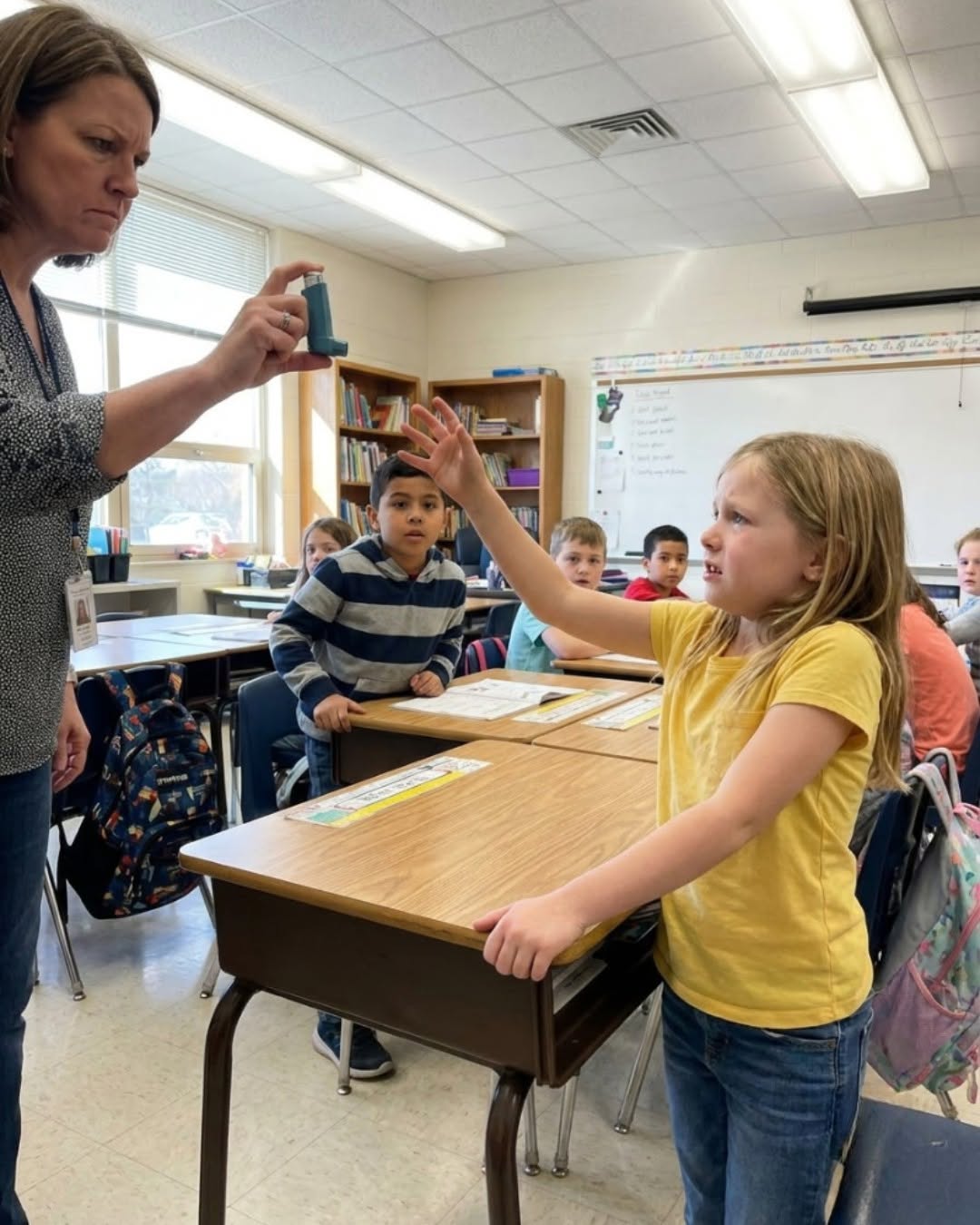 Paramedics had carried Lily out.
The hospital had contacted her mother.
And Rachel already knew enough to identify the decision at the center of it all.
Her daughter had not forgotten her inhaler.
The medication had not been unavailable.
Lily had not refused to use it.
She had reached for it.
She had been holding it.
An adult had taken it away.
Rachel’s voice came through the phone as Principal Holloway listened behind his closed office door.
Then she asked the question that changed the entire situation.
“Why did one of your teachers take away my daughter’s rescue inhaler?”
Paramedics had carried Lily out.
The hospital had contacted her mother.
And Rachel already knew enough to identify the decision at the center of it all.
Her daughter had not forgotten her inhaler.
The medication had not been unavailable.
Lily had not refused to use it.
She had reached for it.
She had been holding it.
An adult had taken it away.
Rachel’s voice came through the phone as Principal Holloway listened behind his closed office door.
Then she asked the question that changed the entire situation.
“Why did one of your teachers take away my daughter’s rescue inhaler?”