The ladder was still rocking when I hit the hardwood.
One second, I was stretching toward the ceiling with a strand of fairy lights looped around my wrist.
The next, my foot slid off the rung and the room dropped out from under me.
My back struck the floor with a deep, blunt crack that seemed to travel through my ribs and settle behind my eyes.
The living room smelled like lemon cleaner, cold coffee, and the warm plastic sting of cheap lights that had been plugged in too long.
Above me, the ceiling fan kept humming.
That ordinary sound was almost insulting.
I tried to breathe, but my lungs would only give me a thin little gasp.
The white ceiling flattened into a spinning circle, and the lights in my hand jingled against the floor.
Margot crossed the room quickly.
She was not frightened.
She was annoyed.
She stood over me in a cream cardigan with her phone already in one hand and asked, “Are you okay?” in the same careful voice she used when somebody set a sweating glass on the coffee table without a coaster.
I tried to sit up.
Pain flashed through my spine so sharply that my arms gave out.
Then my right leg went cold.
It did not feel asleep.
It did not tingle.
It simply stopped feeling like part of me.
“Don’t move me,” I whispered.
Dad ran in from the garage with black grease caught in the lines of his hands.
He had been working on the family SUV in the driveway, and the smell of motor oil came in with him.
Until that afternoon, that smell had always meant safety to me.
Dad fixed things.
He kept spare fuses in old coffee cans, labeled screws in reused jars, and could listen to an engine for ten seconds before telling you which belt was loose.
When I was nine, he repaired the broken wheel on my bike after every store in town told him the model was too old.
When I was twelve, he stayed up past midnight rebuilding the science-fair display I had crushed in the trunk.
I had trusted his hands because those hands had always made damaged things usable again.
That was the trust Margot borrowed when she told him to use those same hands to move me.
Dad looked at my face, then at my leg.
He reached for his phone.
Margot caught his wrist before he finished dialing.
“Ambulances cost a fortune,” she said. “She’s probably just shaken up.”
“I can’t feel my right foot,” I told them.
My voice was weak, but the sentence was clear.
I repeated it.
The mantel clock read 4:38 p.m.
Margot’s book club was supposed to arrive at 5:30 with cheese trays, paper plates, and bottles of wine.
She had spent the morning wiping the baseboards, arranging throw pillows, and asking me to help make the room look “finished.”
The fairy lights had been her last idea.
She wanted them draped across the ceiling because one of the women had posted a picture of a decorated reading room online.
Dad began dialing again.
Margot looked at the clock.
Then she said the sentence I would hear for years whenever a room smelled like lemon cleaner.
“Move her now, or she stays there until dessert.”
Dad froze.
It was not a long hesitation.
That was what made it so difficult to explain later.
He did not stand over me for minutes debating whether I mattered.
He needed only a few seconds to understand that I might be badly hurt, hear Margot’s demand, and decide that keeping peace with his wife was easier than protecting his daughter.
A betrayal does not have to be loud to divide your life into before and after.
Sometimes it is only a phone lowering beside a man’s leg.
Dad lowered the phone.
Margot said urgent care was fifteen minutes away.
Cheaper.
Faster.
Less dramatic.
She used the word dramatic while I lay on the floor unable to feel half my body.
I remembered a lesson from health class.
Suspected spinal injury.
Keep the person still.
Call 911.
Wait for trained responders.
I told them exactly that.
Dad would not look at me.
“We’ll be careful,” he said.
Careful.
He took my legs.
Margot slid her hands beneath my arms.
For one ugly heartbeat, I imagined knocking her away.
I imagined kicking free, grabbing the phone, or screaming loudly enough for a neighbor to come through the door.
But my right leg would not move, and my hands could barely hold themselves flat against the floor.
“Please, Dad,” I said.
He lifted anyway.
White light burst behind my eyes.
My fingers scraped the hardwood.
The fairy lights tangled beneath one elbow, and the ladder continued to rock behind us with a soft metallic tap.
I screamed so loudly that the neighbor’s dog began barking behind the fence.
Dad flinched.
Margot did not.
Cold garage air hit my face as they carried me toward the SUV.
Dad stretched me across the backseat with my knees slightly bent because the door would not close otherwise.
Margot got into the passenger seat and started texting.
Her nails tapped the screen over my breathing.
At 4:51 p.m., she wrote to the book-club group that she might be a little late, but the meeting was still on.
That timestamp would matter later.
Dad drove the speed limit.
He stopped at every red light.
He kept looking into the rearview mirror and saying, “Hang on, honey.”
I stared at the back of his seat and wondered how a man could call me honey while obeying traffic laws through the worst emergency of my life.
The urgent care clinic sat between a pizza place and a dry cleaner.
Dad pulled into a narrow space near the door and came around to the backseat.
He tried to help me stand.
My knees folded immediately.
Pain tore through my back and down my hips.
I vomited onto the pavement.
Margot jumped away so it would not touch her shoes.
The receptionist saw us trying to carry me through the glass door and went pale.
Dad said I had fallen from a ladder, hurt my back, and could not move my legs correctly.
Her chair rolled backward into a file cabinet when she stood.
“This is not urgent care,” she said. “This is an emergency. You should have called 911 from the house.”
A man holding an intake clipboard stopped writing.
A little girl beside the vending machine lowered her eyes to the floor.
The receptionist reached for the phone, but before she could finish explaining the situation, a nurse came through the hallway doors.
She looked at me once.
Then she looked at Dad.
“How long ago did she fall?”
He swallowed.
“Maybe twenty minutes.”
The nurse’s face went still.
Not calm.
Still.
She told everyone to step back.
She told Dad not to touch me again.
With another staff member helping, she lowered me carefully onto the waiting-room floor and placed rolled towels beside my head so I would stop trying to turn toward the voices.
Margot began explaining that they had been careful.
The nurse cut her off.
“Before I call the ambulance,” she said, staring directly at Dad, “I need you to tell me why you carried a suspected spinal injury through that door instead of calling 911.”
Dad’s mouth opened.
Nothing came out.
Margot answered for him.
“We were trying to avoid an unnecessary bill.”
The nurse looked at the wall clock, then at the intake sheet.
“Immediate care means you do not lift her, put her in a car, try to stand her up, and carry her through a lobby.”
Dad sank into a chair.
The grease on his hands had begun to smear across his jeans.
Then Margot’s phone lit up on the counter.
The group message was still open.
At the top was her 4:51 p.m. text.
Running late. Meeting is still on.
Below it, one of the women had replied, Do you need us to come help?
Margot reached for the phone.
The receptionist moved it out of her reach without touching the screen.
Nobody in the waiting room said anything.
The fluorescent lights buzzed.
A printer behind the desk started, clicked twice, and stopped.
That message did what my screaming had not.
Dad finally looked at Margot.
His face folded inward.
He had known she was worried about the gathering.
He had heard her say dessert.
He had simply hoped that if he moved quickly enough, nobody would ever have to name the choice he had made.
The nurse knelt beside me and asked my name.
She asked whether I could feel her touch on my left foot.
Then my right.
I could feel pressure on one side.
On the other, almost nothing.
The ambulance arrived minutes later.
The paramedics placed a rigid collar around my neck, stabilized my body, and moved me onto a board with the kind of practiced coordination Dad had promised he could imitate.
He stood against the wall while they worked.
Margot kept trying to explain.
No one asked her another question.
At the hospital, bright lights moved over me in long white strips as the stretcher rolled down the corridor.
A nurse cut away part of my jeans because they did not want to twist my hips.
An emergency physician asked me to push my feet against his hands.
My left foot moved.
My right barely responded.
The scans showed a serious fracture in my spine with swelling near the nerves controlling my right leg.
The doctor explained that I needed immediate stabilization and further treatment.
He did not tell me that everything would be fine.
He told me the truth in careful pieces.
The injury was serious.
The delay mattered.
The unnecessary lifting mattered.
No one could yet promise how much feeling or strength would return.
Dad sat beside the wall with his elbows on his knees.
Margot stood near the door, arms folded tightly over her cardigan.
When the doctor asked why I had not been transported by ambulance from the house, Dad finally answered.
“My wife said it was too expensive.”
The doctor did not raise his voice.
He did not need to.
“And what did your daughter say?”
Dad looked at me.
“She said she could not feel her foot.”
The room went quiet.
A hospital social worker arrived before I was moved upstairs.
She asked Dad and Margot to leave so she could speak to me alone.
She documented the time of the fall as 4:38 p.m., the text sent at 4:51 p.m., the urgent care arrival, the attempted standing, and the reason given for not calling 911.
She asked whether anyone had forced me to climb the ladder.
I told her Margot had asked me to hang the lights, but I had agreed.
She asked whether I had felt safe at home before that day.
That question was harder.
Margot had never hit me.
She did not need to.
She had a way of making every need sound inconvenient and every complaint sound like proof that I was immature.
Dad usually softened the edges after she left the room.
He would bring me a sandwich, fix a broken charger, or tell me not to take her tone personally.
I used to mistake repair for protection.
They are not the same thing.
That night, doctors treated the injury while Dad sat in the waiting room.
Margot went home.
She said she needed to lock the house and cancel the book club.
Dad did not go with her.
The next morning, I woke to a deep ache across my back and a strange heaviness in my right leg.
When the nurse touched my foot, I felt something faint near my heel.
It was not normal sensation.
It was a distant spark.
Still, it was more than I had felt on the living-room floor.
Dad cried when I told him.
I did not.
For the first week, my world became medication schedules, neurological checks, forms, and the slow humiliation of needing help for things I had done alone since childhood.
Dad stayed.
He brought paper coffee cups into the room and forgot to drink from them.
He answered every question from the medical team.
He also gave the hospital social worker permission to review his phone.
The call log showed that he had started dialing 911 but never completed the call.
The intake note recorded his statement.
Margot’s message remained timestamped at 4:51 p.m.
There was no way to turn those facts into a misunderstanding.
Margot came to see me on the third day.
She brought a clean hoodie and my phone charger.
She stood at the foot of the bed and said, “I am sorry this became such a big thing.”
Not that she was sorry she stopped the call.
Not that she was sorry she ordered Dad to move me.
Sorry it had become a big thing.
I looked at the hoodie in her hands.
Then I looked at Dad.
He stood.
“You need to leave,” he said.
Margot stared at him as though he had spoken in another language.
“This is our family.”
“No,” he said. “This is the moment I failed my daughter because I was afraid of fighting with you.”
Her face changed.
For the first time, she looked less angry than exposed.
She placed the hoodie on a chair and left.
Dad filed for separation while I was still in the hospital.
He did not present it as proof that he had become brave.
He knew leaving Margot did not erase lowering the phone.
When I began rehabilitation, he drove me to every appointment.
At first, I used a wheelchair for longer distances and a walker during therapy.
My right leg responded slowly.
A therapist taught me to notice tiny improvements: a toe moving, a muscle tightening, a few seconds of balance with both hands on the rails.
Progress was not dramatic.
It was repetitive.
It smelled like disinfectant and rubber mats.
It sounded like sneakers squeaking on a polished floor.
Some days I gained an inch.
Some days pain took it back.
Dad learned not to celebrate too loudly.
He learned to ask before helping.
That mattered more than he understood.
Months later, I could walk short distances with support.
I still had weakness and numb patches in my right leg, but I could feel the floor beneath most of my foot.
The doctors would not promise a perfect recovery.
Neither would I.
Dad began therapy of his own.
He stopped explaining that Margot had pressured him.
He stopped saying he had panicked.
He started using the sentence I needed.
“I chose wrong.”
The first time he said it, we were sitting in the hospital parking lot after a rehabilitation appointment.
Rain tapped the windshield.
He kept both hands on the steering wheel.
“I knew you might have a spinal injury,” he said. “You told me what to do. I chose wrong.”
I looked out at the wet pavement.
“I don’t know if I can forgive you.”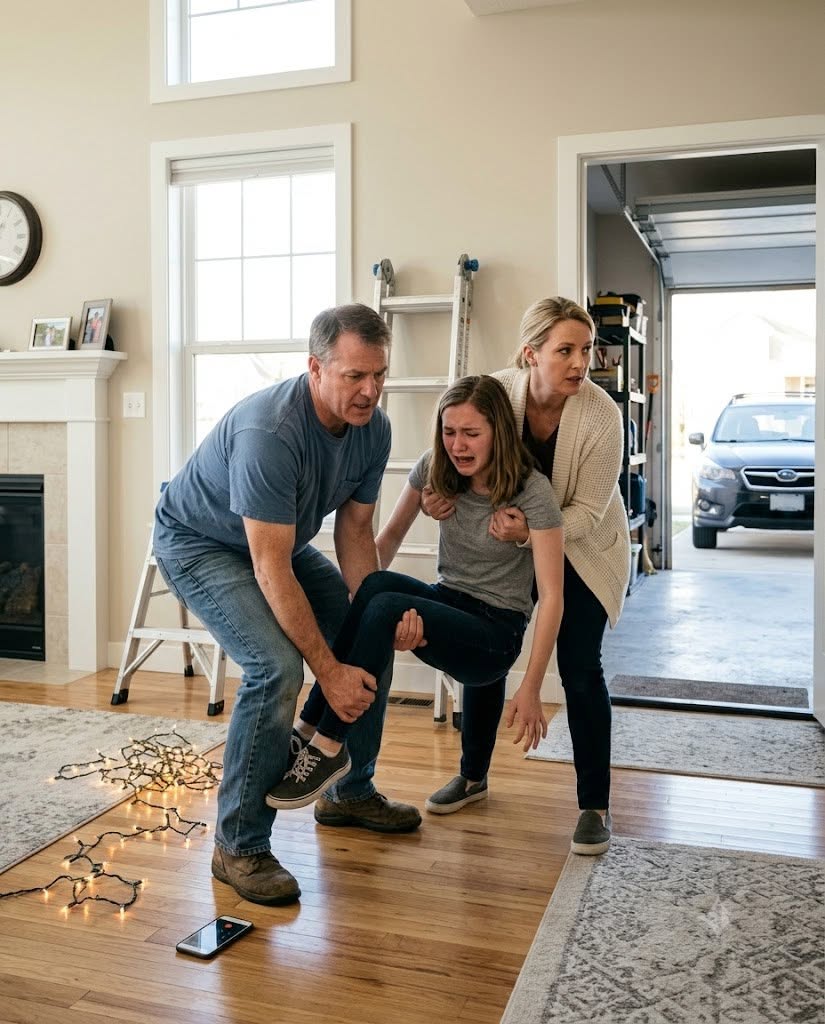 “I know,” he said.
That was the first apology that did not ask me to take care of him afterward.
The hospital report and the social worker’s documentation followed us home.
There were interviews.
There were questions about supervision and medical neglect.
Margot denied that she had understood the seriousness of the injury, but the nurse’s note recorded the words suspected spinal injury, and the timestamps showed exactly how long adults had spent making convenience sound like judgment.
I never saw Margot again after the separation became final.
Dad removed the fairy lights from the living room before I came home.
He also moved my bedroom downstairs so I would not have to use the steps.
For a while, the house still smelled faintly of lemon cleaner.
That was the hardest part.
The scent could pull me back to the floor before I had time to remind myself that I was standing.
Eventually, Dad stopped buying it.
He switched to an unscented cleaner without mentioning why.
That was how care began to look in our house after the accident.
Not speeches.
Not promises.
A bedroom moved downstairs.
A hand held back until I asked for it.
A bottle left on the store shelf.
I was sixteen when I learned that love and safety are not the same thing.
A person can love you and still fail you at the exact moment love is supposed to become action.
Dad loved me when he called me honey from the driver’s seat.
He failed me when he lowered the phone.
Both things were true.
Years later, I still remember the urgent care nurse more clearly than some relatives.
I remember the way she looked at me before she looked at the adults.
I remember that she did not let Margot make the scene smaller.
I remember her pointing to the clock, the intake sheet, and the glowing message on the counter.
She gave the moment a record.
She turned what happened from a family explanation into a sequence of facts.
Fall at 4:38 p.m.
Book-club message at 4:51 p.m.
No completed 911 call.
A child carried through the door with a suspected spinal injury.
Dad’s face collapsed when she asked why.
Mine did not.
I had already learned the answer on the living-room floor.
He was afraid of conflict.
Margot was afraid of inconvenience.
And I was the one whose body paid for both.
The ladder had stopped rocking by the time we left the house.
But in my memory, it never does.
It keeps tapping softly against the hardwood while the phone lowers, the fairy lights scatter, and the man I trusted decides that being careful is the same thing as doing what is right.
It is not.
Repair is not protection.
Regret is not rescue.
And love does not become safe until it is willing to act.
“I know,” he said.
That was the first apology that did not ask me to take care of him afterward.
The hospital report and the social worker’s documentation followed us home.
There were interviews.
There were questions about supervision and medical neglect.
Margot denied that she had understood the seriousness of the injury, but the nurse’s note recorded the words suspected spinal injury, and the timestamps showed exactly how long adults had spent making convenience sound like judgment.
I never saw Margot again after the separation became final.
Dad removed the fairy lights from the living room before I came home.
He also moved my bedroom downstairs so I would not have to use the steps.
For a while, the house still smelled faintly of lemon cleaner.
That was the hardest part.
The scent could pull me back to the floor before I had time to remind myself that I was standing.
Eventually, Dad stopped buying it.
He switched to an unscented cleaner without mentioning why.
That was how care began to look in our house after the accident.
Not speeches.
Not promises.
A bedroom moved downstairs.
A hand held back until I asked for it.
A bottle left on the store shelf.
I was sixteen when I learned that love and safety are not the same thing.
A person can love you and still fail you at the exact moment love is supposed to become action.
Dad loved me when he called me honey from the driver’s seat.
He failed me when he lowered the phone.
Both things were true.
Years later, I still remember the urgent care nurse more clearly than some relatives.
I remember the way she looked at me before she looked at the adults.
I remember that she did not let Margot make the scene smaller.
I remember her pointing to the clock, the intake sheet, and the glowing message on the counter.
She gave the moment a record.
She turned what happened from a family explanation into a sequence of facts.
Fall at 4:38 p.m.
Book-club message at 4:51 p.m.
No completed 911 call.
A child carried through the door with a suspected spinal injury.
Dad’s face collapsed when she asked why.
Mine did not.
I had already learned the answer on the living-room floor.
He was afraid of conflict.
Margot was afraid of inconvenience.
And I was the one whose body paid for both.
The ladder had stopped rocking by the time we left the house.
But in my memory, it never does.
It keeps tapping softly against the hardwood while the phone lowers, the fairy lights scatter, and the man I trusted decides that being careful is the same thing as doing what is right.
It is not.
Repair is not protection.
Regret is not rescue.
And love does not become safe until it is willing to act.